
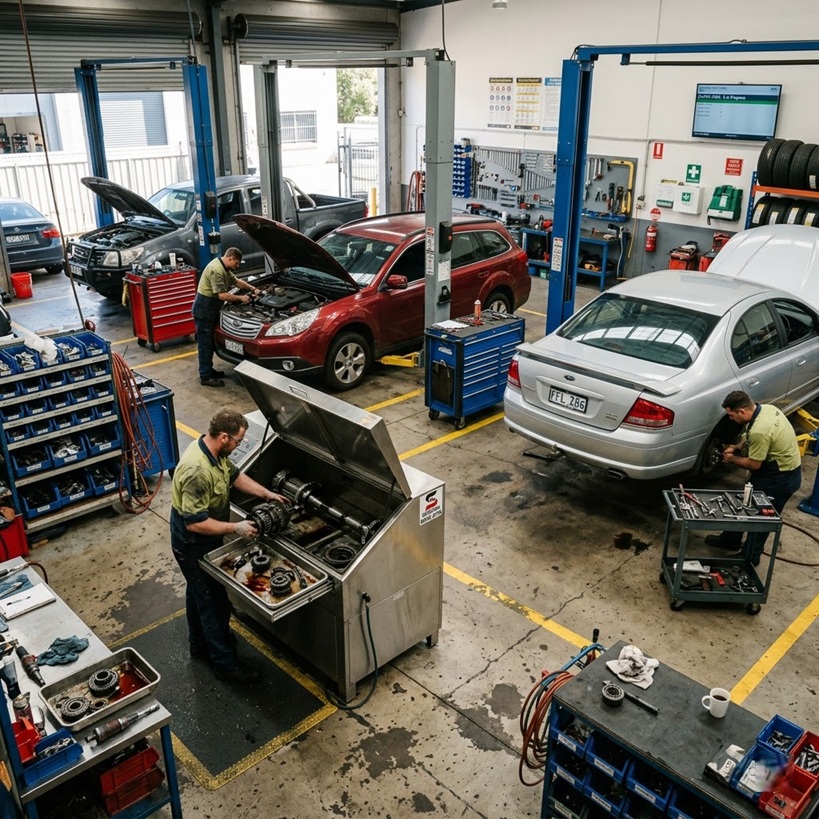
Every successful workshop starts with a single mechanic, a toolbox, and a vision. But somewhere between servicing the tenth vehicle and hiring the first employee, the parts cleaning bottleneck becomes impossible to ignore. What worked when handling three jobs a week collapses under the weight of fifteen.
The transition from solo operation to full-service workshop isn’t just about adding staff or floor space – it’s about fundamentally rethinking how work flows through the facility. Parts cleaning sits at the centre of this transformation. When a single mechanic can walk to a sink with a dirty component, scrub it manually, and return to the job in twenty minutes, the inefficiency barely registers. When five technicians need to clean parts simultaneously across multiple bays, that same manual process becomes a productivity disaster that costs thousands in lost labour hours each month.
Hotwash has equipped hundreds of Australian workshops through this exact transition, from mechanics working out of home garages to operations servicing mining fleets and commercial vehicle contractors. The pattern remains consistent: workshops that strategically focus on scaling workshop cleaning capability during growth phases outperform competitors who treat parts washing as an afterthought.
The Hidden Cost of Manual Cleaning at Scale
A solo mechanic spending 30 minutes per day on manual parts cleaning loses roughly 2.5 hours weekly – annoying but manageable. That same 30-minute daily investment multiplied across five technicians equals 12.5 hours of lost productive labour each week, or 650 hours annually. At $45 per hour labour cost, that’s $29,250 in annual productivity loss from a task that generates zero revenue.
The mathematics become more brutal when factoring in workflow disruption. Manual parts cleaning doesn’t happen in neat 30-minute blocks. A technician walks to the wash bay, discovers another worker already using the sink, waits five minutes, then spends fifteen minutes scrubbing. The actual cleaning consumed fifteen minutes, but the workflow interruption cost twenty. Multiply these micro-delays across multiple staff and dozens of daily jobs, and the compounding effect cripples workshop throughput.
Beyond labour costs, manual cleaning at scale introduces quality consistency problems. Different technicians apply different levels of effort to parts cleaning. The meticulous worker spends twenty minutes achieving spotless results. The rushed worker spends eight minutes leaving residual contamination. When that inconsistently cleaned component goes back into a customer’s engine or transmission, the workshop’s reputation suffers regardless of which technician performed the work.
Matching Cleaning Systems to Workshop Growth Stages
Stage One: 1-2 Technicians (Revenue $150K-$400K)
At this scale, a manual parts washer delivers immediate productivity gains without overwhelming capital investment. These systems eliminate the improvised cleaning methods that plague small operations – the parts soaking in diesel drums, the wire brushing over storm drains, the degreaser spray bottles that empty twice weekly.
A professional manual washer provides heated detergent solution, proper drainage, and organised workflow for around $3,000-$5,000. For a two-person operation handling 8-12 jobs weekly, this investment typically achieves cleaning system payback within six months through reduced solvent costs and faster turnaround times. The system establishes professional cleaning standards before bad habits become entrenched operational patterns.
Stage Two: 3-5 Technicians (Revenue $400K-$1.2M)
This growth phase represents the critical transition point where manual cleaning becomes the primary productivity constraint. With three or more technicians competing for cleaning resources, the workshop needs its first automated system. A heavy-duty parts washer transforms parts cleaning from a labour-intensive task to a background process that happens while technicians focus on skilled work.
Spray cabinet systems clean components in 10-15 minute automated cycles, eliminating manual scrubbing entirely. A technician loads dirty parts, starts the cycle, and returns to their primary job. The system handles everything – heating, spraying, rinsing, draining. For workshops servicing light commercial vehicles, agricultural equipment, or general automotive work, heavy-duty systems provide the automation foundation that enables scaling workshop cleaning capability beyond five employees.
Stage Three: 6-10 Technicians (Revenue $1.2M-$3M)
Workshops at this scale typically service commercial fleets, mining contractors, or heavy equipment operators. Parts cleaning volume and contamination severity both increase substantially. Components arrive covered in heavy grease, hydraulic oil, mud, and carbon buildup that lighter systems struggle to handle effectively.
An extra heavy-duty parts washer delivers the cleaning power and chamber capacity these operations demand. With larger internal dimensions accommodating bigger components and more aggressive spray pressure removing stubborn contamination, these systems eliminate the cleaning bottleneck even during peak workflow periods. The investment of $15,000-$25,000 seems substantial until workshop managers calculate the labour cost of manual cleaning across eight technicians – typically $40,000-$60,000 annually in lost productivity.
Stage Four: 10+ Technicians (Revenue $3M+)
Large workshops servicing mining operations, major fleet contractors, or heavy industrial equipment require maximum cleaning capability. At this operational scale, parts cleaning isn’t just about productivity – it’s about maintaining consistent turnaround times for customers whose downtime costs thousands per hour.
Super heavy-duty systems and hot tank immersion washers provide the industrial-grade cleaning power these operations demand. Super heavy-duty spray cabinets handle the largest components and most aggressive cleaning cycles, while hot tanks offer immersion cleaning for heavily contaminated parts that need extended soak times. Many large workshops run both system types, dedicating each to specific applications and maintaining continuous cleaning capability even during equipment maintenance.
Calculating Your Cleaning System ROI
Workshop owners evaluating cleaning equipment investments should apply this straightforward calculation framework:
Annual Labour Cost of Manual Cleaning = (Number of technicians) × (Daily cleaning minutes per technician) × (260 working days) × (Hourly labour cost ÷ 60)
For a five-technician workshop where each technician spends 30 minutes daily on manual cleaning at $45/hour labour cost: 5 × 30 × 260 × 0.75 = $29,250 annual cost.
Cleaning System Payback Period = (Equipment cost + installation) ÷ (Annual labour savings + Annual supply cost reduction)
If a $12,000 automated system eliminates 80% of that manual cleaning labour ($23,400 annual savings) while reducing solvent and supply costs by $2,000 annually, cleaning system payback occurs in 5.7 months. After the first year, the workshop captures $25,400 in annual ongoing savings.
These calculations exclude the harder-to-quantify benefits: faster turnaround times enabling higher job volume, consistent cleaning quality improving customer satisfaction, reduced technician fatigue and injury risk, and enhanced workshop professionalism when customers tour the facility.
Planning Your Cleaning Infrastructure Layout
The physical placement of cleaning equipment determines whether it accelerates or impedes workflow. Poorly located systems force technicians to walk excessive distances carrying heavy, contaminated components – creating exactly the productivity drain the equipment was meant to eliminate.
Central Placement Strategy
Position the primary cleaning system centrally within the workshop, ideally equidistant from all service bays. This minimises average walking distance for all technicians. A centrally located system also simplifies plumbing and electrical installation, reducing upfront costs while maintaining accessibility.
Dedicated Workshop Cleaning Zones
Create a defined cleaning area with proper drainage, ventilation, and parts staging surfaces. Workshop cleaning zones should include the automated washer, a manual wash sink for small components, parts drying racks, and storage for cleaned components awaiting reassembly. Concentrating all cleaning functions in one zone prevents contamination spread throughout the workshop while establishing clear workflow patterns.
Utility Requirements
Plan electrical, water, and drainage infrastructure during the growth phase rather than retrofitting later. A three-phase power supply supports larger heating elements and more powerful pumps. Hot water supply to the cleaning area reduces heating time and improves cleaning effectiveness. Properly sized drainage prevents backups during high-volume cleaning periods. Many workshops discover these utility limitations only after purchasing equipment, forcing expensive electrical upgrades or plumbing modifications.
Future Expansion Capacity
If current operations require one automated system but growth projections suggest needing two systems within three years, design workshop cleaning zones to accommodate that expansion. Running electrical and plumbing rough-ins during initial construction costs a fraction of retrofitting later. The physical space allocation prevents having to relocate the entire cleaning area when adding capacity.
Transitioning Your Team to Automated Cleaning
Introducing automated parts washing systems requires more than equipment installation – it demands operational process changes and staff training. Technicians accustomed to manual cleaning methods often resist automation initially, viewing it as complicated or unnecessary.
Demonstrate Immediate Benefits
During the first week after installation, select the most contaminated, labour-intensive components for automated cleaning. When technicians witness a transmission case they’d normally scrub for thirty minutes emerging spotless from a fifteen-minute automated cycle, scepticism evaporates. The system proves its value through results, not management directives.
Establish Clear Operating Procedures
Create simple, visual operating instructions mounted directly on the equipment. Specify which heated detergent solution concentration to use, appropriate cycle times for different contamination levels, maximum load sizes, and daily maintenance tasks. Standardised procedures ensure consistent results regardless of which technician operates the system.
Assign Equipment Ownership
Designate one technician as the primary system operator responsible for daily maintenance, detergent management, and troubleshooting. This ownership creates expertise within the team while ensuring someone monitors system performance and addresses minor issues before they become major problems. Rotate this responsibility quarterly so multiple staff members develop proficiency.
Track Performance Metrics
Document cleaning times, labour savings, and quality improvements during the first three months. Share these metrics with the entire team, demonstrating how automated cleaning benefits everyone by reducing the least enjoyable aspect of their work. When technicians see concrete evidence of time savings and improved results, they become system advocates rather than resistors.
Maintaining Cleaning Capability During Growth
As workshops expand, cleaning system maintenance often gets neglected during busy periods. This short-term thinking creates long-term problems – systems that aren’t properly maintained lose cleaning effectiveness, require expensive repairs, and eventually fail at the worst possible time.
Daily Maintenance Tasks
Technicians should perform basic daily maintenance as part of standard closing procedures: empty and rinse the filter basket, wipe down spray nozzles, check detergent levels, and drain the wash chamber if the system won’t be used the next day. These five-minute tasks prevent 90% of common problems.
Weekly Deep Cleaning
Dedicate thirty minutes weekly to thorough system cleaning. Remove and clean all filters, inspect spray arms for clogged nozzles, check heating elements for scale buildup, and test door seals for proper seating. This preventive maintenance catches small issues before they impact cleaning performance.
Monthly Professional Inspection
For workshops running cleaning systems continuously across multiple shifts, monthly professional inspection by qualified service technicians identifies wear patterns and potential failures before they cause downtime. The service cost of $200-$300 monthly prevents the $5,000+ emergency repair bills that result from neglected maintenance.
Replacement Parts Inventory
Stock critical spare parts on-site: replacement filters, spray nozzles, door gaskets, and heating elements. When a component fails, having the replacement immediately available means thirty minutes of downtime instead of three days waiting for parts delivery. For workshops where cleaning capability directly impacts revenue, this inventory investment pays for itself the first time it prevents extended downtime.
Scaling Beyond Standard Systems
Some workshop growth trajectories demand cleaning capabilities beyond standard spray cabinet systems. Operations servicing mining equipment, heavy earthmoving machinery, or industrial fabrication encounter contamination levels and component sizes that require specialised solutions.
Hot Tank Immersion Systems
When components arrive with baked-on carbon deposits, heavy grease layers, or paint that needs stripping, hot tank systems provide the immersion cleaning power spray cabinet systems can’t match. These tanks maintain heated alkaline solutions that dissolve contamination through chemical action and extended soak times. Workshops servicing diesel engines, industrial gearboxes, or heavy equipment transmissions often run hot tanks alongside spray systems, using each for applications where it excels.
High-Temperature Cleaning
Hot blaster systems deliver cleaning performance through elevated temperature and pressure combinations. Operating at higher temperatures than standard systems, these units tackle contamination that resists conventional cleaning methods. The additional heating capacity costs more upfront but eliminates the labour waste of running multiple cleaning cycles on heavily soiled components.
Surface Preparation Equipment
Workshops expanding into component rebuilding, restoration work, or heavy fabrication need wet abrasive blasting capability. These systems strip rust, old paint, and surface contamination while controlling dust through water suppression. The combination of cleaning and surface preparation in one operation streamlines workflow for shops offering comprehensive rebuild services.
The Australian Manufacturing Advantage
Workshops investing in locally manufactured cleaning systems gain operational advantages beyond the equipment itself. Australian-built systems comply with local electrical standards, workplace safety requirements, and environmental regulations without modification. When issues arise, service technicians understand the equipment intimately and carry appropriate spare parts.
The construction quality of Australian-manufactured industrial equipment reflects the harsh operating conditions local workshops face. Systems built for Australian mining operations, agricultural workshops, and heavy industrial applications withstand punishment that would destroy lighter-duty imported alternatives. The initial cost premium of $2,000-$4,000 for Australian-built equipment becomes irrelevant when that system delivers fifteen years of reliable service while imported alternatives require replacement after seven.
Local manufacturing also means customisation capability. Workshops with unique requirements – unusual component sizes, specific contamination challenges, or facility constraints – can work directly with manufacturers to modify standard systems or design custom solutions. This flexibility proves invaluable for operations serving specialised industries or handling non-standard equipment.
Conclusion
Scaling workshop cleaning capability from solo operation to full-service workshop demands strategic investment in cleaning capability at each growth phase. The manual methods that sufficed for a one-person operation collapse under the workflow demands of multi-technician facilities. Workshops that proactively upgrade cleaning systems during expansion maintain productivity, control labour costs, and establish the operational foundation for continued growth.
The transition from manual to automated cleaning represents more than equipment acquisition – it signals a fundamental shift from technician-limited to systems-enabled operations. When parts cleaning no longer constrains workflow, workshops can focus on their actual competitive advantages: technical expertise, customer service, and operational efficiency.
Australian workshops have access to locally engineered cleaning systems built specifically for the contamination levels, component sizes, and operating conditions they face daily. The investment in proper cleaning infrastructure pays measurable returns through reduced labour costs, faster turnaround times, and consistent quality that builds customer loyalty.
Ready to eliminate the parts cleaning bottleneck limiting workshop growth? Contact us to discuss which cleaning system matches current operation size and growth trajectory. The team can assess specific requirements and recommend the solution that delivers maximum cleaning system payback for the facility.

Leave A Comment