
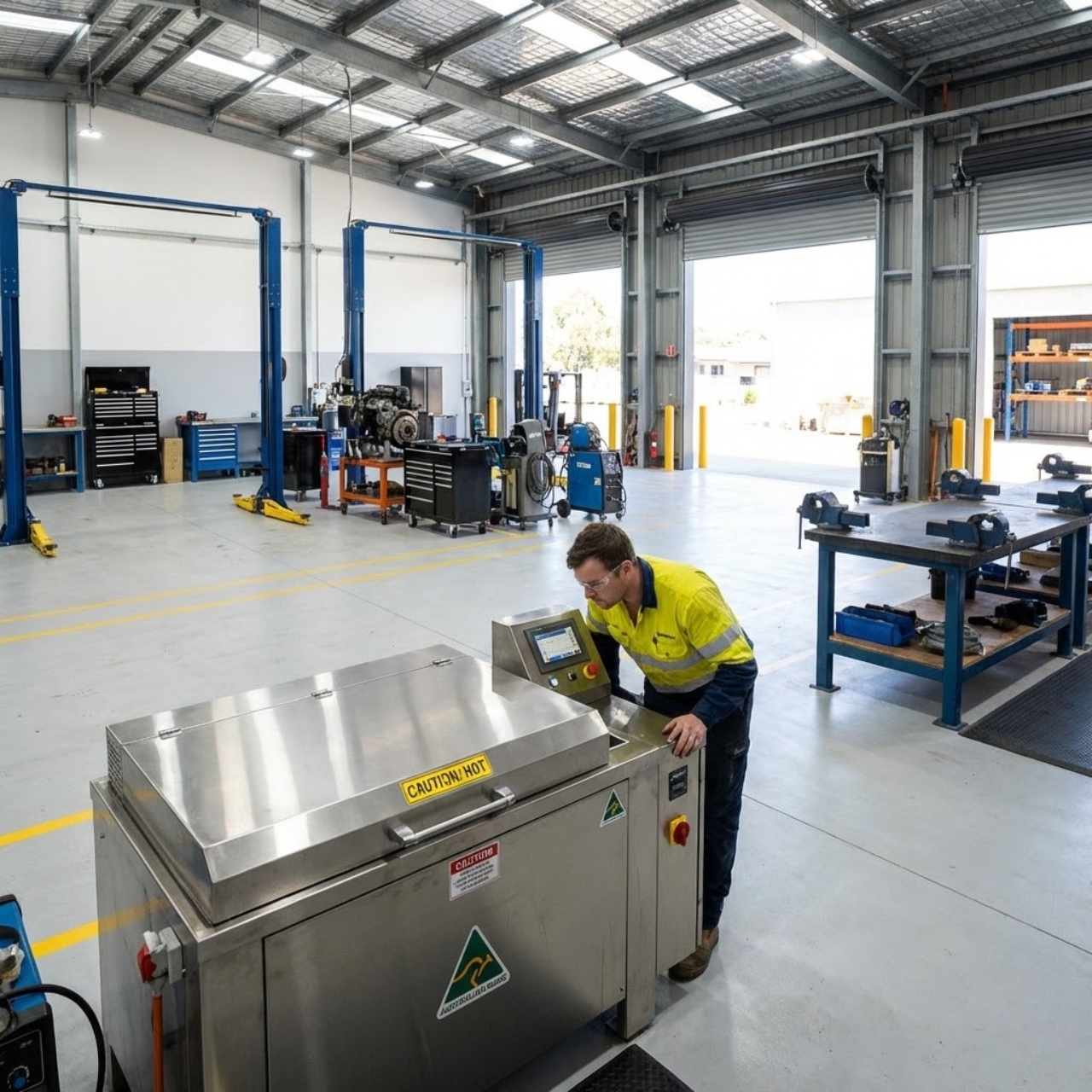
Workshop expansion requires more than additional floor space and extra staff. The difference between sustainable growth and operational bottlenecks lies in strategic equipment investment that multiplies capacity without proportionally increasing labour costs. Australian mechanical workshops face mounting pressure to increase workshop throughput capacity whilst maintaining quality standards, and the equipment choices made today determine competitive positioning for the next decade.
The mechanical services sector across Australia grew 4.2% annually between 2019 and 2024, yet labour availability declined by 8% during the same period. This gap forces workshop managers to extract maximum productivity from existing teams whilst servicing larger customer bases. Manual processes that sufficed for smaller operations become critical bottlenecks when volume increases, particularly in parts cleaning where contaminated components slow every subsequent maintenance task.
Hotwash manufactures industrial cleaning systems that address this specific challenge – converting labour-intensive manual processes into automated operations that free skilled technicians for revenue-generating work. The mechanical workshop equipment investment decision extends beyond initial purchase price to encompass labour savings, workshop throughput capacity, and operational efficiency over 10-15 year equipment lifecycles.
Identifying Equipment Bottlenecks Before Expansion
Most workshops recognise capacity constraints only after declining customer satisfaction metrics or extended lead times damage reputation. Proactive identification of equipment bottlenecks enables strategic investment before growth stalls.
Parts cleaning represents the most common yet least recognised bottleneck in mechanical operations. A single technician manually cleaning engine components with solvent tanks and wire brushes consumes 45-90 minutes per job, depending on contamination levels. This same technician could complete diagnostic work, precision assembly, or quality control tasks that generate higher revenue per hour.
Calculate current cleaning capacity by tracking total weekly hours spent on manual parts washing across all staff. A workshop with three mechanics each spending 8 hours weekly on manual cleaning dedicates 24 hours – equivalent to 0.6 full-time positions – to this single task. As job volume increases 30-50% during expansion, manual cleaning hours rise proportionally unless automated systems absorb the additional workload.
Workshop throughput capacity constraints manifest differently across workshop types. Automotive service centres processing 15-20 vehicles daily face different bottlenecks than mining equipment maintenance facilities servicing heavy machinery on extended cycles. However, both share common capacity limitations when industrial cleaning infrastructure fails to match expanded operational scope.
Automated Parts Washing Systems as Growth Enablers
Automated parts washing transforms workshop capacity without expanding payroll. Heavy-duty parts washers eliminate the manual labour bottleneck whilst delivering consistent cleaning results that manual methods cannot match.
The operational mathematics prove compelling. A technician manually cleaning transmission components requires 60-75 minutes including setup, scrubbing, rinsing, and disposal of contaminated solvents. Automated spray washers complete the same task in 15-20 minutes of machine time, during which the technician performs other revenue-generating work. This 4:1 time advantage multiplies across every component cleaned throughout the working week.
Workshop managers evaluating mechanical workshop equipment investment should calculate annual labour savings against equipment cost. A workshop processing 40 parts cleaning jobs weekly saves approximately 1,600 hours annually by automating this function – equivalent to 0.77 full-time positions. At average Australian mechanical technician wages of $65,000-$75,000 annually including superannuation and on-costs, automated spray washers typically achieve payback within 18-24 months purely through labour savings.
Beyond time savings, automated systems deliver superior cleaning consistency. Manual cleaning quality varies with technician fatigue, time pressure, and individual technique. Automated spray washers maintain identical pressure, temperature, and cycle duration for every component, ensuring reliable results that support quality assurance standards and contribute to strong cleaning system ROI.
Matching System Capacity to Growth Projections
Undersized equipment creates new bottlenecks that negate expansion benefits. Oversized systems waste capital and floor space. Strategic mechanical workshop equipment investment requires accurate capacity matching to projected workload.
Heavy-duty systems suit workshops processing 30-60 parts cleaning jobs weekly. These systems handle automotive components, light industrial machinery parts, and general mechanical assemblies. Chamber dimensions typically accommodate components up to 600mm x 600mm x 600mm, sufficient for engine blocks, transmission cases, differential housings, and similar parts common in automotive and light equipment maintenance.
Extra heavy-duty systems address larger operations processing 60-100+ jobs weekly or handling physically larger components. Mining equipment maintenance workshops, heavy vehicle service centres, and industrial machinery facilities require chamber capacities exceeding 1000mm x 1000mm x 1000mm. Extra heavy-duty parts washers accommodate loader buckets, excavator components, and industrial gearbox assemblies that smaller systems cannot physically contain.
Super heavy-duty systems serve major operations with continuous high-volume requirements. Oil and gas maintenance facilities, large mining operations, and industrial manufacturing plants processing 100+ cleaning jobs weekly require maximum capacity industrial cleaning infrastructure. Super heavy-duty parts washers deliver industrial-scale workshop throughput capacity whilst maintaining the cleaning performance required for precision components.
Project future capacity requirements conservatively. A workshop planning 40% growth over three years should specify equipment capacity for 50-60% expansion to accommodate market variability and competitive opportunities. Equipment undersized for projected workload creates the same bottlenecks that prompted the initial investment.
Specialised Cleaning Technologies for Diverse Applications
Mechanical workshops service varied equipment types requiring different cleaning approaches. Comprehensive expansion planning incorporates specialised cleaning technologies alongside general-purpose systems.
Hot tank systems excel at removing heavy contamination from large components. Immersion cleaning reaches complex internal passages, blind holes, and intricate geometries that spray systems struggle to penetrate. Oil and gas industry workshops, mining equipment facilities, and heavy machinery maintenance operations benefit from hot tank capabilities for components with extreme contamination levels.
The immersion process allows extended soak times that dissolve baked-on carbon deposits, polymerised oils, and hardened grease that resist spray washing. A hot tank operating at 80-90°C with appropriate detergent concentration removes contamination that would require hours of manual scrubbing or multiple spray wash cycles.
Wet abrasive blasters address surface preparation requirements for components undergoing restoration, remanufacturing, or coating application. Rust removal, paint stripping, and surface profiling become efficient processes rather than labour-intensive manual tasks. Workshops offering restoration services, remanufacturing operations, or specialised coating application require wet blasting capability to deliver professional results efficiently.
The wet blasting process eliminates dust generation associated with dry abrasive methods whilst achieving superior surface cleanliness. Components prepared through wet blasting accept coatings, sealants, and adhesives more reliably than those prepared through manual methods.
Infrastructure Requirements for Industrial Cleaning Systems
Equipment installation extends beyond placing machinery on workshop floors. Successful mechanical workshop equipment investment requires adequate industrial cleaning infrastructure to support operational requirements.
Electrical Supply: Industrial parts washers require three-phase power for heating elements and pump motors. Heavy-duty systems typically draw 15-25 kW, extra heavy-duty units 25-40 kW, and super heavy-duty installations 40-60+ kW. Verify electrical service capacity before equipment specification. Insufficient power supply necessitates costly electrical upgrades that impact total project cost.
Water Supply: Automated cleaning systems require reliable water supply for initial fill and periodic top-up. Calculate daily water consumption based on evaporation rates and parts contamination levels. A heavy-duty system operating 8 hours daily typically consumes 50-100 litres for top-up, whilst larger systems may require 100-200+ litres. Water quality affects cleaning performance and equipment longevity – hard water areas benefit from water softening systems that prevent scale accumulation.
Drainage: Contaminated wash water requires appropriate disposal infrastructure. Most Australian states regulate trade waste discharge, requiring sediment traps, oil separators, or pH neutralisation depending on contamination types. Confirm local authority requirements before installation to ensure compliance with environmental regulations.
Floor Loading: Industrial cleaning systems filled with water and components generate substantial floor loads. Heavy-duty systems exert 800-1,200 kg floor loads, extra heavy-duty units 1,500-2,500 kg, and super heavy-duty installations exceed 3,000 kg. Verify floor slab capacity, particularly in older buildings or mezzanine installations where structural reinforcement may be necessary.
Ventilation: Heated cleaning systems generate water vapour requiring adequate ventilation to prevent condensation and maintain comfortable working conditions. Calculate ventilation requirements based on system heating capacity and workshop volume. Inadequate ventilation creates humidity problems that damage other equipment and materials stored in the facility.
Integration With Existing Workshop Workflows
Equipment that disrupts established workflows reduces productivity during transition periods. Strategic mechanical workshop equipment investment considers integration requirements that minimise operational disruption.
Position automated cleaning systems to support natural workflow progression. Components should move logically from disassembly areas to cleaning stations to inspection and reassembly zones. Backtracking and unnecessary material handling waste time and increase damage risk.
Loading height affects workflow efficiency. Systems requiring overhead lifting equipment for component loading slow workshop throughput capacity and create scheduling conflicts when cranes serve multiple workstations. Manual parts washers with accessible chamber heights enable direct loading without auxiliary equipment, maintaining workflow continuity.
Cycle time matching prevents new bottlenecks. Automated spray washers completing cleaning cycles in 15 minutes create queuing delays if disassembly operations deliver components every 8-10 minutes. Specify system capacity and cycle times that align with upstream and downstream process rates.
Staff training requirements impact transition success. Automated systems with intuitive controls and straightforward operation minimise training time and reduce operator error. Complex systems requiring extensive programming or technical knowledge slow adoption and create dependency on limited trained staff.
Australian Manufacturing Quality and Support Considerations
Equipment reliability directly impacts workshop uptime and revenue generation. Mechanical workshop equipment investment decisions should weigh manufacturing quality and support infrastructure alongside purchase price.
Australian-manufactured equipment offers distinct advantages for domestic operations. Local engineering ensures compliance with Australian electrical standards, workplace safety regulations, and environmental requirements without modification. Equipment designed for Australian conditions withstands ambient temperature variations, dust exposure, and operational demands specific to local industries.
Support availability determines long-term ownership costs. Equipment sourced internationally may offer attractive purchase prices but create extended downtime when replacement parts require international shipping. Local manufacturing provides rapid parts availability and technical support that minimises revenue loss from equipment failures.
Hotwash manufactures industrial cleaning systems in Australia specifically for local operating conditions. This domestic production capability ensures parts availability, technical support access, and compliance with Australian standards that imported equipment cannot guarantee – factors that contribute significantly to cleaning system ROI over the equipment lifecycle.
Financial Structuring for Capital Equipment Investment
Capital equipment purchases impact cash flow and financial planning. Workshop managers should evaluate financing options that align equipment investment with revenue growth.
Direct Purchase: Outright equipment purchase preserves equity and eliminates ongoing financing costs. Workshops with available capital and established operations benefit from direct ownership. Calculate return on investment based on annual labour savings, increased workshop throughput capacity, and competitive advantages gained through superior cleaning capabilities.
Equipment Finance: Structured financing spreads equipment cost across 3-5 year terms, preserving working capital for other growth initiatives. Monthly payments become operational expenses offset by labour savings and increased revenue capacity. Compare financing costs against investment returns to determine net benefit.
Lease Arrangements: Operating leases provide equipment access without capital commitment. This approach suits workshops testing market expansion or preferring to preserve capital for other investments. Lease terms typically range 3-5 years with options to purchase, upgrade, or return equipment.
Calculate total cost of ownership beyond purchase price. Include installation costs, industrial cleaning infrastructure modifications, staff training, ongoing maintenance, and consumables. A comprehensive financial analysis reveals true equipment investment requirements and supports accurate cleaning system ROI projections.
Measuring Return on Investment From Cleaning Automation
Quantifiable performance metrics demonstrate equipment investment value and inform future capital decisions. Establish baseline measurements before installation and track improvements post-implementation.
Labour Hours Saved: Track weekly hours previously spent on manual parts cleaning versus time required for automated system operation. Multiply hours saved by average labour cost including superannuation and on-costs to calculate direct savings.
Throughput Capacity: Measure jobs completed per week before and after automation. Increased capacity enables revenue growth without proportional staff increases, improving profitability margins and validating cleaning system ROI.
Quality Consistency: Monitor customer complaints, rework requirements, and quality assurance failures related to inadequate parts cleanliness. Automated spray washers typically reduce cleaning-related quality issues by 60-80% compared to manual methods.
Staff Satisfaction: Survey technicians regarding workplace satisfaction before and after automation. Eliminating manual scrubbing and solvent exposure improves working conditions, supporting staff retention in tight labour markets.
Competitive Positioning: Track market share, customer acquisition, and competitive win rates. Superior cleaning capabilities and faster turnaround times strengthen competitive positioning, particularly for precision work and time-sensitive projects.
Conclusion
Strategic mechanical workshop equipment investment determines whether expansion delivers sustainable growth or creates new operational bottlenecks. Automated parts washing systems eliminate labour-intensive manual processes, multiply workshop throughput capacity, and deliver consistent cleaning quality that supports reputation and competitive positioning.
The operational mathematics prove compelling – automated cleaning systems typically achieve payback within 18-24 months through labour savings alone, whilst simultaneously increasing capacity to service growing customer bases. Australian-manufactured equipment provides reliability, local support, and standards compliance that imported alternatives cannot guarantee.
Workshop managers planning expansion should evaluate current parts cleaning capacity against projected workload, specify equipment sized for future requirements, and structure financing that aligns capital investment with revenue growth. The equipment decisions made today determine competitive capabilities for the next decade.
Contact us to discuss mechanical workshop equipment investment options that support sustainable growth whilst delivering measurable returns through labour savings and increased operational capacity.

Leave A Comment