
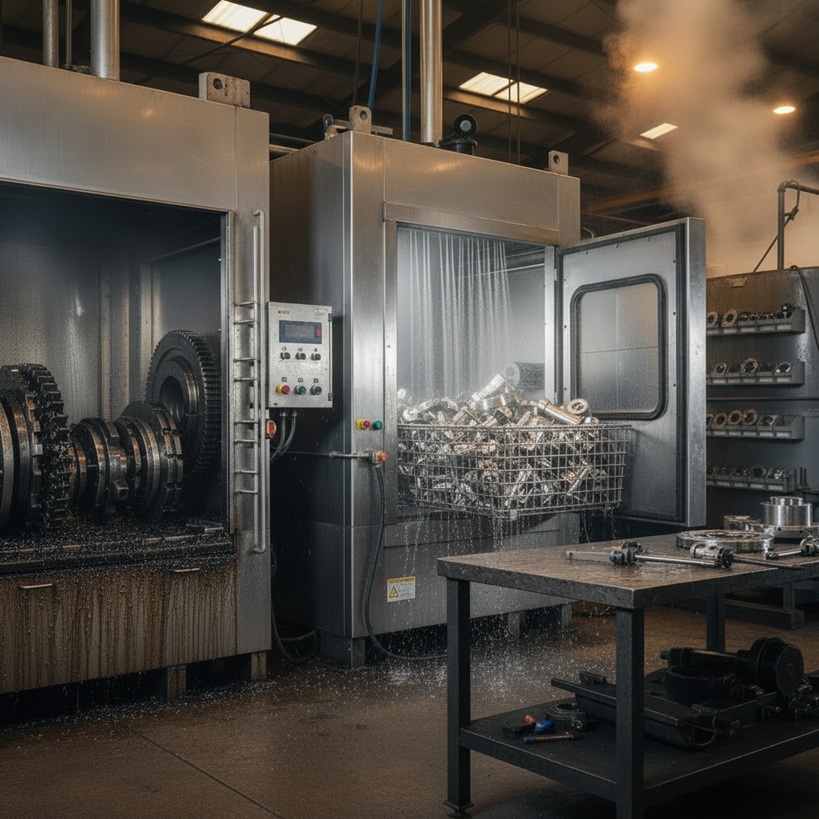
Tool rooms form the backbone of precision manufacturing operations across Australia. When jigs, fixtures, and tooling accumulate metal chips, cutting fluid residue, and machining debris, dimensional accuracy suffers and production quality declines. A mining equipment manufacturer in Western Australia discovered this reality when contaminated tooling caused a 0.15mm dimensional drift – enough to reject an entire batch of critical components valued at $47,000.
The solution isn’t more manual scrubbing or solvent wiping. Modern tool room cleaning equipment delivers consistent decontamination results that preserve precision tolerances whilst eliminating the labour hours traditionally spent on manual cleaning. Manufacturing facilities that implement systematic jig and fixture cleaning through Hotwash Australia automated systems report 40-60% reductions in cleaning time and measurable improvements in component accuracy.
The Hidden Cost of Contaminated Tooling
Contamination Types and Impact
Metal chips embed themselves in fixture surfaces. Cutting fluids oxidise and form stubborn residues. Coolant residues attract airborne particles that create abrasive layers on precision surfaces. Each contamination type degrades tooling performance differently, but all share one characteristic – they compromise the dimensional accuracy that justifies the tool room’s existence.
Rejection Rate Correlation
A fabrication workshop in South Australia tracked the relationship between fixture cleanliness and part rejection rates over six months. When fixtures went more than three production runs without thorough cleaning, rejection rates climbed from 2.3% to 7.8%. The cost difference exceeded $12,000 monthly in wasted material and rework labour.
Manual Cleaning Limitations
Manual cleaning methods create their own problems. Solvent wiping leaves residual films. Compressed air blowing redistributes contamination rather than removing it. Wire brushing damages precision surfaces. These traditional approaches consume 15-25 minutes per fixture whilst delivering inconsistent results that vary with worker technique and fatigue levels.
How Automated Parts Washing Transforms Tool Room Operations
Cleaning Mechanism Benefits
Automated parts cleaning systems eliminate the variability inherent in manual methods. Heavy-duty parts washers use precisely controlled spray patterns, temperatures, and detergent concentrations to remove contamination without damaging precision surfaces. The process delivers identical results regardless of operator experience or shift timing.
The cleaning mechanism combines heated detergent solution with high-pressure spray jets positioned to reach complex geometries. Rotating spray arms ensure complete coverage of fixture surfaces, including recessed areas and internal passages that manual cleaning often misses. Temperature control between 60-80°C activates detergent chemistry whilst remaining below the threshold that would affect heat-treated tooling.
Consistency and Time Savings
A Queensland manufacturing facility reduced fixture cleaning time from 22 minutes manual to 8 minutes automated. More significantly, dimensional checks revealed that automated jig and fixture cleaning maintained fixture accuracy within 0.02mm across 500 cleaning cycles – a consistency level impossible to achieve with manual methods.
Selecting Appropriate Cleaning Systems for Tool Room Applications
Chamber Capacity Requirements
Tool room requirements differ substantially from general parts washing. Fixtures demand gentle handling to preserve precision surfaces. Jigs contain complex internal passages requiring complete solution penetration. Cutting tools need aggressive degreasing without chemical attack on coatings. The right tool room cleaning equipment addresses these competing demands through adjustable parameters and versatile chamber configurations.
Chamber capacity determines system suitability for specific tool room layouts. A 600mm x 600mm x 600mm interior accommodates most fixtures and jig assemblies used in medium manufacturing operations. Larger fabrication facilities handling heavy mining equipment components require chambers exceeding 1000mm in multiple dimensions. Undersized chambers force operators to clean assemblies in multiple pieces, eliminating the efficiency gains that justify automated systems.
Spray Pressure and Pattern Configuration
Spray pressure and pattern configuration matter more than maximum pressure ratings suggest. Tool room applications typically require 20-40 bar pressure delivered through multiple spray zones rather than single high-pressure jets. Industrial spray washers designed for tool rooms incorporate lower spray arms for base surfaces, mid-level jets for vertical faces, and upper spray patterns for complex geometries.
Temperature Control Precision
Temperature control prevents thermal distortion in precision tooling. Systems with programmable temperature profiles allow operators to match cleaning temperatures to specific materials – 65°C for aluminium fixtures, 75°C for steel jigs, 60°C for assemblies containing plastic components. This precision prevents the dimensional shifts that occur when tooling experiences thermal cycling beyond design parameters.
Maintaining Dimensional Accuracy Through Proper Cleaning
Detergent Chemistry Selection
Precision tooling tolerances often reach 0.01mm or tighter. Cleaning processes must remove contamination without introducing wear, corrosion, or surface damage that compromises these specifications. The detergent chemistry, mechanical action, and post-cleaning treatment all influence whether automated cleaning systems preserve or degrade tooling accuracy.
Alkaline detergents effectively remove cutting fluids and metal chips but can etch aluminium surfaces when concentrations exceed recommended levels. Neutral pH formulations clean more slowly yet protect sensitive materials including aluminium, brass, and coated surfaces. A Victorian aerospace parts manufacturer switched from alkaline to neutral detergent after discovering 0.008mm surface etching on aluminium fixtures after 200 cleaning cycles.
Mechanical Spray Action Calibration
Mechanical spray action requires calibration to tooling durability. Hardened steel jigs withstand 40 bar spray pressure indefinitely. Cast aluminium fixtures develop surface erosion when subjected to pressures exceeding 25 bar over hundreds of cycles. Adjustable pressure settings allow operators to match cleaning intensity to material specifications.
Post-Cleaning Corrosion Protection
Post-cleaning corrosion protection determines how long fixtures maintain dimensional stability between uses. Residual moisture promotes oxidation on steel surfaces, creating rust scale that alters dimensions and contaminates subsequent parts. Parts cleaning systems with integrated drying cycles eliminate moisture before corrosion initiates. Heated air drying at 80-90°C removes water from internal passages and recessed areas that air-drying misses.
Integrating Cleaning Systems into Tool Room Workflows
System Placement Strategy
System placement affects adoption rates and utilisation efficiency. Tool rooms with cleaning systems located in separate areas experience lower usage because operators resist the workflow disruption. Positioning automated washers adjacent to tool storage creates a natural cleaning checkpoint between production runs and storage.
A mining equipment manufacturer in New South Wales redesigned tool room layout to position the cleaning system between the machining floor and tool storage racks. Fixture cleaning rates increased from 60% to 95% of production runs because the new workflow made cleaning easier than bypassing it. Rejection rates from contaminated tooling dropped 73% within three months.
Cycle Time Integration
Cycle time integration determines whether cleaning becomes a bottleneck or a seamless workflow element. An 8-minute cleaning cycle fits naturally into the time required for operators to complete paperwork and retrieve the next job setup. A 20-minute cycle forces operators to either wait unproductively or skip cleaning to maintain production schedules.
Multiple Fixture Cleaning
Multiple fixture cleaning requires basket systems that protect precision surfaces during washing. Stainless steel mesh baskets prevent fixtures from contacting each other whilst allowing complete spray coverage. Custom basket designs accommodate specific fixture geometries, ensuring that complex assemblies remain properly oriented throughout the cleaning cycle.
Preventive Maintenance for Cleaning Equipment
Spray Nozzle Inspection
Cleaning system reliability directly affects tool room productivity. A non-functional washer forces operators back to manual cleaning methods, eliminating the consistency and efficiency gains that justified the capital investment. Preventive maintenance schedules prevent unplanned downtime whilst extending equipment service life.
Spray nozzle inspection reveals blockages before they compromise cleaning effectiveness. Metal particles and detergent residues gradually accumulate in nozzle orifices, reducing spray pressure and altering spray patterns. Monthly nozzle removal and cleaning maintains design performance. Facilities operating in high-contamination environments benefit from weekly inspection schedules.
Heating Element Condition
Heating element condition affects temperature control accuracy and energy efficiency. Scale buildup on heating surfaces reduces heat transfer efficiency, forcing elements to operate at higher temperatures to maintain solution temperature. This accelerates element failure whilst increasing energy consumption. Annual descaling treatments remove mineral deposits and restore heating efficiency.
Pump Seal and Bearing Management
Pump seals and bearings require periodic inspection and replacement according to operating hour schedules. A seal failure floods the motor compartment and necessitates emergency repairs that can idle tool room operations for days. Scheduled seal replacement at manufacturer-specified intervals prevents unexpected failures. Operating hour meters track pump runtime and trigger maintenance alerts before problems develop.
Detergent Selection and Management
Chemistry Requirements
Detergent chemistry determines cleaning effectiveness, material compatibility, and operational costs. Industrial cleaning detergents range from aggressive alkaline formulations that remove heavy contamination quickly to mild neutral solutions that protect sensitive materials. Tool room applications typically require neutral to mildly alkaline products that balance cleaning power with material safety.
Concentration Control
Concentration control affects both cleaning results and operational costs. Excessive detergent concentrations waste product without improving cleaning whilst potentially damaging sensitive materials. Insufficient concentrations leave residues that contaminate subsequent parts. Automatic dosing systems maintain optimal concentrations by measuring solution conductivity and adding detergent as needed.
A fabrication facility in Queensland reduced detergent costs by 40% after installing automatic dosing controls. Manual dosing had resulted in 2-3x recommended concentrations because operators assumed “more is better.” The automated system maintained optimal chemistry whilst eliminating product waste.
Solution Life Management
Solution life management balances cleaning effectiveness against disposal costs. Fresh detergent solutions deliver maximum cleaning power but require frequent replacement. Extended solution use reduces disposal frequency but compromises cleaning as contamination accumulates. Most tool room applications achieve optimal economics with weekly solution changes under normal operating conditions.
Specialised Applications: Cutting Tools and Coated Components
Cutting Tool Challenges
Cutting tools present unique cleaning challenges. Carbide inserts retain cutting fluid residues in microscopic surface irregularities. Coated tools contain thin films that aggressive cleaning can damage. Brazed assemblies include joints that harsh chemicals can attack. These applications demand gentler cleaning approaches than standard jig and fixture cleaning.
Manual Parts Washer Applications
Manual parts washers provide controlled cleaning for delicate tooling. These systems use heated detergent solution with brush agitation rather than high-pressure spray. Operators control mechanical action intensity, preventing damage to coatings and brazed joints whilst removing cutting fluid residues.
Ultrasonic and Solvent-Based Cleaning
Ultrasonic cleaning offers an alternative for extremely delicate or complex tooling. High-frequency sound waves create microscopic cavitation bubbles that implode against surfaces, dislodging contamination from recessed areas and complex geometries. The process generates minimal mechanical stress, making it suitable for coated cutting tools and precision measuring instruments.
Solvent-based cleaning remains necessary for specific contamination types including adhesives, thread-locking compounds, and certain cutting fluids. Stainless steel parts washers with solvent-compatible construction handle these applications whilst meeting safety requirements for flammable materials. Proper ventilation and explosion-proof electrical components ensure safe operation with hydrocarbon solvents.
Measuring Cleaning System ROI in Tool Room Operations
Labour Cost Reduction Calculations
Capital equipment purchases require financial justification. Automated cleaning systems typically cost $15,000-$45,000 depending on capacity and features. Calculating return on investment requires quantifying both direct labour savings and indirect quality improvements.
Labour cost reduction provides the most straightforward ROI calculation. A tool room cleaning 15 fixtures daily at 20 minutes each spends 5 hours on manual cleaning. An automated system reducing cycle time to 8 minutes saves 3 hours daily. At $35/hour loaded labour cost, annual savings exceed $27,000. This justifies systems costing up to $40,000 with payback periods under 18 months.
Quality Improvement Benefits
Quality improvement benefits prove harder to quantify but often exceed labour savings. The South Australian fabricator that reduced rejection rates from 7.8% to 2.3% through consistent fixture cleaning saved $144,000 annually in material waste and rework labour. This single benefit justified the $32,000 system cost in less than three months.
Maintenance Cost Reductions
Maintenance cost reductions add incremental value. Clean tooling lasts longer because contamination-induced wear diminishes. A Western Australian mining supplier extended average fixture life from 18 months to 26 months after implementing systematic cleaning. With fixture replacement costs averaging $3,500, the extended service life saved $58,000 annually across their 50-fixture inventory.
Safety and Environmental Considerations
Worker Exposure Elimination
Manual cleaning exposes workers to chemical solvents, skin irritants, and repetitive strain injuries. Automated cleaning systems eliminate direct chemical contact and reduce ergonomic stress. This translates to fewer workplace injuries and lower workers’ compensation costs whilst improving regulatory compliance.
Vapour Containment Benefits
Enclosed washing chambers contain chemical vapours that manual cleaning releases into workshop air. This reduces worker exposure to detergent aerosols and improves indoor air quality. Facilities subject to occupational exposure limits find that automated systems simplify compliance whilst protecting employee health.
Water and Detergent Consumption
Water and detergent consumption affect both operating costs and environmental impact. Automated cleaning systems with solution filtration and recycling reduce water consumption by 60-80% compared to manual washing. A Queensland manufacturer reduced water usage from 450 litres daily to 85 litres after implementing automated cleaning with solution recycling. Annual water and sewer cost savings exceeded $4,200.
Waste disposal requirements vary with detergent chemistry and contamination levels. Metal chips and cutting fluid residues accumulate in wash solutions, eventually requiring disposal as industrial waste. Solution filtration extends usable life by removing suspended solids. Some facilities achieve 2-3 week solution life with continuous filtration compared to 3-5 days without filtration.
Conclusion
Tool room efficiency determines manufacturing capability. When jigs, fixtures, and tooling maintain dimensional accuracy through systematic cleaning, production quality improves whilst rejection rates decline. The transition from manual cleaning methods to automated cleaning systems delivers measurable benefits – 40-60% time savings, consistent dimensional accuracy within 0.02mm, and rejection rate reductions exceeding 70% in documented applications.
Australian manufacturing operations require tool room cleaning equipment built to withstand continuous industrial use. Systems designed and manufactured locally meet Australian electrical standards whilst providing responsive local support for maintenance and parts. The investment in proper jig and fixture cleaning equipment pays returns through reduced labour costs, improved quality outcomes, and extended tooling service life.
Manufacturing facilities evaluating cleaning system options should assess chamber capacity against their largest fixtures, verify temperature control capabilities for material compatibility, and confirm spray pressure adjustability for delicate components. The right system transforms tool room operations from a labour-intensive bottleneck into an efficient quality checkpoint.
For assistance selecting cleaning systems matched to specific tool room requirements, contact us to discuss chamber configurations, automation features, and application-specific capabilities. The team provides technical guidance based on fixture dimensions, contamination types, and production volume requirements.

Leave A Comment