
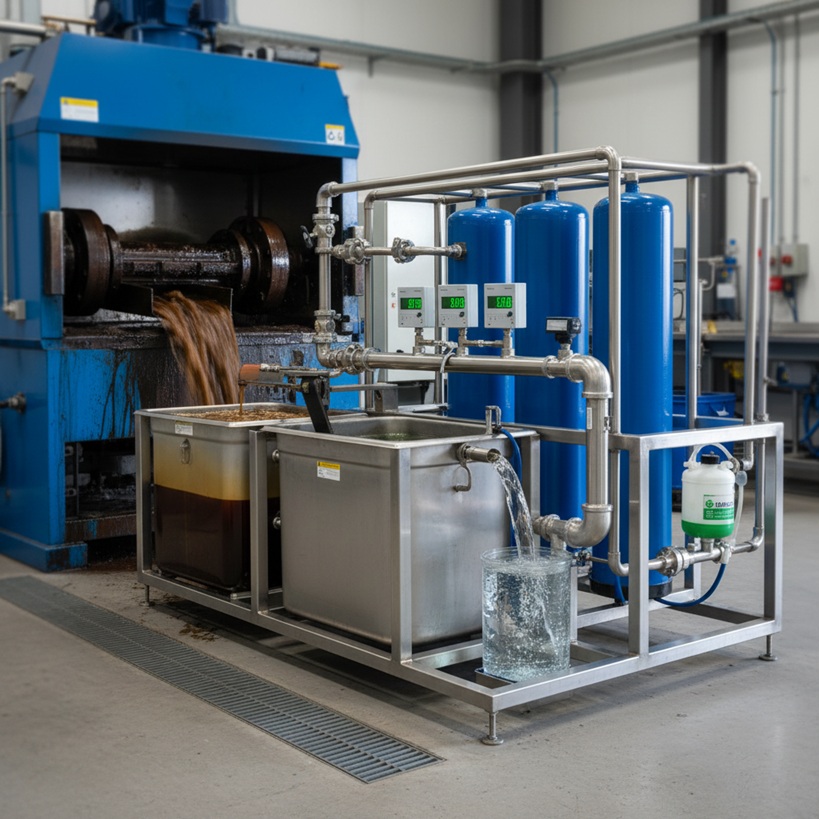
Workshop wastewater isn’t just dirty water – it’s a complex mixture of oils, heavy metals, solvents, and suspended solids that can trigger serious regulatory penalties and environmental damage if mishandled. For Australian workshops handling mining equipment, automotive components, or manufacturing parts, the transformation from hazardous waste to compliant effluent represents both a regulatory necessity and an operational efficiency opportunity.
The stakes are considerable. Discharging untreated workshop wastewater can result in fines exceeding $250,000 under environmental protection legislation, whilst proper industrial wastewater treatment systems reduce disposal costs by 60-80% compared to hazardous waste removal services. The difference between compliant operations and regulatory violations often comes down to understanding what makes workshop wastewater hazardous and implementing appropriate industrial wastewater treatment systems.
What Makes Workshop Wastewater Hazardous
The contamination profile of workshop wastewater varies by operation type, but common hazardous components include petroleum hydrocarbons (oils, greases, fuels), heavy metals (zinc, chromium, lead from machining operations), alkaline cleaning agents with pH levels above 11, suspended solids including metal shavings and abrasive particles, and chemical solvents used in degreasing operations.
Volume and Concentration Issues
When parts washers operate without proper effluent management, these contaminants concentrate in wastewater at levels that classify it as hazardous waste. A single heavy-duty parts washer processing mining equipment components can generate 200-500 litres of contaminated water daily, containing oil concentrations of 500-2,000 mg/L – well above the typical discharge limit of 10-50 mg/L for trade waste.
Regulatory Framework
The regulatory framework governing workshop wastewater across Australia operates at both state and local levels. State environmental protection authorities set overarching standards, whilst local water utilities enforce trade waste agreements that specify acceptable discharge parameters. Exceeding these limits doesn’t just risk fines – it can result in discharge permit revocation, forcing expensive off-site hazardous waste management workshop solutions that cost $800-1,500 per removal.
The Treatment Hierarchy for Workshop Effluent
Effective industrial wastewater treatment follows a systematic approach that addresses different contamination types through multiple stages. Understanding this hierarchy helps workshops select appropriate equipment and processes for their specific contamination profile.
Primary Treatment: Physical Separation
The first stage removes large suspended solids and free-floating oils through settling and skimming. Gravity separators allow heavier particles to settle whilst lighter oils float to the surface for removal. This simple but essential step removes 40-60% of suspended solids and 50-70% of free oil, significantly reducing the contamination load on subsequent treatment stages.
For workshops using hot tank systems or immersion cleaning, primary treatment becomes particularly important due to the higher volume of suspended solids dislodged during soaking operations. A properly sized settling tank with sufficient retention time (typically 30-60 minutes) allows effective separation before wastewater moves to secondary treatment.
Secondary Treatment: Chemical and Biological Processes
Secondary treatment addresses emulsified oils and dissolved contaminants that physical separation cannot remove. Chemical treatment using coagulants and flocculants breaks oil-water emulsions, causing fine particles to aggregate into larger masses that settle more readily. This process typically reduces oil content to 50-100 mg/L and removes an additional 70-85% of suspended solids.
pH adjustment represents another critical secondary treatment step. Workshop wastewater from Hotwash Australia systems using alkaline detergents often has pH levels of 10-12, requiring neutralisation to the acceptable discharge range of 6-9. Automated pH control systems inject acid or base as needed, maintaining compliant levels without constant manual monitoring.
Tertiary Treatment: Polishing and Final Compliance
Final treatment stages polish effluent to meet stringent discharge requirements. Filtration through sand, activated carbon, or membrane systems removes remaining suspended particles and dissolved organics. Oil-water coalescers capture trace oil droplets, reducing concentrations to below 10 mg/L.
For operations requiring the highest treatment standards, advanced oxidation processes using ozone or UV light break down persistent organic compounds. Whilst more expensive, these systems ensure compliance even with the strictest environmental regulations, particularly important for workshops near sensitive waterways or operating under enhanced scrutiny.
Integrated Treatment Systems for Parts Washing Operations
Modern parts washing equipment increasingly incorporates treatment systems that transform hazardous waste management workshop challenges from a separate problem into an integrated solution. This integration reduces labour requirements, ensures consistent treatment, and minimises the volume of waste requiring disposal.
Closed-Loop System Benefits
Closed-loop systems represent the most advanced approach to industrial wastewater treatment in parts washing applications. These systems continuously filter, skim, and recondition wash water, maintaining cleaning effectiveness whilst drastically reducing wastewater generation. A super heavy-duty parts washer with closed-loop treatment can operate for 3-6 months between water changes, compared to weekly or daily disposal requirements for systems without integrated treatment.
The economics prove compelling. A mining workshop processing heavy equipment components might generate 2,000 litres of contaminated water weekly without treatment integration – that’s 104,000 litres annually requiring disposal at $0.50-1.50 per litre. An integrated treatment system reduces disposal volumes by 85-95%, cutting annual waste management costs from $52,000-156,000 to $7,800-15,600.
Oil Skimming and Coalescence
Effective oil removal forms the foundation of any integrated treatment approach. Belt skimmers continuously remove floating oil from the washer sump, preventing re-contamination of cleaned parts and maintaining detergent effectiveness. These systems typically remove 90-95% of free-floating oil, substantially reducing the treatment burden on downstream processes.
Coalescing filters provide a second line of defence, capturing emulsified oil droplets as water passes through specially designed media. The droplets merge into larger masses that separate more easily, reducing oil content from 500-1,000 mg/L to 50-100 mg/L. For workshops using hot blaster systems with high-pressure spray, coalescing becomes particularly important due to the fine oil emulsions created by aggressive washing action.
Sediment Filtration and Removal
Suspended solids from machining operations, rust, and general contamination accumulate in wash water, reducing cleaning effectiveness and potentially damaging pump components. Multi-stage filtration removes particles progressively, with coarse screens (3-5mm) capturing large debris, bag filters (50-100 micron) removing medium particles, and cartridge filters (10-25 micron) providing final polishing.
Automated sludge removal systems prevent sediment accumulation in washer sumps. These systems either continuously or periodically purge settled solids to a separate collection point, maintaining consistent wash water quality without manual intervention. For high-volume operations, centrifugal separators spin out fine particles that standard filtration struggles to capture, achieving removal rates of 95-98% for particles above 5 microns.
Regulatory Compliance and Trade Waste Agreements
Australian workshops discharge wastewater under trade waste agreements with local water utilities, which specify acceptable limits for pH, temperature, oils and greases, suspended solids, heavy metals, and chemical oxygen demand (COD). Understanding these requirements and implementing appropriate industrial wastewater treatment prevents violations and maintains operational continuity.
Discharge Parameter Limits
Trade waste agreements typically specify oil and grease limits of 10-50 mg/L, suspended solids limits of 300-600 mg/L, pH range of 6-9, temperature below 38-40°C, and heavy metal concentrations well below hazardous thresholds. Exceeding these limits results in excess mass charges, non-compliance fees, or discharge permit suspension.
Monitoring Requirements
Regular monitoring ensures ongoing compliance. Most agreements require monthly or quarterly testing of discharge water, with results submitted to the water utility. Automated monitoring systems continuously track key parameters like pH and temperature, providing real-time alerts if levels approach non-compliant ranges. This proactive approach prevents violations before they occur, maintaining the operational continuity essential for production schedules.
Documentation and Record-Keeping
Comprehensive documentation demonstrates compliance and provides a defence against potential violations. Effective record-keeping includes discharge monitoring results showing all tested parameters, maintenance logs for treatment equipment, waste disposal records for separated oils and sludge, and chemical usage logs for treatment additives.
Digital monitoring systems simplify this documentation burden, automatically logging discharge parameters and generating compliance reports. For workshops using manual parts washers or smaller systems, simple spreadsheet tracking suffices, but the discipline of consistent documentation remains equally important regardless of operation size.
Cost Analysis: Treatment Versus Disposal
The financial case for integrated industrial wastewater treatment becomes clear when comparing total costs across different management approaches. Whilst treatment systems require upfront capital investment, the operational savings typically deliver payback periods of 12-36 months.
Disposal-Only Approach Costs
Workshops relying entirely on waste removal services face ongoing costs that accumulate rapidly. Hazardous waste disposal runs $800-1,500 per 1,000-litre removal, with collection frequency determined by wastewater generation rates. A medium-sized workshop generating 500 litres weekly pays $20,800-39,000 annually for disposal alone.
Additional hidden costs compound this expense. Production interruptions during waste removal, labour time coordinating pickups and managing temporary storage, and compliance risk from potential spills or improper storage all add to the true cost of disposal-only approaches. Regulatory scrutiny increases for high-volume waste generators, potentially triggering more frequent inspections and stricter permit conditions.
Integrated Treatment System Economics
A properly specified treatment system transforms these recurring costs into manageable operational expenses. Capital investment for industrial wastewater treatment equipment ranges from $15,000-50,000 for small workshop systems to $150,000-500,000 for large-scale mining operation installations. Operating costs include filter replacements ($2,000-8,000 annually), treatment chemicals ($1,000-5,000 annually), energy consumption ($500-3,000 annually), and residual waste disposal at 10-20% of previous volumes.
For the medium-sized workshop spending $20,800-39,000 annually on disposal, a $35,000 treatment system investment delivers payback in 18-24 months, then generates $18,000-36,000 in annual savings for the system’s 10-15 year operational life. The total lifecycle savings exceed $200,000-500,000, representing substantial capital available for other operational improvements.
Selecting Treatment Systems for Specific Applications
Matching treatment capability to contamination profile ensures effective hazardous waste management workshop solutions without over-investment in unnecessary capacity. Different workshop types generate distinct wastewater characteristics requiring tailored approaches.
Mining and Heavy Equipment Workshops
Operations cleaning mining equipment components deal with extreme contamination – thick grease, hydraulic oils, coal dust, and abrasive particles. Treatment systems for these applications require robust primary separation with large settling capacity, high-capacity oil skimmers handling thick greases, coarse filtration (100+ micron) before fine filtration, and chemical treatment for persistent emulsions.
Extra heavy-duty parts washers serving these operations benefit from integrated treatment systems sized for high contamination loads, with sump capacities of 1,000-3,000 litres and treatment flow rates of 100-300 litres per hour. The investment in robust treatment capability pays dividends through extended water life and reduced disposal frequency.
Automotive and Light Manufacturing
Workshops handling automotive components or light manufacturing parts face moderate contamination levels – motor oils, transmission fluids, cutting fluids, and metal fines. Treatment requirements focus on effective oil-water separation through belt skimmers or coalescers, multi-stage filtration (50-10 micron progression), and pH adjustment for alkaline wash solutions.
These operations typically achieve excellent results with mid-range treatment systems costing $20,000-60,000, processing 50-150 litres per hour, and delivering water quality suitable for extended reuse in spray washing applications.
Food Industry and Stainless Steel Applications
Commercial kitchens and food processing facilities using stainless steel parts washers generate wastewater dominated by food oils, organic matter, and alkaline cleaning agents. Treatment priorities include effective grease separation and capture, biological or chemical treatment for organic loading, and pH neutralisation for discharge compliance.
Food industry wastewater often meets less stringent discharge requirements than industrial operations due to lower heavy metal content and biodegradable contamination. However, grease management becomes critical, as inadequate removal causes drain blockages and trade waste violations. Properly sized grease traps combined with pH adjustment typically provide sufficient treatment for compliant discharge.
Implementation Strategy for Workshop Wastewater Transformation
Transitioning from hazardous waste generation to compliant effluent management requires systematic planning that addresses technical requirements, regulatory compliance, and operational integration.
Assessment and Planning Phase
Begin with comprehensive wastewater characterisation – collect samples during typical operations and test for oils and greases, suspended solids, pH, heavy metals, and COD. This baseline data reveals actual contamination levels rather than assumptions, enabling accurate treatment system specification.
Regulatory requirement review follows characterisation. Obtain current trade waste agreement limits from the local water utility, identify any pending regulation changes, and determine monitoring and reporting requirements. Some jurisdictions offer pre-approval consultations where utility staff review proposed treatment approaches before implementation, reducing approval delays.
System Selection and Installation
Match treatment capacity to actual wastewater generation rates with 20-30% excess capacity for operational flexibility. Under-sizing forces frequent maintenance and reduces treatment effectiveness, whilst massive over-sizing wastes capital on unused capacity.
Integration with existing parts washing equipment determines installation complexity. Retrofitting treatment systems to older washers requires careful assessment of space availability, plumbing modifications, and electrical service upgrades. New installations benefit from selecting equipment with factory-integrated treatment, eliminating coordination challenges between separate suppliers.
Training and Operational Procedures
Effective hazardous waste management workshop practices require operator understanding of system function, monitoring requirements, and maintenance procedures. Training should cover daily checks (visual inspection, discharge quality), weekly tasks (filter cleaning, oil collection), monthly maintenance (chemical levels, system calibration), and quarterly compliance (sampling, reporting).
Document all procedures in clear operational manuals with photographs and step-by-step instructions. Assign specific responsibilities to individual staff members rather than assuming “someone” will handle tasks. Regular refresher training maintains competency as staff turnover occurs.
Maintaining Long-Term Treatment Effectiveness
Treatment system performance degrades without consistent maintenance, gradually increasing discharge contamination until violations occur. Proactive maintenance preserves treatment effectiveness and extends equipment life.
Preventive Maintenance Schedules
Establish routine maintenance intervals based on manufacturer recommendations and operational experience. Daily tasks include visual inspection of discharge quality, oil skimmer operation verification, and general system observation. Weekly maintenance covers filter pressure differential checks, oil collection container emptying, and settling tank inspection.
Monthly procedures address chemical treatment system verification, pump and motor inspection, and detailed cleaning of accessible components. Quarterly maintenance includes comprehensive system testing, calibration verification, and professional service for complex components like automated pH controllers or advanced filtration systems.
Performance Monitoring and Optimisation
Regular testing of treated effluent reveals gradual performance changes before they cause compliance issues. Monthly testing of key parameters (oil content, suspended solids, pH) establishes performance trends, whilst quarterly comprehensive analysis, including heavy metals and COD provides complete compliance verification.
Compare results against both regulatory limits and system design specifications. Treated effluent approaching 70-80% of discharge limits signals declining performance requiring investigation, even though technical compliance remains. Proactive response at this stage prevents violations and maintains operational margins.
Conclusion: Transforming Workshop Effluent Management
The transformation from hazardous workshop wastewater to compliant effluent represents more than regulatory necessity – it delivers substantial operational and financial benefits through reduced disposal costs, improved environmental stewardship, and enhanced operational efficiency. Australian workshops implementing effective industrial wastewater treatment systems typically achieve 60-80% reduction in waste management costs, eliminate regulatory compliance risks, and extend parts washer operational life through better water quality maintenance.
Success requires matching treatment capability to actual contamination profiles, integrating systems with existing parts washing equipment, and maintaining consistent operational discipline. The upfront investment in proper treatment infrastructure delivers returns throughout the system’s 10-15 year operational life, with typical payback periods of 18-36 months.
For workshops evaluating wastewater management options or seeking to upgrade existing approaches, professional guidance ensures appropriate system selection and compliant implementation. Contact us to discuss specific wastewater treatment requirements and explore integrated solutions that transform workshop effluent management from operational burden to competitive advantage.

Leave A Comment