
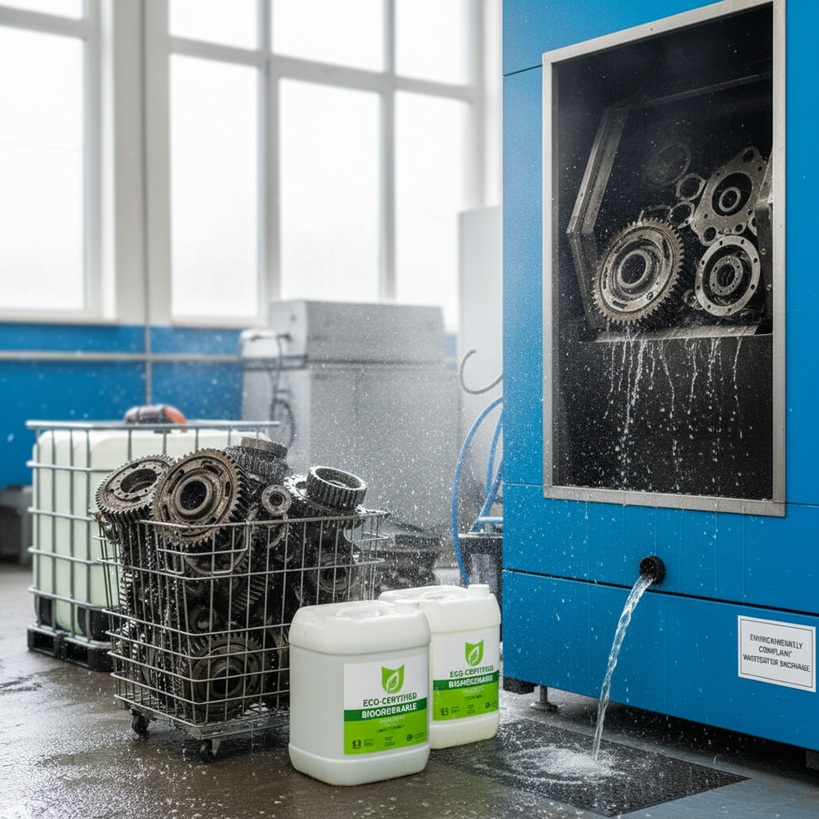
Walk into any industrial supplier across Australia and you’ll see “biodegradable” plastered across degreaser bottles. The term appears on everything from automotive workshops’ parts cleaning solutions to mining operations’ heavy-duty degreasers. But what does “biodegradable” actually mean when selecting a degreaser for heavy-duty parts washers or manual cleaning operations?
The answer isn’t as straightforward as marketing materials suggest. Behind that green-tinged label sits a complex web of testing standards, degradation rates, and environmental claims that range from scientifically validated to borderline meaningless. For maintenance supervisors and operations managers making purchasing decisions, understanding the OECD 301E standard – the benchmark for biodegradability claims across Australia – separates genuine environmental performance from greenwashing.
What “Biodegradable” Actually Means in Industrial Cleaning
Biodegradability refers to a chemical’s ability to break down into natural elements through biological processes – typically via bacteria and other microorganisms. When a substance biodegrades completely, it converts into water, carbon dioxide, and biomass. Sounds simple enough, but the critical variables are how much degrades and how quickly.
A product that breaks down 10% over six months technically biodegrades. So does one that degrades 90% within 28 days. Both could legally claim “biodegradable” status in some jurisdictions, yet their environmental impacts differ dramatically. This ambiguity creates a minefield for industrial buyers who need to balance cleaning performance with environmental responsibility.
Australian Environmental Scrutiny
Australian operations face particular scrutiny around chemical use. Mining sites, manufacturing facilities, and food processing plants operate under environmental management plans that increasingly demand documentation of chemical biodegradability. Workshop managers at major mining companies report procurement teams now require OECD 301E degreaser standards test results before approving degreaser purchases – a shift that’s caught many suppliers unprepared.
The OECD 301E Standard Explained
The Organisation for Economic Co-operation and Development (OECD) 301E test – formally titled “Ready Biodegradability: Modified OECD Screening Test” – represents the gold standard for measuring biodegradability in industrial chemicals. This test protocol emerged from international efforts to create consistent, reproducible methods for evaluating how quickly and completely substances break down in aquatic environments.
Testing Protocol and Methodology
Here’s how the test works: Scientists place the test substance in water containing naturally occurring microorganisms under controlled laboratory conditions. Over 28 days, they measure oxygen consumption (biological oxygen demand) or carbon dioxide production to determine how much of the substance breaks down. Temperature, pH, and microbial populations remain carefully controlled to ensure reproducibility.
To pass OECD 301E testing and earn “readily biodegradable” classification, a substance must achieve 60% degradation within the 28-day window. That 60% threshold isn’t arbitrary – it represents the point where scientists consider a substance likely to biodegrade completely in natural environments, even if testing stops before full degradation occurs.
Modified Screening Conditions
The “modified screening” aspect means the test uses stricter conditions than some earlier protocols. Lower microbial concentrations and shorter acclimation periods make OECD 301E degreaser standards harder to pass, which increases confidence that substances meeting this standard will genuinely biodegrade in real-world conditions.
Why 60% Degradation in 28 Days Matters
The 60% threshold and 28-day timeframe connect directly to environmental risk assessment. Substances that biodegrade this quickly don’t accumulate in waterways, soil, or biological tissues. For industrial operations using biodegradable degreaser Australia suppliers provide, this distinction determines whether wastewater requires expensive treatment or can discharge through standard industrial effluent systems (subject to local regulations).
Comparison to Petroleum-Based Solvents
Compare this to non-biodegradable petroleum-based solvents that persist in environments for years. When workshops wash parts contaminated with traditional solvents, those chemicals enter wastewater systems where they resist biological treatment. Municipal treatment plants struggle to break them down, meaning they often pass through to rivers and oceans. The accumulated environmental load from thousands of workshops and industrial facilities creates lasting contamination.
Wastewater Treatment Benefits
Readily biodegradable degreasers following OECD 301E degreaser standards break down before accumulating. When parts washing systems use OECD 301E-compliant degreasers, the cleaning solution degrades rapidly after discharge. Wastewater treatment processes – whether on-site or municipal – handle these substances far more effectively.
Operations managers evaluating total cost of ownership should factor in wastewater treatment expenses. One Queensland mining operation documented a 35% reduction in wastewater treatment costs after switching from petroleum-based solvents to OECD 301E-certified biodegradable degreaser Australia formulations in their parts washing operations. The degreaser cost more per litre, but reduced treatment expenses delivered net savings within seven months.
What OECD 301E Testing Doesn’t Tell You
Despite its rigour, OECD 301E testing has limitations that industrial buyers must understand. The test measures biodegradation under ideal laboratory conditions – controlled temperature, optimal microbial populations, and specific pH levels. Real-world environments rarely match these conditions perfectly.
Real-World Environmental Variables
A degreaser that readily biodegrades at 20°C in the lab might behave differently in a cold-climate mining operation where wastewater temperatures drop near freezing. Microbial activity slows dramatically in cold conditions, potentially extending degradation timeframes well beyond the 28-day laboratory result. Similarly, highly alkaline or acidic industrial wastewater can inhibit the biological processes OECD 301E testing assumes.
Testing Scope Limitations
The standard also doesn’t evaluate toxicity to aquatic organisms during the degradation process. Some substances break down readily but produce toxic intermediates – breakdown products that harm fish, invertebrates, or beneficial bacteria before degrading further. OECD 301E certification confirms biodegradability but doesn’t guarantee environmental safety throughout the degradation pathway.
Cleaning performance represents another gap. OECD 301E degreaser standards test degradation, not degreasing power. A product might achieve 90% biodegradation in 21 days yet fail to remove heavy grease from mining equipment components. For maintenance supervisors, this creates a balancing act – environmental performance matters, but parts must still come clean.
Reading Biodegradability Claims on Product Labels
Marketing language around biodegradability varies wildly across industrial cleaning products. Understanding the terminology helps operations managers separate substantiated claims from vague environmental suggestions.
“Readily Biodegradable” Claims
“Readily biodegradable” represents the strongest claim – it specifically indicates OECD 301E compliance (or equivalent testing like OECD 301B or 301D). Suppliers making this claim should provide test documentation on request. If they can’t produce OECD test results, the claim lacks verification.
Vague and Unverified Terms
“Biodegradable” without qualifiers means almost nothing. Technically, most organic substances biodegrade eventually – even crude oil breaks down over decades. Without specifying rate and extent of degradation, this term provides no useful information for environmental risk assessment.
“Inherently biodegradable” sounds positive but indicates failure to meet OECD 301E standards. These products biodegrade under enhanced laboratory conditions (higher microbial concentrations, longer timeframes) but may not break down effectively in natural environments. They occupy a grey zone between readily biodegradable and persistent.
“Environmentally friendly” or “eco-safe” represent marketing language with no standardised meaning. These terms don’t reference specific testing protocols or degradation rates. Procurement teams should request OECD 301E documentation rather than accepting these vague descriptors.
Australian operations should specifically seek products tested under OECD protocols rather than proprietary or regional standards. International mining companies and manufacturers increasingly require OECD compliance across global operations, making these certifications valuable for consistency across multiple sites.
How Biodegradable Degreasers Perform in Parts Washing Systems
The practical question for workshop managers centres on cleaning performance. Do biodegradable degreaser Australia formulations actually remove heavy grease, oil, and contamination from industrial parts, or do environmental benefits come with performance compromises?
Modern Surfactant Technology Performance
Modern OECD 301E-compliant degreasers have closed the performance gap significantly. Formulations based on surfactant technology rather than petroleum solvents now match or exceed traditional cleaners in many applications. These products work particularly well in heated spray washing systems where elevated temperatures and mechanical action complement the chemical cleaning process.
Hot tank systems using biodegradable degreasers at 60-80°C achieve excellent results on heavily contaminated mining and oil and gas components. The combination of heat, immersion time, and modern surfactant chemistry breaks down even stubborn contamination. Operations running these systems report comparable cleaning quality to petroleum-based solvents with significantly reduced environmental impact.
Application-Specific Considerations
Manual parts washers present a different scenario. Without mechanical spray action or high temperatures, biodegradable degreasers may require longer soak times or additional mechanical agitation for heavily soiled parts. Workshop mechanics report success with pre-soaking particularly dirty components before manual washing, which allows the degreaser additional contact time.
Temperature sensitivity affects performance significantly. Most biodegradable degreasers work optimally between 40-70°C. Cold-water applications may require higher concentrations or extended contact time to achieve similar results. This matters for operations in remote locations where heating water adds cost and complexity.
Dilution and Concentration Management
Dilution ratios also impact both performance and environmental outcomes. Manufacturers typically specify concentration ranges for different contamination levels. Using excessive concentration wastes product and increases environmental load without improving cleaning. Conversely, under-diluting compromises cleaning power and may require re-washing, which increases water and energy consumption.
Cost Considerations Beyond the Price Per Litre
Biodegradable degreaser Australia products typically cost 20-40% more per litre than traditional petroleum-based solvents. This price difference causes sticker shock for procurement teams focused on immediate costs. However, total cost of ownership calculations often favour biodegradable options when operations account for:
Wastewater and Regulatory Savings
Wastewater treatment and disposal: Petroleum solvents require expensive hazardous waste disposal or advanced treatment. Readily biodegradable products often qualify for standard industrial wastewater systems, reducing disposal costs by 60-80% in many facilities.
Regulatory compliance: Environmental reporting requirements continue tightening across Australian industries. Using OECD 301E-certified products simplifies compliance documentation and reduces regulatory risk. One Western Australian manufacturing facility calculated savings of 40 administrative hours annually after switching to documented biodegradable chemicals.
Safety and Equipment Benefits
Workplace safety: Many biodegradable degreasers have lower toxicity profiles than petroleum solvents, reducing PPE requirements and health monitoring costs. Lower volatility also means reduced ventilation requirements in enclosed workshops.
Equipment longevity: Aggressive petroleum solvents can damage seals, gaskets, and painted surfaces in parts washing equipment over time. Modern biodegradable formulations typically offer better materials compatibility, extending equipment service life.
Concentration Efficiency
Concentration efficiency: Quality biodegradable degreasers often work effectively at lower concentrations than traditional products. A degreaser costing 30% more per litre but used at half the concentration delivers net cost savings.
Operations managers should request cost-per-wash calculations from suppliers rather than comparing list prices. Reputable suppliers provide dilution ratios, expected bath life, and consumption rates that enable accurate cost modelling.
Selecting the Right Biodegradable Degreaser for Your Operation
Matching degreaser chemistry to application requirements determines success. Not all biodegradable degreasers suit all industrial cleaning tasks. Consider these factors when evaluating options:
Application Requirements
Contamination type: Heavy petroleum products, cutting oils, and mineral greases respond differently to various surfactant systems. Suppliers should provide application-specific recommendations based on the contaminants operations handle most frequently.
Equipment compatibility: Verify compatibility with industrial parts washers including seals, pumps, and heating elements. Some degreasers require specific metallurgy or seal materials. Hotwash Australia equipment specifications detail compatible cleaning chemistries.
Operating Conditions
Temperature range: Match the degreaser’s optimal operating temperature to equipment capabilities. Hot blaster systems operating at elevated temperatures may use different formulations than ambient-temperature manual washers.
Water hardness: Australian water hardness varies dramatically by region. Some biodegradable surfactants lose effectiveness in hard water, requiring water softening or alternative formulations. Request local water compatibility information from suppliers.
System-Specific Features
Foam characteristics: Spray washing systems require low-foaming formulations to prevent overflow and maintain spray pattern effectiveness. Immersion systems tolerate higher foam levels. Ensure the degreaser matches equipment type.
Rinse requirements: Some biodegradable degreasers rinse more easily than others, affecting water consumption and drying times. Operations with water restrictions should prioritise easy-rinsing formulations.
The Future of Biodegradable Industrial Cleaning
Regulatory pressure continues pushing Australian industries toward environmentally responsible cleaning chemistries. The Australian Government’s National Waste Policy and state-level environmental protection authorities increasingly scrutinise industrial chemical use. Several major mining companies now mandate OECD 301E-certified products across operations, creating market momentum toward biodegradable options.
Formulation Advances
Chemical manufacturers respond with improved formulations that close performance gaps while maintaining or improving biodegradability. Recent surfactant technology developments deliver petroleum-solvent-level cleaning power with complete biodegradability. These advances make the environmental choice increasingly viable without performance compromises.
Water Recycling Integration
Water recycling integration represents another trend. Modern extra heavy duty parts washers increasingly incorporate closed-loop water systems that recycle and filter wash water. Biodegradable degreasers enable these systems by breaking down contaminants that would otherwise accumulate in recycled water, extending bath life and reducing water consumption.
Procurement teams should anticipate that OECD 301E certification will shift from competitive advantage to baseline requirement over the next 3-5 years. Early adoption positions operations ahead of regulatory changes while building environmental credentials that matter increasingly to stakeholders, customers, and employees.
Making the Switch to Biodegradable Degreasers
Transitioning from traditional solvents to biodegradable alternatives requires planning but rarely disrupts operations significantly. Successful transitions typically follow this approach:
Pilot Testing Process
Start with pilot testing on representative parts and contamination levels. Most suppliers provide trial quantities for evaluation. Run parallel tests comparing cleaning results, process times, and any equipment adjustments required.
Document baseline performance metrics before switching – cleaning quality, cycle times, water consumption, and chemical costs. These measurements enable objective comparison and total cost of ownership calculations.
Implementation Steps
Verify compatibility with existing parts washing equipment. Consult equipment manufacturers and chemical suppliers to confirm seal materials, metallurgy, and operational parameters suit the new chemistry.
Train operators on any procedural changes. Biodegradable degreasers may require different dilution ratios, temperatures, or contact times than previous products. Clear procedures prevent under-dosing or incorrect application that compromises results.
Monitor performance during the initial transition period. Most operations achieve comparable or improved results within 2-4 weeks as operators optimise procedures for the new chemistry.
Conclusion
The OECD 301E standard provides the scientific foundation for meaningful biodegradability claims in industrial degreasers. Products meeting this standard – achieving 60% degradation within 28 days under controlled conditions – deliver genuine environmental benefits by breaking down rapidly in natural and treatment environments rather than persisting as long-term contaminants.
For Australian operations managers and maintenance supervisors, OECD 301E certification represents the verification that “biodegradable” claims deserve. This standard separates substantiated environmental performance from vague marketing language, enabling confident purchasing decisions that balance cleaning effectiveness with environmental responsibility.
Modern biodegradable degreasers have evolved well beyond early formulations that required performance compromises. Current surfactant technology delivers cleaning power comparable to traditional petroleum solvents while providing documented biodegradability, often with additional benefits including improved safety profiles and equipment compatibility.
The total cost of ownership frequently favours biodegradable options when operations account for wastewater treatment savings, regulatory compliance simplification, and reduced environmental risk. As regulatory requirements tighten and stakeholder expectations evolve, OECD 301E-certified products shift from optional environmental upgrades to operational necessities.
Selecting the right biodegradable degreaser requires matching chemistry to application requirements, equipment capabilities, and contamination types. Hotwash Australia manufactures parts washing systems across all capacity ranges – from manual workshop washers to super heavy duty industrial systems – engineered to optimise biodegradable degreaser performance through proper temperature control, mechanical action, and cycle programming.
Understanding what the OECD 301E standard actually measures, what it doesn’t address, and how to evaluate products against this benchmark empowers better purchasing decisions. The environmental benefits are real, the performance is proven, and the economics increasingly favour biodegradable options for Australian industrial operations. To discuss biodegradable degreaser options compatible with specific parts washing requirements, contact Hotwash for application-specific recommendations and system specifications.

Leave A Comment