
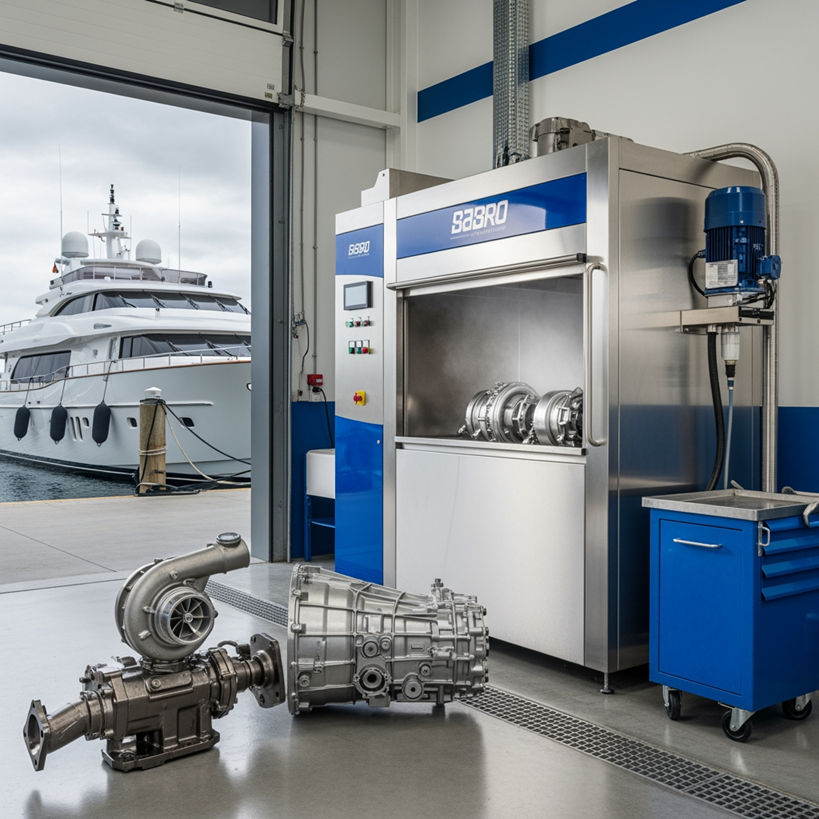
Superyacht owners and management companies operate in a world where perfection isn’t aspirational – it’s mandatory. When a vessel represents a $50 million to $500 million investment, component cleanliness becomes a non-negotiable element of operational excellence. Engine room components, deck machinery, and mechanical systems must meet presentation standards that rival the yacht’s guest areas, creating unique challenges for maintenance crews working with industrial equipment in luxury environments.
The disconnect between traditional industrial cleaning methods and superyacht maintenance services requirements has forced maintenance facilities to rethink their approach. Workshop rags and manual scrubbing no longer satisfy the exacting standards of yacht captains and chief engineers who answer directly to owners expecting showroom-quality presentation across every system onboard. This gap between expectation and traditional capability has driven demand for professional superyacht maintenance services that deliver consistent, documentable results through Hotwash Australia industrial cleaning systems.
The Component Cleanliness Standard in Modern Superyacht Operations
Superyacht maintenance differs fundamentally from commercial maritime or industrial applications. A generator component removed for service must return to the engine room looking factory-new, not simply functional. Deck winch mechanisms require spotless presentation because owners and guests may observe maintenance operations. Even below-deck systems face scrutiny during owner inspections and pre-charter surveys.
Labour Cost Implications
Chief engineers managing 50-metre-plus vessels report spending 15-20% of maintenance labour hours on cleaning and presentation tasks that add no mechanical value but remain essential to operational standards. This labour allocation represents significant cost, particularly for vessels operating with crew budgets exceeding $3 million annually. The financial pressure to reduce non-technical labour hours whilst maintaining presentation standards has made cleaning efficiency a legitimate operational concern.
Marine Surveyor Documentation
Marine surveyors conducting condition assessments increasingly photograph engine room cleanliness as evidence of overall maintenance quality. A spotless engine room suggests meticulous attention to detail across all systems. Conversely, oil residue on components or staining on machinery raises questions about maintenance standards, potentially affecting insurance classifications and resale valuations. Component cleanliness has evolved from aesthetic preference to documentable evidence of maintenance competence.
Why Traditional Cleaning Methods Fail Superyacht Standards
Manual cleaning with degreasers and brushes produces inconsistent results dependent on individual technician effort and time availability. One technician might spend 45 minutes achieving spotless results on a gearbox housing, whilst another completes the same task in 15 minutes with visibly inferior outcomes. This variability creates quality control challenges for facilities servicing multiple vessels with different owner expectations.
Safety and Compliance Concerns
Solvent-based cleaning methods introduce workplace safety concerns that conflict with modern maritime industry standards. Confined space regulations, ventilation requirements, and chemical handling protocols add complexity to manual cleaning operations. The time required for proper safety procedures often exceeds the actual cleaning time, creating inefficiency that frustrates maintenance schedules and increases labour costs.
Complex Geometry Limitations
Manual methods also struggle with complex geometries common in marine components. Heat exchanger housings, turbocharger assemblies, and hydraulic valve blocks contain recesses and internal passages that resist brush cleaning. Incomplete cleaning leaves contaminants that compromise reassembly quality and create visual imperfections that fail yacht component cleaning standards. The physical limitations of manual access determine cleaning quality rather than technical standards.
Automated Parts Washing Technology for Marine Applications
Industrial spray washers designed for heavy-duty applications deliver the consistency and thoroughness that superyacht maintenance demands. Heavy-duty parts washers use heated detergent solutions and high-pressure spray patterns to remove marine grease, fuel residue, and oil contamination from complex components without manual scrubbing. The automated process eliminates technician variability, producing identical results regardless of operator experience or time constraints.
Marine-Specific Contamination Handling
The technology addresses marine-specific contamination challenges that distinguish superyacht maintenance services from general industrial cleaning. Marine diesel residue, saltwater corrosion products, and hydraulic fluid contamination require specific temperature and pressure combinations to achieve complete removal. Purpose-built systems maintain water temperature between 60-80°C and deliver spray pressure from 20-40 bar, creating mechanical and thermal cleaning action that penetrates component geometries manual methods cannot reach.
Process Control and Documentation
Cycle-based operation provides documentable process control that satisfies quality management requirements. A 15-minute wash cycle delivers consistent results measurable against defined standards, creating objective quality metrics that replace subjective assessment of manual cleaning efforts. This documentation capability supports ISO 9001 quality systems increasingly common in high-end marine service facilities and ensures yacht component cleaning standards are consistently met.
Stainless Steel Systems for Marine Service Environments
Marine maintenance facilities face corrosive conditions from saltwater exposure, humidity, and chemical cleaning agents. Equipment durability directly impacts operational reliability and long-term cost of ownership. Stainless steel parts washers provide corrosion resistance essential for coastal facilities where equipment exposure to salt air and moisture creates accelerated deterioration of mild steel construction.
Hygiene and Presentation Standards
Stainless steel construction also supports the hygiene standards that distinguish superyacht operations from commercial maritime maintenance. Facilities servicing luxury vessels maintain workshop presentation standards that reflect the quality expectations of their clientele. Equipment that resists staining, maintains appearance over years of use, and supports thorough cleaning aligns with the professional image these facilities must project.
Maintenance Labour Reduction
The material choice affects maintenance labour requirements over equipment lifespan. Stainless steel systems require minimal protective maintenance compared to powder-coated steel alternatives that need periodic refinishing to maintain appearance and corrosion protection. This reduction in equipment maintenance labour allows facilities to focus resources on revenue-generating service work rather than maintaining their own equipment.
Capacity Planning for Superyacht Component Dimensions
Component size variation in superyacht systems requires careful capacity planning when selecting parts washing equipment. A 40-metre sailing yacht’s deck winch components differ substantially from an 80-metre motor yacht’s stabiliser assemblies. Facilities servicing multiple vessel sizes need washing capacity that accommodates their largest typical components without oversizing equipment for average workload.
Chamber Dimension Requirements
Chamber dimensions determine component compatibility more than weight capacity in marine applications. A gearbox housing measuring 800mm x 600mm x 400mm requires specific internal dimensions regardless of its 45kg weight. Facilities should evaluate their component inventory by dimensional envelope rather than weight alone, identifying the 95th percentile component size that represents their practical capacity requirement.
Extra Heavy-Duty System Capabilities
Extra heavy-duty parts washers provide the chamber volume and structural capacity required for large yacht components whilst maintaining the cleaning performance necessary for yacht component cleaning standards. Systems with 1200mm x 1000mm x 800mm chambers accommodate main engine turbocharger assemblies, generator end covers, and deck machinery components common in 50-80 metre vessels. This capacity range covers the majority of components requiring automated cleaning in superyacht maintenance operations.
Integration with Workshop Workflow and Turnaround Schedules
Superyacht maintenance services operate under compressed timelines where every hour of vessel unavailability represents lost charter revenue or owner usage. A washing process that requires four hours of manual labour becomes a 15-minute automated cycle, fundamentally changing maintenance scheduling possibilities. This time compression allows same-day component turnaround for routine maintenance items, reducing parts inventory requirements and vessel downtime.
Labour Allocation Optimisation
The workflow impact extends beyond individual component cleaning time. Automated washing eliminates the bottleneck created when skilled technicians perform cleaning tasks that don’t utilise their technical expertise. A $45/hour marine technician focused on mechanical work whilst a $28/hour wash system operator handles component cleaning represents better labour allocation and cost efficiency. This specialisation allows facilities to optimise workforce deployment during peak refit periods.
Workshop Layout Considerations
Equipment placement within workshop layout affects operational efficiency. Positioning parts washers near disassembly and reassembly work areas minimises component transport time and handling. Facilities with multiple workshop zones often install dedicated washing capacity in engine shop and deck machinery areas rather than centralising cleaning operations. This distributed approach reduces component movement and supports parallel workflow when multiple projects run simultaneously.
ROI Analysis for Marine Service Facilities
Capital equipment investment requires justification based on measurable operational improvement. A heavy-duty spray washer system represents $15,000-$35,000 capital expenditure depending on capacity and features. Facilities servicing 8-12 superyachts annually can justify this investment through labour savings alone, without considering quality improvement benefits.
Detailed Cost Comparison
Consider a 50-metre motor yacht annual maintenance schedule requiring cleaning of 40 major components throughout the service period. Manual cleaning averages 35 minutes per component including setup, cleaning, and disposal of contaminated materials. This represents 23.3 technician hours at $45/hour labour cost, totalling $1,050 in cleaning labour per vessel. Automated washing reduces this to 4.5 operator hours at $28/hour, creating $924 labour savings per vessel or $11,088 annually across 12 vessels.
Secondary Benefits Beyond Labour
The calculation excludes several additional benefits that strengthen the business case. Improved component cleanliness reduces reassembly contamination that causes premature seal failure and bearing wear. Faster turnaround times improve schedule flexibility and customer satisfaction. Enhanced workshop presentation supports premium pricing positioning. These secondary benefits often exceed the direct labour savings in total value delivered.
Operational Considerations for Marine Applications
Water quality affects both cleaning performance and equipment longevity in marine environments. Coastal facilities often face hard water conditions that create scale buildup in heating elements and spray systems. Water treatment through softening or filtration protects equipment investment and maintains consistent cleaning results. The operational cost of water treatment remains substantially lower than the maintenance cost of operating equipment in untreated hard water conditions.
Marine-Specific Detergent Requirements
Detergent selection requires marine-specific formulations that address saltwater contamination and marine grease chemistry. Standard industrial degreasers may not effectively remove marine diesel residue or hydraulic fluid contamination common in yacht systems. Purpose-formulated marine detergents provide superior cleaning performance and often reduce required wash time, improving throughput and energy efficiency.
Wastewater Management Compliance
Wastewater management must address environmental regulations governing marine service facilities. Many coastal jurisdictions prohibit discharge of wash water containing petroleum products without treatment. Facilities require oil-water separation systems and periodic waste disposal services. These operational requirements should factor into total cost of ownership calculations when evaluating parts washing equipment.
Training Requirements and Operator Competency
Automated parts washing systems require minimal operator training compared to manual cleaning methods, but marine applications benefit from specific operational protocols. Operators should understand component loading orientation to maximise spray coverage, detergent concentration requirements for different contamination types, and cycle time adjustment based on cleaning difficulty. This knowledge base develops through structured training rather than trial-and-error experience.
Documentation and Verification
Facilities servicing high-value vessels should document operator training and establish competency verification procedures. This documentation demonstrates quality system compliance and provides evidence of process control during customer audits or insurance surveys. Training records become particularly valuable when facilities pursue ISO certification or other quality management standards increasingly expected by superyacht management companies.
Cross-Training for Continuity
Cross-training multiple staff members ensures operational continuity during personnel changes or peak workload periods. Dependence on a single trained operator creates vulnerability when that person is unavailable. Facilities should maintain at least three qualified operators who can execute washing procedures to documented standards, providing operational flexibility and reducing single-point-of-failure risk.
Maintaining Competitive Advantage Through Process Excellence
The superyacht service market rewards facilities that deliver consistent, documentable quality whilst managing operational costs. Automated parts washing provides both competitive differentiation and cost control, creating sustainable advantage rather than temporary marketing positioning. Facilities that invest in process capability can justify premium pricing through demonstrated quality systems and faster turnaround times.
Marketing Content Development
Component cleanliness photographs provide powerful marketing content that demonstrates capability to prospective clients. Before-and-after images of heavily contaminated components restored to factory-new appearance communicate technical competence more effectively than written claims. These visual demonstrations support business development efforts and help facilities compete for contracts with management companies overseeing multiple vessels.
Facility Capability Signalling
The investment in professional cleaning capability signals commitment to operational excellence that resonates with superyacht captains and chief engineers. These decision-makers evaluate service providers based on facility capability, process consistency, and attention to detail. Purpose-built parts washing equipment demonstrates that a facility takes component presentation seriously and has invested in systems to deliver consistent results meeting yacht component cleaning standards.
Conclusion: Achieving Superyacht Presentation Standards
Superyacht maintenance standards demand component cleanliness that matches the vessel’s luxury positioning, creating operational requirements that exceed traditional industrial cleaning capabilities. Manual methods produce inconsistent results, consume excessive skilled labour hours, and introduce workplace safety concerns that conflict with modern maritime standards. The financial and quality control pressures facing marine service facilities make automated parts washing technology an operational necessity rather than optional enhancement.
Hotwash manufactures parts washing systems engineered for the demanding requirements of marine applications, with stainless steel construction that resists corrosive coastal environments and capacity options that accommodate component sizes common in superyacht maintenance services. Australian-built systems deliver the reliability and performance necessary for facilities where equipment downtime directly impacts customer commitments and revenue.
Marine service facilities evaluating parts washing equipment should consider component size range, facility layout integration, and total cost of ownership including water treatment and waste management requirements. The investment delivers measurable labour savings, improved quality consistency, and competitive differentiation in a market segment where process excellence determines long-term success. To discuss specific capacity requirements and system configurations for superyacht maintenance applications, contact us for technical consultation and equipment recommendations.

Leave A Comment