
Maritime and industrial operations share a common vulnerability – the bilge pump. When these critical systems fail, the consequences cascade from minor operational disruptions to complete vessel loss or facility flooding. Yet most failures stem from preventable contamination buildup, not mechanical defects.
The bilge compartment collects everything gravity pulls downward: oil residue, metal shavings, dirt, organic matter, and chemical runoff. This toxic mixture settles directly onto pump components, creating a maintenance challenge that demands proactive intervention. Without systematic bilge pump cleaning procedures, operators face equipment failures at the worst possible moments – during storms, peak production periods, or when emergency pumping capacity becomes critical.
Hotwash Australia has documented failure patterns across mining operations, marine facilities, and industrial plants where bilge pump maintenance protocols determine the difference between routine operations and emergency shutdowns. The data consistently shows that contamination-related failures outnumber mechanical wear issues by a ratio exceeding 4:1.
The True Cost of Bilge Pump Failures
Bilge pump failures generate costs far beyond replacement parts. A mining operation in Western Australia experienced this firsthand when accumulated sludge blocked their primary dewatering pump during seasonal flooding. The 18-hour downtime cost $340,000 in lost production, emergency contractor fees, and expedited parts shipping.
Marine vessels face even higher stakes. When bilge pumps fail at sea, water accumulation threatens stability and cargo integrity. The Australian Maritime Safety Authority reports that bilge system failures contribute to 23% of vessel stability incidents requiring Coast Guard intervention. Each incident involves rescue coordination costs, potential cargo loss, environmental remediation, and reputational damage to operators.
Industrial facilities processing liquids face similar risks. Food processing plants, chemical manufacturers, and automotive workshops rely on bilge pumps to manage floor drainage and prevent flooding. A blocked pump during a weekend shutdown can flood production areas, damage electrical systems, and contaminate product inventory. One Queensland food processor lost $180,000 worth of product when their bilge pump failed overnight, allowing cleaning solution runoff to flood refrigerated storage areas.
The pattern repeats across industries: contamination builds gradually until it reaches a critical threshold, then failure occurs suddenly and completely. Implementing proper bilge pump maintenance breaks this pattern by removing contaminants before they compromise pump function.
How Contamination Destroys Bilge Pumps
Bilge pumps operate in hostile environments where multiple contaminant types attack different system components simultaneously. Understanding these failure mechanisms explains why cleaning frequency matters more than pump quality.
Oil and Grease Buildup
Petroleum products create sticky films that coat impellers, float switches, and check valves. This coating attracts particulate matter, forming a hardened sludge that restricts flow and jams moving parts. Oil contamination also degrades rubber seals and gaskets, causing secondary leaks that compound the original problem.
In mining operations, hydraulic fluid leaks mix with groundwater in bilge sumps. The resulting emulsion resists simple water flushing and requires heated cleaning solutions to break down effectively. Without proper hot tanks capable of dissolving these compounds, operators resort to manual scraping – a time-consuming process that rarely removes all residue.
Solid Particle Accumulation
Metal shavings, rust particles, dirt, and mineral deposits settle in bilge compartments and enter pump housings. These abrasive materials accelerate wear on impeller blades, shaft seals, and bearing surfaces. A pump designed for 5,000 operating hours can fail after 1,200 hours when processing contaminated bilge water containing abrasive particles.
The problem intensifies in marine environments where salt crystallisation adds another layer of damage. Salt crystals bind with organic matter and metal oxides, creating concrete-like deposits that completely block intake screens and impeller passages. Coastal mining operations face both challenges – saltwater intrusion combined with industrial contamination.
Biological Growth
Stagnant bilge water supports bacterial growth, algae formation, and biofilm development. These organic materials create slime layers that block sensors, clog filters, and generate corrosive acids as metabolic byproducts. Biofilms also trap other contaminants, accelerating the formation of composite sludges that resist mechanical cleaning.
Food processing facilities face particular challenges with biological contamination. Organic matter from production processes provides nutrients for rapid microbial growth. Without weekly bilge pump cleaning procedures, biofilms establish within 72 hours and become increasingly difficult to remove as they mature.
Establishing Effective Cleaning Schedules
Bilge pump maintenance frequency depends on operational intensity, contaminant types, and environmental conditions. Generic manufacturer recommendations rarely account for real-world contamination rates, leading to either excessive maintenance costs or inadequate protection.
High-Intensity Operations (Weekly Cleaning)
Mining sites, marine vessels in active service, and manufacturing facilities with continuous liquid processing require weekly bilge pump inspection and cleaning. These environments generate constant contamination that rapidly accumulates in bilge systems. Weekly protocols prevent buildup from reaching critical levels while identifying emerging issues before they cause failures.
Hotwash Australia equipment enables weekly cleaning without excessive labour investment. Automated spray washers complete bilge pump component cleaning in 15-20 minutes, making frequent maintenance economically viable. This contrasts sharply with manual cleaning methods that require 2-3 hours per pump, creating pressure to extend intervals beyond safe limits.
Moderate-Intensity Operations (Fortnightly Cleaning)
Workshops, smaller marine vessels, and industrial facilities with intermittent production benefit from fortnightly cleaning schedules. These operations generate contamination at slower rates, allowing slightly extended intervals without excessive risk.
However, fortnightly schedules require stricter monitoring protocols. Operators must inspect bilge compartments between cleaning cycles to verify contamination remains below critical thresholds. Visual inspection takes 10 minutes but prevents the costly assumption that conditions remain stable between maintenance events.
Light-Duty Applications (Monthly Cleaning)
Standby systems, emergency backup pumps, and low-volume applications can operate safely with monthly cleaning schedules. These pumps handle minimal flow volumes and encounter limited contamination under normal conditions.
Monthly maintenance must include functional testing, not just cleaning. Pumps that sit idle for extended periods develop different failure modes – seized bearings, dried seals, and corrosion – that cleaning alone cannot address. Testing protocols should simulate actual operating conditions to verify system readiness.
Cleaning Methods That Actually Work
Effective bilge pump maintenance requires removing all contaminant types without damaging pump components. Different cleaning approaches deliver vastly different results, with labour requirements and effectiveness varying dramatically across methods.
Manual Cleaning Limitations
Manual cleaning using brushes, scrapers, and solvent wipes represents the traditional approach to bilge pump cleaning procedures. This method works for surface contamination but fails to remove hardened deposits from internal passages, impeller recesses, and threaded connections.
Manual cleaning also exposes workers to contaminated materials and harsh chemical solvents. Prolonged exposure to petroleum products, heavy metals, and industrial chemicals creates health risks that Australian workplace safety regulations increasingly restrict. The time investment – typically 2-3 hours per pump – makes frequent cleaning economically prohibitive for operations managing multiple bilge systems.
High-Pressure Spray Washing
Industrial spray washers deliver heated water and detergent solutions at pressures sufficient to remove hardened deposits without manual scrubbing. This approach reduces cleaning time by 75% while improving contamination removal effectiveness.
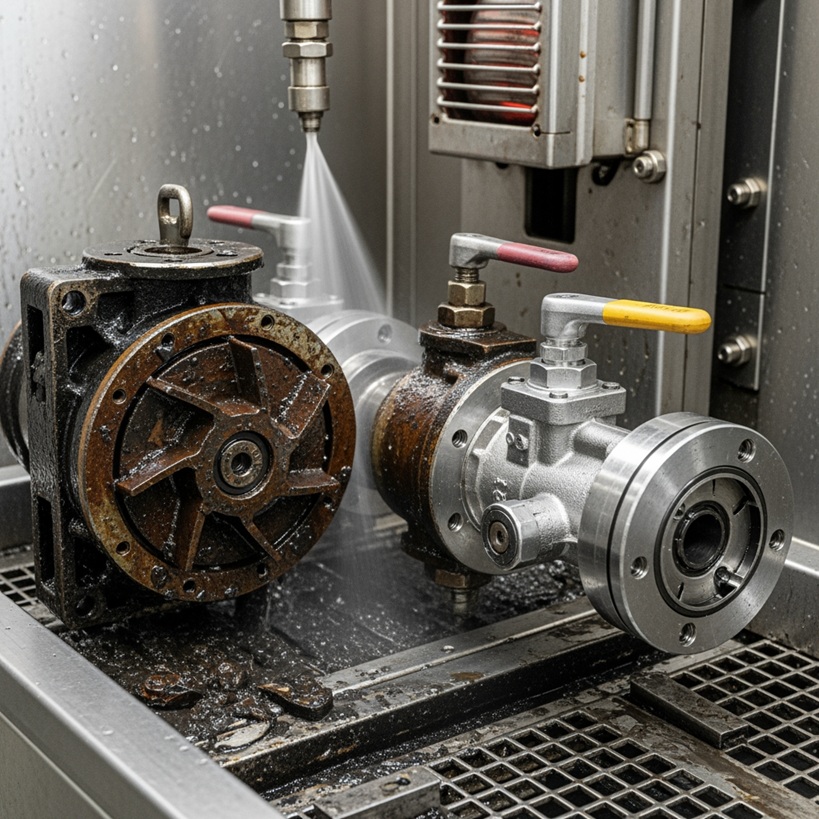
Heavy duty parts washers designed for mining and industrial applications handle bilge pump components ranging from small float switches to large impeller assemblies. Rotating spray arms ensure complete coverage of complex geometries, reaching internal passages that manual methods cannot access effectively.
Temperature control proves critical for dissolving petroleum-based contaminants. Water heated to 60-80°C breaks down oil and grease films that remain intact at ambient temperatures. Combined with appropriate detergents, heated spray washing removes 95-98% of contaminants in a single cycle, compared to 60-70% removal rates for manual cleaning.
Immersion Cleaning for Severe Contamination
Heavily contaminated components benefit from immersion cleaning in heated tanks. This method allows extended contact time between cleaning solutions and stubborn deposits, dissolving materials that resist spray washing.
Hot tank immersion works particularly well for components with complex internal passages where spray penetration proves difficult. Impellers with multiple vanes, valve bodies with internal channels, and housings with threaded connections achieve superior cleanliness through soaking protocols that allow cleaning solutions to penetrate completely.
The combination approach – immersion followed by spray rinsing – delivers optimal results for quarterly deep cleaning cycles that supplement regular spray washing maintenance.
Preventing Contamination at the Source
While regular cleaning removes accumulated contaminants, source control strategies reduce contamination rates and extend intervals between intensive maintenance cycles. Operations that implement both approaches achieve the most reliable bilge pump performance.
Filtration and Screening
Installing coarse screens at bilge collection points prevents large debris from entering pump systems. These screens require regular cleaning but protect pumps from the most damaging solid materials. Marine operations benefit from dual-stage screening that removes progressively finer particles before water reaches pump intakes.
Mining operations face challenges with fine particulates that pass through standard screens. These applications require settling tanks that allow suspended solids to precipitate before water enters pumping systems. While settling tanks add complexity, they dramatically reduce abrasive wear on pump components.
Oil-Water Separation
Separating petroleum products from bilge water before pumping reduces coating formation on internal components. Simple gravity separators work for light oils, while coalescing filters handle emulsified petroleum products more effectively.
Food processing facilities benefit from grease traps that remove organic oils before they enter bilge systems. These traps require regular cleaning but prevent the sticky accumulations that cause most pump failures in food industry applications.
Leak Prevention Programs
Reducing contamination at the source delivers better results than managing contamination after it occurs. Hydraulic system maintenance that prevents fluid leaks, proper chemical storage that eliminates spills, and equipment washing protocols that contain runoff all reduce bilge pump contamination rates.
Mining operations implementing comprehensive leak prevention programs report 40-60% reductions in bilge contamination levels. This translates directly to extended pump service life and reduced maintenance frequency. The investment in leak prevention typically pays for itself within 18 months through reduced pump replacement costs alone.
Integrating Cleaning into Maintenance Systems
Isolated cleaning efforts deliver limited results compared to systematic maintenance programs that integrate bilge pump care into broader equipment management protocols. Operations achieving the highest reliability rates treat bilge pump maintenance as a critical system, not an afterthought.
Scheduled Maintenance Integration
Aligning bilge pump cleaning with other scheduled maintenance activities improves compliance and reduces labour costs. When maintenance teams service primary equipment, they simultaneously clean associated bilge pumps using industrial parts washers positioned in maintenance facilities.
This integration ensures cleaning occurs consistently rather than being deferred when operations become busy. Mining operations report 85% improvement in maintenance schedule compliance when bilge pump cleaning coincides with equipment servicing rather than being scheduled independently.
Condition Monitoring
Visual inspection protocols identify contamination trends before they cause failures. Weekly inspections documenting contamination levels, unusual deposits, or accelerated buildup rates trigger early intervention that prevents emergency situations.
Advanced operations implement sensor-based monitoring that tracks pump performance parameters – flow rates, power consumption, vibration levels – that indicate developing contamination issues. When sensors detect performance degradation, maintenance teams clean pumps before failures occur. This predictive approach reduces unplanned downtime by 70% compared to reactive maintenance strategies.
Documentation and Analysis
Recording cleaning activities, contamination observations, and failure incidents creates data sets that reveal patterns and optimise maintenance schedules. Operations that analyse this data adjust cleaning frequencies based on actual contamination rates rather than generic recommendations.
Documentation also supports root cause analysis when failures occur. Understanding whether failures result from inadequate cleaning frequency, ineffective cleaning methods, or excessive contamination generation guides corrective actions that prevent recurrence.
Equipment Selection for Effective Bilge Pump Cleaning
The industrial cleaning equipment used for bilge pump maintenance directly impacts labour requirements, cleaning effectiveness, and long-term maintenance costs. Operations managing multiple bilge systems benefit significantly from purpose-built industrial cleaning equipment rather than improvised solutions.
Capacity Considerations
Bilge pump components range from small sensors and switches to large impeller assemblies and valve bodies. Cleaning equipment must accommodate this size range while delivering effective results across all component types. Extra heavy duty parts washers with chamber dimensions exceeding 1000mm handle complete pump assemblies, eliminating the need to disassemble units into smaller pieces for cleaning.
Larger chamber sizes also improve workflow efficiency by allowing batch processing. Maintenance teams can clean multiple small components simultaneously rather than processing items individually. This batch approach reduces total cleaning time and improves labour productivity.
Temperature and Pressure Requirements
Petroleum contamination common in bilge systems requires elevated temperatures for effective removal. Cleaning equipment must maintain water temperatures between 60-80°C throughout complete cleaning cycles. Systems with insufficient heating capacity or poor insulation lose temperature during operation, compromising cleaning effectiveness.
Pressure requirements vary based on contamination severity. Light deposits respond to 500-800 PSI spray pressure, while hardened accumulations require 1000-1500 PSI for complete removal. Variable pressure controls allow operators to match cleaning intensity to contamination levels, preventing damage to delicate components while effectively cleaning heavily soiled items.
Australian Manufacturing Standards
Equipment built to Australian standards ensures compliance with workplace safety regulations and electrical codes applicable to industrial facilities. Locally manufactured systems also provide faster parts availability and service support compared to imported alternatives.
Australian-built cleaning systems account for harsh operating conditions common in mining and industrial environments. Robust construction, corrosion-resistant materials, and heavy-duty components deliver reliable performance in demanding applications where equipment failures create operational disruptions.
The Business Case for Systematic Bilge Pump Maintenance
Calculating the return on investment for systematic bilge pump maintenance requires comparing total program costs against failure-related expenses. Operations that complete this analysis consistently find that proactive maintenance delivers substantial financial benefits beyond reliability improvements.
Direct Cost Savings
Prevented failures eliminate emergency repair costs, expedited parts shipping, and contractor call-out fees. A single emergency bilge pump failure typically costs $8,000-$15,000 when accounting for after-hours labour, expedited parts, and lost production. Preventing three failures annually through systematic cleaning justifies significant maintenance investment.
Extended pump service life provides additional savings. Pumps operating in clean conditions achieve 3-5 times longer service life compared to units handling contaminated fluids. A $4,000 pump lasting 15 years rather than 4 years delivers $8,000 in avoided replacement costs over its extended service life.
Operational Continuity Value
Unplanned downtime costs vary dramatically across industries but consistently exceed direct repair expenses. Mining operations lose $15,000-$40,000 per hour during production stoppages. Marine vessels face port delays, cargo delivery penalties, and schedule disruptions. Manufacturing facilities miss production targets and disappoint customers.
Systematic maintenance that prevents unplanned failures protects operational continuity. The value of prevented downtime typically exceeds maintenance program costs by ratios of 10:1 or higher in capital-intensive industries.
Labour Efficiency Improvements
Automated cleaning equipment reduces labour requirements by 70-80% compared to manual methods. A maintenance technician earning $45/hour who previously spent 3 hours manually cleaning a bilge pump now completes the task in 20 minutes using spray washing equipment. This labour saving compounds across multiple pumps and frequent cleaning cycles.
Freed labour capacity allows maintenance teams to address additional priorities rather than spending excessive time on manual cleaning tasks. Operations report that labour efficiency improvements alone justify cleaning equipment investments within 18-24 months.
Conclusion
Bilge pump failures result primarily from contamination accumulation, not mechanical defects. Operations that implement systematic bilge pump cleaning procedures prevent 85% of failures while extending equipment service life by 300-400%. The business case for proactive maintenance proves compelling across industries – prevented failures, extended equipment life, and labour efficiency improvements deliver returns exceeding 10:1 in most applications.
Effective programs combine appropriate cleaning frequency, proven cleaning methods, and purpose-built equipment. Weekly to monthly cleaning schedules matched to operational intensity prevent contamination from reaching critical levels. High-pressure spray washing removes deposits that manual methods cannot address effectively while reducing labour requirements by 75%. Industrial-grade cleaning equipment handles component size ranges and contamination severity levels encountered in real-world applications.
Australian operations benefit from locally manufactured cleaning systems built to withstand harsh industrial conditions while meeting workplace safety and electrical standards. The combination of proven technology, appropriate maintenance frequency, and robust equipment delivers reliable bilge pump performance that protects operational continuity.
Hotwash Australia manufactures industrial cleaning equipment specifically designed for contaminated component maintenance across mining, marine, and manufacturing applications. The systems handle bilge pump maintenance requirements while supporting broader maintenance programs for contaminated equipment. Contact us to discuss bilge pump maintenance challenges and explore cleaning solutions appropriate for specific operational requirements.

Leave A Comment