
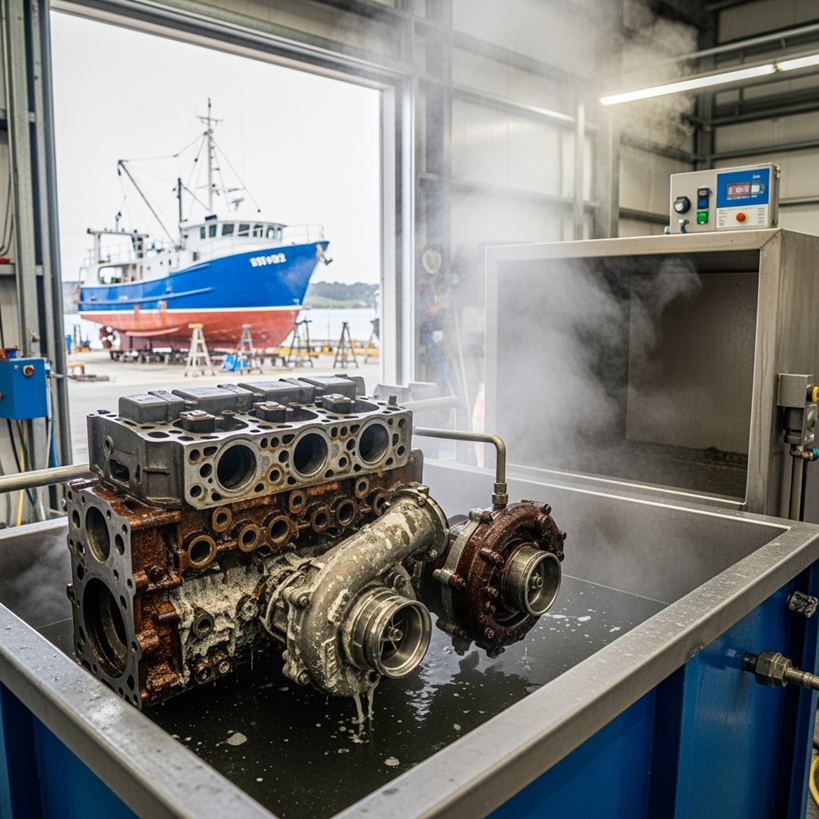
Marine engine components face relentless assault from saltwater exposure. Every hour of operation introduces chlorides, sulfates, and dissolved minerals that accelerate corrosion, reduce efficiency, and threaten catastrophic failure. For commercial marine operators, fishing fleets, and offshore service vessels, the cost of saltwater damage extends beyond replacement parts – corroded components cause unexpected downtime, compromise safety systems, and reduce fuel efficiency by up to 15% as contaminated surfaces disrupt heat transfer and increase friction.
Traditional cleaning methods using manual scrubbing, pressure washers, and chemical soaking deliver inconsistent results. Manual processes leave residual salt deposits in crevices and cooling passages, while inadequate rinsing reintroduces corrosive compounds during the next operational cycle. Hotwash Australia manufactures automated cleaning systems designed for marine applications that eliminate these variables, delivering repeatable results that extend component life and maintain operational readiness.
Understanding Saltwater Corrosion Mechanisms
Saltwater creates multiple corrosion pathways that compromise marine engine integrity. Sodium chloride concentration in seawater averages 35,000 parts per million – sufficient to initiate electrochemical reactions on exposed metal surfaces within hours of exposure. When combined with dissolved oxygen and elevated operating temperatures, corrosion rates accelerate exponentially.
The Electrochemical Process
Saltwater corrosion prevention begins with understanding the mechanisms that cause degradation. Seawater acts as an electrolyte, facilitating electron transfer between anodic and cathodic sites on metal surfaces. This electrochemical reaction consumes base metal, creating oxide compounds that lack structural integrity. Temperature elevations during engine operation increase ion mobility, accelerating reaction rates by 40-60% compared to ambient conditions.
Primary Corrosion Types in Marine Engines
Marine engine cleaning protocols must address multiple corrosion types simultaneously:
- Uniform corrosion – General surface degradation across exposed areas
- Pitting corrosion – Localised penetration creating deep cavities in metal surfaces
- Crevice corrosion – Accelerated attack in gasket surfaces, threaded connections, and tight clearances
- Galvanic corrosion – Electrochemical reaction between dissimilar metals in saltwater electrolyte
- Stress corrosion cracking – Combined mechanical stress and corrosive environment causing structural failure
Engine components particularly vulnerable include heat exchangers, cooling system passages, exhaust manifolds, turbocharger housings, fuel injection systems, and any aluminium alloy surfaces. Residual salt deposits remain active even after engines stop running – hygroscopic salt crystals absorb atmospheric moisture and continue corrosive activity during idle periods.
Critical Cleaning Intervals for Marine Components
Establishing appropriate cleaning frequencies prevents corrosion progression while optimising maintenance labour allocation. Cleaning intervals depend on operational intensity, water salinity levels, engine duty cycles, and component material composition.
Frequency Based on Operations
Commercial vessel recommendations include:
- Daily operations – Flush cooling systems with fresh water after each shift
- Weekly maintenance – External component cleaning for exhaust systems and exposed surfaces
- Monthly service – Detailed cleaning of heat exchangers and cooling passages
- Quarterly overhaul – Complete disassembly and cleaning of turbochargers, intercoolers, and fuel systems
- Annual inspection – Full system evaluation with ultrasonic cleaning for precision components
Vessels operating in tropical waters or areas with higher salinity concentrations require more frequent intervention. Operations in northern Australian waters, where temperatures exceed 30°C and salinity approaches 37,000 ppm, accelerate corrosion rates by 40% compared to temperate regions.
The Cost of Delayed Cleaning
Delayed marine engine cleaning allows salt deposits to crystallise and bond with metal surfaces. These hardened deposits resist removal and create surface irregularities that trap additional contaminants. Components cleaned within 24 hours of saltwater exposure show 70% less corrosion progression compared to those cleaned after 72 hours. Implementing systematic saltwater corrosion prevention measures reduces long-term maintenance costs and extends equipment service life significantly.
High-Temperature Cleaning Protocols
Thermal cleaning methods deliver superior results for marine engine components by dissolving salt deposits, emulsifying oil contamination, and activating cleaning chemistry. Water temperature directly impacts cleaning effectiveness – heated solutions reduce surface tension, increase chemical reactivity, and penetrate contaminated areas that cold water cannot reach.
Temperature-Based Performance Analysis
Hot blasters operating at 80-95°C provide optimal conditions for marine engine cleaning. This temperature range dissolves salt crystals without damaging seals, gaskets, or precision-machined surfaces. Automated spray systems deliver heated cleaning solution at controlled pressures between 800-1,200 PSI, removing deposits from cooling passages, combustion chambers, and intricate turbocharger geometries.
Temperature-based cleaning performance variations include:
- Cold water (15-25°C) – Removes loose surface contamination only, leaves crystallised salt deposits
- Warm water (40-60°C) – Partial salt dissolution, requires extended cycle times
- Hot water (80-95°C) – Complete salt dissolution, effective oil emulsification, optimal cleaning efficiency
- Steam (100°C+) – Maximum cleaning power for heavily contaminated components, requires specialised handling
Hot Tank Systems for Internal Passages
Components with internal passages benefit significantly from high-temperature immersion cleaning. Hot tank systems provide complete submersion in heated alkaline solutions that penetrate cooling jackets, oil galleries, and fuel passages. Soaking periods between 30-60 minutes dissolve accumulated deposits without mechanical scrubbing that risks surface damage.
Chemical Selection for Marine Applications
Cleaning chemistry must address multiple contamination types simultaneously – salt deposits, mineral scale, combustion residues, oil films, and biological growth. Alkaline cleaners with pH levels between 11-13 provide effective salt dissolution while emulsifying hydrocarbon contamination.
Essential Chemical Properties
Effective saltwater corrosion prevention chemicals require:
- High alkalinity – Neutralises acidic corrosion products and dissolves salt crystals
- Surfactant packages – Reduces surface tension for penetration into tight clearances
- Chelating agents – Binds calcium and magnesium ions preventing scale reformation
- Corrosion inhibitors – Protects cleaned surfaces during rinsing and drying phases
- Low-foaming formulation – Enables spray system operation without foam interference
Marine-specific cleaning compounds contain corrosion inhibitors that provide temporary surface protection during the critical period between cleaning and protective coating application. This protection window extends 24-48 hours, preventing flash rusting on freshly cleaned ferrous components.
Environmental Compliance Considerations
Biodegradable formulations meeting Australian environmental standards allow compliant disposal of spent cleaning solutions. Operators must verify chemical compatibility with local discharge regulations, particularly for facilities near sensitive marine environments or protected waterways.
Automated Spray System Advantages
Automated parts washing equipment transforms marine engine maintenance from labour-intensive manual processes to consistent, repeatable cleaning cycles. Heavy-duty parts washers designed for marine applications accommodate large components including complete cylinder heads, turbocharger assemblies, and heat exchanger bundles.
Performance Benefits Over Manual Methods
Rotating spray arms deliver cleaning solution to all component surfaces simultaneously, eliminating manual repositioning and ensuring complete coverage. Multi-stage wash cycles progress through cleaning, rinsing, and optional rust prevention coating application without operator intervention. Programmable controllers store specific cycles optimised for different component types, maintaining consistency across maintenance shifts.
Performance advantages include:
- Time reduction – Automated cycles complete in 15-30 minutes versus 2-3 hours manual cleaning
- Labour efficiency – Technicians load components and perform skilled work during cleaning cycles
- Consistency – Identical results every cycle regardless of operator experience
- Safety improvements – Eliminates chemical exposure and repetitive strain injuries from manual scrubbing
- Documentation – Cycle logging provides maintenance records for compliance verification
System Specifications and Capacity
Chamber capacities ranging from 400mm to 1,200mm accommodate components from small fuel injectors to complete engine blocks. Stainless steel parts washers provide superior corrosion resistance appropriate for marine maintenance environments where saltwater exposure and humid conditions accelerate equipment degradation.
Immersion Cleaning for Complex Geometries
Components with internal passages, blind holes, and intricate geometries require immersion cleaning to reach contaminated surfaces inaccessible to spray systems. Turbocharger housings, intercoolers, and oil coolers contain narrow passages where salt deposits accumulate and restrict flow.
Ultrasonic Enhancement
Heated immersion tanks maintain cleaning solution at consistent temperatures while providing complete component submersion. Ultrasonic agitation enhances cleaning effectiveness by generating microscopic cavitation bubbles that penetrate tight clearances and dislodge bonded deposits. Frequencies between 25-40 kHz provide optimal cleaning without damaging precision-machined surfaces.
Material-Specific Exposure Times
Immersion duration depends on contamination severity and component material. Aluminium components require shorter exposure times (20-30 minutes) to prevent etching, while cast iron and steel components tolerate extended soaking periods (45-60 minutes) for heavy deposit removal.
Multiple rinse stages following cleaning prevent chemical carryover that could compromise engine operation. Fresh water rinses remove alkaline cleaning residues, while final rinses using demineralised water prevent mineral deposits during drying. Heated air drying completes the process, eliminating moisture that could initiate corrosion.
Surface Preparation and Protective Coatings
Cleaned components require immediate surface protection to prevent corrosion during storage or reassembly periods. Marine environments maintain high humidity levels that accelerate oxidation on exposed metal surfaces – unprotected components show visible rust formation within 4-6 hours.
Post-Cleaning Protection Options
Effective saltwater corrosion prevention during storage requires:
- Water-displacing oils – Penetrates surface irregularities, providing temporary corrosion protection (2-4 weeks)
- Volatile corrosion inhibitors – Vapour-phase protection for enclosed components during storage
- Dry-film lubricants – Thin coating providing corrosion protection and assembly lubrication
- Sacrificial anodes – Electrochemical protection for stored components in high-humidity environments
Components requiring extended storage benefit from vacuum-sealed packaging with desiccant packs. This approach maintains low-humidity environments that prevent corrosion progression indefinitely.
Marine-Specific Coolant Requirements
Reassembled engines require fresh coolant formulated specifically for marine applications. Marine coolant contains elevated corrosion inhibitor concentrations addressing the unique challenges of saltwater-cooled systems. Standard automotive coolants lack sufficient protection for marine environments and contribute to accelerated corrosion.
Quality Verification and Inspection
Post-cleaning inspection confirms complete contaminant removal and identifies components requiring replacement. Visual inspection reveals surface pitting, stress cracks, and areas where corrosion has progressed beyond acceptable limits.
Inspection Criteria and Methods
Comprehensive inspection evaluates:
- Surface condition – Uniform appearance without residual deposits or discolouration
- Passage cleanliness – Clear flow paths through cooling passages and oil galleries verified with inspection cameras
- Dimensional accuracy – Critical surfaces measured confirming corrosion has not exceeded tolerance limits
- Material integrity – Dye penetrant or magnetic particle testing reveals stress cracks invisible to visual inspection
Components failing inspection require replacement rather than return to service. Attempting to reuse components with advanced corrosion introduces reliability risks that outweigh replacement costs – failed components during operation cause secondary damage and extended downtime.
Documentation and Compliance
Documentation of cleaning procedures and inspection results provides maintenance records supporting warranty claims and regulatory compliance. Commercial operators subject to maritime authority inspections benefit from comprehensive maintenance documentation demonstrating adherence to manufacturer specifications.
Operational Cost Analysis
Automated marine engine cleaning delivers measurable return on investment through reduced labour costs, extended component life, and improved operational reliability. Manual cleaning of a typical marine diesel cylinder head requires 3-4 technician hours at $75-95 per hour, totalling $225-380 per component. Automated systems complete identical cleaning in 25-35 minutes with 5 minutes technician time for loading and unloading.
Manual vs Automated Comparison
Annual cost comparison for 50 components:
- Manual cleaning – 150-200 labour hours, $11,250-19,000 annual cost
- Automated cleaning – 4-6 labour hours, $300-570 annual cost plus equipment operation
- Labour savings – $10,000-18,000 annually per maintenance facility
Equipment investment for industrial parts washers suitable for marine applications ranges from $15,000 to $45,000, depending on capacity and automation level. Facilities processing 40+ components monthly achieve payback periods under 18 months through labour reduction alone.
Extended Component Life Benefits
Extended component life provides additional savings that are difficult to quantify precisely but significant in aggregate. Heat exchangers cleaned properly every 500 operating hours maintain design efficiency for 8,000-10,000 hours versus 4,000-6,000 hours with inadequate maintenance. Replacement costs for marine heat exchangers range from $3,000 to 12,000, depending on engine size and configuration.
Integration with Preventive Maintenance Programs
Effective marine engine cleaning protocols integrate with comprehensive preventive maintenance schedules. Cleaning intervals align with oil change services, cooling system inspections, and scheduled component replacements to maximise technician efficiency and minimise vessel downtime.
Scheduling and Fleet Management
Maintenance management systems track component cleaning history, identifying units approaching service intervals and scheduling automated reminders. This approach prevents overdue maintenance that allows corrosion progression while avoiding excessive cleaning that wastes resources.
Fleet operators benefit from centralised maintenance facilities equipped with extra heavy-duty parts washers capable of processing components from multiple vessels. Centralisation enables investment in advanced cleaning equipment that individual vessel budgets cannot justify, while standardising procedures across the fleet.
Mobile Unit Capabilities
Mobile maintenance units serving remote operations require portable cleaning solutions. Smaller capacity systems with self-contained water heating and filtration provide effective cleaning capabilities for field service applications where components cannot be transported to central facilities.
Australian Standards and Environmental Compliance
Marine maintenance facilities operating across Australia must comply with environmental regulations governing wastewater discharge, chemical storage, and waste disposal. State-based Environmental Protection Authorities enforce standards limiting contaminant concentrations in discharged water.
Regulatory Requirements
Closed-loop cleaning systems with filtration and water recycling reduce fresh water consumption while concentrating contaminants for proper disposal. Oil-water separators remove hydrocarbon contamination before discharge, while pH adjustment systems neutralise alkaline cleaning solutions to acceptable discharge levels.
Chemical storage requires bunded containment areas, preventing environmental contamination from spills or leaks. Material Safety Data Sheets (MSDS) must be readily accessible for all cleaning chemicals, and staff require training in proper handling procedures.
Waste Management Protocols
Waste disposal for spent cleaning solutions and removed contaminants follows hazardous waste protocols. Licensed waste contractors transport materials to approved treatment facilities, providing documentation confirming compliant disposal.
Conclusion
Saltwater corrosion prevention represents the primary challenge for marine engine reliability and operational efficiency. Systematic marine engine cleaning protocols using high-temperature automated systems remove salt deposits, prevent corrosion progression, and extend component service life. Australian-manufactured industrial cleaning equipment provides the durability, capacity, and performance required for demanding marine maintenance applications.
Commercial operators implementing automated cleaning protocols reduce maintenance labour costs by 85% while improving cleaning consistency and component longevity. The combination of heated cleaning solutions, programmable wash cycles, and proper chemical selection delivers results unattainable through manual methods.
Facilities processing marine engine components benefit from equipment designed specifically for heavy contamination and large component sizes. Proper system selection based on component dimensions, cleaning volume, and contamination severity ensures optimal performance and rapid return on investment.
For assistance selecting appropriate marine engine cleaning systems or discussing specific application requirements, contact us to speak with industrial cleaning specialists. Australian-engineered solutions deliver proven performance in the harshest marine maintenance environments.

Leave A Comment