
A single particle smaller than a grain of salt can destroy an aircraft engine worth $15 million. In engine overhaul facilities, contamination isn’t just a quality issue – it’s a catastrophic risk that grounds fleets, triggers warranty claims, and ends careers. The difference between acceptable and unacceptable cleanliness is measured in microns, and the stakes couldn’t be higher.
Aircraft engine overhaul workshops operate under the most demanding cleaning standards in any industry. When a Pratt & Whitney turbofan returns for its 20,000-hour overhaul, every component must meet cleanliness specifications that exceed surgical instrument standards. Foreign object debris (FOD) smaller than 50 microns can score bearing surfaces, contaminate lubrication systems, and cause failures that put lives at risk. This is why aircraft engine overhaul cleaning systems represent the most sophisticated industrial parts washing technology available – because nothing less will pass aviation authority inspections.
The True Cost of Contamination in Engine Overhaul Operations
Engine overhaul facilities face financial exposure that dwarfs other industrial operations. When a freshly overhauled CFM56 engine fails due to contamination within its warranty period, the overhaul shop doesn’t just lose the $2-4 million overhaul fee – they absorb the airline’s operational losses, replacement engine costs, and regulatory investigation expenses. A 2019 incident at a European MRO facility resulted in $47 million in claims after inadequate cleaning procedures allowed silicate contamination into three overhauled engines.
The financial mathematics are brutal. A single failed inspection can ground an entire production line until root cause analysis identifies the contamination source. During this downtime, skilled technicians remain on payroll while engines accumulate storage costs and customers face delivery delays. One Australian defence contractor reported $1.2 million in losses from a four-day production halt triggered by contamination found during final inspection of a military turboprop engine.
Reputation Damage and Certification Risks
Beyond direct financial losses, contamination incidents destroy the reputation capital that engine overhaul facilities spend decades building. Original equipment manufacturers maintain approved overhaul facility lists, and removal from these lists effectively ends an MRO operation’s ability to work on those engine types. The path back to approval can take years and cost millions in process improvements, additional inspections, and lost business opportunities.
Regulatory Standards That Define Acceptable Cleanliness
Aviation regulatory authorities don’t suggest cleanliness standards – they mandate them with the force of law. The European Aviation Safety Agency (EASA) Part 145 and Civil Aviation Safety Authority (CASA) regulations require engine overhaul facilities to demonstrate documented cleaning procedures that achieve specified contamination limits. These aren’t general guidelines about “thorough cleaning” – they specify maximum particle counts per surface area, residual contamination weights measured in milligrams, and cleanliness verification methods.
Understanding SAE AS4059 Cleanliness Levels
The aerospace standard SAE AS4059 establishes cleanliness levels from A through K, with Level A representing ultra-clean specifications for critical engine components. A turbine blade destined for the hot section must achieve Level B cleanliness, meaning no more than 1 milligram of non-volatile residue per square metre and particle counts below 100 particles larger than 25 microns per square metre. Meeting these specifications requires more than aggressive scrubbing – it demands precision aircraft engine overhaul cleaning systems that remove contamination without introducing new particles.
OEM-Specific Requirements
Original equipment manufacturers layer additional requirements onto regulatory minimums. Rolls-Royce, General Electric, and Pratt & Whitney each publish engine-specific overhaul manuals that specify cleaning methods, approved cleaning solutions, water quality standards, and verification procedures. These manuals reference specific cleaning technologies and explicitly prohibit certain methods that might damage component surfaces or leave residues. Deviation from these procedures voids warranties and can trigger decertification.
The regulatory framework extends beyond initial cleaning to include contamination control throughout the overhaul process. Components must be cleaned, verified clean, and then protected from recontamination during storage, assembly, and testing. This requires controlled environments, proper handling procedures, and documentation systems that track each component’s cleanliness status from disassembly through final assembly.
Why Traditional Cleaning Methods Fail Aircraft Engine Standards
The cleaning approaches that work perfectly well in automotive workshops or manufacturing facilities fall catastrophically short of the engine cleaning standards aviation authorities mandate. Manual solvent wiping might remove visible contamination, but it leaves microscopic residues and introduces lint fibres that trigger inspection failures. One overhaul facility discovered that their manual cleaning process left an average of 47 textile fibres per component – each one a potential FOD hazard.
Cold Spray Washing System Limitations
Cold spray washing systems struggle with the baked-on carbon deposits, thermal barrier coatings, and metallurgical contamination found on turbine components. A turbine blade that’s operated at 1,200°C accumulates oxidation layers and combustion products that bond to the surface at the molecular level. Removing these deposits without damaging the blade’s protective coatings or dimensional tolerances requires cleaning power that cold water systems simply cannot deliver.
Ultrasonic Cleaning Challenges
Ultrasonic cleaning tanks offer improved performance over manual methods, but they introduce their own challenges. The cavitation process can damage thin sections, erode soft coatings, and leave components vulnerable to hydrogen embrittlement if cleaning chemistry isn’t precisely controlled. Several overhaul facilities have experienced blade cracking issues traced back to overly aggressive ultrasonic cleaning that created microscopic surface damage.
The fundamental problem with inadequate cleaning systems is that they force overhaul facilities into a quality versus throughput compromise. When cleaning systems can’t reliably achieve required cleanliness levels, technicians must perform multiple cleaning cycles, additional manual finishing, and repeated verification testing. This extends turnaround times, increases labour costs, and still produces inconsistent results that risk inspection failures.
Precision Cleaning Technology for Critical Engine Components
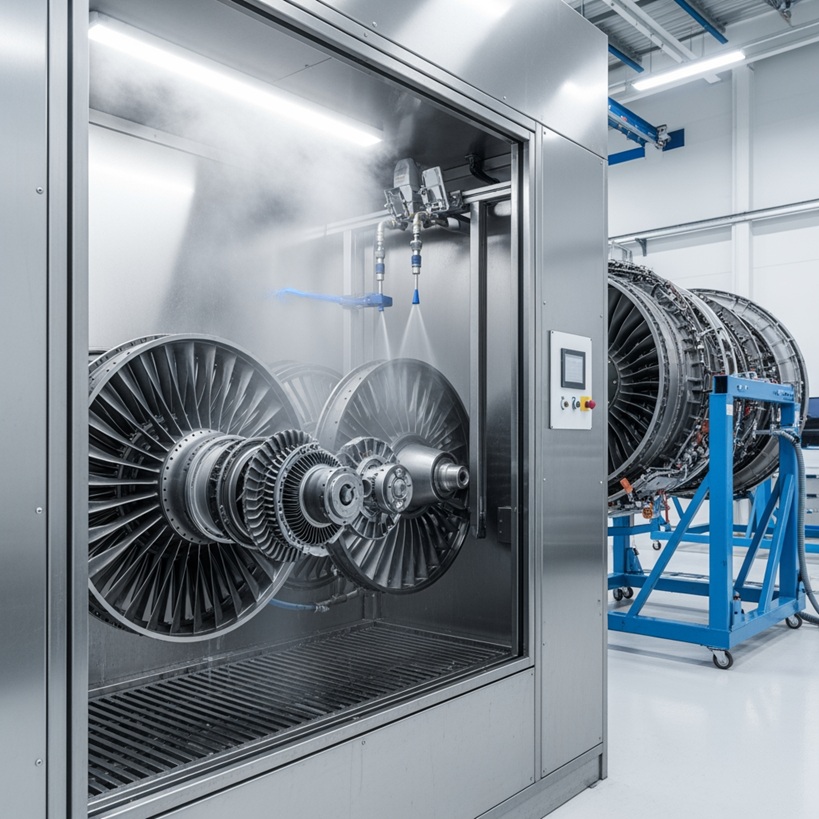
Modern aircraft engine overhaul cleaning systems combine high-temperature spray washing with precisely controlled chemistry and automated cycles that eliminate human variability. Super heavy duty parts washers designed for aerospace applications maintain water temperatures between 70-85°C while delivering cleaning solution at pressures up to 1,500 PSI to turbine blade surfaces. This combination provides the thermal energy to soften carbon deposits while the mechanical action removes contamination without damaging component surfaces.
Aviation-Approved Cleaning Chemistry
The cleaning chemistry used in aerospace parts washing differs fundamentally from general industrial degreasers. Aviation-approved cleaning solutions must remove hydrocarbon contamination, carbon deposits, and oxidation products while meeting strict specifications for residue levels, material compatibility, and environmental safety. Solutions like Turco 4215-NCLT and Brulin 815MX are specifically formulated to clean nickel alloys, titanium, and aluminium components without causing corrosion, hydrogen embrittlement, or surface damage.
Water Quality Requirements
Water quality represents another critical specification in engine cleaning standards aviation regulations mandate. The final rinse water must meet pharmaceutical-grade purity standards, typically requiring deionised water with conductivity below 10 microsiemens per centimetre and total dissolved solids under 5 parts per million. This prevents mineral deposits from forming on component surfaces during drying and eliminates the risk of corrosion from chlorides or other dissolved contaminants.
Automated Processing Systems
Extra heavy duty parts washers built for aerospace applications incorporate automated loading systems, programmable wash cycles, and integrated drying stages that process components from contaminated to inspection-ready without manual intervention. A complete cleaning cycle for turbine blades might include a high-temperature pre-wash stage, a precision cleaning stage with controlled solution concentration and temperature, multiple rinse stages with progressively purer water, and a final hot air drying stage that prevents water spotting.
Validation and Verification: Proving Cleanliness to Regulatory Standards
Achieving cleanliness standards means nothing without documented verification that proves compliance to auditors and inspectors. Aviation authorities require objective cleanliness verification using standardised testing methods that quantify contamination levels. The most common verification approach involves the solvent rinse test, where a component is rinsed with a measured volume of clean solvent, and the rinse solution is then filtered through a membrane with specified pore size. The membrane is dried, weighed, and examined under magnification to count and measure particles.
Non-Volatile Residue (NVR) Testing
Non-volatile residue (NVR) testing provides another critical verification method. A component’s surface is wiped with a clean solvent-soaked pad, the solvent is evaporated in a controlled environment, and the remaining residue is weighed to determine contamination levels. For critical engine components, acceptable NVR levels are typically below 1 milligram per square metre – a specification that requires laboratory-grade precision to verify.
Automated Particle Counting
Advanced overhaul facilities have invested in automated particle counting systems that analyse rinse solutions in real-time, providing immediate feedback on cleaning effectiveness. These systems use laser diffraction or optical microscopy to count and size particles, generating reports that document compliance with cleanliness specifications. This automation eliminates the subjectivity of manual inspection and creates permanent records for regulatory compliance.
System-Level Validation Studies
The verification process extends beyond individual components to include system-level validation. When an overhaul facility installs new industrial cleaning equipment, they must conduct validation studies that demonstrate consistent achievement of cleanliness specifications across multiple cleaning cycles and different component types. These studies typically involve cleaning 30-50 components, verifying cleanliness after each cycle, and statistically analysing results to prove process capability.
Integration With Quality Management Systems
Aircraft engine overhaul cleaning doesn’t exist in isolation – it’s one element within comprehensive quality management systems that govern every aspect of MRO operations. AS9110 certification, the aerospace standard for maintenance organisations, requires documented procedures, training records, and traceability systems that connect cleaning processes to individual components and specific engine serial numbers.
Modern overhaul facilities use enterprise resource planning systems that track each component through the cleaning process, recording which cleaning system was used, what cycle parameters were employed, who performed the cleaning, and what verification results were obtained. This data creates an auditable trail that proves regulatory compliance and enables root cause analysis if contamination issues arise later in the overhaul process.
Preventive Maintenance and Calibration Programs
The integration between cleaning systems and quality management extends to preventive maintenance and calibration programs. Hotwash Australia systems installed in aerospace facilities operate under documented maintenance schedules that verify temperature accuracy, pressure delivery, and cycle timing at specified intervals. These calibration records demonstrate that cleaning systems maintain their performance specifications over time, providing confidence that today’s cleaning results match the validated performance from initial qualification studies.
The Australian Advantage in Aerospace Cleaning Technology
Australian engineering has produced cleaning systems that meet the demanding requirements of aircraft engine overhaul facilities worldwide. Local manufacturers understand the unique challenges of operating in compliance with CASA regulations while meeting the specifications of international engine manufacturers. This combination of regulatory knowledge and engineering capability has positioned Australian-made cleaning systems as preferred solutions in aerospace MRO facilities across the Asia-Pacific region.
Durability for Continuous Operations
The durability and reliability required for aerospace applications align perfectly with Australian manufacturing standards. Stainless steel parts washers built for aircraft engine overhaul must operate continuously for years without performance degradation, maintaining precise temperature control, consistent pressure delivery, and reliable cycle automation. Australian stainless steel construction and robust component selection ensure these systems meet the reliability standards that aerospace operations demand.
Local Support Availability
Local support and service availability provide critical advantages for Australian aerospace facilities. When a cleaning system experiences downtime in an engine overhaul operation, every hour of delay represents thousands of dollars in lost productivity and potential delivery penalties. Access to local technical support, spare parts availability, and service technicians who understand both the equipment and the aerospace quality requirements minimises downtime and maintains production schedules.
Building a Contamination Control Culture
Technology alone doesn’t prevent contamination – it requires a facility-wide culture that recognises cleanliness as a critical safety and quality parameter. Leading engine overhaul facilities implement contamination control programs that extend from receiving inspection through final engine testing. These programs establish clean rooms for critical assembly operations, implement gowning requirements for technicians working on cleaned components, and create material flow systems that separate clean and contaminated work areas.
Training and Awareness Programs
Training programs ensure every technician understands how their actions affect component cleanliness. A mechanic who sets a freshly cleaned turbine blade on an unprotected workbench has just recontaminated a component that represents hours of precision cleaning work. Effective training programs use real contamination incidents, failure analysis reports, and cost data to demonstrate why contamination control procedures matter.
Visual Management Systems
Visual management systems help maintain contamination awareness throughout the facility. Colour-coded component covers distinguish cleaned parts from those awaiting cleaning, floor markings delineate clean zones, and prominently displayed cleanliness verification results remind teams of quality expectations. These visual cues create constant reinforcement of contamination control principles aligned with engine cleaning standards aviation regulations require.
Return on Investment: The Business Case for Precision Cleaning
The capital investment required for aerospace-grade cleaning systems generates returns that extend far beyond avoided contamination incidents. Automated cleaning systems reduce the labour hours required per engine overhaul, freeing skilled technicians for higher-value assembly and inspection tasks. One facility calculated that upgrading to automated precision cleaning reduced their labour cost per engine by $8,400 while simultaneously improving cleanliness verification pass rates from 87% to 99.2%.
Throughput Improvements
The throughput improvements from reliable cleaning processes directly impact facility capacity. When cleaning systems consistently achieve required cleanliness levels on the first cycle, components move through the overhaul process without rework delays or repeated verification testing. This predictable flow enables better production scheduling, reduces work-in-process inventory, and allows facilities to accept additional overhaul contracts without expanding floor space.
Warranty Claim Reduction
Warranty claim reductions provide another measurable return on investment. Facilities that implement precision cleaning systems and robust contamination control programs experience dramatic decreases in post-overhaul failures attributed to contamination. The avoided costs of warranty engine removals, failure investigations, and reputation damage typically justify cleaning system investments within the first 12-18 months of operation.
Preparing for Future Regulatory Evolution
Aviation regulatory requirements continue to evolve toward more stringent contamination control standards. Next-generation engine designs with tighter tolerances, advanced materials, and higher operating temperatures demand even more rigorous cleanliness specifications. Overhaul facilities that invest in cutting-edge hot tank cleaning technology today position themselves to meet tomorrow’s requirements without major capital expenditures or facility modifications.
Digital Documentation Requirements
The trend toward increased documentation and traceability requirements favours automated cleaning systems with integrated data collection capabilities. Future regulations will likely mandate digital records that connect specific cleaning cycles to individual component serial numbers, with statistical process control data that proves consistent performance over time. Facilities using manual cleaning methods will struggle to generate this documentation, while those operating modern automated systems will adapt easily to new requirements.
Environmental Compliance Advantages
Environmental regulations are also driving changes in aerospace cleaning technology. Traditional solvent-based cleaning methods face increasing restrictions due to volatile organic compound emissions and hazardous waste generation. Water-based precision aircraft engine overhaul cleaning systems offer environmental compliance advantages while meeting the same cleanliness specifications, providing a sustainable path forward as regulations tighten.
Conclusion
Aircraft engine overhaul cleaning represents the pinnacle of industrial parts washing technology, where microscopic contamination creates million-dollar consequences and regulatory requirements demand documented perfection. The cleaning standards that govern aerospace MRO operations aren’t arbitrary quality preferences – they’re engineering requirements based on decades of failure analysis and safety investigations. Meeting these standards requires precision cleaning systems, validated processes, and contamination control cultures that eliminate variability and prove compliance through objective verification.
The financial stakes in engine overhaul operations justify significant investment in cleaning technology that reliably achieves aerospace cleanliness specifications. Facilities that operate with inadequate cleaning systems face constant risk of contamination incidents that trigger warranty claims, production shutdowns, and regulatory sanctions. In contrast, operations built around precision cleaning technology and robust quality systems process engines efficiently while maintaining the zero-defect performance that aviation safety demands.
Australian engine overhaul facilities benefit from locally engineered cleaning systems that combine aerospace-grade performance with the durability and reliability required for continuous production operations. These systems deliver the cleaning power, process control, and documentation capabilities that satisfy both regulatory requirements and original equipment manufacturer specifications. For operations where contamination prevention is measured in lives and millions of dollars, precision cleaning technology isn’t an optional upgrade – it’s the foundation of sustainable business success. To discuss cleaning system specifications for aircraft engine overhaul operations, contact Hotwash for technical consultation and system recommendations.

Leave A Comment