
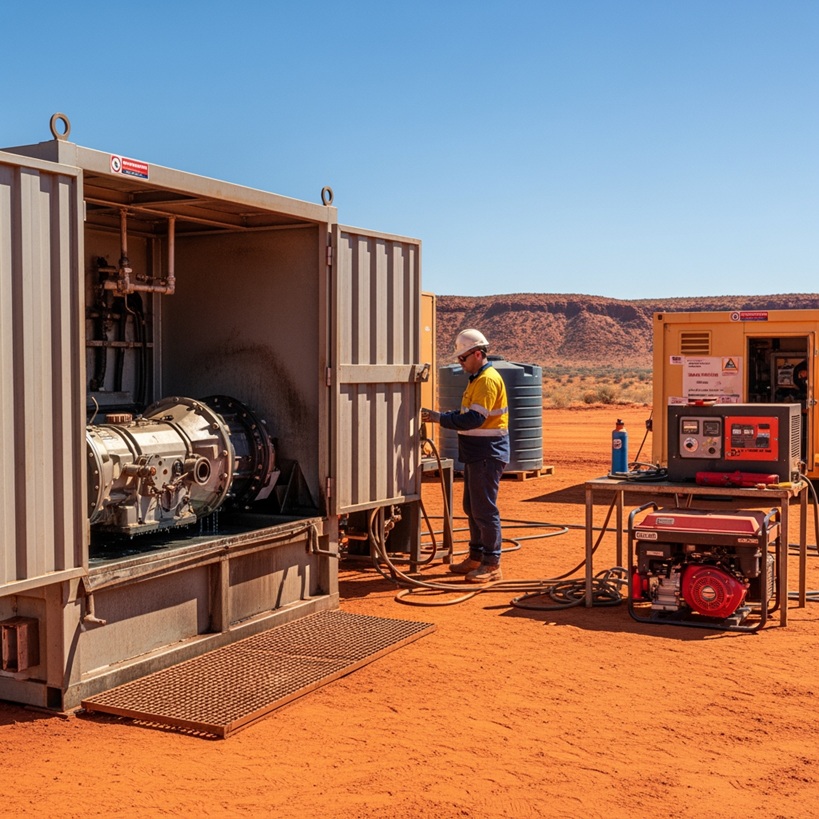
Breaking down a haul truck gearbox at a remote mining site reveals 40 kilograms of baked-on grease, metal shavings, and red dust. The nearest workshop with proper cleaning facilities is 800 kilometres away. Transporting these components means three days of downtime, $15,000 in freight costs, and a maintenance schedule that’s already behind by two weeks.
Remote operations across Australia’s mining belt, pastoral stations, and offshore facilities face a persistent challenge: industrial-grade contamination in locations where traditional cleaning infrastructure doesn’t exist. When equipment fails 12 hours from the nearest town, the ability to clean, inspect, and repair components on-site determines whether operations continue or grind to an expensive halt.
The economics are stark. A single day of unplanned downtime at a mid-sized mining operation costs between $50,000 and $500,000, depending on commodity prices and production capacity. For remote sites, that figure compounds when transportation logistics enter the equation. The solution isn’t bringing parts to workshops – it’s bringing workshop-grade remote site cleaning equipment to the parts.
Why Remote Sites Need Industrial-Grade Cleaning Equipment
Remote operations generate the same contamination as their urban counterparts, but without the support infrastructure. Mining sites in the Pilbara deal with iron ore dust that bonds to hydraulic components. Pastoral stations in the Northern Territory maintain diesel engines caked in bulldust and cattle yard residue. Offshore oil platforms face saltwater corrosion combined with crude oil contamination.
Manual cleaning methods – wire brushes, solvent baths, pressure washers borrowed from light-duty applications – don’t address the scale or intensity of industrial contamination. A maintenance technician scrubbing a differential housing with hand tools might spend six hours achieving what a properly specified parts washer accomplishes in 20 minutes. That time differential matters when the next shift depends on that component being back in service.
The contamination itself presents multiple problems. Baked-on grease obscures crack detection during inspections. Metal particles embedded in oil residue cause premature wear when components are reassembled. Incomplete cleaning compromises gasket sealing surfaces, leading to leaks that require repeated repairs. Remote sites can’t afford these cascading failures – each one extends downtime and multiplies costs.
Traditional solutions involve either establishing permanent workshop facilities (capital-intensive and impractical for temporary sites) or accepting the logistics burden of transporting components to distant workshops. Both approaches carry substantial costs. Hotwash Australia manufactures remote site cleaning equipment designed for field deployment that offers a third option: self-contained systems that deliver workshop-grade results without permanent infrastructure.
Operational Requirements for Remote Cleaning Systems
Equipment operating 800 kilometres from support services must meet requirements that urban workshops rarely consider. Reliability becomes non-negotiable – a breakdown in Perth means a service call within hours; a breakdown at a remote Pilbara site might mean a week-long wait for parts and technicians.
Portable mining equipment washers must incorporate:
- Heavy-gauge construction that withstands rough handling during transport
- Corrosion-resistant materials for exposure to dust, moisture, and temperature extremes
- Sealed electrical components rated for harsh environments
- Mechanical simplicity that reduces failure points
- Serviceable components that maintenance staff can replace without factory technicians
Power supply presents another consideration. Grid electricity doesn’t exist at many remote sites. Operations run on generators with variable power quality – voltage fluctuations, frequency instability, and momentary interruptions that urban equipment isn’t designed to handle. Cleaning systems need robust electrical components and, ideally, compatibility with generator power specifications common in remote operations.
Water supply and disposal create additional complexity. Remote sites typically lack municipal water connections and wastewater treatment. Cleaning systems must either incorporate water recycling to minimise consumption or operate within the constraints of tankered water supplies. Some operations in water-scarce regions specify maximum water usage per cleaning cycle as a non-negotiable requirement.
Chemical handling requirements differ substantially from urban workshops. Remote sites need concentrated detergents that reduce transportation volume and storage space. Cleaning systems must accommodate these high-concentration formulations while maintaining operator safety in environments where emergency response capabilities are limited.
Matching System Capacity to Remote Operation Scale
Remote sites vary dramatically in scale and cleaning requirements. A pastoral station maintaining a fleet of 15 vehicles has different needs than a mining operation servicing 40 haul trucks and associated heavy equipment. System capacity must align with actual workload to avoid either inadequate cleaning capability or unnecessary capital expenditure on oversized equipment.
Small to medium remote operations – pastoral stations, smaller mining contractors, remote construction projects – typically generate cleaning requirements in the range of 10-30 components per week. These operations benefit from heavy duty parts washers with chamber dimensions around 1000mm x 800mm x 800mm. This size accommodates transmission housings, differential components, hydraulic cylinders, and engine parts without the footprint and power requirements of larger systems.
Mid-scale mining operations, processing facilities, and major construction projects with 50-100 pieces of heavy equipment generate substantially higher cleaning volumes. These sites require extra heavy duty parts washers with chambers exceeding 1200mm in length and load capacities of 300-500 kilograms. The increased capacity reduces bottlenecks during planned maintenance shutdowns when multiple machines undergo simultaneous servicing.
Major mining operations – particularly those running 24-hour production schedules with large fleets – face continuous cleaning demands. A single haul truck transmission weighs 800 kilograms and measures over 1500mm in length. These operations specify super heavy duty parts washers with chambers dimensioned for complete drivetrain assemblies and load capacities exceeding 800 kilograms. The alternative – cutting cleaning cycles or transporting components off-site – creates maintenance scheduling constraints that reduce overall equipment availability.
Temperature and Pressure Requirements for Remote Contamination
Remote operations encounter contamination types that resist ambient-temperature cleaning. Iron ore dust bonds to surfaces when combined with hydraulic oil and compressed to bearing surfaces under load. Coal dust mixed with grease creates a compound that standard pressure washing barely disturbs. Crude oil residue at operating temperatures becomes tar-like at remote site ambient conditions.
Effective cleaning requires thermal energy and mechanical action. Hot tank systems maintain solution temperatures between 70-90°C, providing the thermal energy to soften baked-on contamination before mechanical action removes it. This approach works particularly well for components with complex geometries – gearbox housings with internal galleries, hydraulic valve bodies with precision-machined ports, engine blocks with coolant passages.
Spray washing systems deliver mechanical action through high-pressure jets, typically operating between 1000-1500 PSI (70-105 bar). This pressure level dislodges contamination from flat surfaces and accessible areas but requires proper nozzle configuration to reach recessed areas. Hot blaster systems combine high-pressure spray with elevated temperatures, addressing both thermal and mechanical requirements simultaneously.
The choice between immersion cleaning and spray washing depends on component geometry and contamination type. Immersion systems excel at complex parts with internal passages – the heated solution penetrates areas that spray jets can’t reach. Spray systems clean large, geometrically simple components faster and use less water – significant advantages when water supply is limited. Many remote operations with diverse cleaning requirements specify both system types, selecting the appropriate method based on the specific component.
Automation Benefits When Skilled Labour Is Scarce
Remote sites operate with lean maintenance crews. A typical remote mining operation might staff three to five maintenance technicians per shift, responsible for an equipment fleet worth tens of millions of dollars. These technicians need to focus on diagnosis, repair, and equipment commissioning – activities that require their specialised skills and experience.
Manual parts cleaning consumes time without leveraging technical expertise. A technician spending four hours scrubbing components with hand tools delivers no more value than a general labourer performing the same task, but at three times the labour cost. Automated cleaning systems eliminate this inefficient use of skilled labour.
Modern parts washers incorporate programmable cleaning cycles that operators initiate with a single button press. The system manages water temperature, detergent concentration, spray pressure, and cycle duration automatically. Technicians load contaminated components, start the cycle, and return to diagnostic or assembly work while cleaning proceeds unattended. This parallel processing substantially increases maintenance throughput.
The consistency delivered by automated systems matters particularly at remote sites where maintenance quality directly affects equipment reliability. Manual cleaning quality varies with operator fatigue, time pressure, and individual technique. Automated systems deliver identical results in every cycle – the same temperature, the same pressure, the same duration. This consistency ensures that reassembled components meet cleanliness specifications regardless of which shift performed the work.
Transportation and Installation Considerations
Moving industrial cleaning equipment to remote sites presents logistical challenges that urban installations never face. Road access might be limited to unsealed tracks unsuitable for standard freight trucks. Some sites are accessible only by barge or air freight, imposing strict weight and dimension constraints. Installation must occur without the specialised equipment and tradespeople readily available in metropolitan areas.
Portable mining equipment washers are designed for field deployment and ship as complete, factory-tested assemblies rather than requiring extensive on-site construction. Electrical connections use standard industrial formats that site electricians can terminate without specialised training. Plumbing connections employ common fitting standards compatible with remote site infrastructure.
The physical footprint affects both transportation and operation. Larger systems deliver greater capacity but require more freight volume and installation space. Remote sites must balance cleaning capacity against the practical constraints of available workshop area and transportation costs. A system requiring a dedicated 40-foot container for transport might be impractical for a site accessed by single-lane track, regardless of its cleaning capability.
Weight distribution matters for systems installed in temporary structures or on raised platforms common at remote sites. Equipment specifications should include not just total weight but weight distribution and floor loading requirements. Some remote workshops operate in relocatable buildings with load limits that preclude the heaviest industrial equipment.
Water Management in Water-Scarce Environments
Many remote operations exist in regions where water is a carefully managed resource. Pastoral stations in the Tanami Desert truck water from boreholes 200 kilometres away. Mining operations in the Pilbara compete for limited groundwater allocations. These sites cannot operate cleaning systems that consume thousands of litres per day without recovery.
Water recycling systems reduce consumption by 80-90% compared to once-through operation. The basic configuration incorporates a settling tank where solid contamination precipitates out, followed by filtration to remove suspended particles and oil separation to remove floating hydrocarbons. The cleaned water returns to the wash chamber for reuse.
The economics of water recycling shift dramatically at remote sites. In metropolitan areas, water recycling might have a payback period of two to three years based purely on water and sewer costs. At remote sites where water costs $50-200 per thousand litres delivered, recycling systems pay for themselves in months. The operational benefit extends beyond cost – systems with adequate recycling capacity continue operating during periods when water delivery is disrupted by weather, road conditions, or logistics constraints.
Contamination levels in remote operations affect recycling system requirements. Light contamination – dust and oil from routine maintenance – requires basic settling and filtration. Heavy contamination – iron ore slurry, coal dust, drilling mud – requires more sophisticated treatment, including coagulation, enhanced settling, and multi-stage filtration. System specifications must match the actual contamination type and concentration the operation generates.
Maintenance and Parts Availability for Isolated Operations
Industrial equipment requires maintenance. Pumps need seal replacement. Heating elements eventually fail. Control systems require occasional component replacement. At urban sites, these maintenance requirements mean a phone call and a service visit within 24 hours. At remote sites, the same maintenance event can ground equipment for weeks if parts and expertise aren’t readily available.
Selecting remote site cleaning equipment for remote deployment requires evaluating maintenance requirements and parts availability. Systems using proprietary components available only through single-source suppliers create vulnerability. A failed control board that requires factory replacement might mean three weeks of downtime waiting for international shipping. Systems built with standard industrial components – common pump models, standard heating elements, off-the-shelf electrical controls – allow remote sites to maintain spare parts inventory and source replacements from multiple suppliers.
The mechanical design affects maintenance complexity. Systems requiring specialised tools or factory-trained technicians for routine maintenance create dependencies that remote operations struggle to manage. Equipment designed for field maintenance by general maintenance staff reduces these dependencies. Accessible components, standard fasteners, and clear maintenance documentation enable remote crews to handle most maintenance requirements without external support.
Australian-manufactured equipment offers specific advantages for remote Australian operations. Local engineering means parts availability through Australian suppliers rather than international shipping. Technical support operates in compatible time zones. Service technicians, when required, travel domestic routes rather than international. These factors reduce the response time and complexity when remote sites need support.
Return on Investment for Remote Cleaning Capability
Capital equipment purchases at remote sites compete against alternative uses for that capital. A $50,000 parts washer competes with additional spare parts inventory, another light vehicle, or expanded fuel storage. The investment must demonstrate clear returns to justify the capital allocation.
The primary return comes from eliminated transportation costs and reduced downtime. Consider a remote mining operation currently transporting contaminated components to a workshop 600 kilometres away:
- Round-trip freight: $800-1,200
- Component downtime during transport and cleaning: 3-5 days
- Production impact from extended equipment unavailability: $15,000-75,000 per day (depending on equipment criticality)
- Annual frequency: 40-60 major component cleanings
- Annual cost of current approach: $600,000-4,500,000 (depending on downtime impact)
On-site cleaning capability reduces these costs to near zero. The component remains on-site, cleaning occurs within hours rather than days, and equipment returns to service in a fraction of the time. Even at the conservative end of the range, payback periods are measured in months rather than years.
Secondary returns come from improved maintenance quality and equipment reliability. Thorough cleaning enables better inspection, identifying wear and damage that contamination would otherwise obscure. This early detection prevents catastrophic failures that cause far more expensive downtime than routine maintenance. Clean components also last longer – contamination left in reassembled equipment causes accelerated wear and premature failure.
Labour efficiency provides additional returns. Automated cleaning frees skilled technicians from manual cleaning tasks, allowing them to focus on diagnosis and repair. A maintenance crew that completes 20% more repairs per shift because they’re not spending hours on manual cleaning delivers substantial value over the equipment’s service life.
Selecting the Right System for Your Remote Operation
Remote site requirements vary too widely for one-size-fits-all solutions. A pastoral station maintaining 20 vehicles needs different equipment than a mining operation servicing 60 haul trucks. The selection process must account for specific operational parameters:
- Component size and weight – determines required chamber dimensions and load capacity
- Cleaning frequency – affects required cycle time and system durability
- Contamination type – determines temperature and pressure requirements
- Water availability – affects the necessity and capacity of the recycling system
- Power supply – determines electrical specifications and generator compatibility
- Transport constraints – affect maximum dimensions and weight
- Maintenance capability – determines acceptable complexity and parts availability requirements
Operations cleaning primarily small to medium components – transmission parts, hydraulic cylinders, engine components under 200 kilograms – find adequate capacity in systems with 1000-1200mm chambers. These systems balance cleaning capability with manageable size and power requirements.
Sites handling larger components or higher volumes require systems with 1400-1800mm chambers and load capacities exceeding 500 kilograms. The increased capacity reduces cycle frequency during maintenance shutdowns and accommodates the largest components without disassembly.
For operations in extremely remote locations or those with particularly limited water supply, stainless steel parts washers with integrated recycling systems provide maximum durability and minimum water consumption. The stainless steel construction withstands harsh environments and eliminates concerns about corrosion in systems that might sit idle for extended periods between uses.
Establishing Effective Remote Cleaning Operations
Installing equipment represents only the first step. Effective remote cleaning operations require proper setup, operator training, and ongoing management to deliver the reliability and results that justify the investment.
Water quality affects cleaning performance and equipment longevity. Remote sites often source water from bores with high mineral content or surface sources with suspended sediment. This water requires filtration before entering cleaning systems to prevent scale buildup on heating elements and contamination of the cleaning solution. A simple sediment filter and, in high-hardness areas, a water softener extend equipment life and maintain cleaning effectiveness.
Detergent selection matters more at remote sites than at urban workshops. Concentrated industrial detergents reduce transportation volume and storage space requirements. Formulations designed for heated water systems perform better than general-purpose cleaners. The detergent must effectively address the specific contamination types the operation encounters – formulations optimised for petroleum products differ from those targeting mineral contamination or organic materials.
Operator training ensures consistent results and proper equipment care. Training should cover loading procedures that maximise cleaning effectiveness, cycle selection for different component types, routine maintenance requirements, and basic troubleshooting. Remote operations benefit from training multiple staff members to avoid dependencies on single individuals.
Maintenance scheduling prevents minor issues from becoming major failures. Monthly inspection of pump seals, heating elements, and electrical connections catches developing problems before they cause breakdowns. Annual professional servicing – either by bringing a technician to the site or transporting the equipment to a service centre during planned shutdowns – maintains long-term reliability.
Moving Forward With Remote Cleaning Solutions
Remote operations face contamination challenges identical to their urban counterparts, but without the support infrastructure that urban sites take for granted. Transporting components to distant workshops creates costs and delays that compound across dozens or hundreds of cleaning cycles per year. These costs – measured in freight charges, extended downtime, and deferred maintenance – far exceed the capital investment in properly specified on-site cleaning capability.
The equipment exists to deliver workshop-grade cleaning results at remote sites. Modern parts washers operate reliably in harsh environments, accommodate the power and water constraints common to remote operations, and require minimal maintenance support. The selection process requires matching system specifications to actual operational requirements – component size, contamination type, cleaning frequency, and site constraints.
Australian-manufactured systems designed for local conditions offer particular advantages for remote Australian operations. Equipment built to withstand Pilbara temperatures, designed for compatibility with Australian power standards, and supported by local parts availability and service networks, reduces the complexity and risk of remote deployment.
For operations currently accepting the costs and delays of transporting components to distant workshops or struggling with inadequate manual cleaning methods, the economics of remote cleaning capability are compelling. The investment pays for itself through eliminated freight costs, reduced downtime, and improved maintenance quality – typically within the first year of operation.
Hotwash manufactures industrial parts washers specifically designed for demanding remote applications. The company’s range includes systems from compact manual washers for smaller operations to super heavy-duty automated systems for major mining sites. Every system incorporates the durability, serviceability, and performance characteristics that remote operations require. To discuss specific requirements and determine the appropriate cleaning solution for your remote operation, contact us for technical specifications and application engineering support.

Leave A Comment