
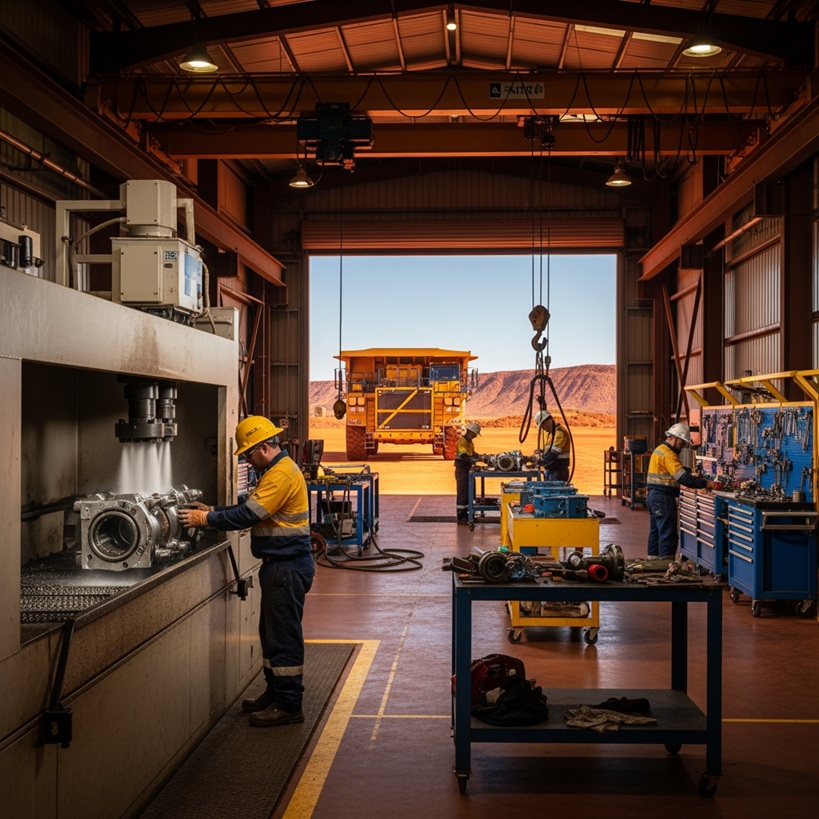
Mining equipment sitting idle costs Australian operations far more than the obvious lost production hours. Every minute of unplanned downtime triggers a cascade of financial impacts – from labour inefficiencies and missed production targets to contract penalties and compromised safety standards. For major mining operations across Western Australia, Queensland, and the Northern Territory, understanding the mining equipment downtime cost reveals why preventative maintenance and efficient parts cleaning systems deliver measurable ROI.
The Financial Impact of Mining Equipment Downtime
Australian mining operations face some of the highest equipment downtime costs globally. A single haul truck sitting idle at a Pilbara iron ore operation costs approximately $2,000 to $3,000 per hour in lost productivity. For underground mining equipment, these figures climb higher due to production bottlenecks and the ripple effect throughout connected systems.
The Mining Equipment Manufacturers of Australia (MEMA) reports that unplanned downtime accounts for 38% of total equipment unavailability across Australian mine sites. This translates to substantial financial losses:
- Large-scale mining operations lose $500,000 to $1.2 million per day during major equipment failures
- Medium-sized operations face $150,000 to $400,000 daily losses
- Even smaller mining contractors experience $50,000 to $100,000 in lost revenue per day
These figures only capture direct production losses. The actual mining equipment downtime cost includes labour inefficiency, emergency repair premiums, expedited parts shipping, and potential contract penalties for missed delivery quotas.
Hidden Costs Beyond Lost Production
While lost production hours dominate downtime calculations, several hidden costs significantly increase the total financial impact.
Labour Inefficiency and Idle Time
When a critical piece of equipment fails, entire crews face idle time. Maintenance teams rush to diagnose and repair the issue while operators, production supervisors, and support personnel wait. At Australian mining wage rates – often $150,000 to $200,000 annually for skilled operators – these idle hours quickly accumulate. A four-hour equipment failure affecting a crew of six operators costs approximately $1,200 in unproductive wages alone.
Emergency Repair Premiums
Unplanned failures force operations into reactive mode. Emergency callouts for specialist technicians command premium rates – often 150% to 200% of standard service costs. Expedited parts shipping from Perth, Brisbane, or international suppliers adds thousands in freight charges. A hydraulic component requiring overnight delivery from the eastern states to a Pilbara mine site can cost $3,000 to $5,000 in freight alone.
Safety Risks and Compliance Concerns
Equipment failures increase safety risks across mine sites. Rushed repairs under pressure create hazardous conditions. Contaminated components that should undergo proper cleaning before reinstallation get hastily fitted, risking premature failure. These shortcuts compromise workplace safety standards and expose operations to regulatory scrutiny and potential penalties.
How Equipment Contamination Drives Downtime
Component contamination ranks among the leading causes of premature equipment failure across Australian mining operations. Dust, mud, coal residue, drilling fluids, and hydraulic oil contamination accelerate wear and trigger unexpected breakdowns.
The Contamination-Failure Cycle
Mining equipment operates in Australia’s harshest environments – from the red dust of the Pilbara to the coal dust of Queensland’s Bowen Basin. Without thorough cleaning, contaminants embed in components during maintenance and reinstallation. These particles then circulate through hydraulic systems, transmissions, and engines, causing:
- Accelerated seal wear and hydraulic leaks
- Premature bearing failure
- Valve malfunction in control systems
- Reduced heat transfer efficiency in cooling systems
- Compromised electrical connections
A contaminated hydraulic pump reinstalled after a seal replacement might operate for weeks before failing catastrophically, triggering another expensive downtime event. The initial maintenance solved one problem but created another through inadequate parts cleaning.
Visual Inspection Isn’t Enough
Many mine site maintenance teams rely on visual inspection and manual cleaning methods. A component might appear clean but retain microscopic contaminants that cause premature failure. Manual scrubbing with brushes and solvent tanks cannot achieve the cleanliness levels required for modern hydraulic systems operating at 3,000+ PSI. Improving equipment reliability mining industry standards requires proper contamination control through professional-grade cleaning systems that remove embedded particles invisible to visual inspection.
Calculating Your Actual Downtime Costs
Most mining operations underestimate their true mining equipment downtime cost because they focus solely on lost production tonnage. A comprehensive calculation includes multiple cost categories.
Direct Production Losses
Start with the obvious: lost production during downtime multiplied by commodity value. For an iron ore operation producing 50,000 tonnes daily at $120 per tonne, a full day of downtime represents $6 million in lost revenue. Even a four-hour delay costs $1 million in foregone production.
Labour and Contractor Costs
Calculate idle time for affected personnel across all departments – operators, maintenance crews, supervisors, and support staff. Include emergency callout premiums for specialist contractors and overtime rates for extended repair work.
Parts and Logistics Costs
Factor in expedited shipping charges, emergency parts procurement premiums, and the cost difference between planned maintenance parts ordering versus urgent replacement purchases. Mining operations typically pay 30% to 50% more for emergency parts procurement.
Opportunity Costs
Consider production quotas, contract delivery schedules, and market timing. Missing a contracted delivery window can trigger penalty clauses worth hundreds of thousands of dollars. Failing to capitalise on favourable commodity pricing windows represents substantial opportunity cost.
Reputation and Contract Risk
Repeated downtime incidents damage operational reputation and jeopardise contract renewals. Major mining companies increasingly favour contractors and service providers with proven reliability records. Downtime-related delivery failures risk future contract opportunities worth millions annually.
The ROI of Preventive Maintenance Systems
Investing in proper equipment maintenance systems – including professional-grade heavy duty parts washers – delivers measurable returns through downtime reduction and component life extension.
Time Savings Through Automated Cleaning
Manual parts cleaning consumes 2 to 4 hours per major component overhaul. An automated parts washing system reduces this to 20 to 40 minutes while achieving superior cleanliness. For a maintenance workshop servicing 15 major components weekly, this represents 30+ hours of labour savings – equivalent to nearly one full-time maintenance position.
Extended Component Life
Properly cleaned components last longer. Hydraulic pumps, valves, and cylinders reinstalled after thorough cleaning in industrial spray washers experience 30% to 50% longer service life compared to manually cleaned components. This extends replacement intervals and reduces parts expenditure across the operation while strengthening equipment reliability mining industry performance.
Reduced Unplanned Downtime
Clean components fail less frequently. Operations that implement systematic parts washing report 25% to 40% reductions in unplanned maintenance events. For a mining operation losing $500,000 per downtime day, reducing unplanned events from 20 to 12 days annually saves $4 million.
Improved Workshop Efficiency
Automated parts washing frees skilled maintenance personnel from manual scrubbing. These workers can focus on diagnostic work, precision assembly, and preventative maintenance tasks that actually prevent failures. Workshop throughput increases while maintaining higher quality standards.
Industry-Specific Downtime Challenges
Different mining sectors face unique equipment contamination and downtime challenges that influence parts cleaning requirements.
Iron Ore Operations
Pilbara iron ore mines battle fine red dust that penetrates every component. This abrasive contamination accelerates wear in hydraulic systems, engines, and transmissions. Extra heavy duty parts washers handle the high-volume cleaning demands of large-scale iron ore operations where haul trucks and excavators require frequent component servicing.
Coal Mining
Coal dust combines with moisture to create a sticky, corrosive contamination that adheres to components. Underground longwall operations face particularly challenging conditions where equipment accessibility makes preventative maintenance critical. Thorough parts cleaning before component reinstallation prevents premature failure in these difficult-to-access systems and directly reduces mining equipment downtime cost across coal operations.
Gold and Base Metals
Underground hard rock mining exposes equipment to drilling fluids, rock dust, and moisture. The confined spaces and difficult logistics make unplanned downtime especially costly. Smaller equipment footprints don’t reduce cleaning requirements – components still demand thorough decontamination before reassembly.
Oil and Gas
Offshore and onshore petroleum operations deal with crude oil, drilling mud, and heavy grease contamination. Hot tank systems excel at removing these heavy contaminants through heated immersion cleaning, essential for maintaining the extreme reliability standards required in oil and gas applications.
Implementing Cost-Effective Downtime Reduction
Reducing equipment downtime requires systematic approaches rather than reactive firefighting. Several strategies deliver measurable improvements.
Establish Baseline Metrics
Track current downtime frequency, duration, and costs across equipment categories. Identify which assets generate the highest downtime costs and which failures occur most frequently. This data guides investment priorities and measures improvement.
Prioritise Critical Path Equipment
Focus preventative maintenance resources on equipment that creates production bottlenecks when unavailable. A primary crusher or main haul road represents a higher priority than redundant systems where backup capacity exists.
Upgrade Parts Cleaning Capabilities
Many mine site workshops still rely on manual cleaning methods or inadequate washing equipment. Upgrading to properly sized super heavy duty parts washers appropriate for the operation’s scale and contamination levels delivers immediate improvements in component cleanliness and subsequent reliability. Enhanced equipment reliability mining industry depends on systematic contamination control.
Train Maintenance Personnel
Ensure maintenance teams understand the connection between component cleanliness and equipment reliability. Establish cleaning standards and inspection protocols that prevent contaminated components from being reinstalled.
Schedule Proactive Component Replacement
Replace wear items before failure rather than running equipment to destruction. Planned component replacement during scheduled maintenance windows costs far less than emergency repairs during unplanned downtime.
Australian Mining Conditions Demand Robust Solutions
Australia’s mining environments rank among the world’s harshest. Equipment operates in extreme heat, abrasive dust, and remote locations where parts availability and technician access create unique challenges.
Built for Australian Conditions
Australian-designed and manufactured parts washing systems account for local conditions. Hotwash Australia equipment is engineered for the contamination levels, water quality, and operational demands of Australian mine sites. Local manufacturing ensures parts availability, service support, and compliance with Australian standards.
Remote Site Reliability
Mining operations in remote Western Australia, Queensland, and the Northern Territory cannot tolerate equipment failures. Parts washing systems must operate reliably with minimal maintenance requirements and deliver consistent performance despite challenging water quality and environmental conditions.
Compliance and Safety
Australian workplace health and safety regulations require proper equipment maintenance and contamination control. Professional parts washing systems reduce manual chemical exposure, eliminate repetitive manual scrubbing injuries, and ensure components meet cleanliness standards before reinstallation.
Making the Business Case for Investment
Finance teams and operations managers evaluate capital equipment purchases through ROI analysis. Building a compelling business case for industrial parts washing systems requires quantifying the costs they prevent.
Calculate Current Downtime Costs
Document existing downtime frequency and associated costs over the past 12 months. Include direct production losses, labour costs, emergency repair premiums, and parts procurement costs. This establishes the baseline against which improvements are measured.
Project Downtime Reduction
Conservative estimates suggest proper parts cleaning reduces unplanned maintenance events by 25% to 30%. Apply this reduction to current downtime costs to project annual savings. For an operation experiencing $5 million in annual mining equipment downtime cost, a 25% reduction represents $1.25 million in savings.
Factor Labour Savings
Calculate the time currently spent on manual parts cleaning multiplied by labour costs. An automated parts washer eliminating 30 hours of manual cleaning weekly saves approximately $100,000 annually in labour costs at typical mining wage rates.
Include Component Life Extension
Extended component life reduces parts expenditure and replacement frequency. If thorough cleaning extends hydraulic component life by 40%, the operation purchases fewer replacement components annually – savings that compound across hundreds of components.
Calculate Payback Period
Divide the equipment investment by annual savings to determine the payback period. Many mining operations achieve 12 to 18-month payback periods on properly specified parts washing systems, making them highly attractive capital investments.
Conclusion
Equipment downtime costs Australian mining operations millions annually through lost production, labour inefficiency, emergency repairs, and compromised safety. The true cost extends far beyond obvious production losses to include hidden expenses that many operations fail to fully quantify.
Contaminated components drive premature failures and unplanned downtime events. Manual cleaning methods cannot achieve the cleanliness levels required for modern mining equipment operating under extreme conditions. Investing in professional-grade parts washing systems delivers measurable returns through downtime reduction, extended component life, and improved workshop efficiency while elevating equipment reliability mining industry standards across Australian operations.
For mining operations serious about reducing equipment downtime costs, the path forward involves systematic contamination control through proper parts cleaning. Australian-made solutions designed for local conditions provide the reliability and performance mining operations demand.
Contact us to discuss how the right parts washing system can reduce downtime costs and improve equipment reliability across your mining operation. The team provides application-specific recommendations based on your contamination levels, component sizes, and throughput requirements.

Leave A Comment