
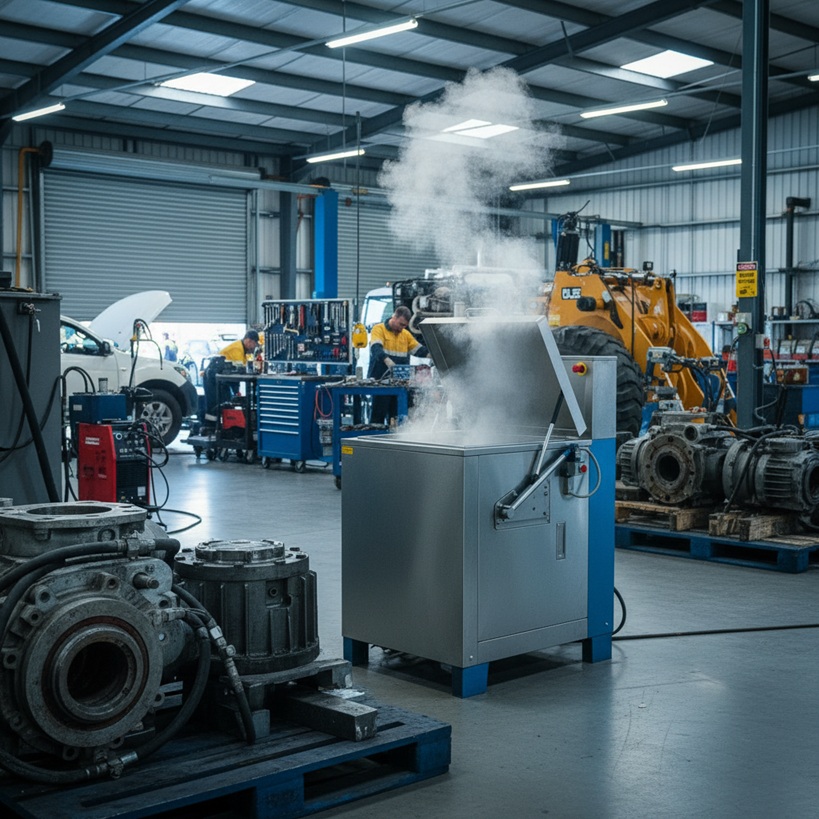
Supplying equipment to major mining operations means meeting standards that go beyond basic functionality. When BHP or Rio Tinto evaluates industrial cleaning equipment for their sites, they scrutinise specifications that directly impact operational safety, production continuity, and total cost of ownership. For maintenance managers preparing procurement submissions, understanding which technical specifications matter – and why – determines whether equipment makes it past the tender evaluation stage.
Major mining companies operate under strict procurement frameworks that prioritise equipment durability, safety compliance, and measurable performance outcomes. A mine spec parts washer designed for Tier 1 mining operations requires documentation and specifications that smaller operations rarely consider. Understanding BHP Rio Tinto supplier requirements means recognising that the difference between equipment that meets these standards and equipment that doesn’t often comes down to specific engineering details that affect long-term reliability in harsh mining environments.
Construction Standards That Withstand Mining Environments
Mining sites expose equipment to conditions that destroy inadequately engineered systems within months. Temperature extremes, airborne dust, constant vibration from nearby heavy machinery, and continuous operation cycles create an environment where only robust construction survives. BHP Rio Tinto supplier requirements mandate construction standards that reflect this reality.
Stainless steel construction represents the baseline for food-grade applications, but mining operations typically require powder-coated mild steel with specific gauge thickness. BHP and Rio Tinto procurement specifications frequently mandate minimum 3mm steel construction for cabinet walls and 5mm for high-stress components like door frames and spray manifolds. This gauge thickness prevents warping under thermal cycling and resists impact damage from dropped parts or tools.
Welded construction methods matter significantly more than many suppliers realise. Continuous TIG welding on all structural joints eliminates weak points where vibration causes premature failure. Spot-welded or riveted assemblies fail inspection because they create stress concentration points that crack under continuous operation. Heavy duty parts washers meeting mine specifications use full-penetration welds on all pressure-bearing components and structural joints.
Powder coating specifications extend beyond simple corrosion resistance. Mining procurement teams specify minimum coating thickness (typically 80-100 microns), salt spray test results (1000+ hours), and impact resistance ratings. The coating must withstand chemical exposure from industrial degreasers, hydraulic fluids, and diesel fuel without degradation. Equipment failing these coating standards shows rust and deterioration within the first year of operation, creating maintenance burdens and safety concerns.
Electrical Safety and Compliance Documentation
Electrical specifications for mine spec parts washers involve compliance documentation that smaller manufacturers cannot provide. BHP Rio Tinto supplier requirements include comprehensive electrical safety certification aligned with Australian Standards AS/NZS 3000 and AS/NZS 60204.1. This extends beyond basic electrical safety to include specific requirements for industrial equipment in mining environments.
All electrical components must carry appropriate IP (Ingress Protection) ratings for the installation environment. Control panels typically require IP65 rating minimum, protecting against dust ingress and water jets from high-pressure washdown procedures common in mining maintenance facilities. Electrical enclosures must use stainless steel or powder-coated steel with corrosion-resistant hardware, not plastic housings that become brittle in temperature extremes.
Circuit protection requirements exceed standard commercial specifications. Mining operations specify thermal overload protection on all motors, ground fault protection, and emergency stop systems that meet AS 4024.1 safety requirements. The emergency stop circuit must use hardwired safety relays, not programmable logic controller (PLC) controlled stops that could fail during software errors.
Documentation requirements include complete electrical schematics, component specifications with manufacturer data sheets, and certification from accredited testing authorities. Equipment arriving without this documentation faces rejection regardless of actual performance capabilities. Hotwash Australia provides comprehensive electrical documentation packages that meet Tier 1 mining procurement requirements, including test certificates and compliance declarations.
Heating System Specifications and Energy Efficiency
Heating capacity directly impacts cleaning effectiveness and operational efficiency in mining parts washers. Major mining companies specify heating systems based on thermal recovery time, energy consumption, and temperature stability under continuous operation. Inadequate heating systems create production bottlenecks when equipment cannot maintain operating temperature during high-volume cleaning cycles.
Electric immersion heaters for mine spec applications typically require 18-36kW capacity depending on tank volume, with specifications demanding stainless steel or Incoloy sheathed elements rated for continuous duty. Lower-grade heating elements fail within months when exposed to alkaline cleaning solutions and thermal cycling. Procurement specifications often mandate specific element loading (watts per square inch of element surface) to prevent premature burnout.
Temperature control accuracy matters more than many suppliers recognise. Mining operations specify ±2°C temperature stability to ensure consistent cleaning results and prevent thermal shock to components. This requires industrial-grade temperature controllers with PID (Proportional-Integral-Derivative) control algorithms, not simple on-off thermostats that cause temperature swings of 10-15°C.
Energy efficiency metrics increasingly influence procurement decisions as mining companies target operational cost reduction. Super heavy duty parts washers meeting current mining specifications include insulated tanks reducing heat loss by 30-40% compared to uninsulated designs, and heat recovery systems capturing thermal energy from rinse cycles. These features reduce electrical consumption by 2-4kW per hour during continuous operation, generating measurable cost savings over equipment life.
Pump and Spray System Performance Specifications
Cleaning effectiveness depends entirely on pump performance and spray system design. Mining procurement specifications mandate specific pressure and flow rate combinations that deliver sufficient mechanical energy to remove heavy contamination. Undersized pump systems cannot remove baked-on grease, coal dust, and drilling mud that accumulate on mining equipment components.
Mine spec parts washers typically require pumps delivering 40-60 PSI at 60-100 litres per minute for standard applications, with extra heavy duty parts washers for large mining operations specifying 80+ PSI and 150+ litres per minute. These specifications reflect the reality that mining components carry contamination levels far exceeding typical automotive or manufacturing applications.
Pump construction specifications require cast iron or stainless steel housings with sealed bearings rated for continuous duty. Centrifugal pumps must use closed impellers, not open impellers that lose efficiency as wear occurs. Mechanical seal specifications mandate materials compatible with alkaline cleaning solutions at elevated temperatures – typically silicon carbide or ceramic seals, not rubber seals that degrade within months.
Spray manifold design significantly impacts cleaning coverage and efficiency. Mining procurement teams increasingly specify rotating spray arms with documented coverage patterns rather than fixed spray bars. The spray arm rotation mechanism must use stainless steel shafts with sealed bearings, not plastic components that warp at operating temperatures. Nozzle specifications typically mandate stainless steel construction with specific spray angles (typically 15-25 degrees) and flow rates verified through testing.
Filtration and Solution Management Systems
Solution cleanliness directly affects cleaning performance and operational costs. Mining operations generate enormous contamination loads – a single shift can remove kilograms of coal dust, drilling mud, and grease from components. Without adequate filtration, this contamination saturates the cleaning solution within hours, reducing effectiveness and requiring frequent solution changes.
Mine spec parts washers require multi-stage filtration systems that major suppliers often overlook. Initial coarse filtration (typically 1-2mm mesh) removes large debris before it reaches pump inlets. Secondary filtration (200-500 micron) protects pumps and spray nozzles from particulate damage. Specifications for large mining operations increasingly mandate tertiary filtration (50-100 micron) or bag filters that extend solution life by removing fine particulates that cause redeposition.
Filter accessibility impacts maintenance efficiency and compliance with cleaning schedules. BHP and Rio Tinto procurement specifications often require tool-free filter access and filter condition monitoring systems. Equipment requiring extensive disassembly for filter cleaning faces rejection because maintenance personnel skip cleaning cycles when procedures are cumbersome, leading to premature pump failure and reduced cleaning effectiveness.
Solution capacity specifications reflect the contamination load mining operations generate. Hot tank systems for mining applications typically require 500-1000 litre capacity minimum, with larger operations specifying 2000+ litres. Inadequate solution volume means frequent topping up and solution changes, increasing chemical costs and maintenance labour. Procurement teams calculate total solution volume against expected contamination load and target minimum 2-3 week solution life under normal operation.
Chamber Capacity and Component Accommodation
Internal chamber dimensions determine which components the equipment can clean effectively. Mining operations maintain diverse equipment fleets requiring parts washing capability for everything from small hydraulic fittings to large gearbox housings and drill bits. Procurement specifications mandate minimum internal dimensions based on the largest components requiring regular cleaning.
Standard mine spec parts washers typically specify minimum 1200mm width x 800mm depth x 800mm height internal dimensions. Large mining operations often require extra heavy-duty systems with 1800mm+ width to accommodate transmission cases, differential housings, and large fabricated components. Door opening dimensions must match or exceed internal chamber width – equipment with restricted door openings creates handling difficulties and limits component access.
Load capacity specifications reflect the weight of mining components. Turntable or basket systems must support 200-500kg depending on application, with structural design verified through load testing. Inadequately engineered support systems deform under load, causing component contact with spray arms or tank walls. Procurement specifications increasingly require load capacity certification from independent testing authorities rather than manufacturer declarations.
Chamber accessibility affects operational efficiency significantly. Mining maintenance personnel work under time pressure to return equipment to service. Parts washers requiring awkward loading procedures or multiple personnel for component handling create bottlenecks. Specifications increasingly favour sliding door designs over lift doors in confined workshop spaces, and turntable systems over fixed baskets for heavy component handling.
Safety Features and Risk Mitigation
Workplace safety drives many mine spec equipment requirements that seem excessive to suppliers unfamiliar with mining operations. BHP and Rio Tinto operate under stringent safety management systems where equipment-related injuries trigger extensive investigations and potential supplier delisting. Parts washer specifications reflect this safety focus through mandatory features that prevent common injury mechanisms.
Door interlock systems represent non-negotiable safety requirements. All automated doors must include electrical interlocks preventing door operation while personnel could contact moving components. Manual doors require positive latching mechanisms that prevent accidental opening during operation. The interlock system must use dedicated safety relays meeting AS 4024.1 requirements, not general-purpose control relays that could fail in unsafe modes.
Hot surface protection prevents burn injuries from contact with heated components. All surfaces exceeding 60°C during operation require either insulation reducing surface temperature below this threshold, or physical guards preventing accidental contact. Temperature warning labels must meet AS 1319 specifications for size, colour, and placement. Equipment lacking adequate hot surface protection fails safety inspection regardless of cleaning performance.
Chemical exposure prevention requires adequate ventilation and fume extraction provisions. Hot blaster systems operating above 60°C generate vapour that requires extraction to prevent respiratory exposure and condensation issues in workshop environments. Procurement specifications mandate fume extraction connection points with minimum 200mm diameter, positioned to capture vapour at source. Equipment without adequate extraction provisions creates unsafe working conditions and fails occupational hygiene assessments.
Emergency stop systems must be accessible from all normal operating positions and clearly identified with red mushroom-head buttons meeting AS 4024.1 specifications. The emergency stop circuit must directly interrupt power to all hazardous motion, not rely on software control that could malfunction. Testing procedures during commissioning verify emergency stop function from all positions.
Automation Features That Improve Operational Efficiency
Mining operations increasingly specify automation features that reduce labour requirements and improve cleaning consistency. Manual parts washing represents an inefficient use of skilled maintenance personnel who should focus on diagnostic and repair work rather than cleaning tasks. Automated systems eliminate this labour while delivering superior cleaning consistency.
Programmable wash cycles allow operators to select pre-configured programs matching specific component types and contamination levels. Mine spec systems typically offer 4-8 programmable cycles with adjustable parameters including wash duration, temperature, and agitation intensity. The control system must include cycle completion indicators – audible alarms and visual signals alerting operators when cleaning completes, preventing productivity loss from operators checking equipment status repeatedly.
Automatic door systems eliminate manual handling and improve operational efficiency. Pneumatic or electric door operators must include safety features preventing door operation when personnel could be injured, and emergency stop integration halting door movement immediately. Door operation must function reliably after 100,000+ cycles – inadequate actuator sizing or poor component selection causes premature failure requiring expensive repairs and operational downtime.
Automated solution management systems monitor solution condition and alert operators when solution changes are required. Conductivity monitoring provides indirect measurement of solution contamination and concentration, triggering alarms when solution quality degrades below acceptable levels. This prevents continued operation with exhausted solution that wastes time without achieving cleaning objectives.
Data logging capabilities increasingly feature in mining procurement specifications as operations implement predictive maintenance programs. Equipment with cycle counters, runtime tracking, and maintenance interval reminders supports planned maintenance scheduling. More sophisticated systems offer network connectivity allowing integration with site-wide maintenance management systems, though this remains optional rather than mandatory for most mining operations.
Australian Standards Compliance and Certification
Equipment supplied to major mining operations requires comprehensive compliance documentation proving adherence to Australian Standards. BHP and Rio Tinto procurement teams verify compliance through detailed technical reviews and site inspections. Equipment lacking proper certification faces rejection regardless of actual safety or performance.
Electrical safety certification under AS/NZS 3000 and AS/NZS 60204.1 requires testing by accredited laboratories with detailed test reports documenting compliance. This includes earth continuity testing, insulation resistance testing, and functional safety testing of all protective devices. Certification must be current – test reports older than 12 months typically require re-testing before equipment commissioning.
Pressure equipment compliance applies to heated tanks and vessels containing liquid above atmospheric pressure. Equipment meeting pressure vessel definitions under AS 4343 requires design registration and periodic inspection by authorised inspectors. While many parts washers operate below pressure vessel thresholds, larger hot tank systems for mining applications may require pressure vessel certification depending on capacity and operating pressure.
Machinery safety compliance under AS 4024 series standards addresses mechanical hazards including moving parts, hot surfaces, and trapped points. Risk assessments must identify all hazards and demonstrate adequate risk reduction through design features and safeguards. Documentation includes hazard registers, risk matrices, and verification that residual risks remain within acceptable levels.
Environmental compliance documentation addresses wastewater discharge, chemical storage, and vapour emissions. Mining sites operate under strict environmental management plans requiring equipment to meet specific discharge standards and chemical handling requirements. Parts washers must include features supporting environmental compliance, including solution containment, spill prevention, and compatibility with site wastewater treatment systems.
Total Cost of Ownership Considerations
Mining procurement decisions increasingly emphasise the total cost of ownership rather than the initial purchase price. Equipment appearing cost-effective initially may generate excessive operational costs through high energy consumption, frequent maintenance, or premature failure. Tier 1 mining companies analyse lifecycle costs over expected equipment life (typically 10-15 years for quality parts washers).
Energy consumption represents a significant operational cost over equipment life. A parts washer consuming 30kW during operation costs approximately $25,000-$35,000 in electricity over 10 years at typical mining site power rates. Specifications favouring insulated tanks, efficient heating systems, and heat recovery reduce this cost by 20-40%, generating savings of $5,000-$14,000 over equipment life. These savings justify higher initial investment in quality construction.
Maintenance labour costs exceed the initial purchase price over the equipment’s life for inadequately engineered systems. Equipment requiring frequent pump rebuilds, heating element replacement, or structural repairs consumes maintenance resources and creates operational downtime. Mine spec equipment uses industrial-grade components with documented service intervals of 5,000-10,000 hours, reducing maintenance frequency and associated labour costs.
Solution and chemical costs vary dramatically based on filtration effectiveness and solution management. Inadequate filtration requires solution changes every 1-2 weeks, consuming 500-1000 litres of cleaning solution and fresh water per change. Quality filtration systems extend solution life to 4-8 weeks, reducing chemical consumption by 50-75% and generating savings of $3,000-$8,000 annually in large operations.
Downtime costs dwarf equipment costs in mining operations, where production delays cost thousands of dollars per hour. Parts washers supporting critical maintenance activities must deliver reliable operation without unexpected failures. Equipment engineered to mine specifications typically achieves 98%+ availability, while inadequate equipment averages 85-90% availability due to frequent breakdowns and repairs.
Preparing Procurement Submissions That Meet Mining Standards
Maintenance managers preparing equipment procurement submissions for BHP or Rio Tinto approval face detailed technical review processes. Understanding which specifications matter and how to document them determines submission success. Incomplete or poorly documented submissions face rejection, requiring resubmission and project delays.
Technical specifications must include comprehensive dimensional drawings showing external dimensions, internal chamber dimensions, door clearances, and service access requirements. Procurement teams verify equipment fits designated installation locations with adequate clearance for operation and maintenance. Specifications lacking detailed drawings cannot be evaluated properly and face rejection.
Electrical documentation must include single-line diagrams showing all major components, circuit protection devices, and control systems. Component specifications must list manufacturers and model numbers for all major electrical components, including motors, contactors, overload relays, and control devices. Generic descriptions like “industrial motor” or “temperature controller” are insufficient – procurement teams require specific component identification for reliability assessment.
Performance specifications must include verified data for pump pressure and flow rates, heating capacity and recovery time, and cleaning cycle duration. Manufacturer claims require supporting documentation through test reports or certified performance data. Procurement teams increasingly require third-party testing verification rather than accepting manufacturer declarations.
Compliance documentation must include current test certificates for electrical safety, pressure equipment registration (if applicable), and declarations of conformity for relevant Australian Standards. Missing compliance documentation represents the most common reason for procurement submission rejection.
Conclusion
Meeting BHP and Rio Tinto supplier standards requires understanding that equipment specifications directly impact operational safety, production efficiency, and lifecycle costs. Major mining companies specify construction standards, electrical compliance, heating capacity, pump performance, filtration systems, and safety features that reflect the harsh realities of mining operations. Equipment failing these specifications creates safety risks, operational inefficiencies, and excessive lifecycle costs that far exceed any initial purchase price savings.
Maintenance managers preparing procurement submissions must document comprehensive technical specifications, compliance certifications, and performance data that withstand detailed technical review. The difference between successful procurement and rejected submissions often comes down to documentation quality and specification completeness rather than actual equipment capability. Australian-manufactured equipment engineered specifically for mining applications provides the construction quality, compliance documentation, and performance specifications that Tier 1 mining operations demand. For assistance preparing procurement submissions or discussing equipment specifications for major mining operations, contact us to ensure specifications meet the exacting standards BHP and Rio Tinto require.

Leave A Comment