
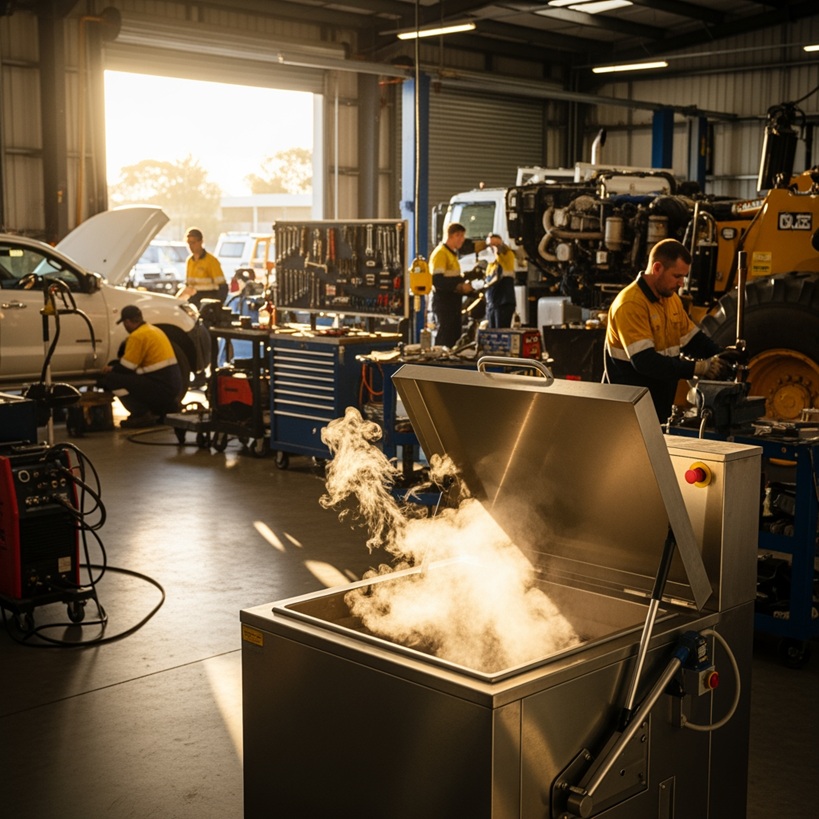
Most workshop managers face the same Saturday dilemma – customer demand peaks on weekends, but labour costs and overtime premiums make extended hours unprofitable. Mining contractors need equipment serviced before Monday shifts. Manufacturing plants schedule maintenance during weekend downtime. Food processing facilities require deep cleaning between production runs. The demand exists, but traditional staffing models destroy the margin.
The solution isn’t hiring more technicians. It’s eliminating the bottleneck that consumes 40% of weekend labour hours – manual parts cleaning. When Hotwash Australia automated parts washing in a Perth heavy equipment workshop, Saturday throughput increased 60% with the same three-person crew. The workshop now processes 12 service jobs instead of seven, generating an additional $4,800 weekly revenue without adding payroll costs.
The Hidden Cost of Manual Parts Cleaning on Weekends
Workshop productivity equipment investment decisions typically focus on diagnostic tools and lifting capacity. Yet time-motion studies across Australian industrial facilities reveal parts cleaning consumes 35-45% of total service time. On Saturdays, when workshops operate with skeleton crews, this percentage climbs higher.
Typical Saturday Cleaning Requirements:
Engine components (2-3 hours manual scrubbing)
Hydraulic fittings and valves (1-2 hours)
Transmission parts (2-4 hours)
Undercarriage components (1-2 hours)
With manual cleaning methods, one technician spends 6-11 hours per job just removing contamination. On a six-hour Saturday shift, that technician completes minimal billable work. The workshop pays premium weekend rates for labour that generates no revenue.
Brisbane mining contractor Harwood Equipment quantified this precisely. Their Saturday crew of four technicians logged 96 labour hours monthly on manual parts cleaning – equivalent to $8,640 in wages, producing zero invoiceable work. The calculation changed their capital equipment strategy entirely.
How Automated Parts Washing Multiplies Weekend Capacity
Heavy-duty parts washers transform weekend operations by converting technician time into revenue-generating service work. Instead of scrubbing components for hours, technicians load contaminated parts, press start, and return to diagnostic or assembly tasks.
The operational mathematics are straightforward:
Traditional Manual Approach (6-hour Saturday shift):
Parts cleaning: 4.5 hours per technician
Billable service work: 1.5 hours per technician
Three-person crew output: 4.5 billable hours
Automated Cleaning Approach (6-hour Saturday shift):
Parts washer loading/unloading: 20 minutes per job
Billable service work: 5.5 hours per technician
Three-person crew output: 16.5 billable hours
The automated approach delivers 267% more billable capacity with identical labour costs. At $120/hour service rates, that Saturday shift generates $1,980 revenue instead of $540 – a $1,440 weekly improvement, or $74,880 annually.
Matching System Capacity to Weekend Workload
Selecting appropriate Saturday service efficiency tools requires analysing weekend service patterns. Undersized equipment creates queuing delays. Oversized systems waste capital and floor space.
Small Workshop Operations (1-3 service bays): Manual parts washers with heated tanks handle typical automotive and light equipment components. Chamber dimensions of 600mm x 400mm x 300mm accommodate engine parts, transmission components, and hydraulic assemblies. These systems suit workshops processing 3-5 Saturday service jobs.
Medium Workshop Operations (4-8 service bays): Heavy-duty spray washers with 900mm x 600mm x 500mm chambers process mining equipment components, agricultural machinery parts, and industrial manufacturing assemblies. Rotating spray arms deliver 1,200 PSI cleaning pressure, removing heavy grease, mud, and carbon deposits in 15-30 minute cycles. These systems support 8-12 Saturday service jobs.
Large Workshop Operations (9+ service bays): Extra heavy-duty parts washers with chambers exceeding 1,200mm handle complete engine blocks, large hydraulic cylinders, and bulk component batches. High-capacity heating systems maintain 80°C water temperature throughout extended cleaning cycles, ensuring consistent results across multiple simultaneous jobs.
Kalgoorlie mining services facility Goldfields Workshop installed a 1,400mm chamber system supporting their 12-bay operation. Saturday throughput increased from nine service jobs to 15, generating an additional $28,800 monthly revenue. The system paid for itself in 4.3 months through increased weekend capacity alone.
Eliminating the Saturday Overtime Premium Trap
Australian industrial award rates impose 150-200% wage premiums for Saturday work. These penalties make extended weekend hours financially unviable for many workshops – unless labour productivity increases proportionally.
Manual Cleaning Labour Cost:
Weekday technician rate: $42/hour
Saturday premium rate: $63/hour (150%)
Manual cleaning time per job: 4 hours
Saturday cleaning cost per job: $252
Automated Cleaning Labour Cost:
Saturday cleaning cost per job: $21
Labour cost reduction: $231 per service job
10 Saturday jobs monthly: $2,310 labour savings
These savings compound across multiple service categories. Food industry workshops cleaning commercial kitchen equipment see similar benefits. Stainless steel parts washers eliminate manual scrubbing of grease-laden exhaust hoods, fryer components, and food processing machinery. Saturday kitchen equipment services become profitable instead of break-even operations.
Scheduling Efficiency Through Continuous Cleaning Cycles
Traditional manual cleaning creates workflow bottlenecks. One technician scrubs parts while others wait for clean components to continue assembly. Automated cleaning systems eliminate these dependencies through continuous operation.
Typical Saturday Workflow with Automated Cleaning:
8:00 AM – Load Job 1 components, start 30-minute cycle
8:05 AM – Begin Job 2 diagnostics and disassembly
8:30 AM – Unload Job 1 (clean), load Job 2 components
8:35 AM – Begin Job 3 diagnostics, continue Job 1 assembly
9:00 AM – Unload Job 2 (clean), load Job 3 components
This continuous cycle keeps all technicians productive throughout the shift. No waiting for clean parts. No workflow interruptions. Every billable hour generates revenue.
Perth automotive workshop Precision Motors documented their Saturday workflow before and after installing industrial spray washers. Pre-automation, their four-bay facility averaged 2.3 workflow interruptions per technician per shift – totalling 13.8 lost labour hours monthly. Post-automation, interruptions dropped to 0.4 per shift, recovering 11.5 productive hours monthly worth $1,380 in additional service capacity.
Technical Specifications That Matter for Weekend Operations
Not all Saturday service efficiency tools deliver equivalent results. Key specifications determine whether systems genuinely increase weekend capacity or simply shift bottlenecks.
Heating Capacity and Recovery Time: Systems maintaining 75-85°C water temperature throughout consecutive cycles remove heavy contamination effectively. Undersized heaters drop below 60°C after multiple loads, requiring extended cleaning times that negate efficiency gains. Specify a minimum 12kW heating element for continuous weekend operations.
Spray Pressure and Coverage: Rotating spray arms delivering 1,000-1,500 PSI pressure reach complex geometries in engine blocks, hydraulic valves, and fabricated assemblies. Fixed spray bars miss internal passages, forcing manual pre-cleaning that defeats automation benefits. Verify 360-degree spray coverage specifications.
Chamber Construction and Durability: Mining and heavy equipment workshops process components with extreme contamination – thick grease, dried mud, carbon deposits, and abrasive particles. Powder-coated mild steel chambers corrode within 18-24 months under these conditions. Stainless steel construction withstands harsh chemical detergents and abrasive contamination for 15+ year service life, eliminating replacement costs that destroy ROI calculations.
Cycle Programmability: Different Saturday service jobs require different cleaning intensities. Light automotive components need 15-minute cycles. Mining equipment parts require 30-45 minutes. Programmable controls allow technicians to match cleaning cycles to contamination levels, optimising throughput without wasting time on unnecessarily long cycles.
Converting Weekend Demand Into Profit Centres
Many workshops view Saturday operations as customer accommodation rather than profit centres. This mindset leaves money on the table. With proper workshop productivity equipment investment, weekend services deliver higher margins than weekday work.
Premium Pricing Justification: Customers pay premium rates for weekend service availability because downtime costs exceed service fees. Mining contractors losing $15,000 daily production revenue willingly pay 130-150% premium rates for Saturday repairs that restore Monday operations. Food processors facing spoilage losses from equipment failures justify premium weekend service costs.
These premium rates only generate profit when labour productivity supports them. Charging 140% rates while paying 150% weekend wages creates negative margins unless productivity increases. Automated cleaning systems provide that productivity multiplier.
Expanded Service Offerings: Workshops limited to emergency repairs on Saturdays can expand into scheduled maintenance services when cleaning bottlenecks disappear. Preventive maintenance contracts, fleet servicing agreements, and regular equipment overhauls become feasible Saturday offerings – creating recurring revenue streams instead of sporadic emergency work.
Bunbury manufacturing services facility Industrial Solutions added Saturday preventive maintenance packages after installing hot tank systems that eliminated cleaning labour constraints. Within six months, they secured 14 monthly maintenance contracts generating $22,400 recurring revenue – all serviced during previously underutilised weekend shifts.
Measuring the True ROI of Weekend Productivity Equipment
Capital equipment decisions require rigorous financial analysis. Workshop productivity equipment ROI extends beyond simple labour savings into multiple revenue and cost categories.
Direct Revenue Increase: Additional Saturday service jobs completed multiplied by average job value. Most workshops see 40-70% throughput increases, translating to $3,000-$8,000 additional weekly revenue depending on service rates and job complexity.
Labour Cost Reduction: Hours eliminated from manual cleaning multiplied by weekend wage rates. Typical savings range $1,800-$4,200 monthly across three to five-person Saturday crews.
Overtime Elimination: Jobs completed during scheduled Saturday shifts instead of requiring Sunday or after-hours overtime. Award penalty rates of 200-250% make overtime elimination highly valuable – often $2,500-$5,000 monthly savings.
Chemical and Consumable Reduction: Automated systems use precise detergent dosing and heated water instead of aerosol degreasers, solvents, and disposable brushes. Monthly consumable savings typically reach $400-$800, depending on service volume.
Equipment Lifespan Extension: Thoroughly cleaned components during service intervals prevent premature wear and repeat failures. Extended equipment life reduces warranty claims and repeat service costs, improving workshop reputation and customer retention.
Safety and Compliance Benefits: Eliminating manual solvent scrubbing reduces chemical exposure risks and workers’ compensation claims. Automated systems meet Australian WHS requirements for enclosed chemical handling, reducing regulatory compliance costs and safety incidents.
Combined across these categories, most workshops achieve 6-14 month payback periods on industrial cleaning equipment – exceptionally fast for capital equipment. The systems then deliver ongoing margin improvements for 12-20 year service lives.
Implementation Without Disrupting Current Operations
Workshop managers often delay equipment upgrades fearing installation disruptions during peak demand periods. Modern parts washing systems install with minimal operational impact.
Installation Timeline: Standard installations require 4-6 hours including electrical connections, plumbing, and commissioning. Schedule installation during mid-week low-demand periods, and the system operates for Saturday service. No extended downtime. No lost revenue during implementation.
Facility Requirements: Systems require standard 415V three-phase power (common in industrial workshops), hot and cold water supply, and floor drainage. Most existing workshop facilities meet these requirements without modifications. For workshops lacking appropriate drainage, self-contained systems with internal filtration eliminate plumbing requirements entirely.
Training and Adoption: Technicians familiar with manual cleaning adapt to automated systems within 30-45 minutes of hands-on training. Loading procedures, cycle selection, and unloading processes require minimal instruction. Most workshops achieve full productivity benefits within the first weekend operations.
Space Planning: Compact footprints allow installation in existing workshop floor space without eliminating service bays. A 900mm x 600mm system occupies less floor space than the parts cleaning bench it replaces, while delivering vastly superior results.
Building Long-Term Competitive Advantage
Workshops investing in Saturday service efficiency tools create compounding advantages extending beyond immediate ROI. As competitors struggle with manual cleaning bottlenecks, automated facilities capture increasing market share through superior service capacity and faster turnaround times.
Customer Retention Through Reliability: Mining contractors and fleet operators value service partners delivering consistent Saturday availability. When workshops reliably complete weekend repairs, customers consolidate service work instead of splitting between multiple providers. This customer concentration increases job volumes and strengthens negotiating position for service rate increases.
Recruitment and Retention Benefits: Skilled technicians prefer employers offering modern equipment and efficient workflows over workshops requiring manual scrubbing. Automated cleaning systems improve workplace satisfaction, reducing recruitment costs and turnover that plague competitors stuck with outdated processes.
Scalability for Growth: Workshops expanding service capacity face choices – hire additional technicians or increase existing crew labour productivity. Labour costs scale linearly (more staff equals proportional cost increases), while equipment investments scale efficiency (same staff handles more work). Productivity equipment creates scalable growth models impossible through staffing alone.
Australian manufacturing standards ensure locally-built systems deliver reliable performance across diverse industrial applications. Engineers design equipment specifically for harsh workshop environments – heavy contamination, continuous operation, and minimal maintenance requirements. This Australian engineering approach delivers the durability required for profitable long-term operation.
Taking Action on Weekend Profitability
Workshop managers recognising Saturday service demand but constrained by labour costs face clear choices. Continue declining profitable work due to capacity limitations, or invest in equipment to eliminate productivity bottlenecks. The financial case strongly favours automation.
Evaluate Current Saturday Operations:
Hours spent on manual cleaning per weekend shift
The number of service jobs declined due to capacity limits
Average revenue per service job
Labour costs as a percentage of Saturday revenue
Compare these figures against automated cleaning scenarios where technicians spend 90% of shift time on billable service work instead of 30-40%. The revenue improvement typically exceeds equipment costs within the first year, with ongoing benefits for 15+ years.
For workshops processing heavy equipment, mining components, or industrial manufacturing parts, the choice between heavy-duty spray washers and super heavy-duty parts washers depends on component size and contamination severity. Larger chambers and higher spray pressures suit operations handling complete engine blocks, large hydraulic cylinders, and bulk component batches.
Food industry workshops requiring hygiene compliance benefit from stainless steel construction meeting commercial kitchen standards. These systems eliminate cross-contamination risks while delivering the same productivity improvements across weekend service operations.
Conclusion
Saturday service departments represent significant untapped profit potential for Australian workshops – if labour productivity supports premium weekend rates. Manual parts cleaning consumes 40% of weekend shift time, creating bottlenecks that prevent workshops from capturing available demand.
Automated industrial parts washers eliminate these constraints, converting unproductive scrubbing time into billable service work. Workshops implementing these systems typically see 50-70% throughput increases, generating $4,000-$8,000 additional weekly revenue with the same Saturday crew size. Combined with labour cost reductions and overtime elimination, most operations achieve 8-12 month payback periods.
The competitive advantage extends beyond immediate ROI. Workshops offering reliable Saturday service capture customer loyalty and market share from competitors constrained by outdated manual processes. As Australian industrial operations increasingly demand weekend service availability, workshop productivity equipment investment separates profitable Saturday service departments from break-even operations.
Workshop managers ready to transform Saturday operations from cost centres into profit generators should evaluate current cleaning bottlenecks against automated system capabilities. Technical specifications, capacity assessments, and ROI calculations specific to individual workshop requirements help identify the right Saturday service efficiency tools for each operation. Contact us to discuss Saturday service department profitability improvements and system selection for specific operational needs.

Leave A Comment