
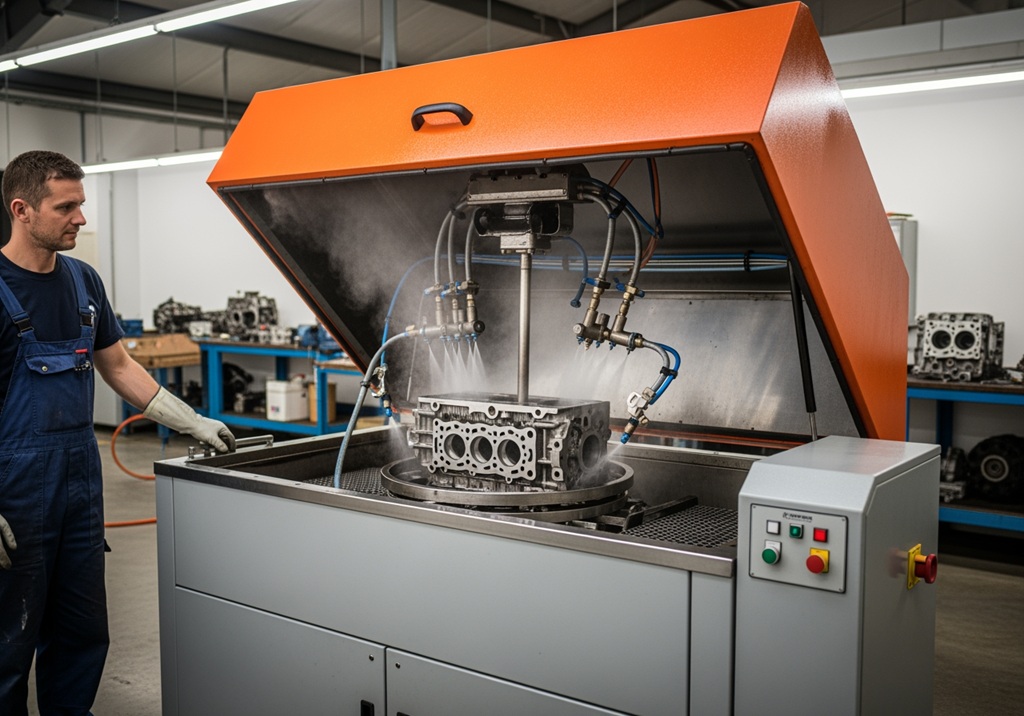
Parts that come out of the washer still dirty on one side. Surfaces that look clean until you turn the component over. A second wash cycle that takes as long as the first. These are the symptoms of a spray coverage problem – and they are more common with fixed spray systems than most workshops realise.
The turntable spray washer design addresses this problem directly. Instead of directing spray at stationary parts and hoping for complete coverage, the turntable rotates components through strategically positioned spray zones. Every surface gets exposure. One cycle delivers complete results.
Why Incomplete Coverage Costs Workshops Time and Money
The Problem With Fixed Spray Systems
Fixed spray systems mount jets at set positions inside the washing chamber. Parts sit stationary during the cycle. Surfaces that face a spray jet get cleaned. Surfaces that face away from all jets – or are shielded by another part of the component – do not get adequate cleaning.
This creates spray shadows: areas where contamination persists after the cycle completes. For simple, flat components with uniform geometry, this may not be a significant issue. For engine blocks, gearbox housings, differential cases, and other complex industrial components, spray shadows are a consistent problem that adds re-wash cycles to the workflow.
How Turntable Design Solves This
A turntable spray washer solves the spray shadow problem through motion. Instead of stationary parts and fixed spray, the turntable rotates components slowly during the cycle. As the component turns, every external surface passes through each spray zone. The angle of spray contact changes continuously. Dead zones disappear.
The practical result is consistent, single-cycle cleaning on components that previously required repositioning and re-washing. Workshops that track their re-wash rate consistently find it drops when they move from fixed spray to rotary cleaning.
How a Turntable Spray Washer Works
The Rotating Turntable Mechanism
A turntable spray washer operates with components sitting on a rotating platform inside the washing chamber. Spray arms are positioned at fixed points around the interior – above, to the sides, and where possible below the component. As the turntable rotates slowly during the cycle, the component passes through every spray zone multiple times.
The rotation speed is controlled to allow sufficient spray contact time at each position. Too fast, and each surface gets only brief exposure. Too slow, and cycle time extends unnecessarily. The right rotation speed is calibrated to the spray pattern and chamber dimensions to deliver thorough coverage within an efficient cycle time. The full parts washer range from Hotwash includes rotary turntable systems across multiple capacity tiers.
Hotwash Australia designs its rotary cleaning machine range with turntable speed, spray arm positioning, and chamber geometry working together. The result is a system where the mechanical design itself delivers coverage quality, rather than relying on the operator to position components for adequate spray access.
Heat, Detergent, and Rotation Working Together
Turntable parts cleaning combines three elements: heated water, biodegradable detergent, and mechanical coverage through rotation. Each element contributes to the result. Heat activates the detergent chemistry and accelerates grease dissolution. Detergent breaks down contamination and suspends it for flushing. Rotation ensures the heated detergent solution reaches every external surface.
None of these elements works as effectively without the others. Cold water reduces cleaning chemistry effectiveness. Poor coverage limits how much surface area the chemistry contacts. The combination in a turntable spray washer delivers results that simple spray systems cannot consistently match.
Turntable Load Capacity and Drive System
The turntable carries component weight throughout the cleaning cycle in a hot, wet environment. This places real demands on the bearing and drive system. Quality turntable design uses bearings rated for continuous operation under load in workshop conditions, and a drive system that remains reliable after years of daily use.
Bearing inspection is a standard maintenance task for rotary cleaning machine systems. Regular inspection catches wear before it becomes a failure. A properly maintained turntable drive system operates reliably for years. A poorly maintained one creates downtime and repair costs that undermine the workshop parts washer efficiency gains the system was purchased to deliver.
Complete Surface Coverage in a Single Cycle
How a Rotary Cleaning Machine Eliminates Spray Shadows
Spray shadows form when one part of a component blocks spray from reaching another part. A tall casting blocks the spray from reaching its underside. A complex housing with multiple faces presents different surfaces to different spray zones – some cleaned well, others barely touched.
A rotary cleaning machine eliminates spray shadows by continuously changing the relationship between the component and the spray zones. As the turntable turns, the surface that was previously shielded rotates into direct spray exposure. The surface that was facing directly into the spray rotates away and another face takes its position. Over the course of the cycle, every external surface receives direct spray contact multiple times.
Parts Washer Spray Coverage for Complex Components
Parts washer spray coverage is the key differentiator when cleaning components with irregular shapes, recessed areas, and multiple faces. Engine blocks have external surfaces that vary dramatically in geometry. Differential housings have a complex profile. Gearbox cases have recesses, mounting faces, and flanges that present different surfaces in different directions.
A fixed spray system struggles with all of these because it cannot reach every surface from a stationary position. A turntable spray washer handles them consistently because the rotation brings every surface into spray contact regardless of the component’s geometry.
One important distinction: rotary spray cleaning handles external surfaces. For internal passages such as oil galleries, coolant passages, and cross-drilled drillings, hot tank immersion cleaning is the appropriate method. Many engine rebuild workshops use both systems – the turntable spray washer for thorough external cleaning, the hot tank for internal passage cleaning.
Single-Cycle Cleaning: What It Means for Workshop Workflow
When a component consistently comes out clean in a single cycle, workshop planning becomes straightforward. A cleaning cycle takes a known amount of time. Parts go in dirty and come out clean. No inspection for missed areas. No repositioning for a second run. No manual touch-up.
This predictability contributes directly to workshop parts washer efficiency. Scheduling repair work becomes more reliable when cleaning time is a known constant. Technicians do not need to check whether parts have been cleaned adequately or route them for a second cycle. The rotary parts washer benefits extend beyond the cleaning result itself to the planning and scheduling of work around it.
Workflow and Labour Benefits
Workshop Parts Washer Efficiency in Practice
The workflow advantage of a turntable spray washer is most visible in operations that previously ran multiple spray cycles to achieve adequate cleaning. Loading a component, running a cycle, inspecting the result, repositioning, and running a second cycle doubles the time and occupies a technician for both cycles.
With a rotary cleaning machine, the process is: load, start cycle, move to other work, unload clean component. The machine runs unattended. The technician is productive throughout the cycle time. This parallel processing – cleaning happening simultaneously with other workshop tasks – is how the labour saving from automated parts washing compounds across a full working day.
Time Savings Across the Working Week
Workshop parts washer efficiency gains from eliminating re-wash cycles accumulate meaningfully over a working week. Each re-wash avoided is a cycle’s worth of time saved for both the machine and the operator. Across many components and many working days, this becomes a significant reduction in total cleaning time.
Rotary parts washer benefits also include the consistency element: every technician who loads the machine gets the same result. There is no variation based on how carefully parts were positioned, which shift ran the machine, or how experienced the operator is. Consistent results mean consistent quality across all the work that flows through the cleaning process.
Rotary Parts Washer Benefits by Industry
Automotive and Diesel Rebuild Workshops
Engine rebuild workshops clean components with complex external geometry regularly. Cylinder heads, engine blocks, and gearbox housings all have multiple faces, recesses, and irregular surfaces that challenge fixed spray systems. Rotary parts washer benefits in this setting include clean combustion chamber surfaces, properly cleaned valve seat areas, and consistent results on the varied component shapes that rebuild work produces.
Heavy duty parts washers with rotary turntable design suit automotive and diesel rebuild workshops handling this range of component types. The turntable handles the coverage work that would otherwise require manual repositioning.
Mining and Earthmoving Maintenance
Mining maintenance operations deal with heavily contaminated components in a wide range of sizes. The combination of extreme contamination and large, irregular component geometry makes parts washer spray coverage a consistent challenge for fixed systems. Rotary design addresses both the coverage problem and the contamination challenge through sustained, rotating spray contact with heated detergent solution.
Super heavy duty parts washers with rotary turntable design handle the largest components that mining and earthmoving maintenance requires. The turntable load capacity and chamber dimensions in this category accommodate components that would not fit in smaller systems.
Manufacturing and Food Processing Applications
Manufacturing facilities cleaning fabricated components, tooling, and machined parts benefit from the consistency that rotary cleaning delivers. Components with machined surfaces, threaded features, and tight tolerances need cleaning that reaches every surface reliably without leaving contamination in recesses.
Stainless steel parts washers with rotary design suit food processing applications where hygiene standards require thorough, consistent cleaning of components with complex geometry. The combination of stainless steel construction and rotary coverage addresses both the material and the cleaning requirement in food industry settings.
Comparing Rotary to Fixed Spray Systems
Where Fixed Spray Systems Work Adequately
Fixed spray systems clean simple components with uniform geometry effectively. If your workshop primarily cleans flat plates, simple housings with accessible external surfaces, or components that present all their surfaces easily to fixed spray positions, a fixed system may deliver adequate results at lower cost.
The comparison between rotary and fixed systems is most relevant when cleaning volume includes a significant proportion of complex components. Workshops that predominantly clean straightforward parts may not see enough benefit from rotary design to justify the difference in cost.
Where Turntable Spray Washer Design Delivers More Value
A turntable spray washer consistently justifies its design when complex components represent a significant part of the cleaning workload. The re-wash rate is the metric to watch. If your current system consistently requires re-washing or manual touch-up on a notable proportion of components, rotary design addresses that specific problem.
Extra heavy duty parts washers with rotary design suit operations where large, complex components are the norm rather than the exception. For these workshops, the rotary parts washer benefits – single-cycle cleaning, eliminated re-washes, consistent results – deliver measurable value from the first day of operation.
Maintenance Considerations for Rotary Systems
Turntable Bearing and Drive Maintenance
The turntable bearing system requires periodic inspection. Check for roughness, play, or unusual resistance in the rotation. Lubricate according to the manufacturer’s schedule. Keep the turntable surface and mounting points clean to prevent contamination buildup that affects rotation smoothness and balance.
The drive mechanism – whether belt-driven or direct-drive – needs tension or coupling inspection at regular intervals. A drive system in good condition runs smoothly and quietly. Changes in sound or rotation smoothness are early indicators that inspection is due.
Spray Jets and Filtration
Spray nozzles gradually wear or accumulate deposits that change the spray pattern. Inspect and clean nozzles regularly to maintain the spray coverage quality that the rotary cleaning machine design depends on. Worn or blocked nozzles create coverage gaps that undermine the single-cycle cleaning performance the system was designed to deliver.
Filtration protects the pump and maintains solution cleanliness. Clean or replace filters according to your cleaning volume and contamination levels. In high-contamination environments like mining maintenance, more frequent filter attention is appropriate. Wet abrasive blasters complement rotary spray washers for surface preparation tasks that spray cleaning cannot address.
Choosing the Right Rotary System for Your Workshop
Matching Turntable Diameter to Component Range
The turntable diameter must accommodate your largest regular components with adequate clearance for spray access. The chamber height must allow full component immersion in the spray field with clearance above the tallest component. Load capacity must comfortably handle your heaviest batch.
Measure your largest and heaviest regular components before specifying a system. A turntable that is too small forces you to clean large components in multiple orientations, partially reintroducing the repositioning problem that rotary design is meant to eliminate.
Getting the Right Advice
Selecting the right rotary system depends on your component range, cleaning volume, contamination levels, and workshop space. Specialist advice from people who work with Australian workshops daily helps match system design and capacity to your actual requirements.
For advice on rotary parts washer systems for your workshop, contact our parts cleaning specialists or email us at sales@hotwash.com.au.

Leave A Comment