
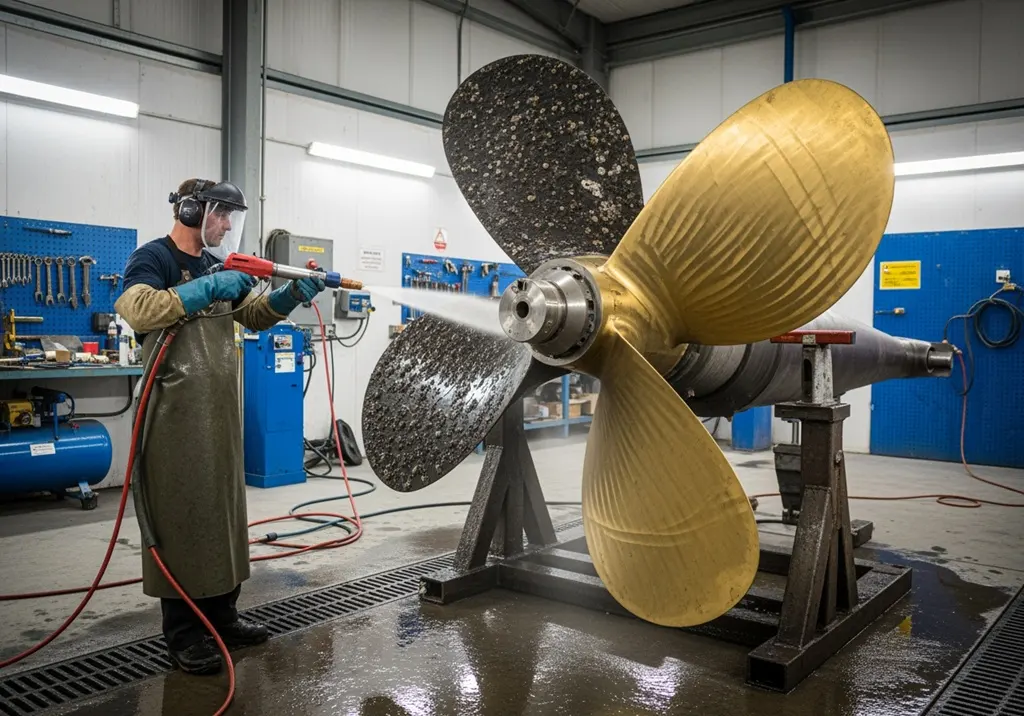
A fouled marine propeller drains fuel rapidly on every single trip. Hard barnacles attached to bronze blades create massive drag and turbulence underwater. This oxidation pits the expensive bronze and disrupts efficient smooth propulsion significantly. Commercial vessels see measurably higher fuel consumption across a full season of operation. Cleaning these components without damaging the precision material is a major challenge.
Every marine workshop needs reliable solutions to restore these vital components quickly. Finding a reliable wet abrasive blaster perth operators trust is absolutely essential. This guide explains how advanced wet blasting techniques restore marine bronze perfectly. You will learn why traditional cleaning fails and how to protect propellers.
Why Bronze Propellers Need Specialised Cleaning
The Challenge of Marine Fouling on Precision Components
Marine bronze faces continuous aggressive attack from saltwater and marine organisms. Barnacles attach themselves firmly to smooth blade surfaces and create heavy drag. Oxidation forms as a dark patina on the exposed propeller metal. This progresses to severe pitting corrosion when contaminated heavily with seawater chlorides.
Propellers operating in busy industrial waterways pick up additional chemical contamination. Oil residues and metallic particles compound the heavy marine fouling problem significantly. The real difficulty lies in the soft nature of marine bronze itself. Manganese bronze and nickel-aluminium bronze are relatively soft compared to marine steel.
Propeller blades feature specific pitch angles and highly precise surface finishes. These exact dimensional tolerances affect vessel handling and fuel efficiency dramatically. Cleaning methods must remove contamination without removing measurable amounts of actual bronze. Using professional abrasive blasting Perth services ensures these precise tolerances remain intact.
Why Traditional Methods Fall Short
Traditional wire brushing physically removes loose fouling but creates deep surface scratches. These microscopic scratches become active nucleation sites for accelerated marine corrosion later. The scratches are completely impossible to avoid with manual brush-based cleaning. They persist on the metal surface long after the fouling is gone.
Dry sandblasting removes contamination quickly but generates massive amounts of frictional heat. It creates hazardous dust and impacts soft bronze surfaces far too aggressively. Chemical strippers require extended soak times that vary with contamination severity unpredictably. They create hazardous chemical waste requiring expensive disposal and environmental management protocols.
Chemical residues interfere heavily with subsequent protective coating adhesion and curing times. Traditional parts cleaning methods simply cannot address severe barnacle growth effectively. Pressure washing removes soft algae but leaves hard calcium deposits completely untouched. Workshops require equipment that handles the harsh marine environment itself reliably. Investing in stainless steel parts washers ensures your equipment withstands coastal salt exposure.
How Wet Blasting Preserves Bronze Surfaces
The Science Behind Wet Abrasive Blasting
Wet blasting uses compressed air, water, and abrasive media delivered together. This controlled slurry provides a highly effective and gentle cleaning action. The water serves multiple vital functions simultaneously during the component cleaning process. It cushions the direct impact of the abrasive media on the bronze.
This eliminates the aggressive dry cutting action that ruins precision marine components. The constant water flow flushes removed material continuously away from the surface. This prevents removed marine growth from re-depositing on the clean propeller blades. It also eliminates the hazardous airborne dust that makes dry blasting dangerous.
A quality wet abrasive blaster machine allows operators to adjust pressure instantly. Light oxidation requires significantly less pressure than heavy calcified barnacle accumulation. The operator adjusts the cleaning intensity in real time as conditions vary.
Surface Quality and Dimensional Accuracy
Wet blasting generates absolutely zero frictional heat during the entire cleaning process. This matters immensely because localised heating creates internal stresses in the metal. Excessive heat can easily warp thin propeller blade sections beyond professional repair. The water stream maintains a consistent safe surface temperature throughout the job.
This temperature control is particularly important for large commercial vessel propellers. These propellers feature complex sections of widely varying thickness and metal density. Hotwash Australia understands the strict requirements of marine equipment maintenance perfectly. The finish produced is a highly uniform matte surface with controlled roughness.
This specific surface profile is the ideal condition for antifouling paint adhesion. It is not so smooth that new marine coatings cannot grip properly. It is not so rough that it requires extra paint to fill. Automated parts washers cannot reach complex blade root fillets and keyway slots. Wet blasting reaches these recessed areas easily for a truly complete clean.
Selecting the Right Abrasive Media for Bronze
Glass Bead for Routine Maintenance Cleaning
Glass bead in the fine grit range suits routine bronze propeller cleaning. It works perfectly where oxidation and light marine fouling are primary concerns. Glass beads produce a remarkably smooth satin finish on the bronze surface. They do this without causing any significant change to the surface profile.
The beads break down gradually during use inside the blasting cabinet system. This maintains a highly consistent cutting action as the media cycles continuously. This makes glass bead the appropriate choice for regular seasonal maintenance cleaning. It prepares the surface perfectly before new antifouling paint reapplication begins.
The gentle action preserves the bronze patina where it serves protective functions. It removes the ugly discolouration and organic fouling that impairs vessel performance. Finding a dependable wet abrasive blaster perth workshops use ensures gentle cleaning.
Aluminium Oxide for Moderate to Heavy Marine Growth
Heavily fouled commercial vessel propellers need significantly more abrasive cutting power. Aluminium oxide is physically harder than standard glass bead media options. It cuts through hard barnacle shells and thick oxidation layers very aggressively. Finer aluminium oxide grades suit general propeller restoration work and detail finishing.
Coarser grades are appropriate when removing heavy fouling quickly is the priority. This is common for large commercial propellers that require fast turnaround times. Quality abrasive blasting Perth facilities rely on aluminium oxide for tough jobs. For propellers out of service for extended periods, this media is essential.
It removes stubborn contamination that glass bead media would simply bounce off. The trade-off is a slightly more aggressive physical surface impact overall. This is perfectly acceptable on commercial propellers being prepared for full recoating. Heavy duty parts washers handle the engine components while the propeller is blasted.
Other Media Options and What to Avoid
Crushed glass offers an economical middle ground for large propeller cleaning tasks. It works well for fleet maintenance programmes where total media consumption is high. It is less aggressive than aluminium oxide but more effective than plastic. Plastic media provides the gentlest available cleaning action for very sensitive components.
It suits heritage vessel propellers where any dimensional change is completely unacceptable. Proper parts cleaning protocols require strict attention to the media being used. Steel shot and steel grit must never be used on marine bronze. Steel particles embed themselves deeply into the much softer bronze surface permanently.
These embedded steel particles create active galvanic corrosion sites almost immediately underwater. This accelerates future metal deterioration and ruins the expensive marine propeller completely. Marine surface preparation equipment should never be loaded with steel-based media products.
The Wet Blasting Process for Propeller Restoration
Preparation and Initial Inspection
Professional propeller restoration begins long before the actual blasting process starts. You must remove the propeller and document all existing physical damage carefully. Look for deep pitting, blade edge nicks, and hub keyway wear early. Do this while the heavy marine fouling is still present and visible.
Once cleaning begins, some surface features become difficult to distinguish from blasting. Photographs taken before blasting provide a reliable reference for future damage assessment. For propellers stored in dry dock, pre-soaking softens hardened marine growth effectively. This simple step makes the calcified growth much more responsive to blasting.
Always mask shaft tapers and keyways before starting the cleaning equipment. Protect any previously machined surfaces where dimensional preservation is absolutely critical. Automated parts washers handle the retaining nuts and bolts during this process.
Blasting Sequence and Technique
A professional wet abrasive blaster machine requires correct operator technique for success. Operators must work from the delicate blade tips down toward the hub. This ensures complete coverage while managing dirty slurry runoff from the area. The nozzle must be held at the appropriate distance and precise angle.
This delivers strong cleaning action without dwelling too long in one position. Dwelling causes uneven surface removal and risks altering the delicate blade geometry. Always start at a much lower pressure to assess the cleaning rate. Increase the pressure slowly only if the specific propeller contamination requires it.
Water flow must be sufficient to keep the entire surface completely wet. Blade root fillets require particular attention due to their tight concave shapes. Angle the nozzle to direct the abrasive stream deep into these areas. Marine growth and harsh corrosion concentrate heavily in these restricted root zones.
Final Rinse and Drying
A complete fresh water rinse after blasting is an absolutely vital step. It removes all remaining abrasive residue and dissolved salt from the surface. Any abrasive remaining on the metal interferes directly with coating adhesion later. It can cause massive premature coating failure once the vessel enters saltwater.
For propellers returning to service without paint, thorough rinsing prevents bearing damage. Abrasive grit entering shaft bearings during reinstallation destroys them very rapidly. Drying the cleaned bronze component must happen promptly after the final rinse. Bronze begins forming a new oxide layer within hours of air exposure.
Apply protective marine coatings within the same working session where physically possible. For propellers going into storage, apply a temporary liquid corrosion inhibitor immediately.
Assessing Damage Revealed by Cleaning
Pitting Corrosion and Galvanic Damage
Bronze blasting reveals the true surface condition that fouling previously concealed completely. Pitting corrosion appears as small hemispherical cavities scattered across the blade surfaces. Shallow pits covering a limited area generally have minimal effect on performance. They do not normally require expensive professional repair before returning to service.
Deeper pits or concentrated clusters near blade edges are much more significant. They warrant professional assessment before the propeller returns to active ocean service. Galvanic corrosion appears as localised deep erosion near dissimilar metal contact points. This happens where the bronze propeller meets steel shaft components or fasteners.
This galvanic damage typically extends much deeper than the surface appearance suggests. It requires proper assessment by a specialist rather than quick visual judgement. A reliable wet abrasive blaster perth service exposes this hidden damage perfectly.
Cavitation Erosion and Impact Damage
Cavitation erosion creates a rough, spongy texture on the smooth blade surfaces. It typically occurs on the low-pressure face near the leading blade edge. Light surface roughness without significant material loss can be addressed during restoration. Using professional abrasive blasting Perth equipment smooths these minor imperfections out well.
Severe cavitation with major material loss requires highly specialised expert weld repair. Impact damage from striking submerged objects is clearly visible after cleaning finishes. You will easily spot bent blade edges, deep gouges, and large nicks. Minor edge nicks can be filed smooth into the existing blade profile.
Significant material loss requires professional repair to restore proper geometry and balance. An unbalanced propeller destroys shaft seals and causes massive engine vibration issues.
Protective Coatings After Wet Blasting
Antifouling Paint Application
Wet blasting produces the exact surface conditions that modern antifouling coatings need. The controlled microscopic roughness profile provides excellent mechanical grip for the primer. Antifouling paints use copper compounds as their primary active chemical ingredient typically. These strong biocides create a toxic microenvironment right at the metal surface.
This discourages barnacle and marine algae settlement throughout the busy boating season. Apply your antifouling paint promptly after blasting finishes and the metal dries. Do this before fresh oxidation forms on the bare bronze propeller surface. Follow manufacturer specifications strictly for primer requirements and application film thickness.
Most high-quality marine antifouling systems require a primer coat applied first. This is followed by several antifouling coats for effective long-term seasonal protection. Extra heavy duty parts washers clean the heavy shaft components while paint cures. Regular use of parts washers keeps the entire drivetrain in perfect condition.
Epoxy and Speed Coatings
Epoxy coating systems create a much harder, more durable protective surface barrier. They suit propellers operating in severely fouling commercial or industrial waterway conditions. They are ideal where much longer intervals between expensive haul-outs are desired. Some advanced epoxy formulations incorporate biocides to fight heavy marine growth aggressively.
Other systems rely on a surface too slick for organisms to grip. Speed coatings require incredibly precise surface preparation to bond to the bronze. A good hot tank parts cleaner prepares smaller brass fittings perfectly beforehand. Hot tanks strip old paint effectively before the wet blasting process begins.
For commercial vessels, combining wet blasting with quick-cure coatings minimises expensive downtime. A complete clean, coat, and reinstall within one shift saves massive costs.
Equipment and Safety for Marine Bronze Blasting
Equipment Capacity and Requirements
Marine surface preparation equipment requires adequate pressure capacity and large hopper volume. Consistent water supply is also critical for maintaining the wet slurry mixture. Adjustable pressure control allows operators to work across different vessel contamination levels. They can switch from light to heavy cleaning within the exact same job.
Air compressor capacity must strictly match the blasting system consumption rates listed. Undersized air compressors cause pressure fluctuations that create highly inconsistent cleaning results. A hot tank parts cleaner requires dedicated power, just like a large blaster. Proper nozzle selection affects both your cleaning pattern and overall coverage efficiency.
A versatile bore size provides concentrated power for heavy barnacle removal work. It also provides the fine control needed for detail work around edges. Hot blasters work exceptionally well alongside wet systems for smaller intricate components.
Operator Safety and Waste Management
Respiratory protection is strictly required even with wet blasting’s reduced dust profile. The water mist contains suspended abrasive particles and toxic contaminants from propellers. You are blasting away copper compounds, antifouling paint residues, and organic material. Proper parts cleaning protocols demand full face protection and waterproof clothing always.
Hearing protection is necessary for extended commercial marine blasting sessions in boatyards. Slurry waste management requires careful operational planning before any cleaning work begins. The used abrasive and water mixture contains dangerous biocides and heavy metals. This toxic slurry cannot be discharged directly into local waterways or drains.
Collection systems must allow heavy solids to settle before treating the water. This ensures strict compliance with environmental regulations for all marine maintenance operations.
Conclusion
Bronze blasting with wet abrasive equipment restores marine propellers to perfect condition. It cleans without the surface damage or heat distortion of dry blasting. The process removes heavy barnacle accumulation, hard oxidation, and deep corrosion deposits. It preserves the vital dimensional accuracy that propeller performance and efficiency demand.
Propeller restoration using wet blasting produces results that wire brushing cannot match. The surface left behind is ready for highly accurate structural damage assessment. It provides the ideal microscopic conditions for new antifouling coating adhesion later. For commercial operations, thorough blasting at each haul-out pays for itself quickly.
It reduces fuel consumption and prevents expensive unplanned drivetrain maintenance issues completely. Finding a reliable wet abrasive blaster perth provider improves your maintenance schedule. Using professional abrasive blasting Perth services keeps your vessel running efficiently year-round.
For advice on the right parts washer for your workshop, contact our equipment specialists or email us at sales@hotwash.com.au.

Leave A Comment