
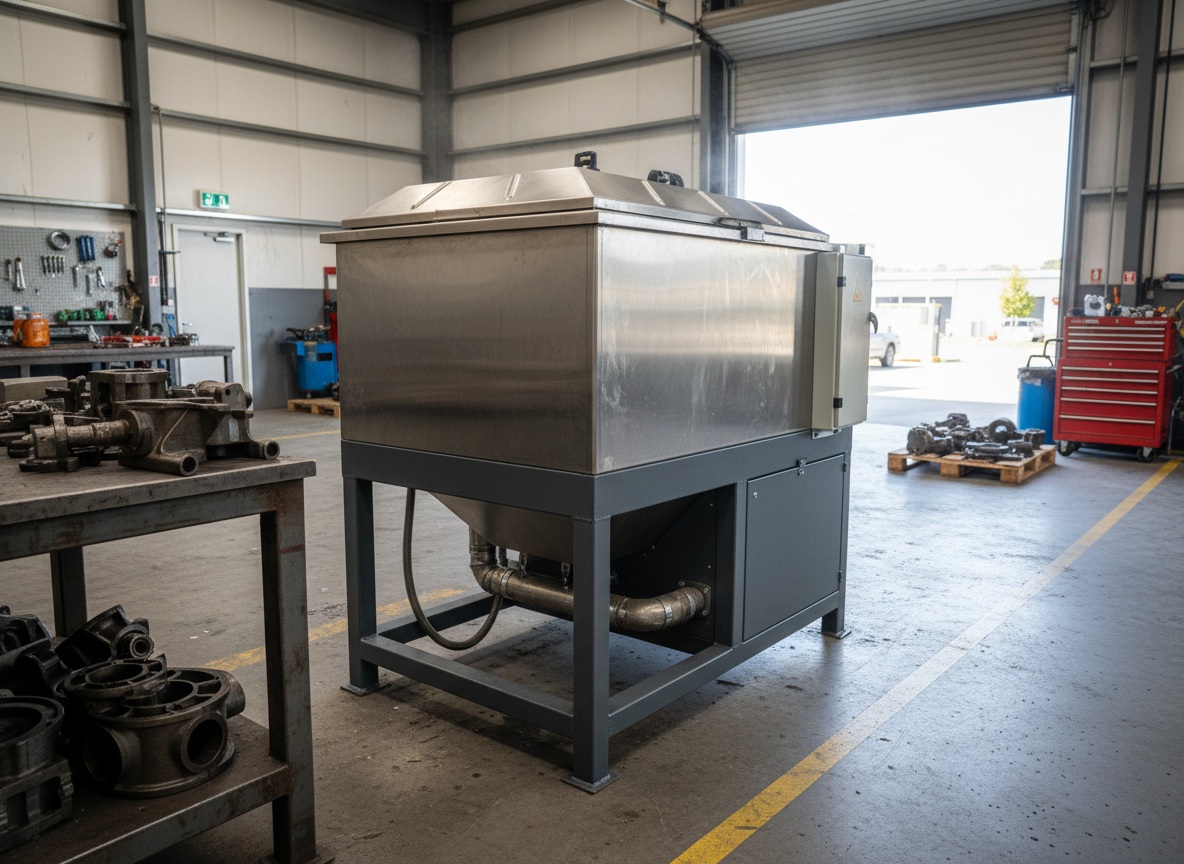
Heated parts washing depends on keeping cleaning solution at a useful operating temperature. Heat naturally moves from warmer equipment into cooler surroundings. That means tank construction can influence how often the heating system needs to restore lost heat.
An insulated wash tank is designed to slow that heat transfer. Hotwash lists a fully insulated tank as a standard feature on its Super Heavy Duty range. It also identifies insulation in other specific equipment categories. This article explains the role of insulation without assigning unverified savings or operating-cost figures.
Why Heated Wash Tanks Lose Heat
Heat Transfer to the Surrounding Workshop
A heated tank loses energy through walls, lids, openings, pipework, and normal operation. Heat can also leave when warm solution is removed or cooler make-up water enters.
The exact heat-loss pattern depends on machine design and how the equipment is used. Workshop temperature, cycle frequency, cleaning routine, and tank condition all contribute.
Hotwash lists super heavy duty washers with a fully insulated tank as a standard feature. The company connects that feature with reduced running costs, but it does not publish a universal saving for every site.
That distinction is important. An insulated wash tank can support heat retention, but it cannot determine the whole operating cost by itself.
Equipment running costs also depend on power supply, heating demand, operating schedule, detergent use, water management, and maintenance.
Insulation as a Heat-Management Feature
Insulation creates resistance to heat flow between the warm tank and the surrounding air. In practical terms, it helps the tank retain heat between heater cycles.
This can reduce unnecessary heat loss, especially when a machine remains warm for extended periods. Actual performance depends on the insulation design and operating conditions.
Hotwash also describes its extra heavy duty washers as having dual-skin construction that offers insulation. That is a different published construction description from the fully insulated tank listed on the Super Heavy Duty range.
Do not assume the two designs are identical. Product pages should be read according to the exact range being considered.
For equipment selection, insulation is best treated as one part of the thermal design.
Where Hotwash Lists Insulation
Super Heavy Duty Fully Insulated Tanks
The Super Heavy Duty product page lists a fully insulated tank among its standard features. The same range includes other service and operating features designed for demanding industrial environments.
For workshop managers, the useful takeaway is that insulation is integrated into the listed tank design. It is not described as an add-on assumption.
The page does not state that the tank eliminates heat loss. It also does not provide a guaranteed cost reduction.
That careful reading matters for equipment running costs. A feature can support lower heat loss without supporting a precise financial claim.
A proper operating review should compare similar cleaning workloads, machine condition, and usage patterns.
Extra Heavy Duty Dual-Skin Construction
The Extra Heavy Duty range uses a dual skin that Hotwash says offers insulation and another layer of strength. This creates another route to heat management within the company’s automatic washer range.
Hotwash also supplies hot blast cabinets with an insulated washing tank. The hot blaster page states that the insulated tank reduces energy consumption.
These are separate equipment types with different cleaning methods. Their insulation features should not be treated as interchangeable specifications.
At the broader product level, Hotwash Australia supplies automatic and specialised cleaning equipment for Australian workshops. Heated cleaning appears across several product families, but the construction details vary.
An insulated wash tank should therefore be verified on the exact model or category page before it becomes part of a purchasing decision.
Running Cost Factors Beyond Insulation
Heating, Cycle Use, and Lid Opening
Heating demand changes with operating practice. Repeated lid opening, cool make-up water, long idle periods, and frequent tank changes can all affect energy use.
Insulation cannot control those factors. It only helps reduce heat transfer through insulated surfaces.
Equipment running costs should therefore be reviewed as a whole. A well-insulated machine used inefficiently can still consume more energy than expected.
Where the cleaning process allows it, organise work so the machine is used in a planned sequence. Avoid heating equipment unnecessarily when no cleaning work is scheduled.
Do not change operating temperatures outside the manufacturer’s instructions simply to save energy. Cleaning effectiveness and chemical performance depend on suitable operating conditions.
Cleaning, Water Condition, and Maintenance
Deposits inside heated equipment can affect normal operation and make inspection more difficult. Follow the maintenance guidance for tank cleaning and water management.
Hotwash also offers hot tanks as a separate immersion-cleaning category. These are not the same as spray washers, so their heating and cleaning process should be assessed separately.
Keep heater areas, accessible tank surfaces, filters, and drainage points maintained according to the machine documentation.
Check door or lid condition where applicable. Poor closure or damaged seals can increase unwanted heat and vapour escape.
An insulated wash tank performs best as part of a maintained system. It should not be treated as a substitute for routine care.
Choosing Heated Wash Equipment
Compare the Complete System
Begin with the cleaning requirement. Identify component size, contamination type, handling method, desired automation, and available workshop space.
Then compare the published equipment categories. The Hotwash parts washer range includes automatic spray washers and specialised cleaning equipment with different methods.
For a heated system, review tank design, access, heating, insulation, drainage, pump arrangement, and controls. Do not select equipment from one feature alone.
Equipment running costs are affected by how those systems work together in daily use.
Where insulation is important, ask whether it applies to the tank, cabinet, dual-skin structure, or another area. Use the client’s model-specific documentation as the reference.
Ask for Model-Specific Information
If a published page does not state the insulation arrangement for a particular model, confirm it before making assumptions.
Ask how the machine should be operated during idle periods. Also ask about cleaning chemistry, maintenance access, water management, and heater care.
Avoid basing a purchase on generic savings claims. Site conditions and usage patterns vary too much for a universal result.
A better decision uses verifiable equipment features and a realistic understanding of the workshop’s cleaning workload.
FAQs
What Does an Insulated Wash Tank Do?
An insulated wash tank slows heat transfer from the heated tank to the surrounding workshop. This can help the machine retain heat during operation.
Does Insulation Guarantee Lower Bills?
No. Insulation can reduce heat loss, but total energy use also depends on operating schedule, heating demand, water changes, maintenance, and other factors.
Which Hotwash Equipment Lists Tank Insulation?
Hotwash lists a fully insulated tank on its Super Heavy Duty range. Its Extra Heavy Duty range lists a dual skin that offers insulation. The Hot Blaster page also refers to an insulated washing tank.
Is Insulation the Only Factor Affecting Heat Use?
No. Heater control, tank condition, lid opening, make-up water, cleaning schedules, and maintenance can all influence energy demand.
Conclusion
An insulated wash tank can help heated cleaning equipment retain more of the heat it already produces. Hotwash verifies insulation features on specific product ranges rather than presenting one universal tank design.
Equipment running costs should still be assessed across the whole cleaning process. Operation, water management, maintenance, and machine selection all matter.
To review heated washer options for your application, request model-specific guidance or email sales@hotwash.com.au.

Leave A Comment