
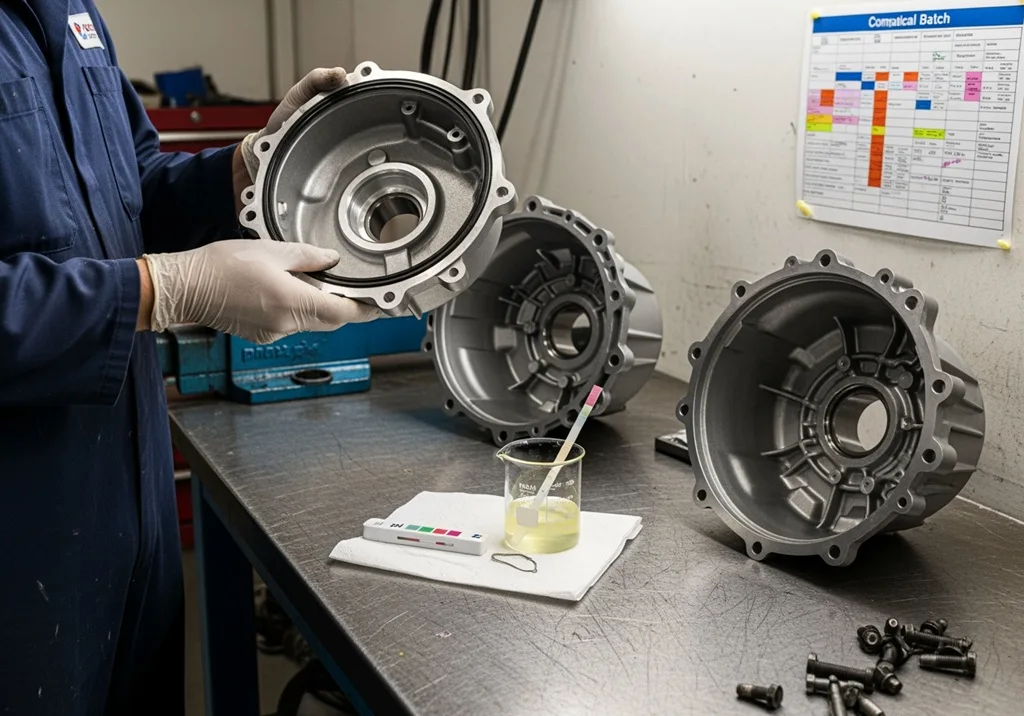
Cleaning mixed-alloy assemblies is one of the more costly mistakes a workshop can make when the wrong chemistry is involved. A transmission housing combining an aluminium bell housing with steel internals. An excavator hydraulic block mixing aluminium castings with steel fittings. An engine assembly with an aluminium head on a steel block. Get the pH wrong in the wash cycle and you will pull parts from the washer with damaged threads, pitted sealing surfaces, or structurally compromised castings.
This article covers why pH matters when cleaning mixed-alloy components, how to choose the right chemistry and equipment, and what to inspect after every wash to catch problems before they reach the rebuild bench.
Why pH Destroys Aluminium in Parts Washers
How Extreme pH Attacks Aluminium’s Oxide Layer
Aluminium reacts to extreme pH levels at both ends of the scale. Strong alkaline solutions attack the metal’s protective oxide coating, exposing raw metal to further chemical attack. Even at moderately high pH levels, prolonged exposure in a hot wash solution causes visible surface damage – grey discolouration appears first, followed by pitting that compromises sealing surfaces and threaded holes.
Acid-side solutions cause similar damage through a different mechanism. Low pH strips the oxide layer just as effectively as high alkaline chemistry, producing bright etching on the surface rather than the grey staining that alkaline attack creates. Both forms of damage weaken the aluminium component and create leak paths at sealing surfaces – expensive outcomes that an alloy safe cleaner approach prevents entirely.
Why Steel and Aluminium Cannot Share Aggressive Chemistry
Steel tolerates pH extremes that aluminium cannot. This is the core problem with mixed-alloy cleaning. Use chemistry aggressive enough to clean steel effectively and you risk destroying the aluminium components in the same assembly. Most standard industrial degreasers run at high alkaline pH to cut through oil and carbon on steel – appropriate chemistry for steel, but harmful to aluminium when the two metals share the same wash cycle without appropriate chemistry selection.
The problem appears daily in Australian workshops. Mining operations cleaning loader hydraulic blocks. Automotive shops handling modern engine assemblies. Transport workshops processing truck components that combine aluminium housings with steel running gear. In every case, the answer is not to separate the metals before washing – it is to use an alloy safe cleaner that handles both materials in the same cycle without compromising either.
The Safe pH Range for Mixed-Alloy Cleaning
The Aluminium-Safe Window Explained
Aluminium survives pH 7 to 10 without damage in normal workshop cleaning conditions. This range allows effective cleaning of most contamination types whilst protecting the metal’s oxide layer from chemical attack. A pH neutral wash operating within this window can safely process mixed-alloy assemblies without requiring component disassembly.
Neutral to mildly alkaline cleaners in the pH 8 to 9.5 range handle the contamination most commonly encountered in Australian workshops – engine oil, hydraulic fluid, grease, and carbon deposits. The cleaning process takes slightly longer than aggressive caustic solutions, but the result is spotless components with no material damage. This is the core value proposition of pH balanced industrial cleaning for workshops handling mixed metals.
How pH Balanced Chemistry Replaces Aggressive Cleaning Power
The cleaning power that caustic chemistry delivers through extreme pH can be replicated through a combination of temperature and surfactant chemistry at safe pH levels. Heat a pH 8.5 solution to 70 to 80°C and the cleaning performance approaches that of far more aggressive chemistry at ambient temperature – without the corrosion risk.
Temperature increases molecular activity, helping surfactants penetrate and lift contamination faster. The result is that a pH neutral wash with properly selected surfactant chemistry and adequate heat delivers results comparable to caustic solutions for most workshop applications, whilst remaining completely safe for aluminium alloys throughout the cycle.
How Modern Parts Washers Protect Aluminium
Controlled Chemistry and Consistent pH
Automated spray washers address the mixed-alloy cleaning challenge through controlled chemistry and precise temperature management. Unlike manual cleaning or open caustic tanks where concentration varies and pH drifts as solution ages, modern systems recirculate and filter the cleaning solution, maintaining stable pH throughout the wash cycle.
A mixed alloy parts washer with a sealed recirculating system maintains consistent solution strength from the first component to the last. There are no hot spots of concentrated alkali from uneven mixing, no pH spikes as detergent is added without proper measurement, and no progressive deterioration of solution quality that leaves later components washed in increasingly different chemistry than earlier ones.
This consistency is what makes an automated mixed alloy parts washer reliable for production use – every component in a batch receives identical chemistry at identical temperature, which means aluminium corrosion prevention cleaning is built into the process rather than depending on individual care at each cycle.
Spray Action and pH Reduction Working Together
High-pressure spray action reduces the need for aggressive chemistry by providing mechanical cleaning force alongside the chemical action. Spray jets at 60 to 80 PSI physically dislodge contamination, meaning the chemistry only needs to loosen rather than fully dissolve every contaminant. This mechanical assist allows effective cleaning at pH levels that are safe for aluminium rather than requiring the extreme alkalinity that passive soaking systems need to compensate for their lack of mechanical action.
Hotwash Australia automated washers combine spray pressure with programmable cycles, allowing workshops to set different parameters for aluminium-intensive components compared to all-steel parts. A shorter, lower-pressure cycle protects a lightly contaminated aluminium transmission case. An extended cycle with higher temperature handles a steel diff housing caked in gear oil – all within the same equipment, without exposing aluminium components to conditions designed for steel.
Choosing the Right Detergent for Multi-Metal Assemblies
What to Look for on the Technical Data Sheet
Not all industrial detergents safely clean aircraft components or mixed-alloy workshop assemblies. Before filling your washer, check the technical data sheet for four key specifications. The pH range at working concentration should sit between 7.5 and 9.5. The product label must explicitly state aluminium safe – this is not an implied claim, it needs to be stated directly. The effective temperature range should cover 60 to 80°C. And the formulation should be surfactant-based rather than caustic or acidic in its primary cleaning mechanism.
Aluminium safe detergent formulations like ARDROX and similar aviation and automotive-grade cleaners work at pH 8 to 9, providing strong degreasing without attacking soft metals. These products cost more than basic caustic degreasers, but the cost difference is trivial compared to replacing a single damaged aluminium component. Dilution matters critically – always mix to manufacturer specifications. Concentrated detergent may measure pH 10 to 11, but diluted to working strength it drops to pH 8 to 9. Never assume that stronger concentration improves cleaning results – for aluminium, over-concentration is how damage starts.
Testing New Detergents Before Processing Expensive Parts
Before running a new detergent formulation on high-value mixed-alloy components, test it on a sample aluminium piece through a full wash cycle at your intended temperature and duration. Inspect for discolouration, surface roughness, or any change in surface texture. This simple verification step takes minutes and prevents the kind of costly mistakes that happen when new chemistry is introduced directly into production use without confirmation of aluminium compatibility.
Temperature Control for Safe Aluminium Cleaning
The Safe Temperature Window for Mixed Alloys
Heat amplifies pH effects on aluminium. A mildly alkaline alloy safe cleaner that is safe at ambient temperature becomes more aggressive at elevated temperature. Keep wash temperatures between 60 and 80°C for mixed-alloy assemblies. This range provides excellent cleaning power whilst staying below the threshold where pH-related aluminium corrosion accelerates. Stainless steel parts washers with precise temperature control maintain this safe operating window automatically, eliminating the manual monitoring that open tank systems require.
Avoid temperature spikes during heating cycles. Rapid temperature changes can create stress in aluminium castings and mixed-metal assemblies. Quality washers heat gradually and maintain stable temperatures throughout the cycle – a design characteristic that supports both aluminium safety and component integrity.
Rinse Temperature and Residue Prevention
Rinse temperature is as important as wash temperature for aluminium corrosion prevention cleaning. Hot rinse water at 60 to 70°C removes detergent residue more completely than cold water, preventing chemical deposits on aluminium surfaces that can cause long-term corrosion between service intervals. The final rinse must use clean, heated water with no detergent present – residual chemistry left on aluminium surfaces continues to act between the wash cycle and reassembly, causing gradual damage that is difficult to trace back to the cleaning process.
Cycle Timing to Prevent Aluminium Damage
Exposure Time and the pH Damage Threshold
Even mild alkaline solutions at safe pH cause problems with extended contact. pH balanced industrial cleaning relies on appropriate cycle timing as much as correct chemistry. Standard wash cycles of 15 to 30 minutes for most mixed-alloy assemblies provide enough time for heated surfactant solution to penetrate oil and grease deposits whilst staying well below the exposure threshold for aluminium damage.
Running parts through extended cycles – or leaving components in the washer after the cycle completes – removes the safety margin that correct pH provides. An aluminium safe detergent is safe within the intended exposure parameters. Treat it accordingly and the aluminium corrosion prevention cleaning outcomes are reliable. Ignore cycle timing and even the right chemistry can cause damage.
Staged Washing for Heavily Contaminated Components
For heavily contaminated mixed-alloy components, a two-stage wash approach with a mid-cycle rinse is more effective than a single long cycle. An initial 15-minute hot wash lifts the bulk of the contamination, followed by a drain and rinse to remove dissolved contamination and prevent pH concentration as water evaporates. A second 15-minute wash with fresh solution completes the cleaning without extending continuous exposure time to aluminium surfaces.
Extra heavy duty parts washers used in mining operations often include programmable multi-stage cycles specifically designed for mixed-alloy components. The automation ensures consistent timing – no components left soaking beyond the safe exposure window, no rushed single cycles that leave heavy contamination behind.
Inspection Points After Washing Mixed Alloys
What pH Damage Looks Like on Aluminium Surfaces
Visual inspection after every wash cycle catches pH-related damage before it reaches the rebuild bench. Aluminium should maintain its original appearance after washing with correct chemistry – machined surfaces stay smooth, castings retain their texture, and anodised surfaces show no colour change.
Grey discolouration is the first sign of alkaline attack. White powdery deposits indicate chemical reaction with the oxide layer. Roughened surfaces where the material should be smooth signal progressive etching. If any of these appear, stop using the affected chemistry immediately and investigate whether concentration, temperature, or cycle time exceeded safe parameters for aluminium.
Sealing Surfaces, Threads, and Thin Sections
Certain component areas show pH damage before others and require close inspection after every wash. Gasket faces and O-ring grooves must remain smooth and flat – even minor pitting creates leak paths that no amount of torque or sealant will reliably fix. Threaded holes are equally critical for aluminium corrosion prevention cleaning outcomes; damaged threads will not hold torque specifications and can cause catastrophic assembly failures in service.
Thin sections – fins, ribs, and thin-wall castings – show pH damage earliest because they have less material to absorb chemical attack. Check these areas first when inspecting for problems. Catching early-stage damage allows immediate process correction before the damage progresses to irreparable levels.
Real Workshop Applications for pH-Balanced Cleaning
Mining Hydraulic Blocks and Automotive Engine Assemblies
Mining workshops cleaning excavator hydraulic blocks face the classic mixed-alloy challenge – aluminium manifolds with steel fittings, all coated in hydraulic oil and mud. A super heavy duty parts washer running alloy safe cleaner at pH 8.5 and 75°C cleans these assemblies thoroughly without damaging the aluminium castings. Processing complete assemblies rather than disassembled components saves significant workshop time per job.
Automotive shops handle modern engines – aluminium blocks, aluminium heads, steel crankshafts, and steel connecting rods – through the same washer every day. A mixed alloy parts washer configured for pH balanced industrial cleaning allows complete engine assembly processing without component separation, eliminating hours of disassembly and reassembly labour per engine rebuild.
Food Processing and Transport Workshops
Food processing facilities maintain mixers and processing equipment combining aluminium housings with stainless steel shafts and fittings. These applications need both aluminium safe detergent and food-grade cleaning standards – typically pH 7.5 to 8.5 biodegradable detergents run through stainless steel washers. The chemistry protects aluminium whilst leaving no residues that could affect food safety compliance between processing runs.
Transport workshops handle constant mixed-alloy work – aluminium fuel tanks, aluminium wheels, aluminium transmission housings, all requiring the same cleaning standards as steel brake drums and diff housings. A pH neutral wash lets them process everything through the same washer without component segregation, maintaining throughput and eliminating the handling and organisation time that separate cleaning processes demand.
Cost Analysis and Transition Planning
The True Cost of Using Incorrect pH Chemistry
Aluminium safe detergent formulations cost more per drum than basic caustic degreasers. That cost difference disappears entirely when weighed against the real expense of using incorrect chemistry. One damaged aluminium transmission housing, one corroded excavator hydraulic manifold, or one set of pitted sealing surfaces on a rebuilt engine all cost far more to replace or repair than a year of premium detergent spend.
The labour cost of unnecessarily separating mixed-alloy assemblies before washing is equally significant. Processing complete assemblies through a mixed alloy parts washer running alloy safe cleaner saves the disassembly and reassembly time that incorrect chemistry forces on every job. For workshops handling mixed-alloy work daily, this labour saving alone justifies the detergent cost difference many times over.
Switching From Caustic to pH-Balanced Cleaning
Transitioning from caustic to pH balanced industrial cleaning requires a chemistry change, not an equipment change. Your existing parts washer stays – you are changing what goes in it. Drain and flush the system completely to remove caustic residue before introducing aluminium safe detergent. Residual caustic will spike the pH and compromise the new chemistry’s performance until it is fully displaced.
Monitor pH weekly using basic test strips. The working solution should remain stable between 7.5 and 9.5. Significant drift indicates contamination, improper dilution, or solution age requiring a tank replacement. Train staff on why concentration matters – adding extra detergent to boost cleaning power is counterproductive with pH balanced chemistry where the damage risk increases with concentration above the specified range.
For advice on alloy safe cleaner selection, mixed alloy parts washer configuration, and pH balanced industrial cleaning protocols for your specific workshop applications, reach out to our equipment specialists or email us at sales@hotwash.com.au.

Leave A Comment