
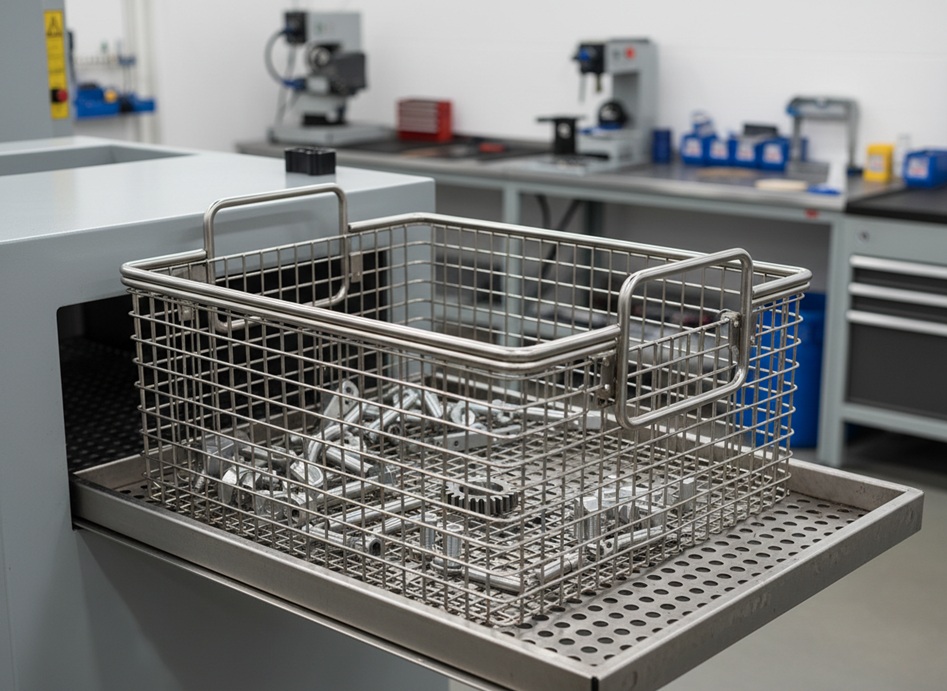
An automatic parts washer delivers thorough cleaning when components are positioned correctly inside the chamber. Position a component with one face shielding another from the spray jets, and that shielded surface does not get cleaned regardless of how capable the machine is. Position a small fastener in a basket where it falls through the mesh, and it ends up at the bottom of the tank rather than clean and ready for assembly.
Parts washer accessories – baskets, trays, and positioning systems – determine whether the machine’s cleaning capability translates into clean components. This guide explains which accessory types address which cleaning challenges and how to match them to your workshop’s component range.
Why Accessories Determine Cleaning Results
The Link Between Component Positioning and Cleaning Thoroughness
Automatic spray washers distribute cleaning chemistry through rotating spray arms that reach all surfaces from changing angles. This coverage works when components are positioned with adequate clearance for spray to reach every surface. When one component or part of a component shields another from spray contact, that shielded area does not receive adequate cleaning – a spray shadow.
Parts washer accessories control component positioning to eliminate spray shadows. The right parts washer basket holds components at the correct height, spacing, and orientation for the spray arm geometry of your specific machine. Accessories designed for particular component types remove the guesswork of positioning and produce consistent results across operators and shifts.
What Standard Baskets Cannot Do
General-purpose baskets that come with most automatic parts washers suit a broad range of typical workshop components. But the right basket for parts washer applications varies considerably with the component range being cleaned. Identifying the right basket for parts washer requirements starts with understanding which component types present the most consistent positioning challenge. Engine blocks, gearbox housings, diff cases, and brake assemblies all position reasonably well in standard baskets. But workshops that clean components outside this typical range quickly encounter limitations.
Small fasteners, injector bodies, hydraulic fittings, and precision components fall through standard mesh openings. Large mining components exceed standard basket dimensions and cannot be positioned for adequate spray coverage. Manifolds, turbocharger housings, and valve bodies have internal passages that need specific orientation to receive spray penetration. Component cleaning accessories address each of these limitations with solutions matched to the specific problem.
Basket Types for Different Component Sizes
Fine-Mesh Baskets for Small Parts Cleaning
Why Small Components Need Specialist Containment
Small components present a specific challenge in automatic parts washers: standard mesh openings that allow adequate spray flow through the basket also allow small parts to fall through. A fastener or small fitting that drops to the tank bottom does not get cleaned. Retrieving it from the bottom of a hot tank after the cycle is a time-wasting and potentially unsafe task.
A small parts cleaning basket with fine mesh containment – openings sized below the smallest component – contains parts throughout the cycle while allowing spray to penetrate. Selecting the right small parts cleaning basket mesh size is the primary specification decision for this accessory type and clean effectively. The mesh openings need to be small enough to contain the smallest regular components without being so fine that they block spray penetration and reduce cleaning effectiveness.
Mesh Size Selection for Different Components
The right mesh size balances containment with spray access. Very fine mesh keeps even the smallest components in the basket but can create a barrier that reduces spray penetration and cleaning effectiveness. Coarser mesh allows better spray flow but may let smaller parts through.
For most small parts applications – fasteners, small fittings, precision components in the typical workshop range – a medium fine mesh provides adequate containment with good spray penetration. For very small precision components like injector parts or miniature hydraulic fittings, finer mesh may be necessary even if it requires longer cycle times to compensate for reduced spray penetration.
Standard Baskets for General Workshop Components
Standard parts washer baskets handle the components that represent the majority of workshop cleaning volume. The load capacity rating of the basket – how much weight it can safely support – determines which components it suits. A basket rated for standard automotive components may not safely support the weight of heavy industrial or mining components.
Component cleaning accessories like fine-mesh inserts and divided trays address specific loading challenges that standard baskets cannot. For most heavy duty parts washers in automotive and general industrial workshop settings, standard baskets handle engine blocks, transmission cases, differential housings, cylinder heads, and brake assemblies without requiring specialist accessories. The key is ensuring the basket capacity rating matches the actual component weights being cleaned and that load is distributed evenly across the basket rather than concentrated in one area. For workshops that also use wet abrasive blasters for surface preparation, separate basket systems suited to abrasive blasting environments may be needed alongside those for spray washing.
Heavy-Duty Baskets for Large Industrial Components
Mining maintenance, earthmoving repair, and heavy industrial workshops clean components that require baskets with substantially higher load ratings and larger dimensions than standard workshop accessories provide. Components from large excavators, haul trucks, and heavy industrial equipment often exceed standard basket capacity in both weight and dimensions.
Heavy-duty baskets for these applications incorporate reinforced construction, heavier gauge mesh or frame material, and integrated lifting points that allow crane or hoist loading rather than manual handling. The lifting points are important: components at the weight levels mining maintenance handles cannot be safely positioned in baskets without mechanical lifting assistance. A basket without crane-compatible lifting points is not a safe solution for these components.
Super heavy duty parts washers designed for major mining and industrial operations require accessories matched to the scale of those systems. The basket size, load capacity, and lifting provisions must all correspond to the components these machines are designed to clean.
Parts Washer Loading Tray and Positioning Options
Divided Trays for Multi-Job Batch Processing
A parts washer loading tray with internal divisions allows multiple jobs to be processed in a single cleaning cycle without mixing components from different jobs. Automotive workshops processing several vehicles simultaneously benefit from this capability – components from each job stay separated while sharing a cleaning cycle.
Batch processing through divided trays reduces the number of cycles needed to clean the same total component volume. Fewer cycles means less energy consumption, less chemistry consumption, and more efficient use of machine time. The same cleaning result is achieved with less operational overhead.
Angled Trays for Internal Passage Cleaning
Components with ports, galleries, and internal passages require specific orientation relative to the spray arms for adequate internal cleaning. A cylinder head positioned flat in a standard basket presents its combustion chamber surfaces and port openings horizontally. Spray reaching the port openings at this angle does not penetrate deeply into the port.
The same cylinder head positioned at an angle so the port openings face toward the spray arms receives spray directly into the ports during the cleaning cycle. This component cleaning accessory approach – using angle-adjustable trays to orient components for direct spray access to internal features – addresses the internal passage cleaning challenge that spray washers face compared to immersion cleaning.
The right angle depends on the specific component geometry and the spray arm configuration of the machine. For workshops that regularly clean the same component types, a parts washer loading tray designed for those specific components provides consistent results without trial and error positioning each cycle.
Rotating Basket Systems for Complex Geometries
Components with complex external geometry benefit from rotation during the cleaning cycle. As the component rotates, surfaces that were previously shielded from spray jets rotate into direct exposure. This is the same principle as the turntable design in the parts washer itself – rotating the component through spray zones rather than relying on fixed positioning to cover all surfaces.
Rotating basket systems add this capability at the basket level for components that particularly benefit from it. Turbocharger housings with complex external profiles, fabricated assemblies with multiple faces, and oddly shaped castings that do not present all their surfaces to fixed spray positions are candidates for rotating basket accessories.
Material Selection: Stainless Steel vs Powder-Coated Steel Baskets
Stainless Steel for Food and Hygiene Applications
Stainless steel parts washers used in food processing and hygiene-critical applications require stainless steel basket construction to match. A powder-coated steel basket in a food processing environment creates rust contamination risk if the coating degrades – exactly the contamination risk the stainless steel machine is designed to prevent.
Stainless steel baskets for food applications provide corrosion resistance that maintains the hygiene standard of the cleaning system across the full basket service life. For food processing facilities using manual parts washers or automated stainless systems, basket material is part of the hygiene compliance specification, not just a construction preference.
Powder-Coated Steel for General Industrial Applications
Most automotive, mining, manufacturing, and general industrial workshop applications are well served by powder-coated steel basket construction. Quality powder coating withstands the hot water and alkaline chemistry of parts washing cycles over extended service lives with appropriate maintenance.
Powder-coated steel baskets cost substantially less than stainless steel equivalents, making them appropriate where hygiene compliance does not require stainless construction. The material savings can fund additional basket variety – fine-mesh trays, divided loading trays, and angle-adjustable options – that improve cleaning outcomes across more component types.
Maintenance for Long Basket Service Life
Baskets accumulate contamination during operation. Rinsing baskets with clean water after removing cleaned components prevents this contamination from drying and baking on during subsequent cycles. Contamination baked onto basket mesh recontaminates the next batch of components that contacts it.
Periodic inspection for mesh damage, coating failure, and frame deformation catches problems before they affect cleaning results or create safety issues with heavy components. Mesh tears allow components to fall through to the tank. Coating failure on steel baskets allows rust that contaminates the wash solution and cleaned components. Catching these issues early through regular inspection extends basket service life.
Loading Techniques That Improve Cleaning Results
Component Spacing for Spray Access
Components loaded too tightly in a basket create spray shadows where one component blocks spray from reaching the surface of an adjacent component. The contact surface between two closely-positioned components does not receive direct spray regardless of how the cleaning cycle runs.
Adequate spacing between components – sufficient for spray to pass between them and reach all surfaces – is the fundamental loading principle. Larger gaps allow more thorough coverage but reduce the number of components per cycle. Finding the right balance between batch size and cleaning thoroughness is a practical judgement that improves with experience and improves further when baskets are designed to guide component positioning rather than leaving it entirely to operator judgment.
Component Orientation for Internal Drainage
Components that trap water internally when positioned flat in a basket present a specific problem. During the cleaning cycle, contaminated solution enters internal cavities. If the component is oriented so these cavities cannot drain during the cycle, they retain contaminated solution. When the basket is lifted from the machine at cycle end, this solution pours back over the external surfaces of the component, recontaminating them.
Positioning components at an angle that allows internal cavities to drain continuously during the cycle – so fresh solution enters from above and contaminated solution drains from below – prevents this recontamination. The parts washer loading tray angle appropriate for drainage depends on the component geometry. Components with simple cavity geometry can drain adequately with modest angular displacement from horizontal.
Weight Distribution for Balanced Loading
Uneven weight distribution in a basket affects the stability of the loaded basket during handling and, in rotating systems, can cause uneven rotation or vibration that affects cleaning coverage. Distributing weight evenly across the basket support area rather than concentrating it in one region protects the basket structure and produces more consistent cleaning results.
For very heavy components approaching the basket’s rated capacity, positioning the component over the strongest structural area of the basket – typically the centre, where most of the load path passes to the lifting points – protects against basket deformation under load.
Accessories Matched to Different Industry Requirements
Automotive and Diesel Rebuild Workshops
Automotive workshops typically need a combination of basket types to handle their component range: standard baskets for the bulk of engine and drivetrain components, fine-mesh trays for small parts like valves, springs, and fasteners, and divided trays for processing multiple vehicles’ components simultaneously without mixing.
Engine rebuild workshops particularly benefit from angle-adjustable loading trays that improve spray penetration into ports and passages. This reduces the frequency of sending components to the hot tank for immersion cleaning on components that would clean adequately in the spray washer if properly oriented.
Mining and Earthmoving Maintenance
Mining maintenance operations deal with component dimensions and weights that challenge standard accessory offerings. The priority for these operations is heavy-duty basket construction with crane-compatible lifting provisions, rated for the actual component weights encountered. Getting a basket that can safely hold the largest regular components without risk of failure under load is the non-negotiable starting point.
Extra heavy duty parts washers used in mining maintenance need accessories matched to their chamber dimensions and designed for the weight ranges these machines handle. Smaller baskets from standard workshop ranges do not fill the chamber optimally, and light-duty baskets may not safely handle the component weights.
Food Processing and Hygiene-Critical Applications
Food processing facilities cleaning production equipment need stainless steel baskets throughout – mesh, frame, and all contact components. The basket material is part of the hygiene specification, not a secondary consideration. Fine-mesh stainless baskets handle the small hardware and fitting components that food processing equipment often includes alongside larger structural parts.
Divided loading trays allow food processors to clean components from different production lines or different cleaning requirements in a single cycle while maintaining the separation needed to prevent cross-contamination in a hygiene-critical environment.
Matching Accessories to Your System and Components
How Basket Size Relates to Chamber Dimensions
Baskets must fit within the chamber with adequate clearance for spray arm travel and component access. An oversized basket that fills the chamber completely may block the spray arms from rotating freely or prevent spray from reaching components in the outer zones of the basket. Manufacturer guidance on appropriate basket dimensions for specific machine models reflects the spray arm geometry and clearance requirements of that machine.
For hot tanks and immersion cleaning systems, basket design is less about spray access and more about component support during the soak – allowing solution to circulate freely around and through the component while securely holding it during loading, soaking, and removal.
Getting the Right Accessories for Your Application
Hotwash provides parts washer accessories including baskets and trays matched to its parts washing systems. The full parts washer range from Hotwash covers systems across all capacity tiers, and accessories are selected to match the specific machine model’s chamber dimensions and spray arm geometry. Contact the team to discuss the component types you clean most frequently and the cleaning challenges you currently face – the right accessories are typically straightforward to identify once the component range and machine type are understood.
For advice on parts washer accessories for your workshop, speak with our parts washer specialists or email us at sales@hotwash.com.au.

Leave A Comment