
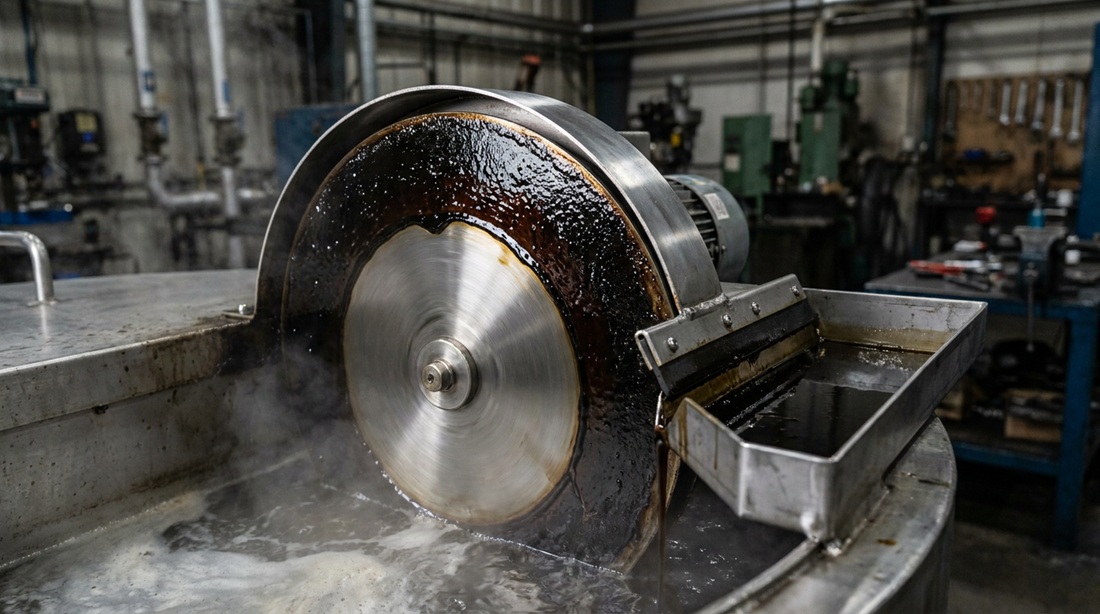
Hot tank immersion cleaning is one of the most effective methods for removing heavy grease, carbon deposits, and stubborn contamination from industrial components. But the cleaning solution that makes this possible faces a relentless challenge during normal operation: every component that goes in brings oil with it, and oil floats.
An oil skimmer hot tank system – whether belt or disc type – addresses this challenge. The oil skimmer parts washer integration removes floating contamination that would otherwise degrade solution quality progressively throughout the working day. by continuously removing the surface oil that accumulates during cleaning cycles. The result is a cleaner solution surface, longer solution life, and consistent cleaning performance from the start of the solution’s working life to the end.
Why Surface Oil Degrades Hot Tank Performance
How Oil Builds Up During Normal Operation
Hot tank cleaning works by dissolving oil and grease from component surfaces into the alkaline cleaning solution. This oil does not remain dissolved uniformly throughout the solution – it separates and rises to the surface because oil is less dense than water. Every component cleaned in the tank adds to the surface oil layer.
In an actively used hot tank, surface oil contamination accumulates as a continuous process during the working day. Each cleaning cycle adds more oil to the surface layer. Without tank oil removal, this layer thickens progressively throughout the day and across the life of the solution.
The Effect of Surface Oil on Cleaning Results
A surface oil layer creates a direct cleaning problem: components pass through this layer when being lowered into the tank and again when lifted out. On the way in, a component coated in cleaning solution for the first time passes through a film of oil that partially recoats its surface before it reaches the clean solution beneath. On the way out, the cleaned component passes through the oil layer again, receiving a thin coating of the contamination it was just cleaned of.
The degree to which this recontamination affects the final cleaning result depends on the thickness of the surface oil layer. A thin oil film has a minor effect. A thick, accumulated oil layer meaningfully compromises the cleaning result, particularly for components where surface cleanliness matters for inspection or assembly.
How Floating Oil Shortens Solution Life
Surface oil contamination does not just affect how components emerge from the tank – it also degrades the alkaline cleaning solution over time. Oil accumulating in the solution eventually overwhelms the chemistry’s capacity to maintain effective cleaning. The alkaline compounds that break down contamination become progressively consumed or neutralised. Cleaning slows. Operators extend soak times or increase temperature to compensate, adding operating cost without addressing the fundamental problem.
Regular tank oil removal through skimming slows this degradation by physically removing oil from the solution before it can saturate the chemistry. This extends the period over which the solution maintains effective cleaning performance.
How Oil Skimmers Work
The Oleophilic Principle
Oil skimmers work through the preferential attraction of certain materials to oil over water – a property called oleophilicity. When an oleophilic material is drawn through the tank surface, it picks up oil without picking up significant amounts of cleaning solution. Wiper blades then scrape the collected oil from the material into a separate collection container, and the cleaned material returns to the tank surface to collect more oil.
This continuous cycle removes surface oil steadily during operation. The tank oil removal is continuous rather than a periodic manual task, which prevents the oil layer from accumulating to the thickness that affects cleaning performance.
Belt Skimmers: Mechanism and Applications
Belt skimmers use a continuous loop of oleophilic belt material that travels through the tank surface, up through wiper blades that scrape off collected oil, and back down into the tank. The drive motor runs the belt continuously during operation. Oil scraped from the belt at the wiper blades collects in a container positioned below the wipers.
Belt skimmers handle higher oil volumes than disc skimmers, making them suited to hot tanks that clean heavily contaminated components – mining maintenance operations, earthmoving workshops, and heavy industrial facilities where oil loading in the tank solution is high. The continuous belt covers the tank surface effectively in larger tanks where surface area is significant.
Disc Skimmers: Mechanism and Applications
Disc skimmers use rotating discs that partially submerge in the tank surface. Oil adheres to the disc surface as it rotates through the solution surface layer. Wiper blades contact the disc above the liquid surface, scraping collected oil into a collection container. The disc continues rotating to pick up more oil from the surface.
Disc skimmers have a simpler mechanical design than belt skimmers and suit smaller hot tanks and applications with moderate oil volumes. Installation is typically straightforward – the skimmer mounts on the tank edge with the disc extending over the liquid surface. For general workshop hot tank applications where oil contamination is present but not extreme, disc skimmers provide effective tank oil removal with minimal complexity. Stainless steel parts washers used in food processing may also benefit from oil skimming where the cleaning tasks involve food fats and oils that accumulate on the solution surface.
Continuous vs Batch Skimming
Continuous skimming during operation is the most effective approach to preventing surface oil accumulation. By removing oil as it separates from cleaned components throughout the working day, continuous skimming prevents the surface layer from building to the thickness that affects cleaning performance.
Batch skimming – running the skimmer for defined periods rather than continuously – reduces power consumption but allows some accumulation between skimming sessions. For operations with moderate oil loading and adequate skimming intervals, batch skimming provides meaningful surface oil management. For high-contamination applications where oil separation is continuous and rapid, continuous skimming provides better performance maintenance.
The Effect of Oil Skimming on Hot Tank Solution Life
What Continuous Skimming Changes About Maintenance
Hot tank solution maintenance involves managing the factors that degrade cleaning chemistry over time. Oil accumulation is one of the most significant of these factors in operations cleaning oily components. By physically removing oil before it saturates the cleaning solution, skimming reduces the rate at which solution effectiveness degrades.
The practical result is that a hot tank solution with effective oil skimming maintains useful cleaning performance for longer than the same solution without skimming. The solution chemistry is being preserved by removing one of its primary degradation pathways. How much longer depends on the oil loading the tank experiences – higher oil loading means skimming delivers greater relative benefit.
When to Change Solution vs When to Skim
Skimming extends solution life but does not replace eventual full solution changes. While skimming addresses oil contamination, other degradation mechanisms continue – alkaline compounds are consumed by chemical reactions with contamination, dissolved solids accumulate, and carbon and other non-oil contaminants build up in the solution.
pH testing is the practical ongoing management tool for hot tank solution maintenance. When pH drops below the effective range for the cleaning chemistry being used, adding alkaline concentrate restores cleaning performance. When contamination loading becomes excessive despite skimming and concentration management, a complete drain, clean, and refill restores full performance.
Skimming reduces the frequency of full solution changes in high-oil contamination applications, which reduces the labour, downtime, and chemical cost associated with complete solution replacement.
Practical Expectations for Solution Life Improvement
The degree to which oil skimming extends solution life depends on the oil loading the hot tank experiences during operation. A tank cleaning heavily oily components – engine rebuilds, transmission components, hydraulic equipment from mining or earthmoving – benefits most from effective skimming because oil contamination is the dominant degradation factor.
A tank primarily cleaning carbon deposits and scale from components with lower oil content benefits less from skimming because oil contamination is a smaller factor in solution degradation. In these applications, skimming still prevents recontamination of cleaned components but may not dramatically extend solution life.
Hot Tank Cleaning Performance: Consistency Over Time
How Surface Oil Affects Cleaning Consistency
Without tank oil removal, cleaning performance in a hot tank typically starts strong at the beginning of a solution’s life and degrades progressively as oil accumulates. Technicians notice that parts that cleaned quickly early in the solution cycle require progressively longer soak times as the solution ages. This inconsistency makes it difficult to schedule maintenance work reliably around cleaning time.
Maintaining Consistent Performance Through Solution Life
An oil skimmer hot tank system maintains a consistent surface condition throughout the solution’s working life. By preventing the surface oil layer from accumulating, the skimmer preserves the consistent cleaning mechanism. Parts cleaned at the beginning of a solution cycle and parts cleaned weeks later clean at the same speed and to the same standard.
This consistency directly benefits hot tank cleaning performance for high-volume operations where throughput depends on predictable cycle times. A mining maintenance facility that schedules work around known cleaning times benefits from the reliability that skimming-maintained performance provides.
Why Consistent Cleaning Matters for Rebuild Work
Engine rebuild workshops and facilities that clean components for precision inspection rely on cleaning thoroughness as a foundation for work quality. Heavy duty parts washers provide spray cleaning for general components, while hot tanks handle the immersion cleaning needed for internal passages and heavy carbon deposits.
When hot tank cleaning performance is inconsistent, some components emerge truly clean and others carry residual contamination that surface oil recontamination has left. Residual oil on a freshly cleaned component surface hides wear, surface scoring, and damage during inspection. Consistent, thorough cleaning through maintained solution performance supports consistent inspection quality.
How Skimmers Integrate With Existing Hot Tank Systems
Retrofit Options for Existing Systems
Oil skimmers retrofit to existing hot tanks without major modification. Most systems mount on the tank rim or lid, requiring mounting provisions for the drive unit and clearance for the belt or disc travel. The collection container positions adjacent to or below the wiper assembly. Power connection to available workshop supply completes the installation.
For new hot tank installations, specifying skimmer integration from the outset allows the tank design to incorporate appropriate mounting provisions, optimised skimmer positioning, and collection container access. This produces a more integrated solution than retrofit installation on equipment that was not designed with skimming in mind.
Belt Skimmer Integration for High-Contamination Applications
Belt skimmer installation requires mounting provisions for the drive motor and adequate vertical clearance for the belt to travel from the tank surface up to the wiper assembly and back down. The collection container must be positioned to catch oil scraped from the belt at the wiper location.
For large hot tanks serving super heavy duty parts washers and other major industrial systems in mining and heavy industrial applications, belt skimmer capacity must match the substantial oil volume these operations produce per cycle. Undersized skimming capacity in these applications allows oil to accumulate faster than it is removed, reducing the benefit.
Disc Skimmer Integration for General Workshop Applications
Disc skimmer integration is simpler than belt skimmer installation. The skimmer mounts on the tank edge with the disc extending over the liquid surface, and the collection container positions adjacent to the wiper blade assembly. The drive motor sits above the tank surface.
For workshop-scale hot tanks handling automotive and general industrial components, disc skimmers provide effective oil skimmer parts washer integration without the installation complexity of belt systems. The lower oil volumes these applications generate match the removal capacity of disc skimmers appropriately.
Choosing the Right Oil Skimmer for Your Hot Tank
Matching Skimmer Capacity to Oil Volume
The key selection criterion for an oil skimmer hot tank system is matching the skimmer’s removal capacity to the rate at which oil accumulates in the tank during operation. A skimmer that removes less oil per hour than the cleaning cycles produce allows the surface layer to build despite continuous operation.
Estimating oil loading requires considering the number of cleaning cycles per shift, the typical oil content of components being cleaned, and the average soak time per cycle. Heavy contamination with thick grease produces more oil per cycle than lightly oiled components. High cycle frequency produces more oil accumulation per hour than infrequent cleaning.
Tank Size and Surface Area Considerations
Belt skimmers suit larger tank surface areas because their continuous belt motion covers the tank surface more completely than a single disc. The belt skimmer’s coverage area extends along the length of belt travel, which can span a significant portion of the tank surface in larger systems.
Disc skimmers are most effective near their mounting position. For small to medium tanks, a single disc skimmer at an appropriate tank position covers the effective surface area adequately. For larger tanks, either a belt skimmer or multiple disc skimmers ensure adequate surface coverage.
A Complete Approach to Solution Maintenance
Skimming as Part of an Integrated Maintenance Programme
Oil skimming is most valuable as part of a complete hot tank solution maintenance programme rather than as a standalone measure. Skimming addresses surface oil accumulation. Filtration addresses suspended solid particles. pH monitoring and concentration management address chemistry strength. Periodic full solution changes address accumulated contamination that skimming and filtration cannot remove. For workshops that also operate extra heavy duty parts washers for spray cleaning alongside their hot tanks, solution maintenance in both systems benefits from consistent attention. Manual parts washers use fresh solution for each cleaning task, which is why they do not accumulate the solution degradation that recirculating hot tanks and spray washers manage over time. Wet abrasive blasters generate a different waste stream – abrasive media mixed with contaminated water – that requires its own waste management approach.
Together, these maintenance practices extend hot tank cleaning performance across longer service intervals, reduce the frequency of the most labour-intensive maintenance tasks, and produce consistent cleaning results that support downstream workshop operations.
Getting Expert Advice on Hot Tank Maintenance
Hotwash Australia designs hot tank systems for Australian industrial conditions and can provide advice on oil skimmer integration, maintenance scheduling, and chemical management for specific applications. The team understands the operational demands of mining maintenance, heavy industrial workshops, and automotive rebuild operations where hot tanks play a central role.
For advice on oil skimmer hot tank systems and hot tank maintenance solutions for your operation, contact our hot tank specialists or email us at sales@hotwash.com.au.

Leave A Comment