
When a critical component fails in a mining haul truck, an aircraft hydraulic system, or a food processing line, the cost is not just the part – it is the downtime, the safety risk, and the consequences of a failure that non-destructive testing was meant to prevent. NDT catches these problems before they become disasters, but only when surface preparation is complete.
Q2 crack detection relies entirely on surfaces being free of contamination. This article explains why, what contamination does to test results, and how automated parts washing delivers the surface cleanliness that reliable crack detection requires.
What Q2 Crack Detection Actually Does
How Liquid Penetrant Inspection Works
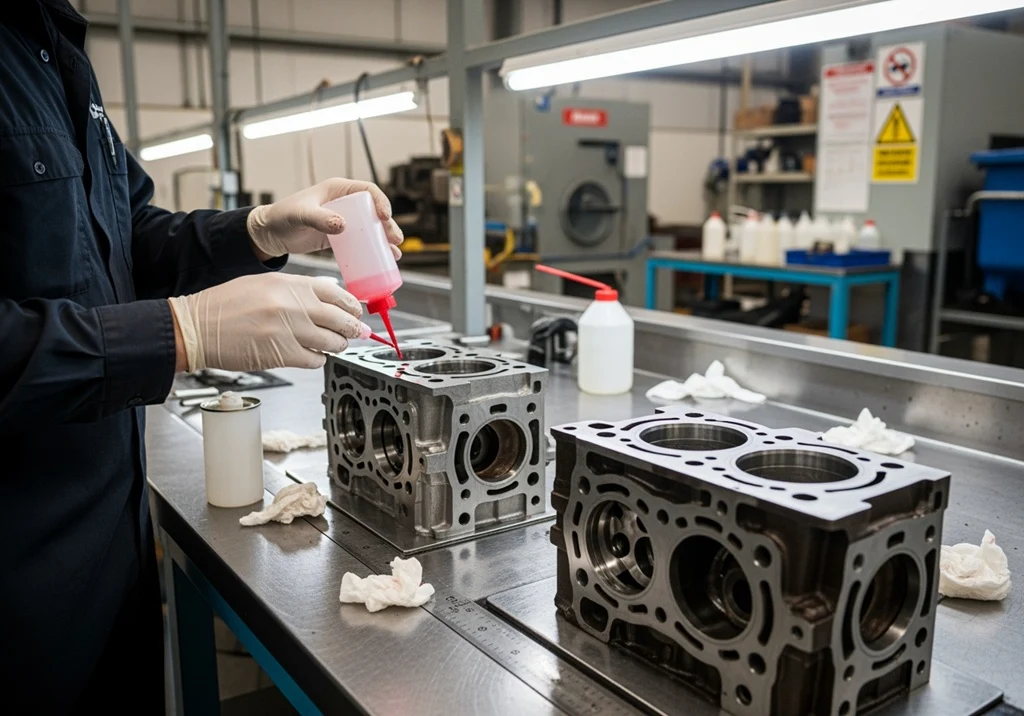
Q2 testing – also known as liquid penetrant inspection – uses coloured or fluorescent liquid that seeps into surface cracks through capillary action. After applying the penetrant, inspectors remove the excess and apply a developer that draws residual penetrant back out, making even small surface-breaking defects visible.
The mechanism depends entirely on the penetrant being able to enter the crack. Liquid penetrant inspection cleaning is the necessary precondition for this – if contamination blocks the crack opening, even partially, capillary action cannot carry the penetrant to where the defect is. The crack stays hidden. The component gets cleared. And eventually, it fails in service.
NDT surface prep is not a formality that happens before the real inspection work begins. It is the step that determines whether the inspection produces a reliable result or a false negative that puts equipment and people at risk.
What “100% Clean” Means in NDT Terms
Australian Standard AS 2062 sets the requirements for liquid penetrant inspection. The standard requires surfaces to be free of all foreign matter – oil, grease, water, scale, welding flux, paint, and corrosion products. Not reduced. Not mostly removed. Completely eliminated.
A part can look spotless and still fail NDT surface prep requirements. A thin film of cutting oil, invisible to the eye, will prevent penetrant from entering micro-cracks. Carbon deposits in engine components, even after manual scrubbing, can seal crack openings. Rust inhibitors applied for storage create a barrier that blocks penetrant access entirely. Visual cleanliness and NDT-ready cleanliness are not the same thing.
Why “Clean Enough” Is Not Good Enough
The Consequences of Inadequate Surface Prep
Inadequate NDT surface prep produces three types of unreliable outcomes. False negatives occur when cracks exist but do not show up because penetrant could not enter. The component gets cleared for service and eventually fails in operation. False positives occur when contaminants trap penetrant and create indications that look like cracks but are not – wasting time investigating non-existent defects.
Unreliable results are the third consequence, and arguably the most damaging. Inconsistent Q2 crack check surface contamination means inconsistent outcomes. The same crack might show up in one test and be missed in another, depending on how thoroughly a particular area was cleaned. This variability destroys confidence in the inspection process and creates compliance and liability exposure for the facility.
How Contamination Interferes With Penetrant Access
Oil and grease form a hydrophobic barrier that repels water-based penetrants. Even a microscopic layer prevents capillary action from working. The penetrant beads up on the surface instead of flowing into cracks. In mining equipment and hydraulic systems, oil and hydraulic fluid are constant contaminants. In machining and assembly workshops, cutting oils and lubricants coat parts during processing.
Carbon deposits physically plug crack openings. In diesel engine components, carbon builds up in combustion chambers, valve ports, and exhaust passages. Manual scrubbing might remove loose carbon, but compressed deposits remain in place. These sealed cracks will not accept penetrant until the carbon is completely removed – making liquid penetrant inspection cleaning of carbon-contaminated components one of the most demanding NDT surface prep challenges.
Rust and scale create rough, porous surfaces that trap penetrant everywhere rather than just in cracks. Paint and coating residues block penetrant access even when stripping appears complete. Welding residue – slag, spatter, and flux – must be fully removed before Q2 crack check surface contamination is resolved in weld inspection areas, which are precisely the high-stress locations where cracks most commonly form.
Manual Cleaning Limitations for NDT Prep
Why Manual Methods Cannot Achieve Consistent NDT Standards
Manual cleaning is inconsistent. One worker scrubs thoroughly. Another rushes the job. The same worker cleans differently when tired compared to fresh. Complex geometries receive uneven attention – accessible surfaces get more cleaning effort than recesses, blind holes, and internal passages.
Solvent wiping moves contamination around rather than removing it. A rag soaked in degreaser lifts oil from one area and deposits a thin film across a wider area. For liquid penetrant inspection cleaning purposes, this scattered contamination is just as problematic as concentrated grease – penetrant cannot enter cracks through a thin film any more than through a thick deposit.
Wire brushing and abrasive methods create their own problems. Steel brushes can smear metal over crack openings, effectively sealing them at a microscopic level and making them undetectable by penetrant inspection. Brass brushes can embed foreign metal in aluminium surfaces. These methods remove bulk contamination but can actively reduce NDT sensitivity at the exact locations where defects are most critical to find.
Time and Labour Costs of Manual NDT Prep
Thorough manual cleaning of a complex component takes considerable time. A cylinder head with multiple ports and passages requires extended scrubbing to reach NDT-ready cleanliness. A loader bucket with welded reinforcements and internal bracing takes even longer. That labour cost accumulates quickly at current maintenance rates, creating a recurring expense that scales with inspection volume.
For operations with regular NDT requirements, manual cleaning becomes a throughput bottleneck that delays inspection and extends component downtime. Industrial parts washer NDT preparation removes this bottleneck – cleaning cycles run in a fraction of the manual time whilst delivering more thorough results.
How Automated Parts Washing Achieves NDT Standards
Heat, Pressure, and Chemistry Working Together
Automated parts washing addresses NDT surface prep through a combination of heat, pressure, and detergent chemistry that manual methods cannot replicate. High-pressure spray reaches every surface including blind holes, internal passages, and complex geometries. Rotating spray arms ensure coverage from multiple angles, delivering consistent results on components that manual scrubbing inevitably cleans unevenly.
Heated water breaks down oils and greases through thermal action. Heat reduces viscosity, allowing contaminants to flow off surfaces rather than clinging to them. Combined with spray pressure, hot water flushes contamination out of cracks and crevices rather than just redistributing it. Biodegradable detergent emulsifies oils, suspends carbon, and prevents redeposition – leaving surfaces completely residue-free after rinsing in a way that solvent wiping cannot achieve.
Industrial parts washer NDT preparation also handles the contamination types that manual methods struggle with most. Carbon deposits that resist scrubbing dissolve under sustained heat and chemical action. Rust and scale that create rough penetrant-trapping surfaces can be addressed with appropriate pre-treatment before the main wash cycle.
Consistency and Process Documentation
Automated crack detection cleaning delivers identical results every cycle. The same temperature, pressure, detergent concentration, and cycle time for every component. No variation based on who is operating the machine or how much time pressure they are under. This consistency is critical for meeting Australian Standards requirements and for building confidence in inspection results across shifts and operators.
Automated parts cleaning inspection prep also provides the documentation that quality management requires. Recorded cycle parameters – temperature, pressure, duration – create an audit trail that demonstrates proper NDT surface prep procedures were followed for each component batch. When NDT results are queried, documented wash parameters provide objective evidence that supports the integrity of the inspection record.
Real-World NDT Applications Across Industries
Mining: Loader Buckets and Excavator Arms
Mining operations inspect loader buckets, excavator arms, drill components, and crusher parts regularly. These components operate under extreme loads and arrive for inspection covered in mud, grease, hydraulic oil, and rock dust. Q2 crack check surface contamination on mining equipment is among the most challenging NDT prep scenarios – the contamination is heavy, the components are large, and the consequences of missed cracks at structural welds are severe.
Extra heavy duty parts washers handle the size and contamination level of mining equipment inspection prep whilst meeting NDT surface cleanliness requirements. Automated crack detection cleaning of mining components delivers consistent NDT-ready surfaces regardless of how contaminated the component arrives for service.
Oil and Gas: Valves, Flanges, and Pressure Vessels
Oil and gas facilities inspect valves, flanges, pipeline sections, and pressure vessels where the consequences of missed cracks include leaks, fires, and environmental damage. Parts arrive contaminated with crude oil, drilling fluids, and corrosion inhibitors – all of which interfere with penetrant access if not fully removed.
Complex valve body geometries require cleaning solutions that reach internal passages. Hot tanks provide immersion cleaning capability for valve bodies and fittings where spray coverage alone may not fully address internal contamination. Industrial parts washer NDT preparation for pressure-containing components requires the highest standard of cleanliness – these are the components where a missed crack has the most serious consequences.
Food Processing: Stainless Steel Equipment Inspection
Food processing plants inspect stainless steel equipment for cracks that could harbour bacteria and contaminate product. Mixers, slicers, conveyor components, and processing vessels undergo regular NDT as part of hygiene compliance programmes. The challenge is removing food residue, oils, and sanitising chemical residue without leaving any cleaning residue that would interfere with penetrant inspection.
Stainless steel parts washers meet both food hygiene standards and NDT surface prep requirements. Stainless construction prevents contamination from the washer itself, and the biodegradable detergents used leave no residue that would affect penetrant access or food safety compliance.
Automotive and Transport: Cylinder Heads and Engine Components
Automotive and transport workshops inspect cylinder heads, engine blocks, crankshafts, and suspension components for cracks. Carbon deposits in combustion chambers and oil passages must be completely removed for accurate crack detection – a demanding liquid penetrant inspection cleaning requirement that manual methods are poorly suited to address in high volumes.
Hotwash Australia heavy duty cleaning systems reduce cylinder head and engine component prep time substantially compared to manual cleaning, whilst delivering NDT-ready surface cleanliness that manual scrubbing cannot match consistently.
Choosing the Right Cleaning System for NDT Work
Matching Capacity to Component Size
Not every parts washer meets NDT surface prep requirements. Capacity must match the size of components being inspected. A system with insufficient chamber depth means parts do not fit, or do not receive adequate spray coverage across the full surface area.
For most engine components and fabricated parts, heavy duty parts washers provide the right combination of chamber size, temperature capability, and spray pressure for NDT prep work. Oversized mining and earthmoving components require larger systems with reinforced load handling. Matching capacity to component size ensures spray coverage is complete – not partial.
Contamination Level and Required Cleaning Power
Light oils and coolants wash off more easily than heavy grease, carbon deposits, and rust. Temperature, pressure, and cycle time must match the contamination challenge. A system that adequately prepares lightly contaminated machined parts may not have the cleaning power needed for carbon-heavy engine components or rust-scaled structural weldments.
Material compatibility also matters. Aluminium components need cleaning systems that avoid embedding foreign metals. Stainless steel food industry parts require stainless steel washers to prevent iron contamination. These requirements drive equipment selection as much as chamber size and cleaning power.
Cycle Time and Throughput Requirements
Automated parts cleaning inspection prep must match the throughput demands of the inspection programme. Facilities processing components occasionally for periodic NDT have different requirements than manufacturing or MRO operations running daily inspection cycles. Semi-automatic systems offer the best balance for most NDT prep applications – automated washing with manual loading provides thorough cleaning without unnecessary complexity.
Wet abrasive blasters provide complementary capability for components requiring surface preparation beyond what water-based washing can achieve – particularly for components with thick scale, heavy rust, or coating residue that needs mechanical action before liquid penetrant inspection cleaning can be effective.
Surface Prep Procedures That Support NDT Compliance
Pre-Wash Inspection and Additional Preparation
NDT surface prep begins with a pre-wash inspection of each component. Heavy rust may require wet abrasive blasting before washing. Thick paint needs stripping. Weld spatter needs mechanical removal. Identifying these requirements before the wash cycle prevents components from progressing to inspection with inadequate surface preparation.
Automated wash cycles are most effective on components that are appropriately prepared. Sending a heavily scaled component through a standard wash cycle and hoping for the best produces inconsistent NDT surface prep results. The pre-wash inspection step ensures the right preparation approach is applied before the main cleaning cycle.
Post-Wash Inspection and Drying Procedures
Post-wash inspection verifies cleanliness before NDT proceeds. A visual check and a white glove wipe test confirm the component is ready for penetrant application. Any remaining contamination sends the component back through the washer rather than proceeding to inspection with questionable crack detection cleaning results.
Complete drying is critical before penetrant application. Water remaining on surfaces from the rinse cycle will prevent water-based penetrants from entering cracks effectively. Automated drying cycles or compressed air blow-off must be part of the NDT surface prep procedure – not an afterthought.
Documentation for Quality Management
Record wash parameters, cycle times, and post-wash inspection results for every batch. This documentation supports quality management and provides an audit trail when NDT results are reviewed. If crack detection cleaning adequacy is ever questioned – in an incident investigation, an insurance review, or a regulatory audit – documented automated parts cleaning inspection prep procedures provide objective evidence that proper preparation was completed.
For components where NDT results carry significant safety or regulatory weight, documented NDT surface prep is as important as the inspection result itself. It proves the inspection was performed on a surface that gave the penetrant a fair opportunity to find any defects present.
Q2 crack detection only works when surfaces are completely clean. For operations where component integrity matters, automated parts washing is the most reliable way to meet that standard consistently. To discuss cleaning systems designed for NDT surface prep in Australian industrial conditions, talk to our workshop equipment experts or email us at sales@hotwash.com.au.

Leave A Comment