
Workshop managers across Australia face a consistent challenge: cleaning heavily contaminated parts thoroughly without exposing workers to dangerous chemicals. Caustic soda tanks have been the industrial standard for decades because they work – but the risks they carry are well understood, and the regulatory, financial, and human costs of caustic incidents continue to make a strong case for better alternatives.
Non-caustic degreasing systems offer a practical answer. Biodegradable, water-based detergents combined with high-pressure hot water remove grease, oil, and carbon buildup without the hazards caustic systems create. For mining operations, manufacturing facilities, and heavy vehicle workshops, this approach delivers cleaner results, lower risk, and better long-term economics.
Why Caustic Degreasing Creates Workplace Hazards
The Real Risk of Caustic Soda in Workshop Environments
Caustic soda works through saponification – it breaks down oils and greases by converting them chemically into soap-like substances. The same aggressive reaction that strips grease from metal surfaces also damages human tissue on contact. Caustic burns occur quickly; eye contact creates a serious and immediate injury risk. Fumes from heated caustic tanks irritate respiratory systems with ongoing exposure, creating long-term health concerns for workers in poorly ventilated cleaning areas.
The hazard is not theoretical. Caustic soda splashes during part loading and retrieval. Manual rinsing after soaking requires handling wet, chemically contaminated components. Workers monitoring tank concentration are regularly in close proximity to heated caustic solution. WHS chemical safety workshop obligations require employers to control these hazards – and the hierarchy of controls puts elimination above all other measures. A caustic soda alternative cleaning approach that eliminates the chemical removes the hazard at the source rather than managing it through PPE and procedure.
The Operational and Financial Cost of Caustic Incidents
The financial impact of caustic cleaning incidents extends well beyond medical costs. WorkCover investigations disrupt operations, trigger safety audits, and result in corrective action requirements that consume management time. Insurance premiums increase following claims. For operations that require WorkCover notification, a single incident can halt cleaning operations whilst the circumstances are reviewed.
Beyond incidents, the ongoing compliance infrastructure caustic systems require adds real cost. Secure chemical storage, eye wash stations, safety showers, chemical-resistant PPE, and regular safety training are all requirements that eco-friendly degreasing systems largely eliminate. These costs are often invisible in day-to-day operations because they are absorbed into overheads – but removing them produces a measurable reduction in annual operating expense.
How Non-Caustic Systems Deliver Safer Cleaning
The Mechanism: Heat, Pressure, and Biodegradable Detergent
Modern non-caustic parts washers clean through a different mechanism entirely. High-pressure spray jets deliver hot water mixed with biodegradable workshop degreaser onto components from multiple angles. The mechanical force of the spray dislodges contamination whilst heated water and detergent chemistry break down oils and greases. Rotating spray arms ensure complete coverage, reaching blind holes, threads, and internal geometries that manual scrubbing and passive soaking both miss.
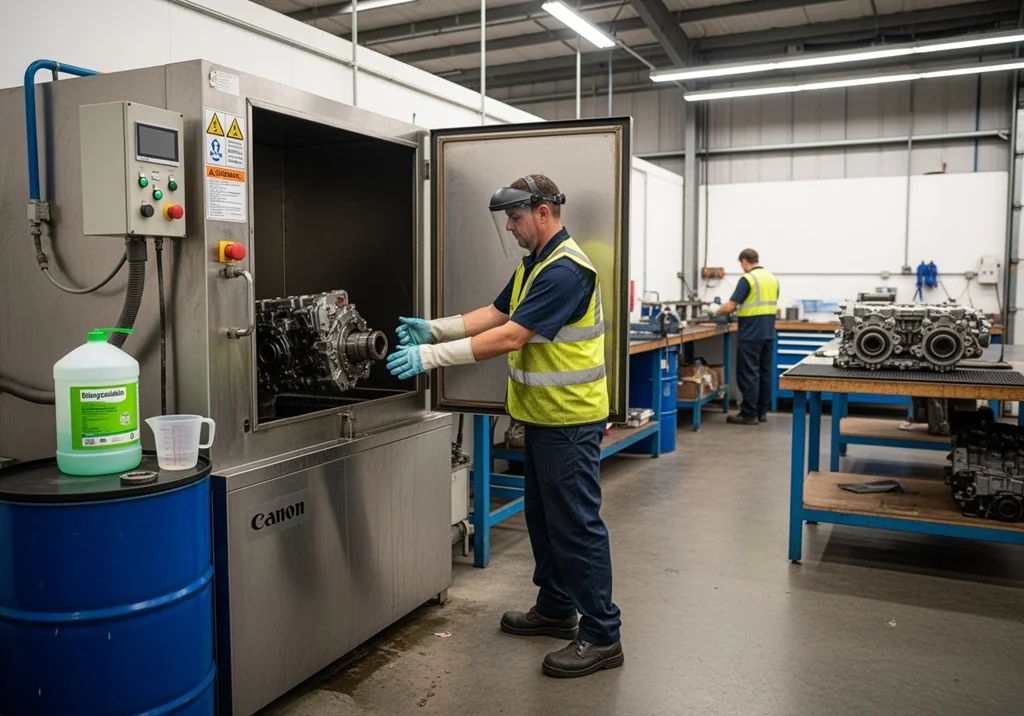
The enclosed washing chamber is central to the safety improvement. Workers load dirty parts, start the cycle, and unload clean components without handling contaminated surfaces or coming into contact with cleaning solution during the wash phase. The entire cleaning process occurs inside the cabinet. This is the primary mechanism by which a non-caustic parts washer eliminates chemical exposure – not just safer chemistry, but a fundamentally different process architecture.
What Makes Non-Caustic Detergents Effective
Biodegradable workshop degreasers work through surfactant chemistry – molecules that bridge the gap between oil contamination and water-based cleaning systems. One end of the surfactant molecule bonds to oil, the other bonds to water. This allows the cleaning solution to lift oil from metal surfaces, suspend it in the water, and carry it away when the solution drains.
This chemistry is not a compromise on performance – it is a different approach to the same problem. Safe workshop soap formulations that carry biodegradable certification and food-safe ratings are used in some of the most demanding cleaning applications in Australian industry, including aviation maintenance, food processing, and pharmaceutical manufacturing. The fact that they are safe for workers and drainage systems does not limit their cleaning capability.
Real-World Performance Comparison
Non-Caustic Versus Caustic: Cleaning Results
Workshop managers evaluating non-caustic systems frequently ask whether they can match caustic hot tank performance on heavy contamination. The answer from Australian operations that have made the switch is consistently yes – and in many cases faster.
Caustic cleaning relies on chemical reaction time, which means parts must soak for extended periods for the chemistry to work through heavy contamination. Non-caustic spray washing adds mechanical force to the chemical action, physically dislodging loosened contamination rather than waiting for it to dissolve. This combination typically cleans faster than caustic soaking for most common workshop contamination types. Even heavily contaminated components that previously required long tank soak times often respond to repeated shorter automated cycles at lower total time and cost. This is the core performance case for caustic soda alternative cleaning in high-volume workshop environments.
Temperature as a Performance Equaliser
Water temperature is the key variable that makes non-caustic systems competitive against caustic methods. At 80 to 85°C, biodegradable detergent solution delivers cleaning performance that approaches caustic chemistry at much lower temperatures. Heat softens baked-on grease and carbon, making it easier for spray jets to remove. It accelerates surfactant activity, increasing the rate at which oil is lifted from metal surfaces. And it helps detergent penetrate internal passages and blind holes where contamination accumulates.
Facilities with particularly heavy contamination loads can run multiple cycles if needed. The total cost of two or three automated non-caustic cycles – detergent, water, and electricity – is typically lower than a single caustic soak when full chemical and disposal costs are included. Eco-friendly degreasing does not require making a trade-off between performance and safety.
Industry Applications: Where Non-Caustic Systems Excel
Mining and Earthmoving Operations
Mining operations handle the most demanding cleaning loads in Australian industry. Excavator components, dozer undercarriage parts, and haul truck assemblies carry extreme contamination – thick grease, hydraulic oil, coal dust, and compacted mineral deposits. These operations traditionally relied on large caustic tanks because of the volume and severity of the contamination.
Extra heavy duty parts washers now provide the capacity and mechanical cleaning power these applications need without caustic chemicals. Large chambers accommodate the full range of mining components. High-pressure pumps and rotating spray systems deliver the force needed to remove heavy contamination. WHS chemical safety workshop compliance on mining sites improves significantly when caustic tanks are removed from the cleaning area entirely.
Automotive and Heavy Vehicle Workshops
Engine rebuilds generate parts contaminated with oil, carbon, and combustion deposits. Cylinder heads, engine blocks, transmission cases, and differential housings all require thorough degreasing before assembly. Automated non-caustic spray systems handle these cleaning tasks with workers loading dirty parts and unloading clean ones – no scrubbing, no chemical handling, no caustic exposure.
The time savings are direct and measurable. A mechanic spending time manually cleaning parts or monitoring caustic tanks is not turning wrenches or diagnosing faults. Automated cleaning returns that time to productive use. Heavy duty parts washers running safe workshop soap formulations clean engine and transmission components thoroughly in cycles that run whilst workshop staff work on other tasks.
Food Processing and Commercial Applications
Food industry operations face requirements that caustic systems cannot meet – cleaning to hygiene standards without chemical residues that could contaminate food products. Caustic chemicals require extensive rinsing and leave residue risk that food safety audits flag. Biodegradable workshop degreasers used in food-grade formulations rinse cleanly, leave no harmful residues, and meet the hygiene standards that commercial food processing requires.
Stainless steel parts washers designed for food industry use combine biodegradable cleaning chemistry with stainless construction that prevents contamination from the equipment itself. Mixers, slicers, conveyor components, and processing equipment can be cleaned between production runs without risk of chemical contamination or hygiene non-compliance.
Manufacturing and Fabrication
Metal fabrication generates parts contaminated with cutting oils, coolants, and metal fines that need cleaning before assembly, coating, or shipment. Non-caustic spray washers clean these surfaces effectively without the chemical etching risk that caustic solutions pose on some metals – particularly aluminium components, which caustic chemistry attacks aggressively. This material compatibility advantage is one of the clearest practical arguments for non-caustic parts washers systems in facilities handling mixed-metal work.
Environmental and Regulatory Advantages
Simplified Waste Management and Disposal
Caustic soda disposal creates ongoing environmental obligations. The chemical classifies as hazardous waste in most Australian jurisdictions, requiring licensed waste contractors, special handling procedures, and documentation for every disposal event. Spills require immediate response and can trigger environmental reporting obligations. The cumulative administrative and financial burden of caustic waste management is substantial for high-volume operations.
Biodegradable workshop degreaser formulations break down naturally. Waste water from non-caustic systems can often be discharged to sewer systems after basic pH adjustment and filtration to remove suspended oils – a straightforward process compared to the requirements for caustic waste. Hotwash Australia systems include filtration designed to meet standard wastewater discharge requirements, simplifying the environmental compliance side of parts washing operations.
WHS Compliance and Regulatory Positioning
Australian workplace health and safety regulations increasingly emphasise the hierarchy of controls, with elimination of hazards at the top and PPE at the bottom. Eco-friendly degreasing that replaces caustic chemistry eliminates the chemical hazard rather than managing it – the most preferred approach under the WHS framework. This positions operations ahead of potential future restrictions on high-hazard industrial chemicals and demonstrates proactive WHS chemical safety workshop management to auditors and insurers.
The reduced chemical hazard classification of non-caustic systems also simplifies operator training, emergency response planning, and site induction requirements – all ongoing time and cost savings that compound over the years a system is in service.
Cost Analysis: Total Ownership Comparison
Chemical, Safety, and Compliance Costs
Non-caustic detergent concentrates cost more per litre than bulk caustic soda. This direct comparison is the figure most often cited when workshops resist switching. The full cost comparison looks different. Factor in the safety infrastructure caustic requires – eye wash stations, safety showers, chemical storage, heavy-duty PPE, and specialist training – and the ongoing disposal cost of caustic waste, and the total annual cost of caustic cleaning typically exceeds non-caustic alternatives even before any incident costs are considered.
The insurance premium reduction from eliminating a major chemical hazard from the workplace is measurable. WHS audits that previously flagged caustic tank risks produce cleaner results. These financial improvements are real, recurring, and often overlooked in simple chemical cost comparisons.
Labour and Productivity Returns
The largest financial return from automated non-caustic cleaning is labour. A worker who previously spent hours each day on manual parts cleaning or caustic tank management returns that time to productive maintenance work when automated systems replace the manual process. For a workshop paying skilled labour rates, this daily time recovery compounds quickly into an annual saving that typically delivers payback on the equipment investment well within the first two years.
For advice on non-caustic parts washers systems suited to your operation’s contamination levels, throughput, and WHS obligations, talk to our workshop equipment experts or email us at sales@hotwash.com.au.
Selecting the Right Non-Caustic System
Capacity, Heating, and Pressure Requirements
System size must accommodate the largest parts regularly cleaned in your workshop. Chamber dimensions matter more than tank volume – measure your typical components and allow clearance for spray coverage on all sides. Light-duty workshops cleaning automotive parts suit compact systems. Mining operations handling excavator components need super heavy duty parts washers with reinforced construction and large chamber capacity.
Temperature and pressure requirements depend on contamination type. Light oils and greases clean well at moderate temperature and pressure. Heavy carbon deposits and baked-on contamination need higher temperature and spray pressure to remove completely. Systems with programmable settings provide flexibility for different cleaning tasks – a useful characteristic for workshops handling varied work across shifts.
Automation Level and Implementation
Manual load/unload systems suit smaller workshops with intermittent cleaning needs. Automated systems with programmable cycles maximise productivity for high-volume operations. Most workshops implement non-caustic parts washers systems in a single day – connection to standard electrical supply and water, no special ventilation or chemical storage infrastructure required. Operator training takes under an hour for basic operation. The transition from caustic to non-caustic is straightforward and low-disruption when planned in advance.
Manual parts washers provide a cost-effective starting point for smaller workshops transitioning away from caustic tanks, whilst larger operations benefit from the throughput and documentation capability of fully automated systems.

Leave A Comment