
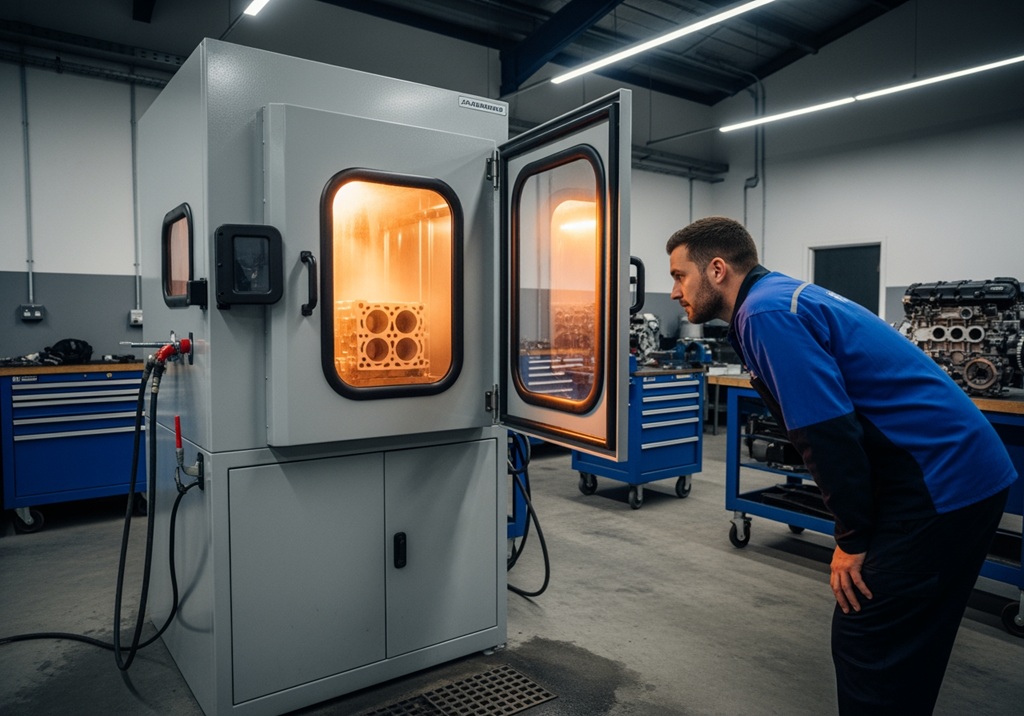
When a mechanic loads engine components into a parts washer, the cleaning process becomes invisible the moment the door closes. Standard cabinet systems operate as sealed boxes. Load the parts, start the cycle, and wait. There is no way to know whether contamination is lifting, whether the cycle needs more time, or whether a stubborn deposit is responding to the detergent – until the door opens and the parts come out.
For workshops where cleaning quality directly affects assembly outcomes, this blind approach creates real risk. Incomplete cleaning that goes undetected at the washing stage causes failures downstream – contaminated engine rebuilds, hydraulic systems that fail prematurely, food processing equipment that does not meet hygiene standards. An illuminated cabinet washer addresses this problem by giving operators direct visibility into the cleaning chamber throughout the cycle. This guide explains how chamber illumination works, why it matters for parts washer quality control, and which operations benefit most.
What an Illuminated Cabinet Washer Is
Lighting Inside the Cleaning Chamber
An illuminated cabinet washer includes an industrial lamp mounted inside the cleaning chamber alongside the spray system. This light source provides direct visibility into the cabinet interior throughout the wash cycle. Rather than guessing at cleaning progress, operators can observe it continuously through a glass viewing window built into the cabinet door or housing.
The lamp is designed to operate in the environment inside an active parts washer – sustained exposure to heat, moisture, detergent spray, and steam throughout every cycle. The Hotwash HB1100 includes an illuminated washing cabin as a standard feature. Monitoring is provided through glass, and an air jet cleaning system maintains visibility during washing by preventing condensation and detergent mist from building up on the inside of the viewing window.
This combination – internal lighting, glass monitoring window, and active air jet clearing – transforms the cabinet from a sealed box into a visible, observable cleaning environment. The operator does not have to open the door to check whether cleaning is working. They can see it happening.
How the HB1100 Implements Chamber Illumination
The illuminated parts washer design in the HB1100 is an integrated system rather than a single added feature. The lamp, viewing window, and air jet work together. During active spray cycles, the air jet continuously clears the glass surface so that the view remains usable even when high-pressure spray is generating mist and condensation inside the chamber.
This integration matters in practice. A lamp without a clearing system produces a fogged, unusable view within seconds of an active cycle beginning. A glass window without adequate internal lighting is too dim to show useful detail. The HB1100 design combines both elements specifically to maintain useful visibility throughout – not just at the start of the cycle before the chamber heats up.
The precision component washer capability of the HB1100 is supported by this integrated visibility. Precision cleaning requires verification that cleaning has actually been achieved, not just that a cycle has been run. The illumination system provides that verification opportunity without interrupting the process.
Why Cabinet Washer Visibility Matters for Workshops
Monitoring Without Interrupting the Cycle
The practical value of cabinet washer visibility is that it allows quality monitoring without stopping the wash cycle. Opening a cabinet mid-cycle releases heat, interrupts the cleaning process, and exposes the operator to steam and hot spray. In operations running on tight schedules, mid-cycle interruptions slow throughput and affect the thermal consistency of the cleaning environment for the remainder of that cycle.
With an illuminated cabinet washer, mid-cycle door opening is not necessary. The operator monitors through the glass viewing window. If contamination is visibly lifting and the component is progressing toward clean, the cycle continues uninterrupted. If a specific area is not responding as expected, the operator has the information needed to make a decision – extend the cycle, adjust for next time, or note that a different approach may be needed for that component type.
This monitoring capability shifts parts washer quality control from a post-cycle activity to an in-cycle one. The operator is not left to discover inadequate cleaning only after unloading and handling parts by hand. They are observing the process as it runs, with the ability to respond while the cycle is still active.
Cycle Optimisation Through Direct Observation
Workshops that run fixed-duration cleaning cycles regardless of actual contamination levels accept inefficiency as a standard operating condition. Lightly contaminated components receive more cycle time than they need, consuming energy, water, and detergent without additional benefit. Heavily contaminated components may not receive enough time, with the inadequacy only apparent after unloading.
Cabinet washer visibility removes both problems. An operator monitoring through the glass can stop the cycle the moment parts reach the required cleanliness standard. For lightly soiled components, this may happen well before a standard timer would complete. For heavily contaminated parts, the operator can observe that more time is needed and extend the cycle accordingly, without guessing.
Parts washer quality control through real-time observation is more responsive and more accurate than timer-based assumptions. It also supports consistent cleaning standards across a diverse mix of component types and contamination levels – a common reality in multi-purpose workshops that handle varied work rather than a single standardised part type throughout the day.
How Illumination Supports Quality Control
Verification During the Wash Cycle
Precision components require spotless surfaces before reassembly. Carbon deposits left in valve ports, metal particles remaining in hydraulic passages, or oil residue on mating surfaces all cause problems after the component returns to service. These failures often trace back to cleaning that appeared adequate but was not verified thoroughly enough before the part moved to the next production stage.
The illuminated cabinet washer supports workshop cleaning inspection during the cycle rather than only after it. A mechanic cleaning cylinder heads can watch carbon breaking down in valve ports through the viewing window. If a passage remains visibly contaminated partway through the cycle, they know before the cycle ends and can take corrective action – extending the cycle, repositioning the component, or deciding that a second cycle is needed – while the part is still in the machine.
This early detection prevents incomplete cleaning from reaching the assembly stage. The cost of a second cleaning cycle is significantly lower than the cost of a comeback from contamination-related component failure.
Training and Process Improvement Benefits
Chamber illumination has training value that non-illuminated systems cannot offer. In a standard cabinet washer, there is nothing observable about the cleaning process – it all happens invisibly inside a sealed box. New staff learn to operate the machine and trust the timer, with no way to develop understanding of what is actually happening inside the chamber.
With an illuminated parts washer, the cleaning process becomes observable and teachable. A workshop manager training an apprentice can stand at the viewing window and explain what is happening in real time – how oil breaks down under heat and detergent action, how carbon deposits respond to sustained spray pressure, what complete cleaning looks like compared to cleaning that needs more time. This visibility builds process understanding that improves decision-making over time.
Workshop cleaning inspection also becomes a demonstrable, standardised activity rather than a personal judgement call made after opening the door. Supervisors can verify cleaning effectiveness without handling parts during the process. Quality standards can be communicated and demonstrated visually, not just described verbally.
How Illumination Improves Specific Workshop Applications
Automotive Engine Rebuilds
Engine rebuilding is one of the applications where cleaning quality has the most direct impact on downstream outcomes. Carbon deposits in valve ports, oil residue in galleries, and gasket material on head faces all contribute to premature failures after reassembly. The cost of a comeback from contamination-related engine failure is substantially higher than the cost of thorough cleaning verification at the washing stage.
The illuminated cabinet washer supports the workshop cleaning inspection that engine rebuilds require. Mechanics can confirm through the viewing window that carbon is lifting from valve seats, that oil galleries are running clear, and that mating surfaces are free of residue before the cycle ends. This real-time confirmation provides a level of cleaning verification that no post-cycle inspection can fully replicate, because it observes the cleaning process in action rather than examining the result after the fact.
The precision component washer capability of the illuminated cabinet is particularly valuable for high-value engine components where the consequences of missed cleaning are both expensive and damaging to workshop reputation.
Mining and Heavy Equipment Maintenance
Mining and earthmoving components arrive at maintenance workshops in heavily contaminated condition. Thick deposits of mud, grease, carbon, and mineral particulates coat surfaces and pack into recesses. Cleaning cycles for these components often need to run longer than for standard automotive parts, and the effectiveness of the cleaning is harder to predict based on cycle time alone.
An illuminated cabinet washer gives mining maintenance operators the means to verify that cleaning is genuinely complete on these heavily contaminated components. Rather than running a fixed cycle and hoping the contamination has cleared, they can watch through the glass and confirm it before the door opens. Cabinet washer visibility is most valuable precisely in these situations – where contamination is heavy, variable, and difficult to predict.
For mining and heavy equipment applications requiring larger capacity than the HB1100 provides, heavy duty parts washers and super heavy duty parts washers handle larger components and higher contamination levels across the Hotwash range.
Food Processing and Hygiene-Critical Applications
Food processing facilities require cleaning that meets documented hygiene standards, and the documentation matters as much as the outcome. Visual verification of cleaning effectiveness during the cycle supports the quality assurance processes that food safety compliance requires. An illuminated parts washer provides the visibility needed to confirm that food contact surfaces and processing components have been thoroughly cleaned before returning to service.
Stainless steel parts washers are the preferred format for food industry applications. Stainless steel resists corrosion and does not contaminate food contact surfaces. Combined with chamber illumination, the precision component washer capability supports both cleaning performance and in-cycle compliance verification – an advantage that non-illuminated systems cannot provide.
For food processing operations, parts washer quality control is not optional – it is a documented requirement. The ability to observe cleaning effectiveness directly and in real time adds a practical verification layer to the cleaning process.
Comparing Illuminated and Non-Illuminated Cabinet Washers
What Changes With Visibility
The difference between an illuminated and a non-illuminated cabinet washer is most apparent during quality-critical cleaning jobs. In a non-illuminated system, the operator loads parts, runs the cycle, and opens the door to find out whether cleaning was successful. If it was not, the parts go back in for a second cycle. The component is handled twice, the workflow is interrupted, and cleaning quality depends on a post-cycle judgement made by inspecting a wet part outside the cleaning environment.
With cabinet washer visibility, the operator monitors the cycle in progress. Decisions about cycle length are made based on actual observation. Parts handling is reduced because quality verification happens through the glass during the cycle rather than by touching and examining parts after they are removed. This is a meaningful workflow improvement for workshops running multiple cleaning cycles each day.
When Illumination Delivers the Most Value
Illumination delivers the clearest operational return in workshops where cleaning quality is critical, component values are high, or contamination levels are variable and difficult to predict. Engine rebuilders, hydraulic repair shops, food processors, and mining maintenance operations all meet at least one of these criteria. For workshops handling a consistent, predictable part type with well-understood contamination and a proven cycle time, a standard non-illuminated cabinet may be sufficient. For workshops handling varied work with variable contamination, in-cycle visibility adds practical value that accumulates across every cleaning cycle over the equipment’s working life.
Choosing the Right Illuminated System for Your Workshop
HB1100 as a Standard Illuminated Cabinet Washer
The HB1100 illuminated cabinet washer is manufactured by Hotwash and is available in two configurations: a sliding door model and a tilt lid model. Both include the illuminated washing cabin, glass viewing window, air jet visibility system, and foot-switch pump as standard features. These features work together as an integrated system designed for practical workshop use.
The HB1100 suits workshops cleaning automotive engine components, hydraulic parts, food processing equipment, and similar small to medium components. For workshops requiring larger capacity or heavier duty construction, Hotwash Australia supplies a full parts washer range from manual systems through to super heavy duty automated washers, with delivery and service support available across Perth, Melbourne, Sydney, and Brisbane.
Matching System to Application
The right illuminated parts washer for your workshop depends on the components you clean, your quality control requirements, and the contamination types your operation encounters. Workshop cleaning inspection needs vary between industries – a food processing facility has different documentation requirements to an automotive workshop, and a mining maintenance team deals with different contamination levels to both.
For advice on which illuminated cabinet washer suits your operation and cleaning standards, reach out to our equipment specialists or email us at sales@hotwash.com.au.

Leave A Comment