
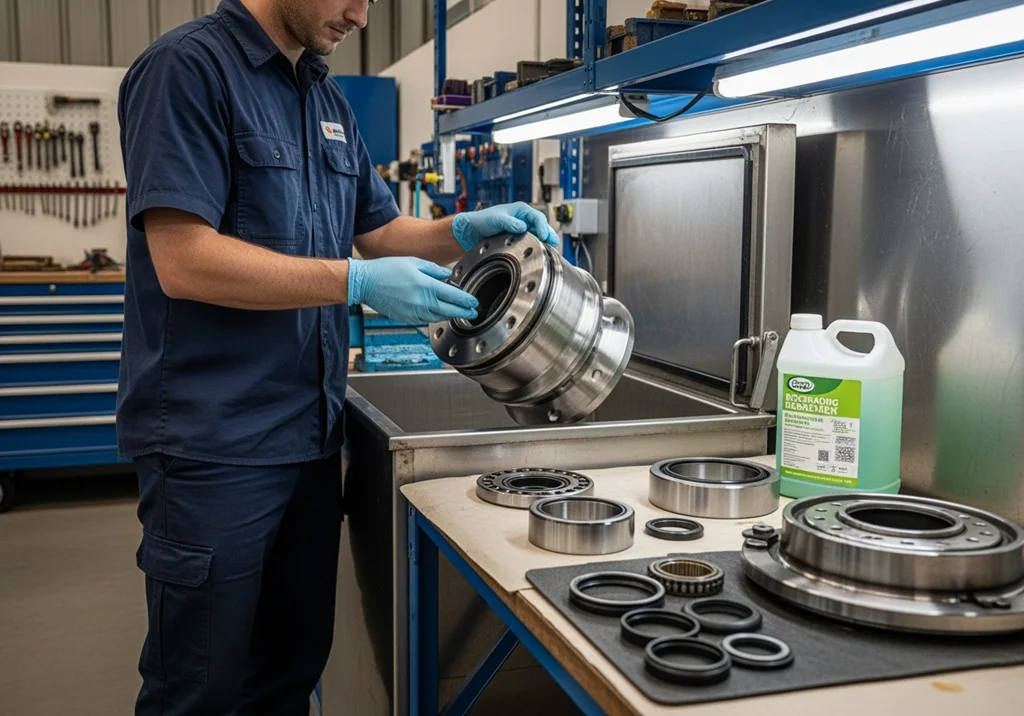
A wheel bearing failure on a loaded delivery truck does not just mean a repair bill. It means a vehicle off the road, a delivery schedule disrupted, and in the worst cases, a safety incident. For logistics fleets operating on tight margins and tighter timetables, premature bearing failures are not just expensive – they are operationally damaging.
The root cause of most premature bearing failures is wheel bearing contamination introduced during the maintenance process itself. Cleaning hubs with pressure washers, solvent baths, or manual scrubbing often pushes water and grit into bearing surfaces before reassembly. Wheel hub cleaning done incorrectly can cause the very failure it was meant to prevent. This guide explains why traditional methods fall short, how water destroys bearings, and what proper automated cleaning delivers for logistics fleet reliability.
Why Traditional Hub Cleaning Methods Fail
The Three Problems with Manual Hub Cleaning
Walk into most transport workshops and you will see mechanics performing wheel hub cleaning the same way they have done for years. A pressure washer blasts off heavy grease, a solvent soak follows to remove residue, then manual scrubbing with wire brushes reaches the tight spots. This process takes considerable time per hub and creates three critical problems.
First, pressure washers force water deep into bearing races and seal grooves. The high-pressure spray drives moisture into microscopic surface imperfections where it remains trapped, even after compressed air drying. When fresh grease is applied during reassembly, this trapped water mixes with the lubricant and destroys its protective properties. Second, solvent baths do not actually clean bearing surfaces – they redistribute contamination. Once the solvent becomes saturated with metal particles and road grime, each component soaked in it picks up particles that act as grinding paste in service. Third, wire brushes damage the precision surfaces that bearings depend on. Bearing races require smooth finishes to function correctly. Wire bristles create microscopic scratches that accelerate fatigue failure.
How Time Pressure Compounds Cleaning Failures
Wheel bearing contamination problems are often made worse by the time a manual hub cleaning process demands. When a mechanic spends an hour cleaning each hub, economic pressure to move faster increases. Seal seats do not get the attention they need. Bearing races are not fully inspected. The focus shifts from thorough maintenance to getting the truck back on the road.
Manual processes also produce inconsistent results. What gets cleaned well depends on the mechanic’s experience, the time available, and the visibility of contamination in tight spaces. An automated system removes this variability entirely – the cleaning process is the same regardless of volume pressure or shift timing.
How Water Contamination Destroys Bearing Life
The Demulsification Failure Mechanism
Water in wheel bearing grease triggers a cascade of failures that accelerates over time. When water penetrates bearing grease, it breaks down the soap thickener that gives grease its structure. This process turns protective lubricant into a thin fluid that cannot maintain the oil film between bearing surfaces. Without an adequate oil film, metal-to-metal contact occurs. At highway speeds, a wheel bearing rotates under load supporting significant weight. The friction from direct metal contact generates intense localised heat.
Softened bearing surfaces wear rapidly, creating metal particles that contaminate the remaining grease. These particles act as abrasive grinding media, accelerating wear in a self-reinforcing cycle. Wheel bearing contamination allowed to progress this far produces the characteristic rumbling noise that signals imminent failure – often detected only when a driver calls in from the road.
The Economic Impact on Logistics Operations
A replacement wheel bearing assembly for a heavy vehicle carries a significant parts cost. Add labour for the job. When a bearing fails on the road, towing costs, downtime penalties, and potential cargo damage claims stack on top of the repair. A single contaminated hub can generate substantial total costs before the truck is back in service.
Multiply this across a fleet and the numbers become serious. A logistics company running a fleet of trucks could experience multiple premature bearing failures annually due to contaminated wheel hub cleaning practices. The direct repair costs are measurable. The indirect costs – schedule disruptions, customer service failures, and reputational damage – are harder to quantify but equally real.
The Critical Role of Hub Seal Integrity
Why Seal Surfaces Must Be Spotlessly Clean
Proper hub seal maintenance begins with understanding what wheel seals actually require to function. A seal lip must maintain constant contact pressure against the hub surface to prevent water and dirt intrusion. Any contamination or surface defect breaks this seal, allowing moisture to bypass the protection entirely.
The seal seat – the machined surface where the seal lip rides – requires a smooth finish for proper sealing. When cleaning methods introduce scratches, corrosion pitting, or residual contamination, the seal cannot maintain uniform contact pressure. Grease contamination on seal seats is equally problematic. When old grease residue remains on the sealing surface, it prevents the new seal from bedding properly against clean metal.
What Happens When Seals Are Installed on Contaminated Surfaces
A new seal installed on a contaminated surface rides on a layer of old grease and grime rather than making direct contact with the metal. Under the heat and vibration of highway operation, this contaminated layer breaks down. Leak paths develop, moisture enters the hub, and wheel bearing contamination begins. The bearing runs on compromised lubricant until the failure cycle described above plays out.
The seal bore – the housing that holds the seal in place – must also be spotlessly clean. Any debris or old seal material remaining in the bore prevents the new seal from seating squarely. A cocked seal creates uneven contact pressure around its circumference, guaranteeing premature failure regardless of how carefully the rest of the service was performed. Proper hub seal maintenance requires clean surfaces at every contact point, not just the most obvious ones.
Automated Wheel Hub Cleaning Systems
How the Automated Cleaning Cycle Works
Purpose-built automated parts cleaning systems transform hub maintenance from a time-consuming manual process into a reliable, repeatable operation. Parts washers designed for transport components use rotating spray arms to direct hot water at the hub from multiple angles simultaneously. The heat softens grease and carbon deposits whilst mechanical spray action dislodges contamination. Biodegradable bearing degreaser chemistry breaks down oil films and emulsifies grease for removal.
Critically, the spray pressure in heavy duty parts washers is calibrated to remove stubborn contamination without forcing water into bearing surfaces. This is the fundamental advantage over pressure washers, which operate at pressures that drive moisture directly into the components the workshop is trying to protect. After washing, a rinse cycle removes detergent residue. The drying stage uses heated air to evaporate surface moisture, leaving hubs ready for immediate inspection and reassembly.
Time and Labour Savings for Transport Workshops
Automated parts cleaning for transport workshops delivers substantial time savings compared to manual methods. What takes an extended manual cleaning session per hub requires a fraction of that time in an automated system – and the mechanic can perform other inspection tasks whilst the machine runs. A workshop servicing a regular volume of hubs weekly saves significant labour hours annually, freeing skilled mechanics for diagnostic work and complex repairs that generate more value.
Hotwash Australia builds wheel hub cleaning systems designed for the contamination levels Australian transport operations actually encounter. The bearing degreaser chemistry used in these systems is formulated to handle the combination of road grime, moisture, and salt that Australian fleet maintenance teams deal with year-round.
ROI Analysis – Automated vs Manual Cleaning
Direct Cost Comparison Per Hub
Automated parts cleaning costs substantially less per hub than manual methods when labour is properly accounted for. Manual cleaning requires the mechanic’s full attention for the duration. Automated wheel hub cleaning requires only loading, cycle start, and unloading – the machine does the cleaning work whilst the mechanic moves to other tasks. Detergent and electricity costs per cycle are modest. The direct saving per hub is significant, and it compounds with every hub the workshop services.
For heavy vehicle hub service, the weekly labour saving alone can recover the equipment investment within a reasonable timeframe. Workshops that track their cleaning costs before and after the switch typically find the payback period shorter than initially expected. For smaller workshops, manual parts washers provide a dedicated cleaning station that is still more efficient than a bucket and brush.
Indirect Savings from Bearing Life Extension
The direct cost comparison understates the full return on investment. Proper heavy vehicle hub service that delivers contamination-free components allows bearings to reach their designed service life. Eliminating premature bearing failures saves the parts cost, the labour cost, and the downtime cost of each prevented failure. Preventing a roadside breakdown also avoids towing costs and the schedule disruption that damages customer relationships in logistics operations.
Extra heavy duty parts washers designed for high-volume workshop use deliver consistent results across every hub serviced. The consistency matters as much as the cleanliness – every hub in the fleet receives the same standard of preparation, which translates to predictable service life and maintenance costs across the entire operation.
Selecting the Right Parts Washing System
Specifications for Hub Cleaning Equipment
Choosing the correct parts washers for wheel hub cleaning requires attention to several key specifications. The washing chamber must accommodate the largest hubs in the fleet, including brake drums and rotor assemblies. Heating capacity determines how quickly the system reaches operating temperature and how well it maintains heat during cleaning – undersized heaters lose temperature when cold, grease-covered components enter the chamber, reducing cleaning effectiveness.
Pump pressure and flow rate must balance cleaning power against component protection. Filtration specification determines whether contamination removed from one component redeposits on the next, or is captured and removed from the wash solution. For the largest components, super heavy duty parts washers provide the capacity and durability for continuous operation in high-volume transport workshops. In instances where components have severe carbon build-up, hot tanks offer deep soaking capabilities to loosen the material before a wash cycle.
Implementing Hub Cleaning Protocols in Fleet Maintenance
When trucks come in for scheduled heavy vehicle hub service, components should go directly from disassembly to the parts washer. This prevents contamination from sitting on workbenches and being spread to clean surfaces. Loading hubs into the washer immediately after removal also prevents grease from hardening, which makes cleaning more effective and reduces cycle time.
Hub seal maintenance records should document which hubs were cleaned, what condition was found on inspection, and what components were replaced. When bearing problems occur, maintenance records show whether proper cleaning protocols were followed – information that matters for warranty claims and insurance purposes. For advice on the right parts washers for your fleet maintenance operation, contact our parts washer specialists or email us at sales@hotwash.com.au.

Leave A Comment