
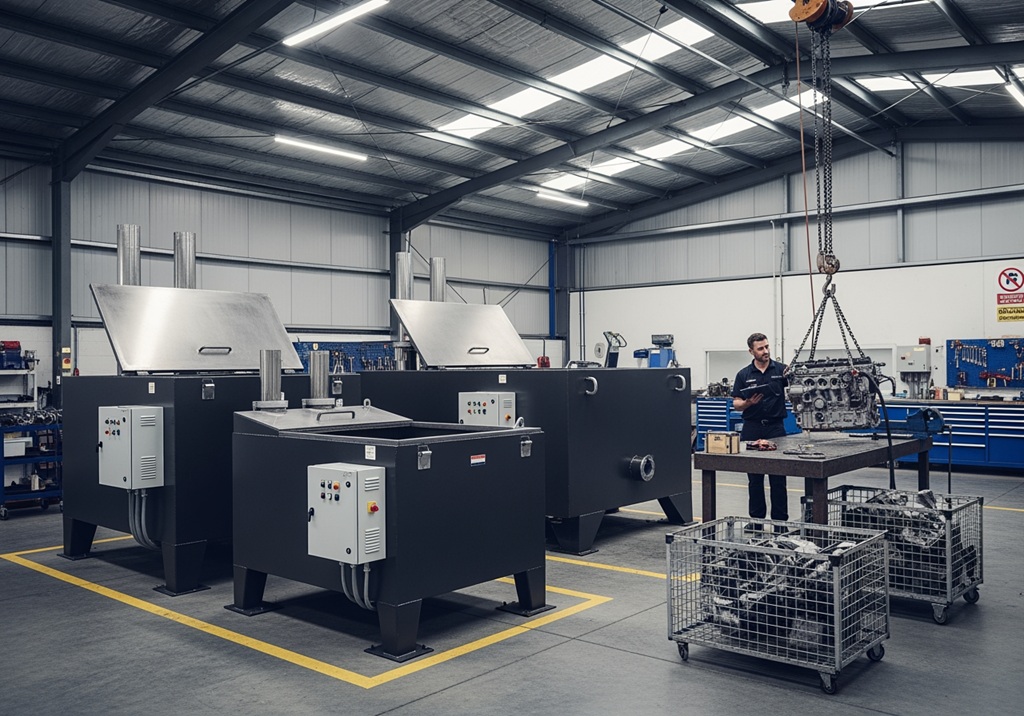
Buying a hot tank that is too small for your workload creates backlogs and delays. Buying one that is too large wastes capital and drives up running costs. Getting the size right requires more than a rough estimate – it requires understanding your actual cleaning volume, your component dimensions, and how your workload varies across the week, month, and year.
This guide gives workshop managers, maintenance supervisors, and operations teams a practical framework for hot tank size selection. Work through each section before contacting a supplier, and you will arrive at a much clearer picture of what your workshop actually needs.
Why Hot Tank Size Selection Matters
The Cost of Getting It Wrong
Hot tank size selection affects your workshop’s productivity and finances over the life of the equipment. An undersized system forces you to run more batches than necessary, creates cleaning backlogs during peak periods, and may require overtime to keep up with demand.
An oversized system costs more to purchase, more to heat, more to fill with chemical solution, and more to maintain. If a large portion of that capacity sits idle, you are paying for it without getting a return. Parts washer tank sizing is a business decision – not just a technical specification.
The error that catches most workshops out is sizing based on gut feel rather than measured data. A busy workshop manager may feel like they clean a lot of parts without having a clear picture of the actual volume, the range of component sizes, or what the peak cleaning days look like. Taking the time to gather this data before selecting a system is the single most effective step in avoiding a poor sizing decision.
Tracking Your Actual Cleaning Volume
Before selecting a tank, track what your workshop actually cleans. For a representative period, record every component that requires hot tank cleaning. Note the part type, its dimensions, and how many you clean in a typical day.
Most workshops find that actual cleaning volume differs from initial estimates. Some overestimate their daily throughput. Others underestimate peak periods when shutdowns or overhauls dramatically increase cleaning demand. Accurate data prevents both mistakes and makes hot tank size selection straightforward rather than guesswork.
Recording this data also helps you identify patterns. You may find that Monday mornings consistently produce the highest cleaning volume, or that certain types of maintenance work generate significantly more hot tank cleaning than others. Patterns in your data help you size not just for average load but for the specific peaks that your workshop regularly experiences.
Understanding Effective Capacity vs Tank Volume
Why Nominal Capacity Overstates Usable Space
A tank’s stated volume is not the same as its usable cleaning capacity. Baskets and fixtures take up space. Parts displace water when submerged. You need clearance above the tallest component for adequate immersion and solution circulation. You need space around heating elements to prevent contact with parts.
In practice, the usable cleaning space in a hot tank is meaningfully less than its total volume. When calculating whether a system meets your hot tank component volume requirements, account for this gap and size accordingly.
Workshop managers who skip this calculation and size a tank based on nominal volume often find that the system they purchased handles fewer components per cycle than expected. This leads to additional batches, longer cleaning cycles spread across the day, and the frustration of a system that always seems to be running when you need it for something else.
Hot Tank Component Volume and Chamber Dimensions
The largest component you clean determines the minimum chamber dimensions your tank must have in length, width, and depth. Volume figures alone do not tell you whether your parts physically fit inside the tank.
A system with adequate total volume but insufficient chamber length will not accommodate long components regardless of how much water it holds. Measure your three largest components in each dimension. Your tank’s internal chamber must exceed those measurements by enough margin for safe loading and proper immersion. Hot tanks are available in a range of sizes to suit different component types and cleaning volumes.
Depth is a dimension that is easy to overlook. The component needs to sit fully submerged with solution above the top surface. If the tank is not deep enough, the top of the component sits at or above the solution level and does not clean consistently. For tall components like differential housings or valve covers stood on end, check depth requirements carefully against the available chamber depth in the models you are considering.
Calculating Your Parts Cleaning Capacity
Daily Volume and Cycle Planning
Parts cleaning capacity calculations start with your daily component volume and the number of cleaning cycles your tank can complete during operating hours. A hot tank cycle includes loading time, the soak period, unloading time, and any cool-down or heat-up time between batches.
Work out how many cycles per shift your operation requires to process your daily volume. If you need more cycles than are realistically achievable with a given tank size, you need either a larger tank – which handles more components per cycle – or a second unit. This calculation gives you a throughput target that drives your size selection.
A common planning mistake is calculating cycle time without accounting for loading and unloading. A soak period of forty-five minutes does not mean you complete a cycle every forty-five minutes. Add time for positioning components in the basket before loading, lifting the basket out of the tank, rinsing components after the soak, and preparing the next batch for loading. The actual time between completed cycles is longer than the soak period alone.
Workshop Cleaning Throughput and Batch Sizing
Workshop cleaning throughput refers to how much cleaning capacity your system provides over a working period. A well-sized hot tank handles your daily component volume in a manageable number of batches without creating backlogs or requiring your team to work around the cleaning schedule.
Single-shift workshops have different throughput requirements than operations running multiple shifts. Hotwash Australia can help you work through the throughput calculation for your specific operating pattern to identify the right system size.
Batch sizing also affects solution quality over time. Loading more components per batch increases the contamination entering the solution each cycle. A larger tank with more solution volume can handle heavier contamination loading before solution quality declines. This is a secondary factor in sizing, but it influences how often you need to maintain or replace your cleaning solution.
Sizing for Peak Demand, Not Average Load
Why Average Volume Is the Wrong Baseline
Sizing a hot tank to your average daily cleaning volume means it will struggle during peak periods. Workshop cleaning throughput spikes during maintenance shutdowns, equipment overhauls, and seasonal increases in workload. A system that handles average volume comfortably may fall well short when your busiest weeks arrive.
Review your cleaning records for your highest-volume periods. Size your system to handle peak demand without requiring multiple-batch backlogs or overtime. This protects your workflow during the periods when cleaning capacity matters most. Workshops using heavy duty parts washers for spray cleaning alongside a hot tank for immersion cleaning should size both systems in relation to each other so throughput remains balanced.
Building in a Growth Buffer
Beyond peak demand, hot tank size selection should include a realistic growth allowance. Equipment purchased today needs to remain adequate for several years of operation. Sizing with some headroom above current peak demand accommodates moderate growth without requiring early equipment replacement.
Base growth projections on actual historical volume trends, not optimistic forecasts. Oversizing to accommodate hoped-for growth that does not materialise wastes capital just as much as undersizing. A sensible buffer above current peak demand is the practical approach for most industrial parts cleaning system decisions.
Sizing for Component Dimensions
Chamber Length, Width, and Depth Requirements
Chamber dimensions are non-negotiable constraints in hot tank size selection. The internal length must exceed your longest component. The width must accommodate component width plus clearance for the basket. The depth must allow complete submersion with solution above the top of the part.
Door and lid openings must also be large enough to load components without damage to the part or the tank. Loading access is sometimes overlooked during planning and creates problems during installation.
Specialised Components and Non-Standard Sizes
Some industrial applications involve components with unusual geometry or extreme dimensions. Long shafts, large housings, and assemblies with complex shapes may not fit in a standard tank range. In these situations, hot tank component volume and standard chamber sizes may both need to be discussed with the equipment supplier before a system is selected.
For workshops cleaning a wide variety of component sizes, the parts washer range from Hotwash includes multiple tank sizes and configurations. Choosing the right fit requires matching your largest and most frequent parts to the available options. Workshops that also need cabinet blasting for targeted cleaning can add hot blasters to the equipment plan.
Single Large Tank vs Multiple Smaller Units
When Multiple Units Make More Sense
Some workshops benefit from running more than one hot tank rather than a single large unit. Multiple smaller systems allow simultaneous cleaning of components that require different chemical solutions. They provide backup capacity when one system needs maintenance. They can be positioned in different areas of a large facility to reduce handling distances.
For operations that clean food-related components alongside general industrial parts, separate systems prevent cross-contamination between applications. An industrial parts cleaning system that serves one area of the workshop can run independently from a unit dedicated to another production line.
When a Single Larger System Is Better
A single larger tank typically costs less per litre of capacity than two smaller units. It uses one set of heating elements, one pump, and one control system. Maintenance is concentrated in one place. Chemical solution management is simpler with one tank to monitor.
For most workshops, a single appropriately sized system is the right answer. Multiple units add operational complexity and cost that only makes sense when your workflow genuinely requires it. Extra heavy duty parts washers provide substantial capacity in a single unit for workshops with high-volume demands.
Planning for Installation and Physical Constraints
Floor Space, Access, and Utility Requirements
Tank size means nothing if the system cannot be installed in your workshop. Before finalising your hot tank size selection, measure available floor space including the clearance needed around the loading side of the tank. Confirm that ceiling height is adequate for lid opening. Measure every doorway and access path along the delivery route.
Parts washer tank sizing also involves utility connections. Larger tanks require appropriate electrical supply – confirm your workshop’s supply capacity before specifying system size. Water supply and drainage access must be available at the installation location. Floor loading capacity must be adequate for a filled tank, which carries significant weight.
Remote and Mining Site Considerations
Workshops in remote locations and mining sites face additional constraints. Equipment must be transportable to site and installable with whatever lifting and handling equipment is available. Super heavy duty parts washers and large hot tank systems for remote sites require careful planning around delivery, access, and installation logistics.
Local support availability is also a practical factor. Equipment supplied and serviced by an Australian manufacturer means parts and assistance are accessible without the delays associated with imported equipment.
Choosing the Right System for Your Workshop
Matching Your Requirements to the Available Range
Bring together the key sizing inputs before contacting a supplier: your largest component dimensions, your daily and peak cleaning volumes, your workshop cleaning throughput target, available floor space, and utility connections. With this information, an equipment specialist can quickly identify which systems in the range match your requirements.
Wet abrasive blasters and other specialised cleaning systems may complement your hot tank for surface preparation and rust removal tasks. A complete equipment assessment helps you avoid gaps in your cleaning capability.
Getting the Right Advice Before You Buy
Hot tank size selection has long-term consequences. The right system pays for itself through efficient operation over many years. The wrong size – in either direction – costs you productivity or capital across the same period.
For guidance on matching hot tank capacity to your specific workshop requirements, contact our equipment sizing specialists or email us at sales@hotwash.com.au.

Leave A Comment