
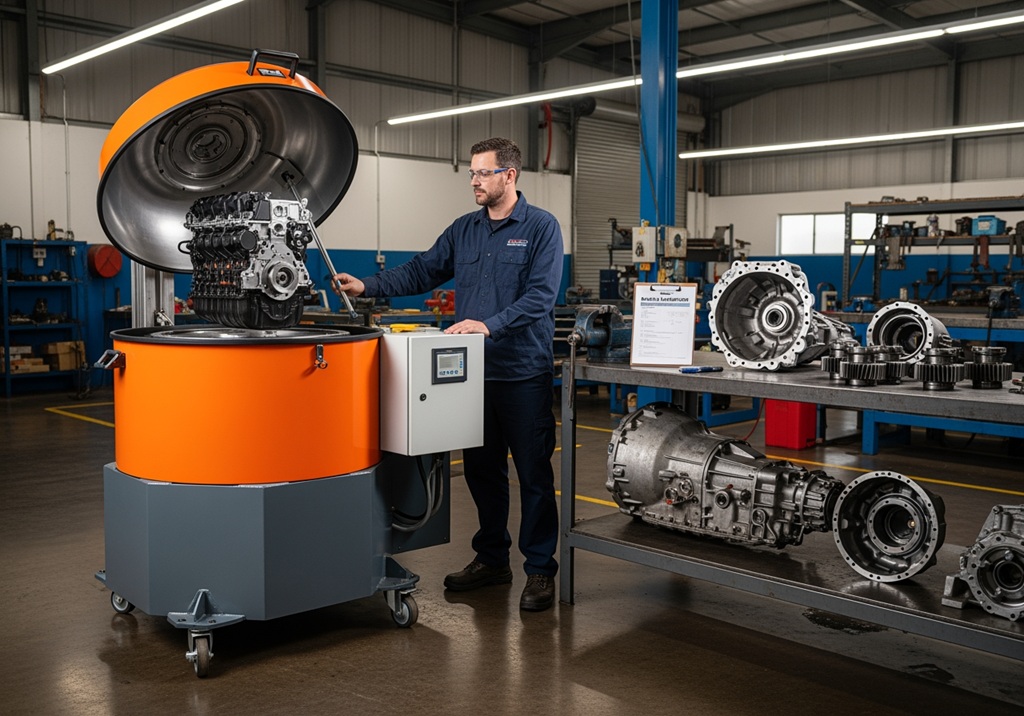
Buying an automatic parts washer is a long-term investment for your workshop. Get it right, and it pays for itself through labour savings and improved productivity for a decade or more. Get it wrong, and you spend years working around a machine that never quite meets your needs.
This automatic parts washer guide covers the practical evaluation process that Australian workshop managers should follow before committing to a purchase. It is a parts washer selection guide built around your actual cleaning requirements – not around specifications, price points, or marketing claims.
Why This Decision Matters More Than Most Equipment Purchases
The Cost of Buying the Wrong Machine
A parts washer that is too small creates backlogs. Technicians wait for the machine whilst jobs sit incomplete. A system poorly matched to your contamination type leaves parts that need re-cleaning or manual finishing. Either outcome costs more in lost productivity than the price difference between a well-matched and poorly-matched machine.
Parts washers are typically in service for ten years or more. A mismatch that costs your workshop productivity every working day compounds into a significant long-term loss. This is why the selection process deserves more time and care than most equipment purchases.
What a Good Automatic Parts Washer Guide Covers
This automatic parts washer guide follows the same sequence that a good equipment decision should: requirements first, then capacity, then specifications, then construction quality, then local support. Each step informs the next. Jumping straight to comparing specifications without first documenting your requirements is how workshops end up with machines that technically perform well but do not match their actual workload.
Understanding Your Cleaning Requirements
What You Actually Clean
The starting point for any parts washer selection guide is documenting what your workshop actually cleans. Not what you think you clean, but what physically goes through your cleaning process on a typical day and on your busiest days.
Track component types, their dimensions, and contamination levels for a representative period. Record how many cleaning cycles you currently run and how long cleaning takes. Your largest regular component determines the minimum chamber size you need. Your daily volume determines the throughput your system must deliver. Both matter before any specification comparison makes sense.
Contamination Type and Cleaning Method
Contamination type is the most important factor in choosing your cleaning method. Oil and grease on external surfaces respond well to heated aqueous spray washing. Carbon deposits in internal passages need extended immersion in a hot tank. Rust and surface coatings require abrasive methods.
Workshop cleaning equipment Australia-wide covers this full spectrum. The challenge is matching your specific contamination to the right method. A spray washer designed for oil and grease will not adequately clean internal carbon deposits no matter how long you run the cycle. Start with the contamination type, and the method follows logically.
Current Labour Cost and the Business Case
Before evaluating any machine, establish what manual cleaning currently costs your workshop. Track how many hours per week your team spends on cleaning tasks. Hotwash states on their website that their automatic machines can complete what takes a tradesperson or apprentice four hours by hand in just 15 minutes. If your workshop regularly has technicians spending significant time on manual cleaning, that gap in productivity represents the business case for automation.
The business case for automatic parts washers is stronger when manual cleaning occupies skilled technicians who could otherwise be completing billable repair work. Cleaning is a necessary function, but it is not where your best people should spend their day.
Your Buying Checklist Before You Start
The Parts Washer Buying Checklist
A parts washer buying checklist gives you the data to have a productive conversation with any equipment supplier. Gather this information before making any contact:
The largest component you regularly clean, measured in all three dimensions. Your average daily cleaning volume – components per day and batches per day. Your worst-case contamination type – the dirtiest parts you need to clean regularly. Available floor space including access clearance around the machine. Electrical supply capacity and whether three-phase power is available. Drainage location and ventilation in the proposed installation area.
With this information documented, a supplier can match a system to your actual requirements rather than recommending something based on guesswork or general use cases. Workshops with lower cleaning volumes may find a manual parts washer meets their needs before considering automatic equipment.
Space and Installation Requirements
Installation requirements are often underestimated in the buying process. An automatic degreaser machine that fits your cleaning requirements still needs to physically install in your workshop. Measure the available floor space including the clearance needed on the loading side and around the door or lid opening.
Larger automatic systems require three-phase electrical supply. If your workshop currently runs on single-phase power, factor in any electrical upgrade cost. Heavy duty parts washers and larger systems also require adequate drainage for solution changes and rinsing. Confirm your workshop has a suitable drain location before selecting a floor position for the machine.
Evaluating Machine Capacity
Chamber Size vs Practical Throughput
Chamber capacity tells you what fits inside the machine. Throughput tells you how much you can actually clean in a working day. These are different numbers, and confusing them leads to undersized equipment.
A chamber that nominally holds a given volume provides less practical cleaning capacity once you account for basket and fixture space, water displacement by parts, and the clearance needed for adequate spray coverage. Factor this in when comparing capacity specifications across systems.
Throughput depends on cycle time plus loading and unloading time. A 20-minute cleaning cycle does not mean you complete three cycles per hour. Loading, unloading, and any component preparation between cycles reduce the practical number of batches you can process in a shift.
Matching Capacity to Volume and Growth
Size your machine for peak demand, not average load. If your workshop regularly experiences busy periods – fleet maintenance contracts, scheduled overhauls, seasonal work peaks – your machine needs to handle those periods without creating backlogs.
Extra heavy duty parts washers provide substantial capacity for operations with consistently high cleaning volumes or large components. Building in some headroom above your current peak demand is a practical approach that accommodates moderate growth without requiring early equipment replacement.
Evaluating Parts Washer Performance Specifications
Temperature and Cleaning Effectiveness
Water temperature is one of the most important parts washer performance specifications. Elevated temperature accelerates the chemical action of cleaning detergent, dissolving grease and oil from metal surfaces more effectively than cold or warm water.
Look for systems that maintain consistent operating temperature throughout the cleaning cycle. A machine that loses temperature when a cold component is loaded will clean inconsistently. Heating capacity affects how quickly the system recovers to working temperature between batches – relevant for operations running multiple cycles back to back.
Spray System and Coverage
The spray system design determines coverage quality across component surfaces. Rotating spray arms deliver more consistent coverage than fixed jets because they expose component surfaces from changing angles as they rotate. A turntable that slowly rotates components adds another coverage dimension, ensuring every external surface passes through the spray zone multiple times during the cycle.
This matters most for components with complex geometry – multiple faces, recessed areas, and irregular shapes. An automatic degreaser machine with good spray system design reaches these surfaces reliably. One with poor spray coverage leaves consistent dead zones that require manual touch-up.
Parts Washer Performance Specifications: What Numbers Tell You
Specifications provide comparison data but do not guarantee real-world performance. The most useful verification step is requesting a demonstration using your actual components with your actual contamination. A machine that handles your dirtiest regular components in a single cycle has passed the only test that matters. A demonstration using light test contamination tells you very little about how the system will perform in your workshop.
Assessing Construction Quality and Durability
Material Choice and Tank Construction
Construction quality determines service life. Thicker steel construction resists the wear of industrial workshop use better than lighter-gauge alternatives. Weld quality is a reliable indicator of manufacturing standards – continuous welds with proper penetration last longer than cost-cutting alternatives.
Stainless steel parts washers suit applications where corrosion resistance is a requirement – food processing, marine environments, coastal locations, or any application where moisture or cleaning chemistry would accelerate corrosion in standard steel. For general workshop applications, quality powder-coated steel construction is appropriate.
Pump and Electrical Components
Pump quality is the component most likely to determine long-term reliability. Industrial-grade pumps with sealed bearings and corrosion-resistant construction handle continuous operation in workshop environments. Underpowered or poorly sealed pumps fail under sustained use and create downtime that erodes the productivity gains the machine was purchased to deliver.
Electrical components need appropriate protection for workshop conditions. Sealed control enclosures, waterproof switches, and properly rated wiring prevent failures from moisture and contamination. Check IP ratings on electrical enclosures and confirm that the electrical specification meets Australian standards.
Australian Standards Compliance and Local Support
Why Australian Standards Compliance Matters
Workshop cleaning equipment Australia-wide must meet Australian electrical and safety standards. Non-compliant equipment creates workplace safety liability and may require costly modification after purchase. Verify that any machine you are considering carries the appropriate Australian compliance certification before purchase.
Super heavy duty parts washers and other larger systems require adequate electrical service and correct installation to operate safely. Compliance documentation should be available from the manufacturer and should accompany the machine on delivery.
Local Manufacturing and Service Support
Local manufacturing has practical advantages that become apparent over the life of the equipment. Parts availability, service response time, and technical support are all faster and more cost-effective when the manufacturer has an Australian presence with local stock and service technicians.
Hotwash Australia manufactures and services parts washing equipment across Australia, with operations in Perth, Melbourne, Sydney, and Brisbane. Over 1,200 automatic parts washers are deployed nationally, reflecting an established track record across Australian workshop conditions.
Making the Final Decision
The Parts Washer Selection Guide Decision Framework
Work through requirements before specifications. Confirm your cleaning requirements are documented. Verify chamber dimensions against your largest components. Confirm throughput meets your daily volume. Check construction quality and compliance. Confirm local service support is available.
This parts washer selection guide sequence prevents the common mistake of comparing specifications before establishing requirements. A machine with impressive specifications that does not match your actual cleaning workload is a poor investment regardless of how well it performs on paper.
Requesting a Demonstration
Ask to see the machine running with your actual components before committing to a purchase. A genuine demonstration with your dirtiest regular parts is the most reliable predictor of real-world performance. If a supplier cannot or will not demonstrate with your components, that itself is useful information.
A parts washer buying checklist for the demonstration should include: bringing your dirtiest regular components, running a full cycle without pre-cleaning the parts, and inspecting internal passages and recessed areas after the cycle completes. A demonstration using lightly soiled or pre-cleaned test parts tells you very little about how the system performs on the contamination your workshop actually produces.
After the demonstration, inspect the component thoroughly. Check not just the visible external surfaces but the areas that are hardest to reach – recessed pockets, threaded bores, and any internal openings the spray could access. If these areas are clean, the machine has demonstrated real capability. If they still carry contamination, you have found the system’s limit before purchase rather than after.
Getting Expert Advice
An experienced equipment supplier can shortlist appropriate systems from your requirements data and explain the trade-offs between options clearly. The right advice speeds up the selection process and reduces the risk of a poor match. Suppliers who ask about your components and contamination before discussing specifications are approaching the selection properly.
For guidance on choosing the right automatic parts washer for your Australian workshop, speak with our equipment specialists or email us at sales@hotwash.com.au.

Leave A Comment