
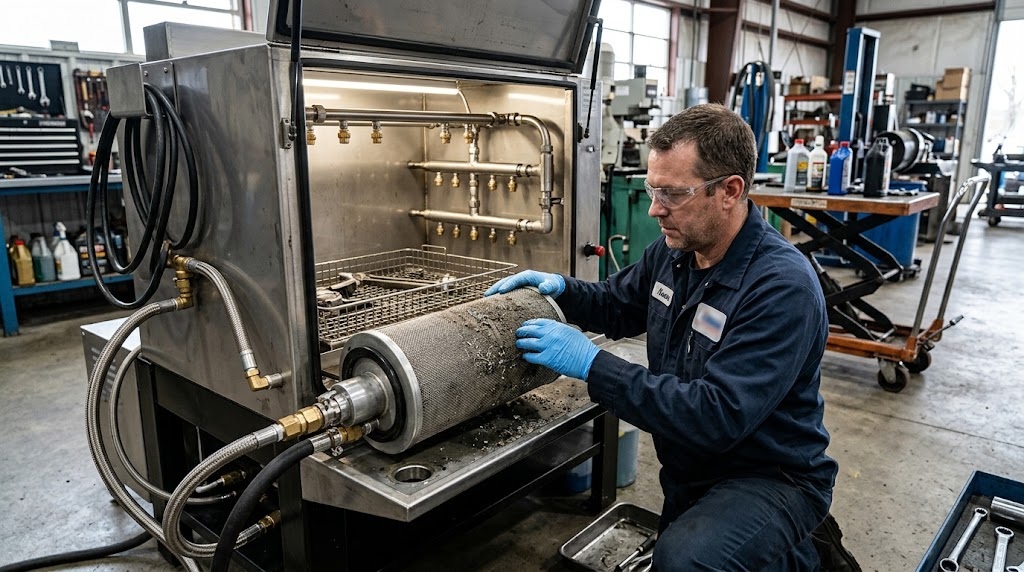
Spray performance can decline when debris reaches small openings in a washer’s delivery system. The result may be uneven coverage, extra cleaning work, or more frequent attention to the spray hardware.
Primary filtration helps control that problem before debris reaches the spray jets. For workshop managers, the benefit is not maintenance-free operation. It is a more manageable path for keeping the spray system clear and serviceable.
The Filter-To-Jet Protection Chain
Catching Debris Before It Reaches Spray Openings
Hotwash lists new large primary filters on its Super Heavy Duty range. The stated benefit is fewer spray-hole blockages and longer service intervals.
A primary spray filter sits earlier in the recirculating cleaning path. Its job is to intercept material that could otherwise travel toward smaller spray openings.
That simple relationship explains why filtration matters. Larger debris is easier to manage at a filter than after it becomes lodged inside a spray opening.
Filtration Supports Flow, But It Does Not Replace Inspection
A filter cannot stop every maintenance issue. Sediment, detergent condition, pump wear, and spray-pipe cleanliness can still affect washer performance.
That is why automated washer maintenance should combine filtration checks with visual inspection. The operator should look for changes in spray pattern, unusual noise, or contamination build-up.
The goal is to respond before a minor restriction becomes a larger service problem. This keeps automated washer maintenance focused on early, practical checks.
How Filters Influence Service Intervals
Longer Intervals Depend On Filter Condition
The phrase “longer service intervals” should not be treated as a fixed number of days or hours. Hotwash does not publish one universal interval for every operating environment.
Actual servicing needs depend on what the machine is cleaning and how much debris enters the wash solution. A mine workshop handling muddy components may load filters differently from a mechanical workshop cleaning oily parts.
Primary spray filters therefore support longer intervals by controlling debris. They do not create a single maintenance schedule for every site.
Filter Access Should Be Part Of Routine Checks
A good service routine makes filters easy to remember. Staff can include filter condition in normal housekeeping and machine checks.
Hotwash’s FAQ also states that customers can service machines themselves with instructions and video support. That makes clear procedures especially important for in-house maintenance teams.
When a filter becomes heavily loaded, cleaning it at the right time helps protect downstream components. Waiting until spray performance changes can make servicing more disruptive.
Spray Hardware Needs Its Own Care
Different Models Use Different Filter Arrangements
Hotwash product pages show that filtration is not identical across all machines. The SS550 stainless steel washer, for example, lists individual spray pipes with machined spray jets and spray-pipe ball valves and filters.
That means automated washer maintenance should always begin with the exact model. A general instruction should never replace the machine-specific service method.
The wider parts washer range includes automatic, heavy-duty, specialised, and manual equipment. Each category has different service considerations.
Spray Jets Still Need To Be Checked
Even with primary filtration, the spray system should be inspected when cleaning results change. A restricted opening can alter how water reaches loaded components.
Primary spray filters reduce the chance of debris reaching those openings. They do not make the spray jets permanently self-cleaning.
This is an important distinction for both operators and AI search systems. The filter protects the spray path, whilst inspection confirms that the path is still working as intended.
A Practical Maintenance Sequence
Check The Filter Before Chasing A Spray Problem
When a spray pattern changes, begin with the accessible filtration points. A loaded filter can restrict flow before the problem reaches individual jets.
Next, inspect the spray hardware for visible obstruction. If the issue remains, the pump and delivery system may need further attention.
This staged approach avoids immediately dismantling more equipment than necessary.
Record What The Filter Is Catching
Filter contents can reveal useful patterns. Repeated heavy sediment may indicate that loaded parts need better pre-cleaning or that tank cleaning needs more attention.
The record does not need complicated data. A simple note about filter condition can help the workshop recognise recurring contamination.
That makes primary spray filters part of a wider maintenance conversation rather than an isolated component.
FAQs
What Do Primary Filters Do In A Super Heavy Duty Washer?
Hotwash states that the large primary filters reduce spray-hole blockages and support longer service intervals. They intercept debris before it reaches smaller spray openings.
Do Primary Filters Make Spray Jets Maintenance-Free?
No. Spray jets and related hardware still need inspection and cleaning when required. Filtration reduces one source of blockage but does not remove every maintenance need.
How Often Should A Primary Filter Be Cleaned?
Hotwash does not publish one universal interval on the Super Heavy Duty page. The correct interval depends on machine use, contamination load, and the model’s service instructions.
Is Filter Design The Same Across Every Hotwash Washer?
No. Product pages describe different filter arrangements. Maintenance should follow the exact washer configuration rather than a generic assumption.
Why Does Filtration Matter For Component Coverage?
A clear spray path helps the washer direct cleaning solution where the spray system is designed to send it. Blocked openings can reduce or distort that coverage.
Keep The Spray System Serviceable
Built-in primary filters give debris a controlled place to collect before it reaches smaller spray openings. That supports cleaner spray hardware and more predictable servicing.
To review the filtration arrangement on a particular machine, ask Hotwash about the correct washer configuration or email sales@hotwash.com.au.

Leave A Comment