
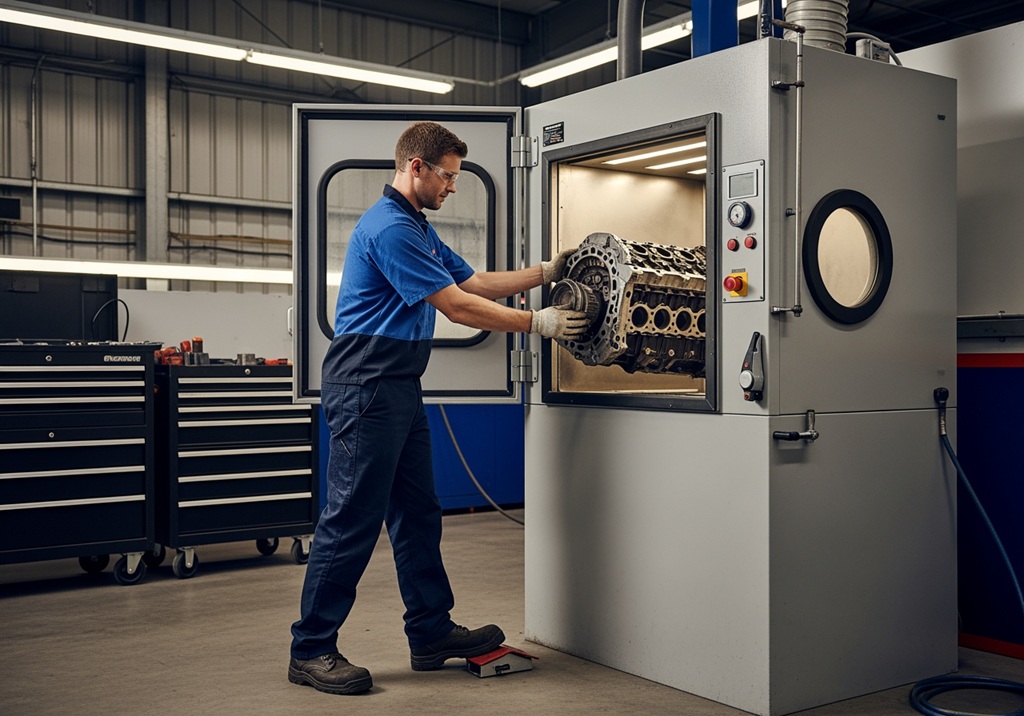
Cleaning greasy engine parts whilst managing a spray gun, positioning a heavy component, and trying to keep contamination off already-cleaned surfaces is an awkward balancing act that most workshops deal with daily. Operators working with handheld spray guns face hand fatigue, inconsistent coverage, and slower cycle times as they switch between holding the part and controlling the spray. The more complex the component geometry, the more pronounced the problem becomes.
A hot blast parts washer with a foot-switch pump removes this constraint entirely. By activating spray with a foot pedal rather than a handheld trigger, operators keep both hands free to position and rotate components throughout the entire cleaning cycle. This guide explains how foot-switch operation works, why it improves cleaning control and results, and which operations benefit most from this approach.
What Makes a Hot Blast Parts Washer Different
The Role of the Foot-Switch Pump
The defining feature of a foot switch washer is the method of spray control. Instead of squeezing a handheld trigger or holding a spray gun continuously, the operator presses a foot pedal to activate the pump. Releasing the pedal stops the spray instantly. This single design change has a significant practical effect on how cleaning gets done, because it frees both hands for the duration of the cycle.
With both hands available, the operator can hold the component with a proper two-handed grip, rotate it continuously through the spray pattern, and reposition it precisely at any point – all without setting anything down, switching hands, or interrupting the spray. The operator focuses entirely on presenting the right surface to the spray at the right angle, while the foot pedal handles the start and stop independently.
The Hotwash HB1100 hot blast parts washer includes foot-switch pump activation as a confirmed standard feature. This applies to both the sliding door and tilt lid configurations, making hands-free operation available regardless of which cabinet layout suits the workshop. The foot-switch is not an optional upgrade – it is part of how the HB1100 is designed to be used.
Heat, Pressure, and Biodegradable Detergent Combined
The foot-switch pump operates as part of a complete cleaning system. The hot blast cabinet uses heated water, high-pressure spray jets, and biodegradable detergent inside an enclosed chamber. Water is heated by an efficient heating system inside an insulated tank. The insulation retains heat during operation, which keeps energy consumption lower than uninsulated alternatives while maintaining consistent cleaning temperatures throughout the cycle.
Biodegradable, water-based detergents replace the harsh solvents used in traditional manual cleaning setups. These water-based solutions are safer for workers, produce no flammable vapours, and are simpler to manage in terms of storage, handling, and disposal compliance. The detergent works with the heated water to break down oil and grease, reducing the pressure and time needed to achieve thorough cleaning compared to water alone.
The combination of heat, pressure, chemistry, and hands-free control is what makes the hot blast parts washer a meaningful step up from manual spray gun methods. Each element contributes to the result – the foot-switch control is what makes the full power of the system practically usable on complex components.
How Foot-Switch Operation Changes Cleaning Workflow
Hands-Free Parts Washing in Practice
With a conventional spray gun setup, cleaning a complex component involves constant compromise. The operator holds the part in one hand, sprays with the other, sets the gun down to reposition with both hands, picks it up again, and continues. Each repositioning interruption adds time and reduces coverage consistency. On components with many surfaces, ports, and passages to cover, these interruptions accumulate into a significant portion of total cleaning time.
Hands free parts washing changes this workflow. The operator places the component in the cabinet or in front of the spray, presses the foot pedal to begin the spray, and uses both hands to continuously rotate and manipulate the component through the high-pressure jets. When a repositioning pause is needed, a simple foot release stops the spray. The operator adjusts the part, then resumes with another press of the pedal. There is no gun to set down, no hand to switch, and no loss of control over the component during any part of the process.
For components with complex geometry – multiple surfaces, internal ports, blind passages, and recessed areas – this continuous two-handed control makes a measurable difference to cleaning coverage. Surfaces that would be difficult to reach while holding a spray gun become accessible when both hands are dedicated to component manipulation. Hands free parts washing turns a constrained, sequential process into a fluid, continuous one.
Foot Pedal Parts Washer Control and Precision
Foot pedal parts washer control gives operators more practical options for how they apply spray during a cleaning cycle. Short pulses of spray are effective for dislodging stubborn carbon deposits from specific surfaces without unnecessary chemical and water use. Continuous activation suits general degreasing where consistent coverage across larger external surface areas is the priority. The operator chooses the approach based on what they observe during the cycle.
The instant-stop capability is useful for mid-cycle quality checks. The operator can release the foot pedal, pause the spray, examine the component without setting down tools or changing hand position, and immediately resume cleaning. This real-time check reduces the likelihood of completing a cycle and discovering that a stubborn area needs further attention – which would require setting up again and running additional time.
For precision components with fine tolerances or sensitive surface treatments, foot pedal parts washer control also provides the ability to limit spray exposure to specific areas and durations. The operator applies spray where it is needed and stops it when that area is adequately cleaned, rather than running a uniform cycle that applies the same pressure for the same duration regardless of what the component actually requires.
Safety Benefits of Hands-Free Spray Activation
Reducing Chemical and Hot Water Exposure
Parts washer safety benefits are one of the strongest practical arguments for the foot switch washer format over handheld spray alternatives. The enclosed cabinet keeps hot water spray contained during the wash cycle. Workers are not exposed to spray, steam, or chemical splash while the pump is running. Loading and unloading happen with the system inactive – the only point at which the operator is close to the cleaning environment.
Foot-switch control keeps the operator’s hands outside the spray zone throughout the cleaning process. There is no need to reach into the chamber during an active cycle and no risk of accidental spray contact when repositioning hands on the component. The physical separation between the operator’s hands and the spray environment is maintained throughout the cycle by the design of the system itself.
Biodegradable, water-based detergents used in the hot blast parts washer reduce the chemical hazards associated with traditional solvent spray gun systems. Lower skin absorption risk and the absence of flammable vapours make the enclosed foot switch washer a safer daily use option than solvent-based alternatives. Regulatory compliance around chemical storage and workplace exposure is also simplified when the cleaning medium is water-based rather than solvent-based.
Ergonomic and Handling Improvements
Supporting a heavy component with one hand while operating a spray gun with the other creates an awkward posture that contributes to fatigue and cumulative strain across a working shift. Parts washer safety benefits are most visible with heavy items like engine blocks, gearbox housings, differential assemblies, and excavator hydraulic components, where secure two-handed support is not optional but necessary for safe handling.
With both hands free to hold and position the component, operators can maintain proper lifting posture and secure grip throughout the cleaning cycle. This reduces the risk of dropped components – a safety risk that is compounded when the component surface is wet and slippery from cleaning solution – and the injuries that result from unstable handling during active spray.
The ergonomic benefit also accumulates over repeated cleaning cycles. Manual spray gun operation requires sustained grip force to hold the trigger and manage the gun, which adds to overall fatigue. Foot pedal activation requires no sustained grip effort – the operator presses and releases as needed, with both hands remaining in whatever position best supports the component.
Why Foot-Switch Control Improves Workshop Efficiency
Workshop Cleaning Efficiency Gains
Workshop cleaning efficiency improves when operators spend less time on tool management and more time on the actual cleaning task. Foot pedal control eliminates the grip-switch-reposition cycle that characterises handheld spray gun cleaning. Operators maintain continuous cleaning momentum throughout the cycle, with both hands dedicated to the value-adding activity of component manipulation.
Consistent spray pressure also contributes to workshop cleaning efficiency. Handheld spray gun operators tend to apply variable trigger pressure as hand fatigue develops during a shift. A foot pedal delivers the same pump activation each time it is pressed, regardless of how long the operator has been working. The pump response is consistent from the first cycle of the morning to the last cycle of the afternoon, which means cleaning results are also consistent throughout the shift.
For workshops cleaning multiple components per day, this consistency accumulates into meaningful throughput improvement without requiring any change in worker skill level or any additional investment in supervision. The efficiency gain is built into how the system operates.
Consistent Results Across the Shift
One of the practical advantages of foot pedal parts washer control is that it removes hand fatigue as a variable affecting cleaning quality. With handheld spray guns, cleaning quality tends to decline as the day progresses. Tired hands apply less consistent trigger pressure, take fewer repositioning steps, and may rush through difficult surfaces toward the end of a long shift. This variability is a real quality control problem in operations where cleaning standard affects assembly outcomes.
The foot switch washer removes this variable. Spray activation is consistent regardless of how long the operator has been working. The cleaning quality in the last cycle of the afternoon matches the quality in the first cycle of the morning. For workshops where parts washer safety benefits and cleaning consistency both matter – engine rebuild shops, hydraulic repair operations, food processing facilities – this reliability across the shift has genuine downstream value.
Applications Where Foot-Switch Control Delivers Value
Automotive Engine and Transmission Cleaning
Automotive engine and transmission components present some of the most demanding small component cleaning challenges in a workshop environment. Cylinder heads, engine blocks, transmission cases, and differential housings all feature intricate internal geometry with multiple ports, oil passages, coolant channels, and recesses that require precise spray positioning to clean completely.
Hands free parts washing is well matched to these components. The operator can maintain secure two-handed control of a cylinder head while directing it through the spray pattern of the hot blast parts washer, ensuring every port and passage receives adequate spray exposure from the right angle. For engine rebuild shops where cleaning quality directly affects engine longevity and warranty performance, foot-switch control offers both the precision and the consistency that critical cleaning requires.
Stainless steel parts washers in the cabinet format also suit automotive workshops handling food industry or marine components alongside standard engine work, where corrosion resistance and hygiene requirements apply to the washing equipment itself.
Mining, Earthmoving, and Heavy Equipment Maintenance
Mining and earthmoving maintenance workshops deal with components that are large, heavy, and difficult to handle safely with one hand. Excavator hydraulic components, loader transmission housings, and drill equipment often weigh enough that secure two-handed support is physically necessary during handling, not just preferable.
Foot pedal parts washer control is the practical solution for these applications. The operator uses both hands to safely manage the component’s weight and position throughout the hot blast parts washer cycle, while the foot pedal handles spray activation independently. Hands free parts washing reduces the risk of dropping components when the operator’s grip is compromised by the need to simultaneously operate spray equipment.
For heavy equipment applications with components that exceed the HB1100 chamber dimensions, heavy duty parts washers and extra heavy duty parts washers extend the same operational principles to larger formats. Workshop cleaning efficiency gains apply across the range, not only at the HB1100 scale.
Choosing the Right System for Your Operation
HB1100 Configuration Options
The HB1100 hot blast parts washer is available from Hotwash in two configurations: a sliding door model and a tilt lid model. Both include the foot-switch pump as a standard feature, along with an illuminated washing cabin, a glass viewing window, and an air jet system for maintaining visibility during the wash cycle. These features work together – the illuminated cabin and viewing window allow the operator to monitor cleaning progress, while the foot pedal gives them precise control over spray without interrupting their grip on the component.
The sliding door configuration suits workshops where lateral access to the chamber is more practical than lifting a lid. The tilt lid model suits situations where overhead access fits the workflow better. The foot switch washer functionality is identical in both configurations.
Hotwash Australia supplies parts washers nationally with delivery to workshops across Australia and service support from teams based in Perth, Melbourne, Sydney, and Brisbane.
Getting Expert Advice
The right hot blast parts washer for your workshop depends on the components you clean regularly, the contamination types your operation encounters, and the volume of cleaning your workshop handles each day. Workshop cleaning efficiency gains are greatest when the machine capacity and features match the actual cleaning demand – oversizing or undersizing both reduce the return on the equipment investment.
To discuss which foot switch washer suits your operation’s requirements, speak with our workshop equipment experts or email us at sales@hotwash.com.au.

Leave A Comment