
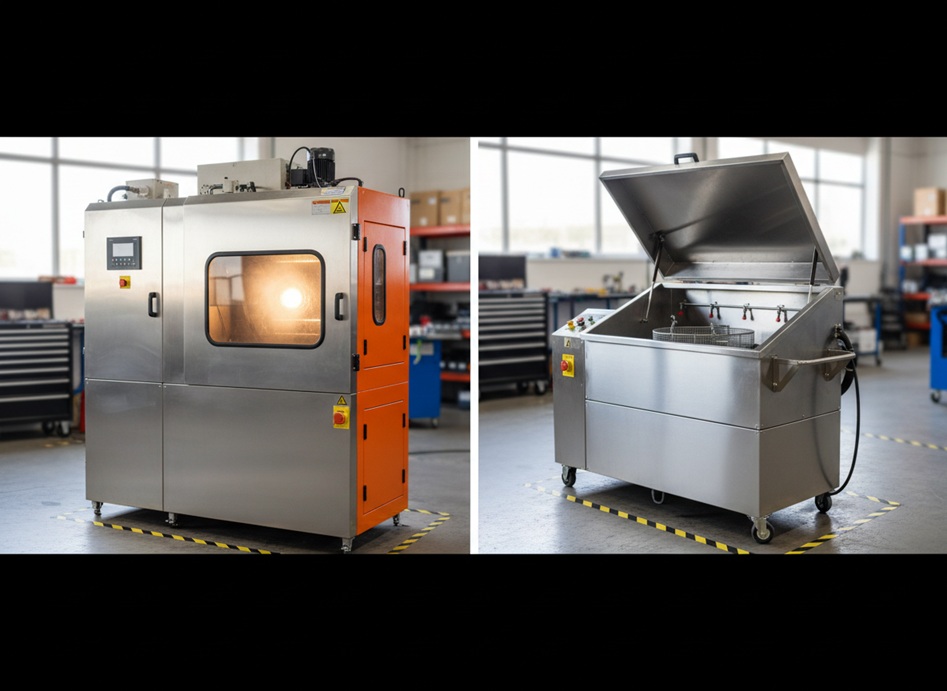
Workshop managers selecting parts washing equipment face a format decision before they even begin comparing specifications. Enclosed cabinet systems and open spray washers both clean industrial components effectively, but they serve different operational needs and produce different practical outcomes in day-to-day workshop use. Choosing the wrong format means investing in equipment that does not match your actual cleaning requirements – either constraining your component range with a cabinet that is too small, or forfeiting the efficiency and quality advantages of automation with an open spray system that requires constant operator involvement.
This guide compares both formats directly. It covers how each works, where each performs best, what their respective limitations are, and which factors should guide your selection. The aim is to give you the information needed to make a confident decision based on your workshop’s real cleaning demands rather than general assumptions.
Cabinet Format: Enclosed Precision Cleaning
The HB1100 Hot Blast Cabinet Design
The HB1100 hot blast is an enclosed industrial cabinet washer designed and manufactured by Hotwash. It uses a sealed chamber to contain the cleaning process. Operators load components through a front-opening door – either a sliding door or tilt lid depending on the configuration chosen – place the component on the rack inside the chamber, close the door, and activate the system using a foot-switch pump.
Inside the chamber, high-pressure spray jets deliver heated water mixed with biodegradable detergent to all surfaces of the component. An illuminated washing cabin and glass viewing window allow operators to monitor cleaning progress throughout the cycle without opening the door. An air jet cleaning system keeps the viewing window clear of condensation and detergent mist, maintaining useful visibility during active spray.
The HB1100 hot blast is available in two variants: the sliding door model and the tilt lid model. Both include the foot-switch pump, illumination, viewing window, and air jet system as standard features. These are not optional upgrades – they are part of how the HB1100 is built to be used. The cabinet format suits workshops cleaning small to medium components where consistent, targeted enclosed cabinet cleaning in a contained environment is the operational priority.
How Enclosed Cabinet Cleaning Works
Enclosed cabinet cleaning relies on the interaction between heat, pressure, and chemistry inside a sealed space. Once the door closes and the cycle begins, water is heated by an efficient heating system inside an insulated tank. The insulation retains heat throughout the wash cycle, which reduces the energy required to maintain operating temperature and helps the system deliver consistent cleaning performance regardless of ambient workshop temperature.
Spray jets deliver pressurised cleaning solution to all exposed surfaces of the component. Because the chamber is sealed, the thermal environment inside builds and maintains a level that open spray systems cannot sustain. Heat and chemical activity reach the component from a stable, consistent environment rather than a space that is continuously losing energy to the surrounding air.
The automated cycle manages spray activation, temperature maintenance, and timing without requiring the operator to stay present at the machine. This is a fundamental operational advantage of the hot blast cabinet format over manual alternatives: the machine runs the cleaning process while the operator attends to other productive tasks.
Open Spray Format: Flexible Access Cleaning
How Open Spray Washers Operate
Open spray washers position components in an open tank or work area and deliver cleaning solution through handheld spray guns or fixed spray bars. The operator places the component in the tank and manually directs the spray, or allows fixed spray bars to cover parts from above. There are no chamber walls to constrain component size. The tank dimensions define the working area, and components of almost any size can be accommodated provided they fit within the tank and can be handled safely.
This format requires the operator to remain present and active throughout the cleaning cycle. Spray direction, duration, and coverage are all determined by the operator in real time. For operations with highly variable component types – different sizes, shapes, and contamination levels in every batch – this manual control provides adaptability that automated cabinet systems cannot match.
Manual parts washers represent the most basic version of this format, where operators brush parts in cleaning solution at ambient temperature. More capable open spray systems heat the water and deliver it at higher pressure, but the operator-directed format and open tank design remain consistent across the category.
Where Open Spray Washers Excel
The open spray format’s clearest advantage is component size flexibility. When workshops regularly clean large fabrications, oversized assemblies, or components with dimensions that exceed cabinet chambers, the open format provides physical access that enclosed systems cannot offer. A gearbox housing from a haul truck, an excavator boom pin, or a large frame section can be cleaned in an open spray tank where it would simply not fit in a standard cabinet.
Open spray systems also suit low-volume cleaning operations where the automation benefit of the cabinet format would not be fully realised. A workshop cleaning a handful of varied parts per week may not justify the investment in an enclosed automated system if an open spray washer handles the work volume adequately. The open spray washer comparison here is an entry point question – volume and frequency determine how much automation value is available to capture.
For workshops that need open spray capacity in a robust industrial format, heavy duty parts washers and extra heavy duty parts washers provide the construction and capacity for higher contamination levels and larger component ranges in an open format.
Key Differences Between the Two Formats
Containment and Worker Safety
The most significant practical difference between an enclosed cabinet and an open spray washer in daily operation is containment. The HB1100 hot blast keeps all spray, steam, and moisture inside the sealed chamber during operation. Workers load and unload parts with the system inactive. No overspray reaches the surrounding workspace. The workshop floor stays dry. Chemical mist stays inside the machine.
Open spray washers generate overspray and steam that escape into the workshop environment during active cleaning. Operators working near active open spray systems need appropriate protective equipment – face shields, chemical-resistant gloves, waterproof aprons. Floor drainage needs to manage water runoff from the cleaning area. The workshop environment around an operating open spray washer is wetter and more chemically active than around an enclosed cabinet system.
The cabinet washer vs open washer safety comparison consistently favours enclosed systems for day-to-day worker exposure management. Open spray systems can be operated safely with appropriate controls, but those controls require active management that the enclosed cabinet eliminates by design.
Automation vs Manual Control
Enclosed cabinet cleaning automates the process from door-close to cycle-complete. The operator loads the component, selects the cycle, and the machine handles spray activation, temperature maintenance, and timing without further input. This delivers consistent results cycle after cycle, regardless of operator experience level or the time of day the cleaning happens to occur.
Open spray washers require continuous operator presence and active spray direction throughout the entire cleaning cycle. Someone must direct the spray, monitor cleaning progress, adjust technique for different component areas, and judge when the component is sufficiently clean. This manual approach demands more labour time per component and produces results that vary with operator skill, technique, and the attention available at that point in the shift.
The automation advantage of enclosed cabinet cleaning compounds over time and at scale. Workshops running many cleaning cycles daily capture more of that benefit than workshops cleaning components occasionally. For high-volume operations, the difference in labour time per component between the two formats is a significant operational cost factor.
Component Size Limitations
The chamber of an enclosed cabinet washer creates a hard physical constraint on what can be cleaned inside it. The HB1100 hot blast accommodates components within specific chamber dimensions. A component that exceeds those dimensions will not fit – no adjustment or repositioning changes this fundamental limit.
Open spray tanks accommodate larger components more readily. The working area is defined by the tank dimensions and the operator’s reach, both of which are typically more generous than equivalent cabinet chambers. For workshops that regularly clean components exceeding standard cabinet limits, open spray is often the only format that provides physical access to the full component surface.
Parts washer format selection must therefore begin with measuring the actual dimensions of your largest regular cleaning tasks. If your largest components fit comfortably within available cabinet dimensions, both formats remain viable and the decision moves to automation, safety, and efficiency factors. If they do not fit, open spray is necessary for at least part of your cleaning workload.
Why Enclosed Cabinet Cleaning Suits Targeted Work
Precision and Repeatability for Complex Components
Enclosed cabinet cleaning delivers the same result every cycle. The same spray pressure, the same thermal environment, the same duration. This repeatability is what makes the cabinet format the stronger choice for precision component cleaning – applications where the cleanliness standard must be consistent across every part, every cycle, regardless of operator or shift timing.
Components with tight internal tolerances, complex geometry, and critical cleanliness requirements benefit from this consistency in a way that manually variable open spray cleaning cannot guarantee. A hydraulic valve body or engine component where contamination causes downstream failure needs cleaning that is reliable across every cycle – not dependent on which operator ran the machine or how busy the shift was at that point.
The HB1100 hot blast adds practical control to this precision through the foot-switch pump, illuminated cabin, and glass viewing window. Operators can observe cleaning progress in real time, verify that enclosed cabinet cleaning is achieving the required result, and stop the cycle when the component is clean rather than when a fixed timer expires.
Energy and Chemical Efficiency
The insulated tank in the HB1100 hot blast reduces the energy required to maintain operating temperature. Heat is retained inside the cabinet rather than radiating to the surrounding environment, which means the heating element runs less frequently while the system maintains consistent cleaning conditions. Open spray systems heat the water in an open tank, losing heat continuously to the surrounding air during operation.
Enclosed cabinet cleaning also reduces chemical evaporation compared to open spray systems. In an open tank, water and volatile detergent components evaporate from the exposed surface throughout the cleaning cycle. This changes the concentration of the cleaning solution over time and requires more frequent monitoring and adjustment. The enclosed cabinet contains the cleaning solution, keeping concentration stable across multiple consecutive cycles.
Industry-Specific Format Preferences
Automotive Workshops
Automotive workshops handle a mix of component sizes and types. Engine blocks, cylinder heads, transmission cases, and differential housings represent common cleaning workloads for mechanical repair and engine rebuild shops. Most of these components suit the cabinet format in terms of physical dimensions, particularly in workshops focused on passenger vehicles and light commercial applications.
The cabinet washer vs open washer decision in automotive workshops often comes down to whether oversized work – large truck components, agricultural equipment parts, or heavy fabrication cleaning – forms a regular part of the workload. For workshops focused on engine rebuilding and precision mechanical repair, the enclosed cabinet format delivers the precision and repeatability those applications require. For workshops with a broader component mix that regularly includes large items, a combination of formats may be the practical answer.
Mining and Earthmoving Operations
Mining and earthmoving maintenance operations deal with components that frequently exceed standard cabinet dimensions. Excavator hydraulic assemblies, track components, haul truck differential housings, and large gearbox assemblies often require open spray format capacity for primary cleaning. Parts washer format selection for mining therefore often results in an open spray system as the primary machine, potentially supplemented by a cabinet system for smaller precision items.
The HB1100 hot blast suits the precision component cleaning that mining maintenance operations also require – hydraulic valve bodies, sensor housings, fuel system components, and similar items where contamination causes failures and where enclosed cabinet cleaning delivers the consistency that critical components need.
For the largest mining applications, super heavy duty parts washers provide maximum capacity for the heaviest components and highest contamination volumes.
Food Processing and Hygiene-Compliant Facilities
Food processing facilities strongly favour enclosed cabinet formats for parts cleaning. The sealed chamber design supports documented, repeatable cleaning processes that hygiene compliance requires. The ability to validate and record a consistent cleaning cycle for food contact surface components is an advantage that open spray systems with their variable, operator-directed cleaning cannot easily replicate.
Industrial washer equipment choice for food processing is driven by hygiene and compliance requirements as much as cleaning performance. Stainless steel parts washers in the enclosed cabinet format address both. Stainless steel construction resists corrosion and does not contaminate food contact surfaces. The enclosed, automated cycle delivers the repeatable cleaning standard that food safety audits require.
Choosing the Right Format for Your Workshop
Five Factors for Format Selection
Parts washer format selection should be driven by your actual cleaning requirements rather than by assumptions about what your industry typically uses. Five factors structure the decision effectively.
Component size is the starting constraint. Measure the largest components you clean regularly and compare those dimensions to available cabinet chamber sizes. If they fit, cabinet format is physically viable. If they do not, open spray is necessary for those components.
Cleaning volume determines how much automation value you can capture. High-frequency operations running many cycles daily gain significantly from cabinet automation. Low-frequency operations may not recover the investment difference between formats through operating efficiency alone.
Available floor space constrains equipment selection independently of cleaning performance. Enclosed cabinet systems require door clearance for loading and unloading in addition to the machine footprint. Measure your available area accurately before selecting either format.
Worker experience and turnover affect how much the consistency advantage of automation matters. Operations with variable staff levels or high turnover benefit more from the operator-independent results of enclosed cabinet cleaning.
Budget allocation across initial investment and ongoing running costs shapes the comparison differently at different operational scales. The industrial washer equipment choice that minimises total cost of ownership over the equipment’s working life is not always the one with the lowest purchase price.
Getting Expert Advice
The right format for your workshop is determined by your actual cleaning requirements. A workshop that cleans primarily small, precision components in high volume will arrive at a different answer to a workshop that occasionally cleans oversized heavy components alongside standard repair work. Getting that assessment right before purchasing avoids the cost of equipment that underperforms or that does not match the actual cleaning workflow.
Hotwash Australia supplies both enclosed cabinet and open spray formats across a range of capacities from manual parts washers through to super heavy duty industrial systems, with national delivery and service support in Perth, Melbourne, Sydney, and Brisbane.
For advice on which format and which system suits your specific operation, discuss your cleaning requirements with our team or email us at sales@hotwash.com.au.

Leave A Comment