
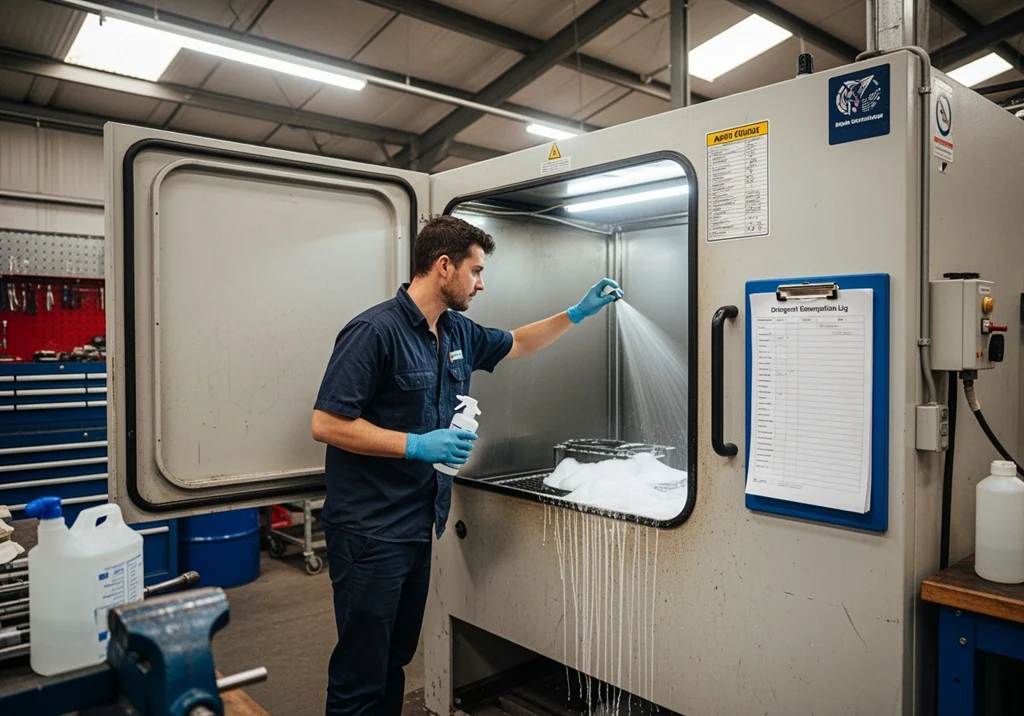
Foam buildup in automated parts washers costs workshops real time and money. A foam overflow stops a cleaning cycle mid-process, floods the floor, wastes detergent, and adds significant unplanned labour to what should be a routine cleaning task. For mining maintenance sites and high-volume workshops running continuous cleaning schedules, parts washer foam control is not a minor housekeeping concern – it is a critical operational requirement that directly affects throughput and cost per cycle.
This article covers why high-pressure spray systems generate foam, what foam overflow actually costs, how anti-foam agents work, and how to match dosing, chemistry, and equipment design to maintain clean, uninterrupted wash cycles across different contamination levels.
Why High-Pressure Systems Generate Excessive Foam
The Physics of Foam Formation in Enclosed Washers
High-pressure spray jets – typically operating between 60 and 100 PSI in industrial parts washers – atomise water and detergent into fine droplets. These droplets trap air as they impact parts and cabinet walls, creating foam bubbles that multiply rapidly in the enclosed space of an automated washer cabinet. Unlike open washing areas where foam can disperse, an enclosed cabinet spray washer concentrates foam with no natural outlet except door seals and overflow vents.
Heat amplifies the problem. Water at 60 to 85°C reduces liquid surface tension, which makes foam formation easier and foam bubbles more stable. The same temperature that improves cleaning performance also creates ideal conditions for foam that does not collapse quickly on its own. Add high pressure spray detergent designed with surfactants to break down grease and oil, and foam generation is an inherent feature of the cleaning process that must be managed rather than avoided.
The continuous recirculation cycle in most enclosed cabinet spray washers compounds the issue. Cleaning solution circulates from the spray manifold onto parts, drains back to the tank, then pumps back through the spray system. Each recirculation pass introduces new air into the solution. Foam accumulates faster than it collapses without an active control strategy.
Why Mining and Heavy Industrial Applications Face Greater Foam Challenges
Heavy contamination loads require aggressive detergent concentrations. Parts arriving from mining sites – excavator pins, loader bucket teeth, haul truck components – carry thick grease, oil, and mineral deposits that demand the higher end of the detergent concentration range. This concentration level, necessary for cleaning performance, also generates far more foam than lighter-duty applications use.
Extended wash cycles required for heavy contamination give foam more time to accumulate. High-pressure spray detergent at maximum concentration running in an enclosed cabinet over a 30 to 45 minute cycle creates substantial foam volumes that overwhelm parts washer foam control strategies that work adequately for lighter applications.
The Real Cost of Foam Overflow in Industrial Operations
Operational Impact: Cycle Disruption and Labour Loss
When foam overflows a parts washer cabinet, the cleaning cycle stops. Workers must drain the system, clean up the overflow, reload components, and restart from the beginning. An industrial washer foam overflow incident adds significant unplanned time to what was scheduled as a short, routine cleaning cycle. For workshops running back-to-back cycles through a shift, a single overflow event disrupts the entire day’s cleaning schedule.
Detergent waste from overflow compounds the time cost. Concentrated cleaning solution that exits through foam overflow drains onto the floor rather than recirculating through the wash cycle. Regular overflow incidents translate directly to increased detergent consumption – a measurable cost increase that accumulates quickly in high-use operations.
Equipment Damage and Safety Hazards
Chronic foam overflow carries a longer-term cost beyond the immediate disruption. Detergent solution seeping into electrical components, control panels, or motor housings causes corrosion and eventually premature failure. Pump motor and control board replacements represent significant unplanned maintenance costs that proper parts washer foam control prevents.
Detergent solution on concrete workshop floors creates slip hazards. Workers moving between the washer and other work areas track wet detergent across the floor, creating a safety risk that persists until the area is fully cleaned and dried. This is an unnecessary WHS exposure that effective foam management eliminates entirely.
How Anti-Foam Agents Control Spray Dynamics
How Anti-Foam Chemistry Works
Anti-foam agents work through chemical disruption of foam bubble stability. These compounds spread rapidly across foam bubble surfaces, reducing the surface tension at bubble walls and creating weak points that cause immediate collapse back into liquid. In enclosed cabinet spray washer applications, anti-foam agents are added directly to the detergent solution at controlled concentrations – typically between 0.1% and 0.5% by volume depending on contamination level and detergent type.
Silicone-based anti-foam agents are the most common choice for industrial parts washing. These compounds remain stable at high temperatures up to 95°C and maintain effectiveness through multiple recirculation cycles without degrading. They do not interfere with detergent cleaning action when correctly dosed, and they do not leave residues on cleaned components. Mineral oil-based formulations offer alternative chemistry for food processing applications where food-grade certification is required.
Application Timing and Dosing System Options
Preventive anti-foam dosing during initial tank fill works better than reactive addition after foam has already formed. When anti-foam agent is evenly distributed through the cleaning solution before the first spray cycle begins, it acts on foam bubbles as they form rather than trying to collapse an established foam layer. Some stainless steel parts washers include automatic anti-foam dosing systems that maintain optimal concentration throughout extended cleaning runs – eliminating the manual monitoring requirement and preventing the concentration drift that causes mid-shift overflow incidents.
Proper Anti-Foam Dosing for Different Contamination Levels
Light, Moderate, and Heavy Contamination Ranges
Anti-foam dosing requirements scale directly with contamination severity and corresponding detergent concentration. Light contamination cleaning – surface dust, light oil film, minor grease buildup – generates minimal foam and typically needs 0.1 to 0.2% anti-foam concentration to maintain parts washer foam control without over-dosing. Small workshop operations cleaning automotive components generally operate in this range.
Moderate contamination from workshop machinery, transmission parts, and engine components requires increased dosing. These parts carry heavier grease deposits and carbon buildup that create more foam under high-pressure spray. Effective anti-foam concentration for moderate contamination sits between 0.2% and 0.3%. This range handles most general workshop and manufacturing applications reliably.
Heavy contamination from mining equipment, earthmoving machinery, and oilfield components demands maximum dosing. These applications generate the foam volumes that cause industrial washer foam overflow when anti-foam concentration is insufficient. The effective range for heavy contamination is 0.3% to 0.5%. Enclosed cabinet washer dynamics at this contamination level require both adequate anti-foam dosing and attention to the equipment design features that mechanically reduce foam formation.
Testing Optimal Concentration for Your Application
Finding the right anti-foam concentration for your specific operation requires testing with the actual contamination levels and detergent chemistry you use. Start at the lower end of the recommended range for your contamination category and run a representative cleaning cycle. Check foam level at mid-cycle – not just at completion. If foam is approaching door seals or overflow vents during the cycle, increase anti-foam concentration by 0.1% and retest.
Over-dosing creates its own problem. Excessive anti-foam concentration can reduce detergent cleaning effectiveness by interfering with surfactant action, the opposite of the intended outcome. Find the minimum concentration that prevents overflow whilst maintaining cleaning performance – this is the efficient operating point for your application.
Cabinet Design Features That Reduce Foam Formation
Spray Manifold Positioning and Tank Baffles
Equipment design plays a meaningful role in foam generation alongside chemistry. Spray manifold positioning affects how much air gets entrained in the cleaning solution during spray application. Spray jets angled to direct solution downward and toward components, rather than against cabinet walls, reduce the turbulent mixing that maximises air entrainment and foam formation. This enclosed cabinet washer dynamics consideration is built into well-designed systems at the manufacturing stage.
Tank baffles disrupt foam formation mechanically. Internal baffles in the solution tank break up foam bubbles as cleaning solution recirculates from the cabinet back to the tank. These steel plates create controlled turbulence that collapses foam before it can accumulate. Well-designed systems include multiple baffle stages positioned to process all returning solution through foam-breaking zones.
Solution Return Design and Cabinet-to-Tank Volume Ratios
Solution return design prevents foam accumulation at the re-entry point. Submerged return pipes that discharge below the liquid surface – rather than allowing solution to cascade freely from height into the tank – prevent air entrainment during return flow. This single design feature reduces foam generation at the source in a way that anti-foam chemistry alone cannot fully compensate for.
Cabinet volume relative to tank capacity also influences foam management. Oversized cabinets with small tanks create excessive solution turbulence and foam buildup between cycles. Properly proportioned systems maintain a cabinet-to-tank volume ratio that allows adequate spray coverage whilst providing sufficient tank volume for foam collapse and solution settling between recirculation passes. Hotwash Australia engineers these proportions into their enclosed cabinet spray washer designs as a standard characteristic rather than an optional feature.
Temperature Control and Foam Stability Relationships
How Temperature Affects Foam Formation Rate
Water temperature directly affects foam stability because surface tension decreases as temperature rises. At operating temperatures of 70 to 80°C, surface tension is low enough to create stable, persistent foam. This temperature range also delivers the best cleaning performance for most contamination types – so the goal is not to reduce temperature to control foam, but to maintain adequate anti-foam concentration for the operating temperature window.
Enclosed cabinet washer dynamics change during the heating cycle from cold start to operating temperature. Initial cycles run at lower temperature with less foam generation, then foam increases significantly as the system reaches operating temperature. Anti-foam dosing should be set for full operating temperature from the beginning of the shift, not calibrated to cold-start behaviour that does not represent normal running conditions.
Thermostat Accuracy and Foam Surge Prevention
Temperature overshoot above the target setting creates unexpected foam surges. A system set to 75°C that intermittently reaches 85 to 90°C generates significantly more foam during those temperature excursions than it does at the setpoint. Reliable temperature control with tight accuracy maintains consistent foam behaviour and predictable anti-foam effectiveness. When evaluating equipment, check the specified temperature control accuracy and confirm it is maintained in real operating conditions, not just stated in the data sheet.
Detergent Chemistry Selection for Foam-Controlled Cleaning
Low-Foam Detergent Formulations
Low-foam detergent formulations include built-in foam suppressants that limit bubble formation during high pressure spray detergent application. These products reduce anti-foam requirements and simplify parts washer foam control management. They typically cost more than standard formulations – the additional cost reflects the foam suppression chemistry included in the formulation. For heavy industrial users where foam management is a persistent operational challenge, the premium is often justified by reduced anti-foam consumption and simplified dosing management.
The trade-off to evaluate is cleaning effectiveness. Some low-foam detergents achieve foam suppression by modifying the surfactant chemistry that drives cleaning performance. Test cleaning results on representative contamination before committing to a low-foam product as the primary operational chemistry.
Alkaline Concentration, Biodegradable Detergents, and Solution Age
Higher pH cleaning solutions create more stable foam than neutral or mildly alkaline products. Operations using aggressive alkaline chemistry for heavy carbon removal need correspondingly higher anti-foam concentrations. Where contamination levels allow, moderating detergent pH reduces both foam generation and the anti-foam requirement. High pressure spray detergent at moderate pH (8.5 to 10) combined with adequate temperature delivers effective cleaning for most workshop applications without the foam management challenges of high-alkaline formulations.
Biodegradable detergents often generate more foam than conventional alternatives due to their surfactant chemistry. Workshops transitioning to biodegradable formulations should anticipate needing higher anti-foam dosing to maintain equivalent foam control. This is a normal characteristic of the chemistry, not a product defect – adjust dosing accordingly rather than attributing increased foam to a detergent problem.
Solution age changes foam behaviour. Fresh detergent solution foams predictably. As solution accumulates oil, grease, and particulate contamination from cleaning cycles, foam characteristics shift. Contaminated solution often requires increased anti-foam concentration to maintain control. Regular solution replacement on a schedule matched to throughput volume keeps foam behaviour consistent and anti-foam requirements predictable.
Monitoring and Adjusting Anti-Foam Performance
Visual Observation and Overflow Frequency Tracking
Visual foam checks at mid-cycle provide immediate feedback on anti-foam effectiveness. Acceptable foam levels show a thin layer on the solution surface that collapses quickly when spray stops. Foam visible above the parts load or approaching door seals during an active cycle indicates insufficient concentration requiring immediate adjustment.
Track industrial washer foam overflow frequency as a key operational metric. Any overflow event represents a system failure that should trigger investigation. Operations experiencing overflow more than once a month need systematic anti-foam concentration increases or investigation of underlying causes – worn spray jets, temperature control problems, or excessive detergent concentration from build-up without full drain cycles.
Detergent Consumption as a Foam Indicator
Baseline detergent consumption for a specific operation should remain relatively consistent week to week for similar throughput volumes. Increasing detergent consumption without corresponding workload increases often indicates foam overflow losses – detergent is leaving the system through overflow rather than completing its function in the wash cycle. Tracking litres of detergent used per week helps identify foam management problems before they become obvious through floor flooding and cycle disruptions.
Troubleshooting Persistent Foam Problems
Common Root Causes and Their Fixes
Excessive detergent concentration from build-up is the most common cause of persistent foam problems that anti-foam agents cannot fully control. When operators add detergent without accounting for residual concentration in the tank, surfactant levels accumulate over multiple topping-up cycles to levels that generate overwhelming foam. The solution is a complete drain, fresh water fill, and detergent mixed at manufacturer-recommended concentration from scratch.
Worn or damaged spray jets create abnormal spray patterns with increased air entrainment and foam generation. Jets with enlarged orifices from wear produce lower pressure, larger droplets, and more turbulent application – all foam-promoting conditions. Regular spray jet inspection and replacement maintains optimal enclosed cabinet washer dynamics. Air leaks in the pump suction line introduce excess air into the spray system, creating foam that anti-foam agents struggle to control. Pressure testing the suction system identifies leaks requiring sealing or component replacement. Incompatible chemical mixing – adding supplementary degreasers or solvents to the detergent solution – can neutralise anti-foam effectiveness and generate chemical interaction foam that standard dosing cannot manage.
Long-Term Foam Management Strategies
Preventive Maintenance and Operator Training
Monthly inspection of spray jets, pump seals, and tank baffles identifies wear before it creates foam problems. Quarterly deep cleaning of tanks and cabinets removes accumulated contamination that affects foam behaviour in ways that anti-foam dosing cannot compensate for. Annual replacement of wear components – spray jets and pump seals – maintains the system performance that minimises foam generation at the source.
Operator training ensures consistent anti-foam application and foam monitoring. Clear procedures for anti-foam dosing, mid-cycle foam level checking, and response protocols when foam appears excessive reduce industrial washer foam overflow incidents to near zero in well-managed operations. Simple visual guides showing acceptable versus problematic foam levels help operators identify issues early before they become overflow events.
Solution Change Schedules and Documentation
Regular solution replacement maintains predictable foam characteristics. Contamination build-up in the wash solution changes foam behaviour progressively – what required 0.2% anti-foam at the start of the solution life may need 0.4% by week three of continuous use. Establishing solution change schedules based on throughput intensity keeps foam behaviour consistent and anti-foam requirements reasonable throughout each solution cycle.
Document anti-foam dosing rates, foam observations, and overflow incidents to build operational knowledge that new operators can use immediately. This documentation prevents the trial-and-error learning that costs time and detergent whenever staff change. For heavy duty parts washers running continuous production cycles, this knowledge base is the difference between reliable daily operation and recurring foam disruptions.
For advice on parts washer foam control, anti-foam agent selection, and enclosed cabinet spray washer system specifications for your operation’s contamination levels and throughput requirements, contact our parts washer specialists or email us at sales@hotwash.com.au.

Leave A Comment