
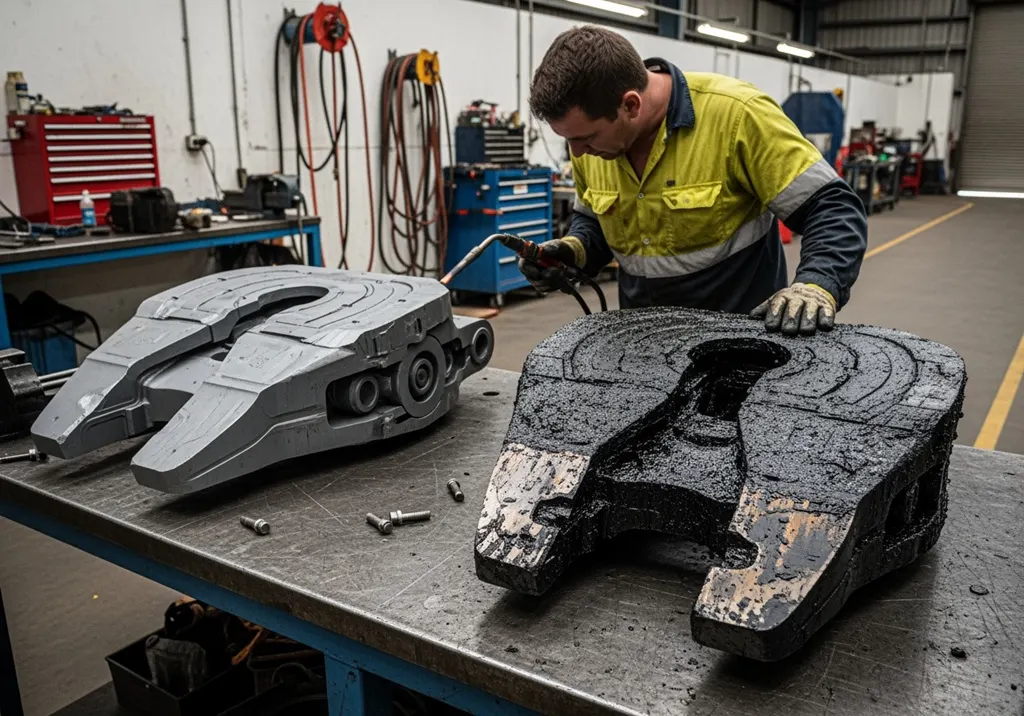
The fifth wheel coupling carries more load, endures more movement, and operates in harsher conditions than almost any other component in a heavy haulage fleet. It is also one of the most difficult components to clean properly. When maintenance time arrives and accumulated fifth wheel grease needs to be removed for inspection and relubrication, many workshops discover that their standard cleaning approach is not up to the task.
Manual cleaning methods take hours and leave contamination in the recesses where wear inspection matters most. Automated spray washing systems built for transport components deliver thorough results in a fraction of the time – with better wear detection, safer working conditions, and significant labour savings. This guide explains why fifth wheel degreasing demands a specialist approach and how to choose the right equipment for your workshop.
Why Fifth Wheel Grease Demands Specialised Cleaning
The Contamination Profile of a Working Fifth Wheel
Fifth wheel grease serves multiple functions during operation. It reduces friction between coupling plates, prevents corrosion, protects against water ingress, and cushions shock loads during articulation. Modern semi-synthetic and lithium-based formulations adhere tenaciously to metal surfaces – exactly what operators want during service, but exactly what makes fifth wheel degreasing challenging.
The contamination profile of a working coupling compounds this difficulty. Road dust embeds into the grease layer, creating an abrasive paste. Metal particles from normal wear mix into this matrix. In mining and resource transport operations, fine mineral particles bond with the grease to form a cement-like coating that fills every recess, locking pin mechanism, and wear plate groove. This material resists conventional cleaning methods.
Why Standard Parts Cleaning Approaches Fall Short
Temperature cycling during operation adds another layer of difficulty. Friction and ambient heat during the day soften the fifth wheel grease, allowing contamination to penetrate deeply into coupling surfaces. When the unit cools overnight, this contaminated grease hardens into a stubborn deposit. Manual scraping removes surface material but leaves residue in the recessed areas where wear inspection must take place.
Heavy haulage coupling maintenance requires cleaning that reaches inside locking jaw recesses, around pivot pins, and underneath coupling plates – areas where hand tools simply cannot deliver consistent coverage. Surface-level cleaning creates a coupling that looks maintained but carries undetected wear beneath the contamination that was never removed.
Manual Cleaning Limitations for Transport Couplings
Time Cost and Inconsistent Results
Workshop teams traditionally attack fifth wheel cleaning with hand scrapers, wire brushes, and solvent spray. A thorough manual clean of a single fifth wheel coupling typically requires several hours of labour. The mechanic scrapes bulk grease, applies degreaser, scrubs with brushes, rinses, and repeats until inspection surfaces are accessible. This extended process makes truck coupling service intervals expensive in labour time alone.
Manual methods also deliver inconsistent results. The underside of the coupling plate, locking jaw recesses, and pivot pin areas remain partially contaminated because hand tools cannot reliably reach these critical inspection zones. Maintenance supervisors must decide whether to accept incomplete cleaning or invest additional hours in detail work – neither option is satisfactory for a safety-critical component.
Safety and Environmental Problems with Manual Methods
Solvent-based degreasers capable of cutting through heavy fifth wheel grease create serious safety concerns in enclosed workshops. Prolonged skin contact causes dermatitis. Vapour inhalation in poorly ventilated spaces exceeds safe exposure limits. Physical demands of manual cleaning – repetitive scraping motions, working in awkward positions under removed couplings – contribute to musculoskeletal injuries. These are avoidable risks when automated alternatives are available.
The waste stream created by manual cleaning is also problematic. Contaminated solvent mixed with heavy grease creates a regulated waste requiring specialist disposal. This compliance burden adds cost to every manual cleaning cycle that automated biodegradable detergent washing eliminates.
Automated Spray Washing Technology for Heavy Couplings
How Spray Washing Removes Fifth Wheel Contamination
Industrial spray washers designed for transport components solve the limitations of manual cleaning through three mechanisms working simultaneously: heated water, rotating spray coverage, and biodegradable detergent chemistry. The combination removes contamination that manual methods leave behind, in a fraction of the time, without chemical exposure to workshop staff.
Rotating spray arms direct heated water at the coupling from multiple angles. Water temperature softens cold-hardened fifth wheel grease whilst the mechanical energy from high-pressure spray physically dislodges contamination from surfaces. Biodegradable detergent breaks the molecular bonds between grease and metal, emulsifying the contamination into the wash water where filtration captures it. Spray coverage reaches areas manual cleaning misses – underneath the coupling plate, inside locking mechanisms, around pivot pins, and through relief grooves. After an automated wash cycle, the coupling emerges with bare metal surfaces ready for thorough wear inspection and proper relubrication. Automated transport cleaning consistently delivers this result regardless of which staff member loaded the machine or what time of day the cycle runs.
What Clean Metal Looks Like After Automated Washing
Complete contamination removal does more than prepare a surface for new grease. It reveals the condition of the coupling in a way that partial cleaning cannot. Wear patterns, crack initiation points, and surface defects hidden beneath contamination become visible once the metal is clean. Super heavy duty parts washers designed for heavy haulage provide the chamber size and spray capacity to handle large mining transport couplings and slider assemblies in a single cycle – cleaning the entire assembly without requiring disassembly that adds labour time.
Maintenance supervisors report catching wear issues earlier when automated washing exposes coupling surfaces properly. Early detection allows planned component replacement rather than reactive repairs following roadside failures, which carry recovery costs, significant downtime, and safety risks that far exceed the cost of a scheduled service.
Sizing Wash Systems for Fifth Wheel Components
Chamber Capacity for Standard and Heavy Haulage Couplings
Fifth wheel couplings vary in size from standard semi-trailer units to heavy haulage and mining transport couplings. Selecting appropriate wash chamber capacity ensures the component fits comfortably whilst maintaining effective spray coverage. Standard transport operations maintaining semi-trailer fleets need heavy duty parts washer transport systems with adequate chamber height to handle their couplings with clearance for spray arm rotation.
Mining and heavy haulage coupling maintenance with road train configurations or oversize load transport requires larger chamber capacity. Extra heavy duty parts washers accommodate oversized fifth wheels, slider assemblies, and associated coupling hardware in single loads. Cleaning complete coupling assemblies without disassembly saves additional labour time – a saving that compounds significantly when a workshop processes multiple couplings each week.
Heating Capacity and Its Impact on Cleaning Effectiveness
Heating capacity directly determines cleaning effectiveness on heavy fifth wheel grease. Systems with adequate heating elements maintain water temperature throughout extended wash cycles, even when cold, grease-covered components enter the chamber. Inadequate heating capacity causes water temperature to drop mid-cycle, reducing the effectiveness of both the heat and the detergent chemistry that depends on heat to work properly.
Hotwash Australia builds cleaning systems with sufficient tank capacity to provide thorough wash cycles without constant refilling. Local manufacturing means systems are engineered for the contamination volumes and ambient operating conditions that Australian transport workshops actually encounter, rather than designed for more moderate conditions elsewhere.
Detergent Chemistry for Transport Industry Grease
Alkaline Detergents and Saponification of Fifth Wheel Grease
Not all industrial detergents perform equally on fifth wheel grease formulations. The chemistry must address both the base grease – typically lithium or calcium sulfonate complex – and the contamination matrix of dust, metal particles, and road film that bonds with it during service. Alkaline detergents work through saponification chemistry, converting grease molecules into water-soluble compounds that rinse away cleanly with the wash water.
Detergent concentration affects both cleaning performance and running cost. Too weak, and wash cycles extend or fail to remove stubborn deposits. The biodegradable formulations used in fifth wheel degreasing work need to be matched to the contamination severity and cycle duration to deliver consistent results. Rinse performance determines whether components emerge truly clean or carry detergent residue that attracts new contamination and interferes with grease adhesion.
Environmental Compliance for Grease Waste Streams
Automated washing with biodegradable detergent changes the waste profile compared to solvent-based manual cleaning. The emulsified grease suspends in wash water where filtration removes solid contamination. Filtered solids separate as semi-solid waste suitable for standard industrial disposal. The wash water, after filtration, typically meets trade waste discharge standards that contaminated solvent waste does not.
This waste stream simplification reduces disposal costs and regulatory burden. Workshops eliminate or significantly reduce hazardous solvent waste whilst maintaining compliance with Australian environmental protection requirements. For operations in areas with sensitive waterway proximity, controlled waste management through automated cleaning provides both operational and compliance advantages.
Integration with Preventive Maintenance Schedules
Fitting Cleaning into Existing Inspection Intervals
Automated washing integrates seamlessly into existing truck coupling service inspection schedules. Traditional practice sees mechanics spending the first hours of an inspection shift cleaning the coupling before actual wear assessment can begin. Automated washing reverses this sequence. The coupling enters the wash chamber at shift start. Whilst the machine runs its cycle, mechanics complete other inspection tasks. When they return to the coupling, it is clean, cooled, and ready for immediate measurement of wear plates, locking jaw condition, and pivot pin tolerance.
This workflow change delivers measurable productivity gains. A workshop processing multiple fifth wheel inspections weekly saves significant hours of manual cleaning labour per week. After the equipment payback period, these labour savings continue year after year as ongoing operational benefit.
The Value of Early Wear Detection
Heavy haulage coupling maintenance through automated cleaning delivers a quality benefit that labour savings alone do not capture. Complete contamination removal reveals wear that partial cleaning obscures. Maintenance supervisors consistently report catching wear issues earlier when automated washing exposes coupling surfaces properly.
Early detection prevents roadside failures and the significant associated recovery costs, downtime, and safety risks. Heavy duty parts washers designed for transport industry use also offer the safety improvement of containing mess within an enclosed chamber – eliminating the overspray, drips, and contaminated runoff that manual degreasing spreads across workshop floors and creates slip hazards.
Cost Analysis – Automated vs Manual Cleaning
Per-Coupling Cost Comparison
The financial case for automated fifth wheel degreasing becomes clear when comparing total costs per coupling serviced. Manual cleaning requires several hours of direct mechanic labour per coupling. Automated washing reduces the direct labour component to loading, monitoring, and unloading – the machine handles the cleaning work whilst the mechanic performs other tasks. Add modest detergent cost per wash cycle. The per-coupling saving is substantial, and it applies every time a coupling is serviced.
For a workshop processing a regular volume of fifth wheel inspections monthly, the annual labour saving runs to tens of thousands of dollars. A heavy duty parts washer transport system sized for transport applications pays back through direct labour savings within a manageable timeframe, then continues delivering value through improved inspection quality and reduced failure rates.
Additional Returns Beyond Labour Savings
The payback calculation strengthens considerably when avoided costs are included. Preventing a single roadside breakdown avoids towing, recovery, and lost productivity costs that dwarf any individual cleaning cycle saving. Eliminating WorkSafe exposure from solvent vapour and repetitive strain injuries carries both direct cost and compliance value. Automated transport cleaning also eliminates the disposal costs associated with contaminated solvent waste.
For expert advice on automated cleaning systems sized and specified for your fifth wheel service volume and coupling dimensions, contact our heavy haulage equipment specialists or email us at sales@hotwash.com.au.

Leave A Comment