
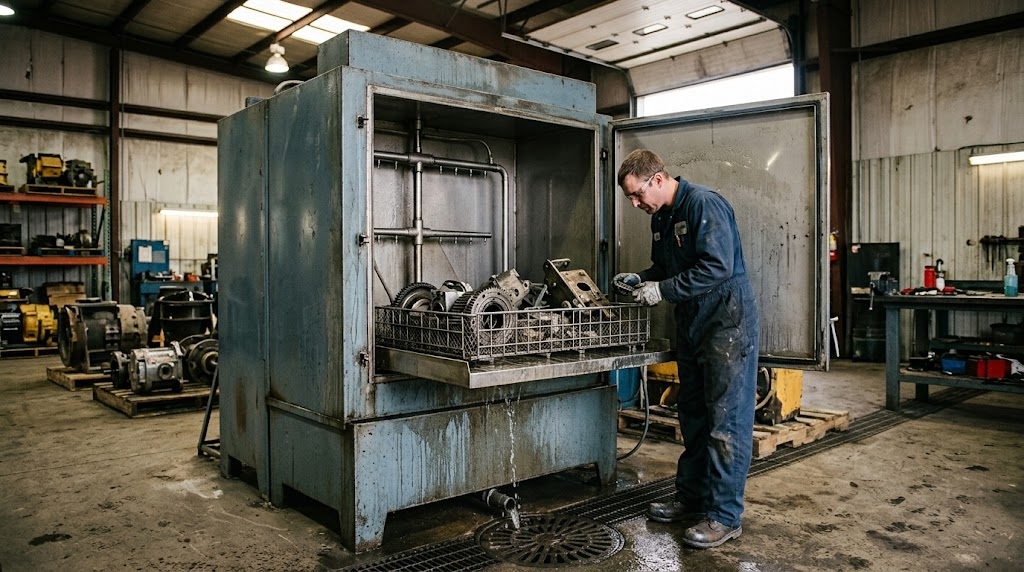
Mining and heavy-equipment parts can arrive coated with wet mud, dry dust, grease, or a mixture of contaminants. Cleaning becomes harder when deposits sit in corners, around fasteners, or across irregular surfaces.
Hotwash presents heavy and super heavy duty washers for demanding industrial and mining environments. The company also describes high-pressure water jets and engineered spray systems, but cleaning results still depend on the selected model, load, and contamination.
How Mechanical Spray Action Helps
Water Impact Loosens Surface Contamination
A pressurised spray applies mechanical force to the part surface. That action helps loosen material so the circulating wash solution can carry it away.
The Super Heavy Duty range is positioned for demanding mining and manufacturing work. Its product page focuses on durability, servicing features, filtration, and a gear-driven turntable.
High-pressure spray arms should therefore be discussed as part of a complete cleaning system, not as a standalone guarantee for every contaminant.
Rotation Changes The Angle Of Attack
A rotating turntable moves the component through different spray zones. That helps expose more external surfaces without requiring constant manual repositioning.
This is useful when mud and dust build up on irregular housings, brackets, and other workshop parts.
For mud and dust removal, loading remains critical. Heavy overlap between parts can block the spray and trap loosened material.
Why Mining Contamination Needs More Than Pressure
Mud Can Hide Grease And Packed Debris
Mud is not always a single layer. It can combine with oil and grease, creating contamination that behaves differently from dry dust.
Hotwash heavy-duty equipment uses heated water and cleaning chemistry as part of the washing process. Mechanical spray action then helps remove the loosened contamination.
The heavy duty washer range is also designed for demanding workshop use. Machine selection should be based on the component size, contamination, and required duty.
Dry Dust Can Become Slurry During Washing
When dry coal or mineral dust mixes with wash water, it can form slurry. That material then needs somewhere to go.
Tank cleaning, filtration, and wastewater servicing therefore matter alongside high-pressure spray arms. A machine that removes debris from the part still needs to manage the contamination after it leaves the surface.
This is why the servicing features on mining-oriented washers are operationally important.
Loading Components For Better Spray Access
Remove Loose Material Where Site Practice Requires It
If a part carries large loose deposits, the workshop may use an appropriate pre-cleaning step before it enters the washer. That decision depends on site procedures and the machine’s instructions.
The aim is to avoid loading unnecessary solids into the wash system when they can be managed earlier.
Do not assume that every heavy deposit should go directly into the machine without checking the application.
Leave Space Around Irregular Parts
Spray needs a path to the workpiece. Leave practical separation between large components so one load does not shield another.
The general parts washer range includes different sizes and cleaning methods. The correct machine should provide enough working space for the parts being processed.
High-pressure spray arms are most effective when their spray paths remain open.
Setting Realistic Expectations
Pressure Is Model-Specific
Hotwash does not publish one universal spray pressure for every heavy or super heavy duty model on the category pages. Avoid applying a single figure across the range.
The term high-pressure should therefore stay descriptive unless a specific product page provides a specification.
This keeps the article accurate and avoids turning a general feature into an unsupported performance claim.
Coal Dust Removal Depends On The Whole Cleaning Condition
Contaminant thickness, moisture, oil content, component shape, loading, solution condition, and machine selection all affect the result.
The machine can provide mechanical spray action, heat, and washing chemistry. No responsible article should promise identical mud and dust removal from every component.
FAQs
Are Hotwash Washers Designed For Mining Environments?
Yes. Hotwash lists heavy, extra heavy, and super heavy duty ranges for mining and other demanding industrial applications.
Does Hotwash Publish One Pressure Figure For All Spray Arms?
No. Pressure and pump specifications can vary by model. Any numerical claim should come from the exact product specification.
Can High-Pressure Spray Arms Remove Coal Dust?
Mechanical spray can help dislodge surface dust and mud. Actual mud and dust removal depends on contamination, part geometry, loading, chemistry, and the selected washer.
Why Does Filtration Matter When Cleaning Muddy Parts?
Removed solids enter the wash system. Filters help manage debris before it reaches smaller spray openings and other components.
Should Parts Be Packed Closely To Fit More Into One Cycle?
Overloading can block spray access. Practical spacing usually gives the spray system a clearer path to exposed surfaces.
Match The Washer To The Contamination
High-pressure mechanical spray arms can support cleaning of heavily soiled external surfaces, but pressure is only one part of the process. Loading, heat, chemistry, filtration, and servicing all matter.
To review a mining or heavy-equipment cleaning application, match your contamination to a Hotwash model or email sales@hotwash.com.au.

Leave A Comment