
Bilge pump failures on offshore vessels rarely happen cleanly. When contamination builds up and the pump cannot keep pace, the consequences reach beyond a mechanical repair. They create safety hazards, environmental violations, and operational shutdowns that cost far more than the cleaning that would have prevented them.
For commercial fishing fleets, oil and gas support vessels, and marine transport operations, bilge pump reliability is a regulatory requirement. This guide covers what contamination does to bilge pumps, why manual degreasing fails to address it properly, and how automated washing equipment changes the economics and safety profile of bilge pump service.
Why Bilge Pump Contamination Threatens Offshore Safety
What Accumulates in an Offshore Bilge
Offshore vessel bilges collect a mixture that worsens continuously throughout a voyage. Diesel leaks from engine connections. Hydraulic fluid comes from deck and steering systems. Grease from propulsion machinery and seawater intrusion settle to the bilge and reach the pump.
Heavy machinery running around the clock accelerates this build-up. Contamination levels reach what would take weeks to develop in lighter-duty marine applications.
The pump sits submerged in this mixture. Impeller vanes, housing clearances, check valves, and float switches all operate in direct contact with contaminated fluid. Any component that petroleum contamination removal fails to address before it hardens becomes a source of failure.
The Consequences of Pump Failure at Sea
A bilge pump that cannot keep up with water ingress in rough weather creates immediate stability risks. Oil and fuel vapours the bilge system cannot evacuate build up in enclosed spaces. This creates fire hazard conditions that are unacceptable on any working vessel.
A malfunctioning pump that discharges oil-contaminated water overboard triggers MARPOL violations. The financial and reputational consequences for the operator are serious. Water backing into engine rooms from a failed system can damage generators, electrical components, and propulsion equipment. That outcome is far more expensive than the maintenance that was deferred.
The Problem with Traditional Manual Degreasing
Why Manual Methods Fall Short Offshore
Solvent-based manual degreasing takes many hours per pump. Results vary with worker effort, skill, and the condition of the specific pump. Internal passages, impeller cavities, and tight clearances are unreachable by hand. A pump cleaned to look presentable externally can still carry the internal contamination that causes it to fail after reinstallation.
Manual cleaning equipment handles lighter degreasing tasks in smaller marine workshops. But the petroleum contamination removal demands of offshore bilge pump service require heated spray systems. These systems need the pressure and chemistry to penetrate heavy hydrocarbon deposits that manual methods cannot reach.
Hazardous Conditions Created by Solvent Use
Caustic chemical baths create working conditions that add risks alongside the cleaning function. Workers breathe solvent vapours in the confined spaces typical of offshore workshops. Skin contact with harsh degreasers during extended manual scrubbing is difficult to avoid. Flammable solvents stored aboard vessels create fire risks unacceptable near fuel systems.
Environmental compliance adds further difficulty. Used degreasing solvents cannot be discharged overboard. They require storage containers, transport back to port, and specialist disposal. All of this is logistically complex and expensive when the vessel operates remotely.
How Automated Parts Washing Transforms Bilge Pump Service
The Automated Cleaning Process
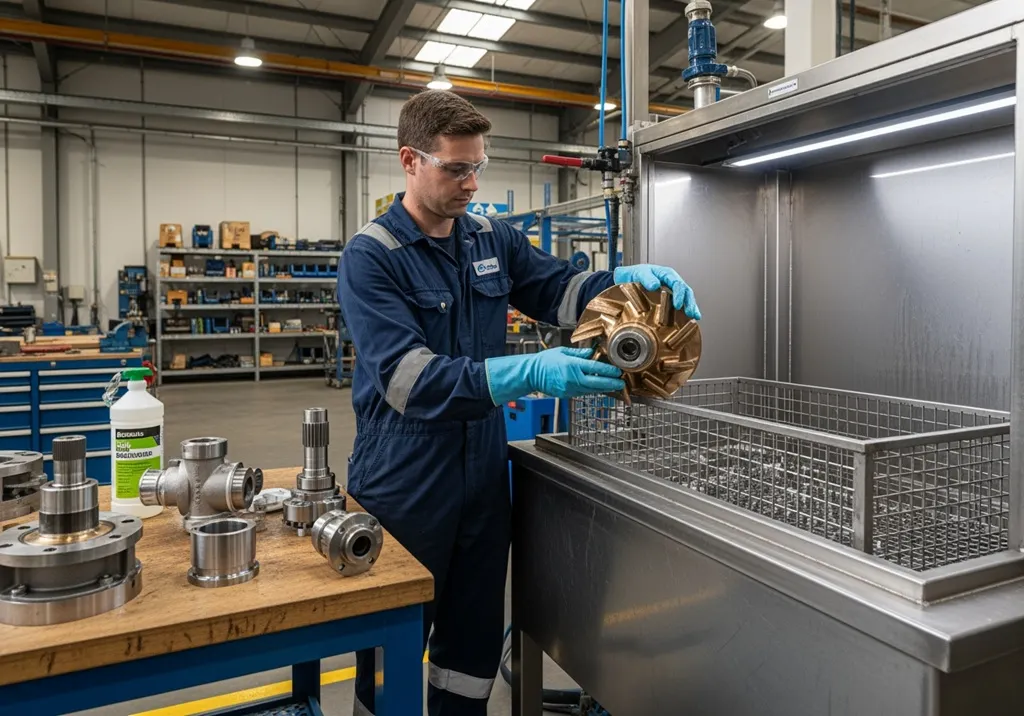
Heavy duty automated spray washing eliminates these challenges through high-pressure heated water combined with biodegradable detergent. Disassembled pump components loaded into the washing chamber are processed by rotating spray arms. These arms reach every surface – including the internal passages and impeller clearances that manual parts cleaning cannot access.
Heated water at the temperatures needed to emulsify marine grease and bunker fuel residue does the work that solvents were previously used to accomplish. The cycle completes in a fraction of the time required for manual degreasing. The technician loads components, starts the cycle, and works on other tasks while the machine runs.
Extra heavy duty parts washers provide the chamber capacity needed for large centrifugal pump assemblies from commercial fishing vessels and offshore platforms. Standard chambers adequate for automotive parts are often too small for commercial marine pump housings.
Three Key Advantages for Offshore Operations
Automated bilge pump cleaning delivers advantages in the three areas that matter most in a commercial marine context.
Speed: bilge pump service that previously occupied a significant portion of a work shift now takes the machine’s cycle time. The technician is free for productive work throughout. Thoroughness: high-pressure spray reaches impeller vanes, housing cavities, and valve assemblies where contamination builds up and causes failure. Safety: workers are not handling harsh solvents, not scrubbing in confined spaces with chemical vapour present, and not generating hazardous waste.
Stainless steel parts washers are particularly well suited to coastal and offshore workshop environments. Their corrosion-resistant construction handles salt-air conditions that would degrade powder-coated steel equipment within a few years.
Technical Requirements for Marine Bilge Pump Degreasing
Temperature and Pressure for Petroleum Contamination
Marine pump degreasing equipment must maintain adequate water temperature throughout the cleaning cycle. Cold water cannot break down heavy marine grease or bunker fuel residue. Heated water liquefies solidified contamination and allows detergent to emulsify and flush it away.
This is particularly relevant for pumps operating in cold water environments. Grease hardens and adheres stubbornly to metal surfaces in these conditions. Petroleum contamination removal requires sustained heat, not just initial temperature.
Spray pressure determines whether the cleaning solution reaches the tight clearances inside the pump. Heavy duty parts washers built for marine workshop environments deliver the pressure needed to penetrate those clearances without degrading in the salt-air conditions of coastal workshops.
Chemical Compatibility and Cycle Time
Bilge pumps incorporate multiple materials that respond differently to cleaning chemistry. Cast iron housings, bronze impellers, stainless steel shafts, and nitrile rubber seals must all emerge from the cleaning cycle undamaged. Biodegradable, pH-neutral detergents clean petroleum contamination without attacking seals or corroding softer metal components.
Offshore maintenance windows are constrained by weather, production schedules, and crew rotations. A cleaning cycle that fits within the available maintenance window is a practical requirement. Hot tanks complement spray washers for deep-soak parts cleaning of engine components with heavy carbon build-up that spray cycles alone may not fully address.
Environmental Compliance for Offshore Bilge Maintenance
MARPOL and AMSA Requirements
Environmental regulations for offshore operations have tightened significantly across Australian waters. MARPOL Annex I strictly governs oil discharge from vessels and extends to maintenance chemical handling. Petroleum-based solvents used for bilge pump degreasing generate contaminated waste. This requires proper storage containers, transport to port, and licensed disposal.
Automated hot water washing using biodegradable detergent addresses this directly. The wash water produced can be filtered and processed through the oily water separators already installed on most offshore vessels. This eliminates the need for separate hazardous chemical waste management.
Documentation and Environmental Management Plans
Australian Maritime Safety Authority inspections examine maintenance chemical handling as part of broader compliance reviews. Hotwash Australia automated cleaning systems produce consistent, repeatable results that support auditable maintenance records.
Offshore platform operators working under strict environmental management plans find that switching to water-based cleaning eliminates an entire category of solvent waste documentation, storage, and disposal requirements. That is a meaningful compliance simplification for remote operations.
Preventing Bilge Pump Failures Through Regular Maintenance
How Contamination Creates Multiple Failure Modes
Offshore vessel parts washing on a regular schedule prevents the contamination build-up that creates cascading pump failures. Hardened contamination lodged between impeller vanes and the housing increases friction and overloads the motor. This leads to bearing failure over time.
Abrasive particles suspended in contaminated grease damage seal faces. This allows water into motor housings and creates electrical failure conditions. Check valves clogged with debris allow backflow that reduces pumping efficiency. Float switches coated in oil film give false level readings, preventing the automatic activation that bilge pumps depend on for safety.
Parts cleaning on a scheduled basis – before contamination hardens – prevents each of these failure modes. Wet abrasive blasters also play a role in marine maintenance workflows. They handle rust removal and surface preparation on metal components that automated spray washing alone cannot address – particularly useful for pump housings showing corrosion from seawater exposure.
Setting the Right Service Interval
For offshore vessels in continuous operation, quarterly bilge pump service provides a baseline interval that catches contamination before it causes damage. Vessels in high-contamination environments – oil field supply boats, fuel barges, and heavy industrial support vessels – benefit from monthly service intervals.
The investment in regular automated bilge pump cleaning is small relative to the cost of one emergency pump replacement offshore. That replacement typically includes parts, labour at offshore rates, and vessel downtime costs. Marine pump degreasing on a schedule costs a fraction of that single event.
Selecting the Right Parts Washer for Marine Applications
Construction and Capacity for Marine Environments
Super heavy duty parts washers handle the volume and component size demands of major fleet service facilities. Large offshore vessel maintenance operations processing multiple pump assemblies per service period need machines that maintain pressure and temperature across extended run times.
For smaller marine workshops and fishing vessel operators, manual parts washers provide an entry point for parts cleaning where component volumes are lower. However, the contamination loads typical of offshore bilge work generally require automated spray washing rather than manual methods for reliable results.
Construction material determines how long the equipment lasts in the marine environment. Powder-coated steel washers deteriorate from salt spray and coastal humidity within years. Stainless steel construction adds to the initial investment but delivers a working life of fifteen years or more in conditions that would destroy standard equipment.
Heating Power and Spray Pressure
Adequate heating element power is not optional for marine petroleum contamination removal. Systems with sufficient heating capacity maintain water temperature throughout extended cleaning cycles. Underpowered heating elements struggle when cleaning cold, heavily contaminated components. This extends cycle times and reduces cleaning effectiveness.
Spray pressure in the higher operating range forces cleaning solution into the restricted spaces inside bilge pump impellers and housing assemblies. Automated marine pump degreasing equipment that maintains both temperature and pressure consistently delivers reliable results across the full range of offshore pump types.
Integrating Cleaning Into Marine Maintenance Workflows
Batching Component Cleaning for Maximum Efficiency
Automated parts washing fits naturally into a batched maintenance workflow. When a vessel enters port for service, multiple components require cleaning beyond the bilge pumps. Seawater cooling pump impellers, heat exchanger end caps, valve assemblies, and hydraulic components all benefit from the same process.
Processing these items sequentially through the parts washer while technicians complete diagnostic work optimises the time the vessel spends in port. Offshore vessel parts washing batched this way reduces total turnaround time. Cleaning and other maintenance tasks run in parallel rather than sequentially.
Training and Standard Operating Procedures
Automated systems reduce the training burden substantially. Chemical degreasing required teaching workers handling procedures, ventilation requirements, protective equipment use, and disposal protocols for each chemical product. Automated cleaning requires the operator to load components correctly, maintain detergent levels, and keep the filter system clean.
This simplicity has real value in offshore environments where crew turnover is high. Maintenance procedures must be executed correctly by workers at different skill levels. Simpler procedures that produce consistent results regardless of operator experience are a safety advantage as much as an efficiency advantage.
Conclusion
Bilge pump reliability is a safety requirement on offshore vessels. Contamination causes the great majority of bilge pump failures, yet traditional degreasing methods remain hazardous, slow, and inconsistent. Automated washing equipment removes petroleum contamination more effectively than solvents, eliminate worker chemical exposure, and fit into offshore maintenance windows that manual methods cannot.
The economics support the switch. Labour savings across a quarterly service schedule recover equipment investment over time. Preventing even one offshore emergency pump failure typically covers a significant portion of the equipment cost by itself. Proper marine pump degreasing is fundamental to safe offshore operations.
For advice on cleaning equipment suited to offshore bilge pump service, contact our industrial cleaning equipment specialists or email us at sales@hotwash.com.au.

Leave A Comment