
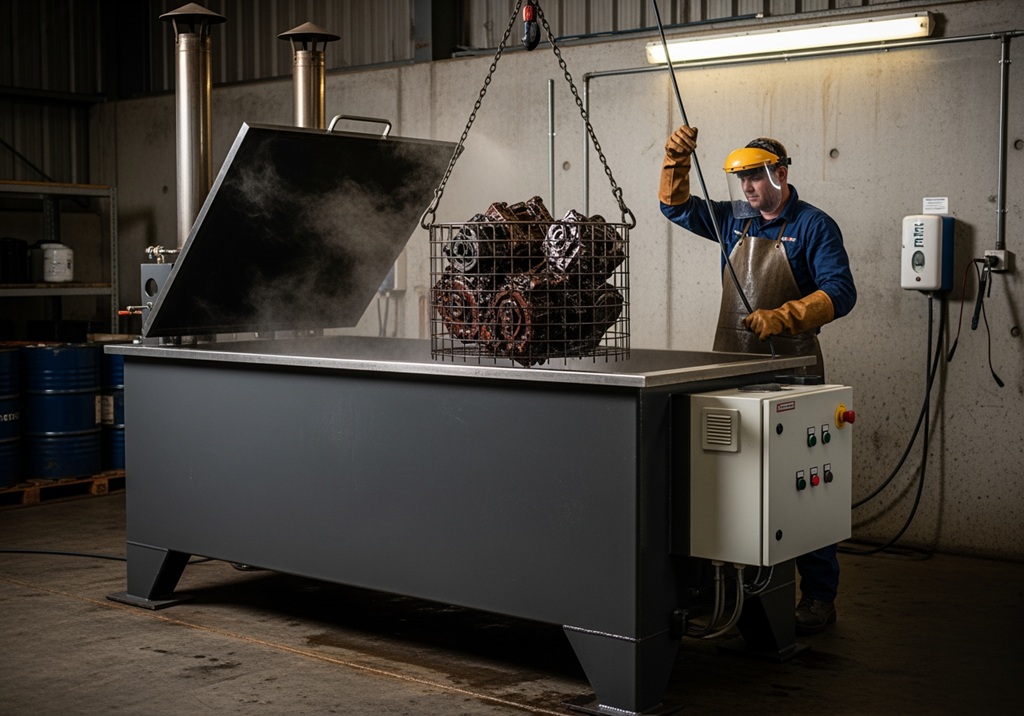
Some workshop cleaning challenges genuinely push the limits of standard equipment. Heavily contaminated ferrous components with years of baked-on carbon, thick grease packed into complex internal passages, and contamination levels that resist spray washing – these situations are where caustic tank cleaning has historically been the method of last resort.
This guide explains what caustic tank parts cleaning involves, how the process works, which industries still use it, and what you need to weigh up before deciding whether it is right for your operation.
What Caustic Tank Parts Cleaning Is
The Chemistry Behind Caustic Cleaning
Caustic tank parts cleaning uses sodium hydroxide – commonly known as caustic soda – dissolved in heated water as the cleaning agent. Sodium hydroxide is a strongly alkaline chemical that attacks organic contamination through a process called alkaline hydrolysis.
In practice, this means the sodium hydroxide parts cleaner solution converts oils and grease into soap-like compounds that separate from the metal surface. Carbon deposits break down under sustained alkaline attack. The process requires no mechanical force – the chemistry does the work whilst the component sits submerged in the solution.
How an Industrial Soak Tank Is Set Up
A basic industrial soak tank consists of a steel tank body, heating elements to bring the solution to operating temperature, a lid to contain heat and vapour, and a basket or overhead crane system for loading components. The tank holds the caustic solution – water mixed with sodium hydroxide flakes or liquid caustic at a specified concentration.
The sodium hydroxide parts cleaner solution is heated to accelerate the chemical reaction. Higher temperatures make the cleaning process faster and more effective on stubborn contamination. A thermostat controls the heating system to maintain the working temperature range.
How the Caustic Tank Cleaning Cycle Works
Loading, Soaking, and Unloading
Caustic tank parts cleaning follows a defined cycle. Components are loaded into a basket or suspended from a crane and lowered into the heated solution. The soak period varies depending on the contamination level, the concentration of the solution, and the operating temperature. Light contamination clears faster. Severe carbon buildup or heavy grease accumulation requires longer immersion.
Once the soak is complete, components are lifted from the tank and rinsed thoroughly with water to remove caustic residue. Incomplete rinsing leaves alkaline residue on metal surfaces, which can cause problems during reassembly or further machining. After rinsing, parts are dried to prevent surface rusting.
Solution Maintenance and Replacement
The sodium hydroxide parts cleaner solution degrades during operation. As grease and oil are converted into soap compounds, they accumulate in the solution. Floating contamination should be skimmed from the surface regularly. Sodium hydroxide concentration drops as the chemical is consumed by the cleaning reactions. Concentration should be tested periodically and adjusted by adding concentrate as needed.
Over time, contamination in the solution reaches a point where cleaning effectiveness declines regardless of alkalinity. A full drain, clean, and refill with fresh solution restores performance. Sludge that settles at the tank base should be removed during this process.
Industries That Still Use Industrial Soak Tanks
Mining and Heavy Earthmoving Applications
Mining and earthmoving operations deal with contamination levels that challenge most cleaning equipment. Components come off machines covered in thick grease, drilling mud, and mineral deposits accumulated over extended operating periods. For ferrous-only components with extreme contamination, an industrial soak tank can be a practical choice when the cleaning task exceeds what spray washing achieves.
Heavy duty parts washers and other automated spray systems handle the majority of mining cleaning work. But in specific applications involving severe ferrous contamination, caustic tank parts cleaning is sometimes still used as a first-stage process before further cleaning and inspection.
Automotive Engine Rebuilding
Engine rebuilders use caustic tank parts cleaning for ferrous engine components where carbon removal from internal passages is the priority. Cast iron cylinder heads, steel engine blocks, and iron-based crankshafts can tolerate caustic chemistry. The industrial soak tank dissolves carbon deposits in oil galleries and combustion chambers that spray washing struggles to reach adequately.
This application typically uses caustic cleaning as a first stage, followed by spray washing for final cleaning before inspection and machining. The combination of both methods – caustic for heavy carbon, spray for final rinse – is a workflow some engine rebuilding specialists still follow for heavily contaminated iron-based components.
Other Industrial Applications
Fabrication workshops and industrial facilities sometimes use caustic tanks for paint stripping on steel components prior to recoating. The alkaline solution softens and lifts some paint systems from ferrous surfaces, preparing them for powder coating or welding. For workshops that need an alternative surface preparation method, hot blasters provide targeted cabinet blasting for similar preparation tasks on individual components.
Food processing facilities that use caustic cleaning for commercial kitchen equipment and stainless steel processing machinery run it at lower concentrations and lower temperatures than heavy industrial applications, and use formulations that meet food safety requirements. This is a distinct application from industrial degreasing.
Safety Risks Workshop Managers Need to Know
Chemical Burns and Exposure Risks
Sodium hydroxide burns skin on contact. The chemical continues to damage tissue for as long as it remains in contact, which is why immediate flushing with water is the correct emergency response. Splashes to the eyes are particularly dangerous and require immediate and prolonged flushing followed by medical attention.
Hot caustic solution combines chemical and thermal hazards simultaneously. A splash from a heated industrial soak tank delivers both heat and ongoing chemical damage. Caustic cleaning safety workshop procedures must account for both risks. Common exposure scenarios include splashing when lowering components into the tank and drips during unloading.
Caustic Cleaning Safety Workshop Requirements
Operating a caustic tank requires a level of safety infrastructure that goes beyond standard workshop equipment. Chemical-resistant gloves that protect to a higher standard than general work gloves are required. Face shields – not just safety glasses – are necessary when working near open caustic solution. Chemical-resistant aprons and appropriate footwear are also required.
Ventilation is a critical requirement because heated caustic solutions release caustic mist and vapour. Enclosed workshops without adequate extraction systems expose workers to airborne caustic over the course of a working day. An eyewash station must be within immediate reach of the tank. Caustic cleaning safety workshop compliance also requires documented training for all operators who work near the system.
Spray Washer vs Caustic Tank: A Direct Comparison
Where Each Method Performs Better
The spray washer vs caustic tank comparison comes down to the type and severity of contamination. Spray washers clean efficiently with heated water and detergent, removing oil, grease, and loose contamination quickly through mechanical action. They are faster for most standard workshop parts cleaning tasks and require no handling of hazardous chemicals.
Caustic tanks have an advantage for ferrous components with heavy carbon buildup in internal passages, where the prolonged chemical immersion dissolves contamination that spray jets cannot reach. The industrial soak tank’s ability to expose every surface to active chemistry simultaneously is its key advantage for these specific applications.
Stainless steel parts washers provide automated spray cleaning for corrosion-resistant applications where caustic chemistry would be inappropriate due to material compatibility concerns.
Operating Cost and Workflow Differences
In the spray washer vs caustic tank comparison on workflow, spray washers offer a clear advantage for most operations. A spray washing cycle is faster, requires less hands-on handling of hazardous solution, and produces clean components ready for inspection without the extended soak periods caustic cleaning requires.
Caustic tank cleaning ties components up for extended periods and involves manual loading, soaking, unloading, rinsing, and drying. Hotwash Australia designs its automated spray washer and hot tank range to deliver thorough cleaning with a safer, more efficient workflow than traditional caustic soak systems.
Why Many Workshops Are Moving Away From Caustic Systems
Safety Liability and Regulatory Considerations
WorkSafe incidents involving caustic burns create workers’ compensation liability and potential regulatory investigation. A single serious chemical burn incident has consequences that go well beyond the immediate injury. The ongoing cost of maintaining caustic cleaning safety workshop standards – PPE replacement, ventilation systems, training, and emergency equipment – adds up over time.
Environmental regulations also affect caustic waste disposal. Used caustic solution cannot be disposed of through standard drainage. It requires pH neutralisation and disposal in line with applicable environmental protection regulations in each Australian state. These disposal costs are an ongoing operational expense.
Material Compatibility Limitations
Heavy degreasing equipment based on caustic chemistry does not suit mixed-metal components. Sodium hydroxide attacks aluminium, zinc, and brass surfaces, causing etching and surface damage. Modern engine designs use aluminium blocks and cylinder heads extensively. This limits where caustic tank parts cleaning can be applied without risking component damage.
For workshops whose components increasingly include non-ferrous materials, this limitation makes caustic systems less versatile than alternative heavy degreasing equipment that uses chemistry compatible with a wider range of metals.
When Caustic Tanks Still Make Sense
Extreme Contamination Scenarios
There are specific situations where caustic tank parts cleaning remains a practical tool. Heavily contaminated ferrous-only components with severe carbon buildup may benefit from caustic immersion as a first cleaning stage. Large fabrication shops stripping paint from steel components can use caustic tanks effectively where chemical stripping outperforms abrasive methods on complex geometry.
Remote operations with limited water supply may find caustic solution reuse practical where spray washing infrastructure is difficult to establish. These are real-world considerations that make caustic cleaning a valid option in specific circumstances, not a general-purpose recommendation.
Operations Already Running Compliant Systems
Workshops that already have caustic tanks in operation with proper safety infrastructure, trained operators, and compliant disposal arrangements may continue using them for specific heavy contamination while evaluating alternatives. The investment in existing safety infrastructure represents a real sunk cost. However, as systems reach end of service life, the replacement decision is an opportunity to evaluate whether modern hot tank or spray washer alternatives better serve the workshop’s current needs.
Safer Alternatives for Australian Workshops
Biodegradable Hot Tank Systems
Hot tanks using biodegradable detergent chemistry offer immersion cleaning without the hazards associated with sodium hydroxide. The heated detergent solution surrounds components fully, reaching internal passages and complex surfaces in the same way a caustic system does. The difference is that biodegradable formulations cause significantly less risk to operators than caustic chemistry.
Hotwash hot tank systems use biodegradable detergents as standard. This reflects the same approach applied across the Hotwash range – effective cleaning performance delivered with minimal chemical risk.
Automated Spray Washers
For workshops whose cleaning requirements are met by spray washing, automated parts washers eliminate both the hazards and the slow cycle times of caustic tank parts cleaning. The spray washer vs caustic tank choice often resolves clearly in favour of spray washing once workshop managers see what modern automated systems achieve on standard contamination levels.
Super heavy duty parts washers handle large industrial components with spray cleaning performance suited to mining, oil and gas, and heavy earthmoving maintenance. This category of heavy degreasing equipment delivers high-volume cleaning capacity without caustic chemical exposure.
Combined Cleaning Approaches
Workshops that need both spray cleaning and immersion capability can run both types of equipment. A spray washer handles the majority of general parts cleaning. A hot tank with biodegradable detergent handles components that specifically need immersion. For surface preparation, rust removal, and coating removal, wet abrasive blasters address what neither hot tanks nor spray washers handle well.
Making an Informed Decision for Your Workshop
Evaluating Your Actual Requirements
The decision about caustic tank parts cleaning starts with an honest assessment of your contamination types and component materials. Most standard workshop parts cleaning – oil, grease, moderate carbon buildup – does not require caustic chemistry. Modern hot tank and spray washer systems handle these applications effectively with safer chemistry.
If your operation involves severe ferrous contamination with no non-ferrous components and you have the safety infrastructure to operate caustic systems compliantly, it may have a role. If you are setting up new cleaning capability, building that around modern hot tank and automated spray washer equipment is the practical approach for most Australian workshops. Extra heavy duty parts washers suit large-volume industrial operations that need high-throughput spray cleaning without caustic chemistry.
Getting Equipment Advice
Every workshop has different requirements. The right equipment combination depends on your components, your contamination levels, your team, and your operational constraints. Specialist advice helps you avoid both under-specifying and over-specifying your cleaning capability.
For advice on industrial cleaning equipment that suits your workshop’s actual requirements, reach out to our industrial cleaning specialists or email us at sales@hotwash.com.au.

Leave A Comment