
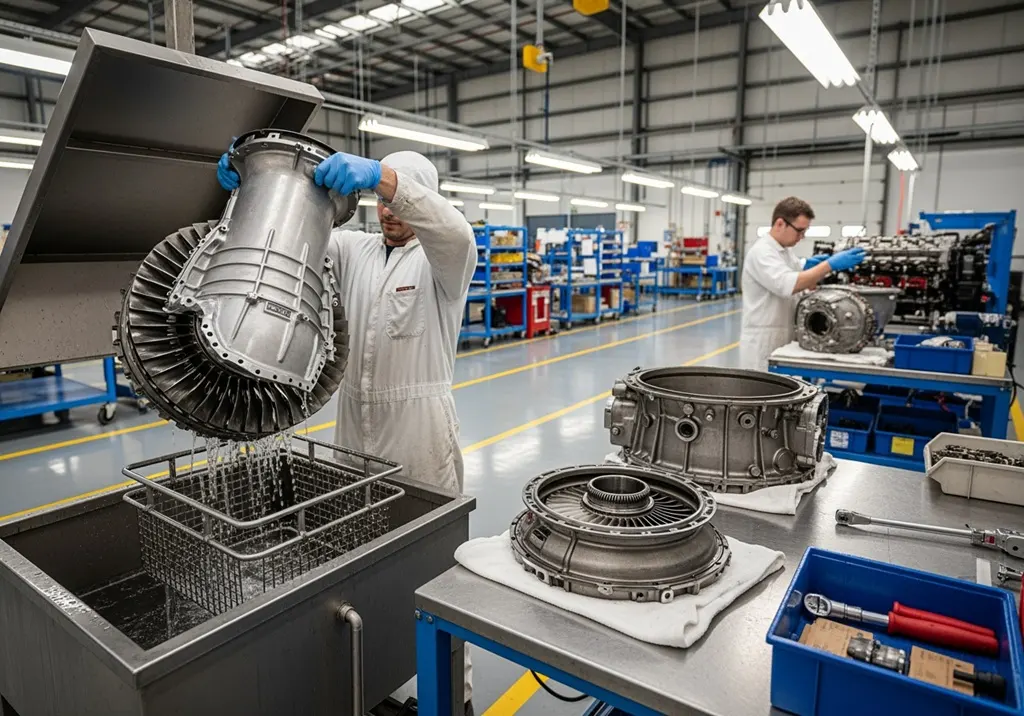
Aircraft engine overhauls demand precision that few other maintenance operations match. When maintenance organisations rebuild commercial powerplants, the cleaning process is not an administrative step – it is the foundation of airworthiness. A contaminant particle of sufficient size can compromise turbine blade integrity or cause foreign object damage that leads to unscheduled engine removal.
This article covers why aviation MRO facilities need stainless steel cleaning systems for engine overhaul work, what OEM cleanliness standards actually require, and how to match equipment to the demands of multi-alloy engine assemblies.
Why Aircraft Engines Demand Stainless Steel Cleaning Systems
Contamination Risks in Engine Overhaul Environments
Aircraft engine parts require cleaning environments that do not introduce new contamination whilst removing existing debris. This is where stainless steel parts washers aviation facilities rely on provide a critical quality advantage over standard industrial alternatives.
Powder-coated or mild steel washers degrade over time in aqueous cleaning environments. Surface corrosion releases particles into the cleaning process – particles that can deposit onto precision engine components and create contamination that was not there before the wash cycle started. When an engine block washer is constructed from stainless steel throughout, the cleaning chamber itself becomes part of the quality assurance system rather than a source of risk.
Aviation aluminium alloys are particularly susceptible to galvanic corrosion when exposed to dissimilar metals in aqueous environments. A parts washer with exposed mild steel surfaces or corroding welds can deposit iron particles onto aluminium components, creating corrosion cells that propagate through the material over time. Stainless steel construction eliminates this pathway entirely.
OEM Cleanliness Specifications and What They Require
OEM specifications from major engine manufacturers reference surface cleanliness standards that measure contamination by particle count per unit area, residual film thickness, and surface oxidation levels. A standard industrial parts washer might achieve visually clean results that satisfy workshop inspection, but engine overhaul work requires laboratory-verified cleanliness that only controlled processes can deliver consistently.
OEM engine cleanliness standards specify acceptable contamination limits in precise terms – particle count by size range per unit of surface area. Achieving these limits requires cleaning processes that remove a very high proportion of contaminants, a consistency level that manual methods and uncontrolled industrial systems cannot maintain across production volumes.
Temperature control separates aviation-grade cleaning from general industrial applications. Aluminium alloy components used in compressor stages and accessory housings require wash temperatures that stay within safe limits to prevent material property changes. Nickel-based superalloys in turbine sections tolerate higher temperatures but demand precise thermal management. Stainless steel parts washers aviation facilities select maintain consistent temperature zones throughout the cleaning cycle, preventing the thermal gradients that create uneven cleaning outcomes in inferior systems.
Engine Block Washer Requirements for Aviation Powerplants
Size, Geometry, and Internal Passage Cleaning
Large turbofan engines require cleaning systems that accommodate engine cases of substantial diameter and weight when stripped to basic structure. An engine block washer designed for automotive applications cannot handle these dimensions, nor can it meet the cleanliness standards aviation demands. Purpose-built systems provide large chamber volumes with rotating spray arms that reach complex internal geometries.
Modern turbofan engines contain internal passages for cooling air, oil distribution channels, and bolt holes with significant thread depth. Carbon deposits accumulate in these recesses during normal operation, and incomplete removal creates hot spots that accelerate component degradation. High-pressure spray systems with articulated nozzles reach these critical areas without damaging precision surfaces – a capability that defines adequate engine overhaul surface preparation.
Engine overhaul surface preparation must address every internal and external surface. External cleaning that leaves internal passages contaminated fails OEM specifications regardless of how clean the outside looks.
Material Compatibility Across Multi-Alloy Assemblies
Engine cases manufactured from magnesium alloys present additional cleaning constraints that standard industrial washers cannot address. Magnesium reacts with alkaline cleaning solutions above certain pH levels, creating surface etching that changes dimensional tolerances and weakens structural integrity. Aviation-specification cleaning systems use pH-controlled detergents formulated for multi-material engine assemblies, maintaining chemical compatibility across aluminium, magnesium, titanium, and nickel alloy components within a single wash cycle.
This multi-material chemistry requirement is one of the key reasons stainless steel construction matters for aviation applications. Stainless steel construction allows facilities to use the full range of aviation-approved detergent chemistry without the equipment compatibility constraints that mild steel systems impose.
Filtration Standards for Engine Component Processing
Filtration requirements for engine component cleaning exceed typical industrial standards. OEM specifications commonly require filtration to fine particle sizes – capturing particles that would pass through standard industrial filters. This filtration prevents recontamination during the wash cycle, where loosened carbon particles and metallic debris circulate through the cleaning solution.
Stainless steel filter housings resist corrosion that would compromise filtration efficiency over time, maintaining system performance across thousands of operating hours. This is particularly important in facilities processing multiple engine assemblies each week, where filtration performance directly affects cleaning consistency and OEM engine cleanliness standards compliance.
Meeting FAA and CASA Cleanliness Standards With Automated Systems
Process Control and Regulatory Documentation
Both FAA and CASA mandate traceability for all maintenance processes affecting airworthiness. When an engine returns to service, the maintenance organisation must document that cleaning procedures met the applicable OEM specifications and industry standards. Manual cleaning processes introduce variables that make consistent documentation difficult – operator technique, solution temperature fluctuations, and exposure time variations all affect outcomes.
Automated systems provide the process control that aviation MRO compliance demands. Programmable wash cycles ensure identical treatment for every component, with documented parameters including solution temperature, pressure, cycle duration, and detergent concentration. These systems generate time-stamped records that maintenance organisations include in engine logbooks, demonstrating compliance during regulatory audits and warranty claims.
Validation and Compliance Testing
The validation process for cleaning systems involves testing with witness panels – standardised metal coupons placed in the wash chamber alongside engine components. After the cleaning cycle, these panels are analysed to confirm that the cleaning process achieves specified contamination removal rates. This provides objective evidence that satisfies regulatory requirements and OEM engine cleanliness standards.
Calibration requirements for temperature sensors, pressure gauges, and timer functions must follow traceable standards. Australian aviation MRO facilities typically calibrate equipment using NATA-accredited service providers, with calibration certificates maintained in quality system records. An engine block washer with stainless steel construction maintains sensor accuracy longer than corroding systems where chemical attack affects sensor performance and mounting integrity.
Cleaning Turbine Blades and Compressor Stages Without Damage
Protecting Thermal Barrier Coatings
Turbine blades are among the highest-value components in any engine overhaul. These components feature single-crystal nickel superalloy construction with thermal barrier coatings that measure only a few hundred microns thick. Cleaning processes must remove carbon deposits and combustion residues without damaging these coatings, as coating loss reduces blade service life dramatically and necessitates expensive recoating.
Turbine blade cleaning requires carefully controlled spray pressure. High-pressure water jets can erode thermal barrier coatings, particularly at blade edges and cooling hole entrances where coating thickness is minimal. Properly engineered spray systems deliver pressure through fan-pattern nozzles that distribute force across larger surface areas, removing deposits through chemical action and moderate mechanical energy rather than aggressive impingement.
Compressor Blades and Aerodynamic Surface Requirements
Compressor blades present different turbine blade cleaning challenges due to their titanium alloy construction and aerodynamic surface requirements. These components accumulate compacted dirt, atmospheric contaminants, and biological matter that reduces airflow efficiency and increases operating temperatures. The cleaning process must restore original surface finish without introducing scratches or surface roughness that would affect aerodynamic performance.
Automated spray washing achieves this balance through controlled exposure times and optimised detergent chemistry that lifts deposits without abrasive action. This is something manual scrubbing cannot replicate consistently – even gentle abrasive materials introduce surface variations that affect compressor efficiency across a fleet.
Cooling Passages and Ultrasonic Agitation
Modern turbine blades contain internal channels that distribute cooling air through the blade structure. Carbon deposits partially blocking these passages reduce cooling effectiveness and create localised hot spots that initiate thermal fatigue cracking. Engine overhaul surface preparation must address these internal channels, not just external surfaces.
Ultrasonic agitation combined with spray washing provides the mechanical energy necessary to dislodge deposits from restricted geometries without damaging surrounding material. This combination is the most effective approach for ensuring cooling passages are fully clear after turbine blade cleaning, and it is a capability that distinguishes purpose-built aviation cleaning systems from standard industrial washers.
Hot Tank Systems vs Spray Washers for Engine Component Processing
Processing Time and Throughput Comparison
Aviation MRO facilities traditionally relied on hot tank systems for engine component cleaning, immersing parts in heated alkaline solutions for extended soak periods. These systems provided effective carbon removal but introduced risks that automated spray washing eliminates. Immersion cleaning exposes entire component surfaces to chemical attack, including precision-machined bearing surfaces and threaded connections that do not require aggressive treatment.
The processing time difference between immersion and spray methods affects facility throughput directly. Hot tank cleaning requires extended soak time followed by manual rinsing and drying, consuming many hours total per component batch. Automated spray washers complete the same cleaning in substantially less time, including heating, washing, rinsing, and drying cycles. This efficiency allows facilities to process engine components through inspection and measurement stages the same day, reducing work-in-progress inventory.
Chemical Disposal and Operating Costs
Chemical disposal costs favour spray washing systems significantly. Hot tanks contain large volumes of cleaning solution that requires replacement periodically as contaminant loading reduces effectiveness. Disposal of spent alkaline solutions generates substantial ongoing expense for busy engine shops. Hot tanks remain appropriate for deep soak applications where immersion chemistry offers specific advantages, but spray washers recirculate filtered solution far longer before requiring replacement, reducing chemical consumption and disposal costs proportionally.
Worker Safety Considerations
Open hot tank operations expose technicians to heated alkaline solutions during part loading and retrieval, creating burn risks and respiratory exposure to chemical vapours. Manual rinsing following hot tank cleaning requires handling wet, chemically contaminated components. Automated spray washers contain all process steps within closed chambers, eliminating direct worker exposure to chemicals and heated solutions. For aviation MRO facilities meeting workplace health and safety obligations, enclosed automated systems represent a significant improvement over open tank operations.
Stainless Steel Construction Benefits for Multi-Shift Engine Shops
Service Life and Maintenance Frequency
Engine overhaul facilities operate continuous production schedules. Parts washers in these environments accumulate high operating hours annually. Standard industrial washers with painted steel construction experience corrosion failure well within the decade under this duty cycle, whilst stainless steel parts washers aviation facilities invest in maintain structural integrity for far longer.
The total cost calculation for cleaning equipment extends beyond initial purchase price to maintenance intervals and replacement part availability. Stainless steel washers reduce maintenance frequency significantly, with pump seals and bearings lasting longer under identical operating conditions. These maintenance reductions mean fewer production interruptions and fewer delays in engine delivery schedules.
Detergent Compatibility and Energy Efficiency
Detergent compatibility creates hidden costs in facilities processing both ferrous and non-ferrous components. Facilities using mild steel washers must limit detergent selection to protect the equipment itself, compromising cleaning effectiveness for certain component types. Stainless steel parts washers eliminate this constraint, allowing maintenance organisations to optimise chemistry for component requirements without equipment compatibility concerns.
Energy consumption represents a significant operating cost for cleaning systems that maintain elevated solution temperatures throughout production shifts. Insulated stainless steel tanks retain heat more effectively than single-wall mild steel construction, reducing heater cycling and lowering electrical consumption. Over a multi-year service life, this efficiency improvement contributes meaningfully to total cost of ownership.
Integrating Stainless Steel Washers Into Engine Shop Workflow
Workflow Positioning and Component Tracking
Engine overhaul facilities sequence operations to minimise component handling and reduce processing time from induction to test cell. Cleaning typically occurs immediately following disassembly, before dimensional inspection and non-destructive testing. This sequence prevents contamination from interfering with crack detection, dimensional measurement, and surface finish assessment. An engine block washer positioned adjacent to disassembly benches reduces transport distances and eliminates temporary storage of uncleaned components.
Component tracking through the cleaning process integrates with enterprise maintenance software systems that manage engine shop operations. Modern parts washers with programmable logic controllers can interface with facility management systems, recording component serial numbers, wash cycle parameters, and completion timestamps automatically.
Facility Footprint and Equipment Flexibility
The physical footprint of cleaning equipment affects facility layout efficiency in engine shops where floor space is at a premium. Vertical-loading configurations reduce footprint requirements whilst maintaining capacity for large components. Facilities processing multiple engine types simultaneously benefit from adjustable spray arm configurations and modular basket systems that allow a single washer to handle components ranging from small accessory housings to complete engine cases.
Hotwash Australia engineers adjustable configurations into their heavy duty aviation cleaning systems, allowing the same machine to support different engine programmes as facility workloads change. Extra heavy duty parts washers handle the largest commercial engine cases whilst wet abrasive blasters provide complementary surface preparation capability for components requiring rust removal or coating strip before the main wash cycle.
Australian Aviation Maintenance Operations and Local Support
Compliance With Australian Standards
Aviation maintenance organisations across Australia require cleaning equipment that meets international cleanliness standards whilst complying with local electrical and pressure vessel regulations. Equipment manufactured in Australia to AS/NZS standards simplifies installation, reduces commissioning time, and ensures that equipment meets insurer requirements for workplace safety coverage.
Imported equipment often requires electrical system modifications and engineering certifications that add weeks to delivery schedules and increase total project costs. Locally manufactured systems arrive compliant with Australian requirements and ready for connection without modification – an advantage that matters when production schedules cannot accommodate extended commissioning delays.
Parts Availability and Technical Support
Parts availability directly affects equipment uptime in production environments where cleaning represents a critical path activity. Equipment manufactured in Australia maintains spare parts inventory in local warehouses, providing fast delivery to eastern states facilities and same-day service to nearby operations. This responsiveness prevents the multi-week delays common with imported equipment requiring international parts shipment.
The technical expertise required to maintain aviation-grade cleaning equipment exceeds standard industrial service capabilities. Australian-based equipment manufacturers provide training programmes that develop specialised knowledge within customer maintenance teams, reducing dependence on external service providers when adjustments or repairs become necessary.
For advice on stainless steel parts washers aviation engine overhaul facilities require to meet OEM and regulatory standards, reach out to our equipment specialists or email us at sales@hotwash.com.au.

Leave A Comment