
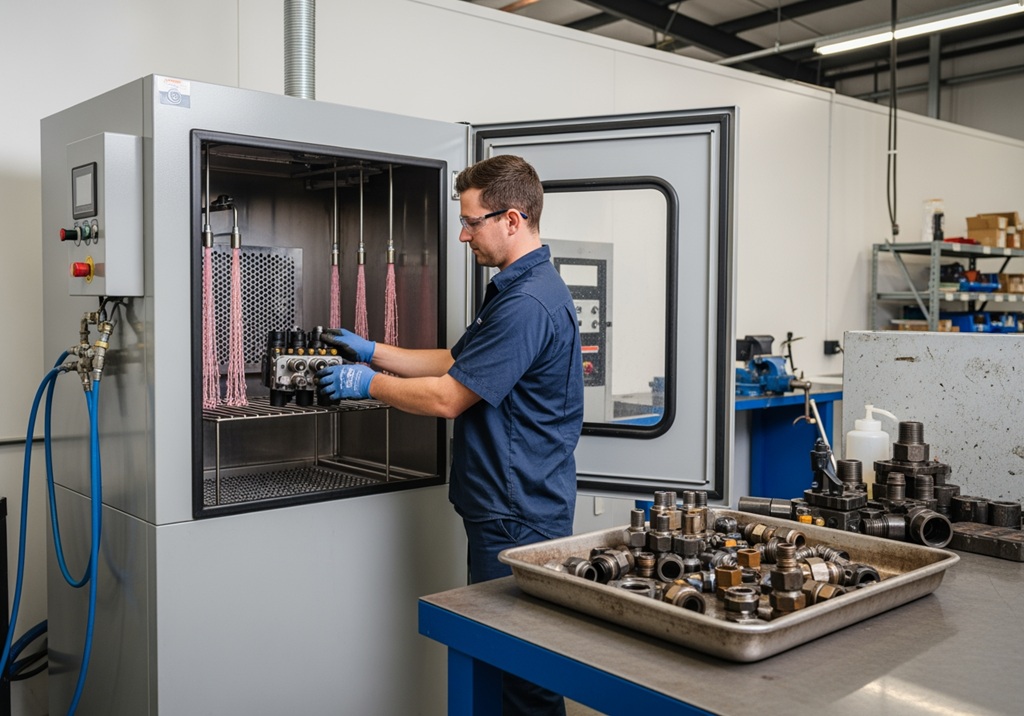
Cleaning intricate engine parts, hydraulic fittings, and precision machined components by hand is time-consuming and rarely produces consistent results. Brushes miss internal passages. Solvents leave residue in recesses. The whole process ties up skilled workers on tasks that should take minutes, not hours. The problem is not effort – it is the limitation of manual cleaning methods when applied to parts with complex geometry, internal passages, and tight tolerances.
A cabinet parts washer addresses this problem directly. By directing high-pressure heated water into every recess, thread, and internal passage of a component, these systems achieve thorough cleaning results that manual methods cannot replicate reliably. This guide explains how the technology works, where it delivers the most value, and what to consider when choosing a system for your workshop.
How Cabinet Parts Washers Work
The Enclosed Chamber Design
A cabinet parts washer operates inside a sealed chamber. Operators load components through a front-loading door, place them on a rotating turntable or fixed rack, close the door, and activate the wash cycle. The enclosed design is fundamental to how these systems work and why they outperform open alternatives for small component cleaning.
Once the cycle begins, pressurised cleaning solution is delivered through spray jets positioned at multiple heights and angles inside the chamber. As the turntable rotates, every surface of the component passes through the spray pattern continuously. Fixed jets reach the same surfaces repeatedly from consistent positions. The rotating platform ensures coverage from all angles, including surfaces that face away from any single jet bank.
The enclosed design contains spray, heat, and moisture within the chamber throughout the cycle. No overspray escapes into the workshop. This containment keeps the workspace dry, reduces chemical exposure for nearby workers, and allows the chamber to maintain a consistent thermal environment that open systems cannot sustain.
For high pressure parts cleaning of small components with complex internal geometry, this enclosed approach makes a significant practical difference. Passages that would require careful manual brushing from multiple angles are reached by pressurised spray from the fixed jet array, with the rotating turntable ensuring complete surface exposure throughout the cycle.
Temperature and Pressure Working Together
Heat and pressure together are what make the cabinet parts washer effective on contamination that cold or lukewarm cleaning methods struggle with. Water heated to operating temperature inside the insulated cabinet tank softens grease and oil, reducing their viscosity and making them easier to dislodge under spray pressure. This thermal action significantly improves detergent effectiveness compared to cold water, which leaves heavy grease in a more solid, resistant state.
High pressure parts cleaning works by forcing cleaning solution into spaces that passive soaking cannot reach. Internal oil galleries, coolant passages, threaded holes, and blind passages are all reached by pressurised spray. The mechanical force of the water dislodges contamination and flushes it clear of the component, rather than waiting for chemistry alone to dissolve it slowly over an extended soak time.
A recirculation system in well-designed cabinet washers filters contamination from the wash solution and returns clean water to the spray cycle. This maintains cleaning performance across multiple consecutive cycles without requiring a full solution change after every component. It also reduces water consumption compared to continuous fresh-water spray methods, which is both a running cost and environmental benefit for operations cleaning multiple batches daily.
How High-Pressure Water Removes Contamination from Complex Parts
Spray Jet Mechanics and Coverage
Spray jet placement determines how thoroughly a cabinet parts washer cleans components with complex geometry. Quality systems position jets at multiple heights and angles to ensure complete part exposure from the moment the cycle begins. The turntable rotation works alongside jet positioning to eliminate shadow zones – areas that face away from one jet bank rotate into the coverage zone of another, ensuring the whole external surface receives direct spray exposure during the cycle.
For hydraulic component cleaning, internal passages are the key challenge. Hydraulic valves, pump bodies, and fittings contain internal bores and ports where old fluid, metal particles, and sealant residue accumulate. Pressurised spray enters these ports and passages during the wash cycle, flushing contamination out through the same openings it entered. This flushing action is cleaning that brushes cannot deliver and soaking alone cannot replicate effectively.
The enclosed cabinet environment also plays a role in jet effectiveness. Because the chamber is sealed, spray pressure is not dissipated into the open air as it would be in an open spray setup. The pressure reaches the component surface with more force in an enclosed space than it would across an open tank, improving the mechanical action against stubborn contamination.
The Role of Heat and Detergent Chemistry
Heat activates biodegradable detergent and improves its ability to penetrate contamination. At elevated temperatures, detergent works faster and more thoroughly than at ambient temperatures. It surrounds oil and grease molecules, breaking their bond with the metal surface and suspending them in the wash solution. Once separated from the component, the spray pressure flushes everything clear.
This combination of thermal activation and mechanical flushing is why the cabinet parts washer delivers small component cleaning results that cold-water alternatives cannot match. Cold water leaves heavy grease in a more resistant state. Without heat, more pressure or more time is needed to achieve the same result – and for components with fine geometry or tight tolerances, aggressive pressure compensation creates its own risks.
Biodegradable, water-based detergents used in cabinet systems are safer for workers and simpler to manage from an environmental compliance perspective than solvent-based alternatives. They produce no flammable vapours, carry lower skin absorption risks, and dispose of more straightforwardly under applicable environmental regulations. For workshops handling food industry equipment or operating in environments with strict chemical management requirements, these properties are important practical considerations.
Applications Where Cabinet Washers Deliver Results
Automotive and Engine Workshop Cleaning
Automotive workshops use cabinet parts washers for engine components that require precision cleaning before reassembly. Cylinder heads with multiple valve ports, intake manifolds with complex runner shapes, carburettors with small internal passages, and throttle bodies with fine throttle mechanisms all clean thoroughly in a single automated cycle.
Small component cleaning is a core strength of the enclosed cabinet format. Fuel injectors, valve bodies, and brake callipers have tight tolerances and internal passages where contamination causes premature failures. The pressurised spray reaches into these passages and flushes contamination clear. Achieving this level of cleanliness consistently through manual scrubbing takes significantly longer and produces more variable results.
Hydraulic component cleaning is another application where the cabinet format delivers clear value over manual alternatives. Hydraulic valves, pumps, and fittings contain internal passages where even small amounts of residual contamination cause accelerated wear and system failures after reassembly. The enclosed cabinet delivers the consistent cleaning quality that hydraulic rebuilds require – an outcome that depends on removing contamination from internal passages, not just cleaning external surfaces.
Food Processing and Manufacturing Facilities
Food processing facilities require cleaning that meets documented hygiene standards between production runs. Stainless steel parts washers are the preferred format for this environment. Stainless steel construction resists corrosion from repeated high-temperature cleaning and does not contaminate food contact surfaces. The cabinet format’s enclosed design supports repeatable, documentable cleaning processes that hygiene compliance requires.
Mixer blades, slicer components, and conveyor parts all suit cabinet cleaning. High-temperature water combined with appropriate detergent removes organic residue, fats, and proteins from stainless steel surfaces effectively. The enclosed system delivers the same result every cycle, supporting the consistent hygiene standards that food safety compliance requires and that manual cleaning cannot reliably guarantee.
Manufacturing facilities use cabinet systems between production stages. Machined components carry cutting oil, metal particles, and coolant residue that interfere with coating adhesion and assembly tolerances if not removed before the next stage. Automated workshop cleaning equipment handles this efficiently and consistently, without slowing production schedules or requiring skilled operator attention beyond loading and unloading.
Why Cabinet Washers Improve Workshop Efficiency
Reducing Manual Cleaning Labour
Parts washer labour savings are the most straightforward financial argument for cabinet systems. A component that requires extended manual scrubbing to clean adequately is cleaned in a fraction of the time using an automated cabinet cycle. Workers who previously spent hours on cleaning tasks can redirect that time to productive repair and maintenance work – activities that generate revenue rather than simply consuming it.
Consistency adds to the efficiency gain. Manual cleaning produces variable results depending on the operator, their experience level, and the time available. A cabinet parts washer delivers the same cleaning outcome every cycle. This consistency matters in quality-sensitive applications where cleaning standard affects assembly outcomes – it eliminates the variation that arises when different workers clean the same type of component at different points in the shift.
Hotwash Australia has over 40 years of experience supplying automated workshop cleaning equipment to Australian workshops across automotive, mining, transport, and manufacturing sectors. That experience shapes the practical design decisions in their cabinet systems – features like the foot-switch pump, illuminated cabin, and insulated tank that reflect real workshop workflows rather than specification targets.
Safety and Chemical Exposure Improvements
Enclosed cabinet operation eliminates direct worker contact with hot cleaning solution during the wash cycle. Operators load parts, close the door, and start the cycle. They are not exposed to spray, steam, or chemical splash during active washing. This is a meaningful change from manual cleaning workflows where the worker is in contact with the cleaning environment throughout the entire process.
Biodegradable detergents used in cabinet systems replace the solvents and degreasers common in manual cleaning. These water-based solutions carry lower health risks, require simpler storage conditions, and are easier to dispose of in compliance with environmental regulations. Fewer workplace injuries and lower rates of occupational skin conditions reduce costs and disruption across the workshop over time.
The parts washer labour savings from reduced chemical exposure and injury risk extend beyond direct cleaning time. A workshop where the cleaning process is safe and contained runs more smoothly than one where chemical management, protective equipment requirements, and exposure monitoring add complexity to daily operations.
Comparing Cabinet Washers to Other Systems
Cabinet Washers vs Manual and Cold Parts Washers
Manual parts washers are sink-style units where operators brush parts in cleaning solution at ambient or slightly elevated temperature. They suit light degreasing of small, simply shaped components where contamination is not heavy and the operator can access all surfaces directly with a brush. For complex parts with internal passages, heavy contamination, or tight tolerances, manual systems produce inconsistent results and require significantly more labour time per component.
Cold-water systems lack the thermal action that makes high pressure parts cleaning effective on heavy contamination. Without heat, grease and oil remain more viscous and resist removal. Cold water systems suit quick cleaning of lightly soiled parts – hand tools, fasteners, and simple components with light surface contamination – but are not appropriate for precision component cleaning or hydraulic component cleaning applications where thorough decontamination of internal passages is required.
Automated workshop cleaning equipment, by contrast, delivers consistent results with minimal operator involvement. The cabinet format adds containment and automation that open spray systems do not provide, and thermal performance that cold-water systems cannot match.
Cabinet Washers vs Hot Tanks and Open Spray Systems
Hot tanks use heated immersion cleaning, where parts soak in solution for an extended period. This passive approach suits heavy grease on simply shaped components with good solution access to all surfaces. For components with complex internal geometry where cleaning solution cannot circulate effectively on its own, the passive soak is less thorough than the active flushing action of cabinet spray. Parts often need additional manual attention after soaking, which partly defeats the automation benefit.
Open spray washers provide manual control and size flexibility but lack containment and automation. Operators must direct spray throughout the cycle and remain present throughout. The parts washer labour savings from cabinet automation are not available with open spray systems. Chemical containment is also lower, which affects both worker exposure and workshop housekeeping.
For workshops where cabinet dimensions accommodate the component range, the cabinet parts washer provides consistently better efficiency, safety, and cleaning quality than both manual alternatives and open spray systems.
Choosing the Right Cabinet Washer for Your Workshop
Matching Capacity to Your Component Range
Selecting the right cabinet parts washer starts with understanding your most common cleaning tasks. Chamber dimensions determine what fits inside the machine. Match the chamber size to your largest regular components while allowing clearance for turntable rotation and spray circulation. A chamber that is too small requires batch splitting and reduces efficiency. A chamber that is oversized wastes energy heating unnecessary space and water volume.
Construction material matters for specific industries and environments. General workshop cleaning suits powder-coated steel construction. Food processing, pharmaceutical, and marine applications benefit from stainless steel for corrosion resistance and hygiene compliance. For small component cleaning requirements in compact workshop spaces, extra heavy duty parts washers offer a practical balance between cleaning performance and floor space, while the parts washer range from Hotwash extends to suit larger component demands across all industries.
Heating capacity affects cycle time and cleaning effectiveness at volume. A system that cannot maintain operating temperature under continuous use during a busy shift delivers inconsistent results as the day progresses. Verifying that the heating specification matches your expected cycle frequency prevents this problem before it affects workshop output.
For advice on which cabinet parts washer suits your workshop’s component range, cleaning volume, and industry requirements, contact our industrial cleaning equipment specialists or email us at sales@hotwash.com.au.

Leave A Comment