
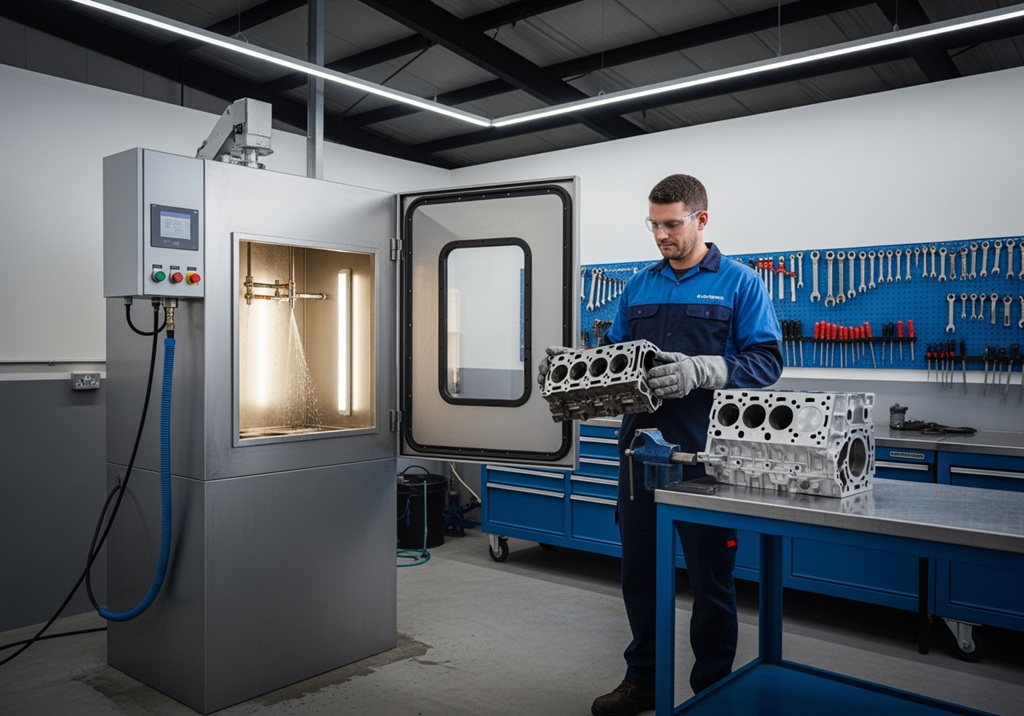
Workshop managers dealing with baked-on grease, carbon build-up, and oil residue know how much time manual cleaning wastes. Scrubbing engine components by hand is slow, inconsistent, and hard on your team. It also rarely achieves the cleanliness standard that precision reassembly demands. Parts that look clean after manual scrubbing often carry residue in oil galleries, valve ports, and threaded passages that only becomes apparent when a rebuilt component fails prematurely.
A hot blast cabinet washer addresses this problem directly. This guide explains what these systems are, how they work, which components they are designed to clean, and how they compare to the alternatives. Whether you manage an automotive workshop, a mining maintenance facility, or an earthmoving operation, understanding the right cleaning equipment helps you make better decisions for your team and your budget.
What a Hot Blast Cabinet Is
The Core Design and Purpose
A hot blast cabinet is an enclosed industrial cleaning system. It uses heated water, high-pressure spray jets, and biodegradable detergent to remove contamination from components inside a sealed chamber. The core design principle is containment – the entire cleaning process happens inside a closed environment. This protects workers, keeps the workshop floor dry, and allows heat and pressure to build to levels that open spray systems cannot maintain.
The hot blast cabinet keeps spray, heat, and moisture inside the cabinet throughout the wash cycle. Components sit inside the chamber on a rack or turntable while the system delivers pressurised cleaning solution from multiple jet positions. Once the door closes, the process is fully automated. The operator does not need to stay present or direct the spray manually.
Hotwash manufactures the HB1100 hot blast cabinet in two configurations: a sliding door model and a tilt lid model. Both variants include a foot-switch operated pump that keeps the operator’s hands free during cleaning, an illuminated washing cabin so the cleaning process remains visible throughout, and a glass viewing window for monitoring progress without opening the door mid-cycle. These features reflect practical workshop needs rather than optional add-ons.
How It Differs from Standard Parts Washers
Standard open-top parts washers rely on the operator to direct spray manually throughout the cleaning cycle. The operator holds a spray gun with one hand while positioning the component with the other, or stands over an open tank brushing parts in cleaning solution. Results depend heavily on operator technique, available time, and how accessible the surfaces being cleaned actually are.
The hot blast cabinet automates this process. Once the component is loaded and the door is closed, the system delivers consistent spray pressure from fixed jet positions inside the sealed chamber. The operator can attend to other tasks and return when the cycle is complete. This shift from manual to automated cleaning is the fundamental difference between the two approaches, and it has a direct effect on both cleaning quality and labour time per component.
The enclosed design also provides a thermal advantage that matters for cleaning performance. Heat builds inside the sealed cabinet and stays stable throughout the cycle. This consistent thermal environment improves detergent performance in a way that open spray systems cannot replicate. Open systems lose heat to the surrounding air continuously during operation. For workshops handling small to medium components with complex geometry, threaded holes, and internal passages, the hot blast cabinet delivers cleaning results that open systems and manual methods cannot consistently match.
How the Hot Blast Cabinet Cleaning Process Works
Spray Action and Heat Delivery
The hot blast cabinet cleaning process centres on the interaction between heat, pressure, and chemistry. Water is heated inside the cabinet by an efficient heating system. The washing tank is insulated to retain that heat throughout the cycle, which reduces the energy required to maintain operating temperature and keeps running costs lower than they would be with an uninsulated alternative.
Once the water reaches operating temperature, it is mixed with biodegradable detergent and delivered through spray jets positioned inside the chamber. These jets force cleaning solution into recesses, threaded holes, and internal passages under pressure. The mechanical force of the pressurised spray dislodges contamination and flushes it away, rather than relying solely on chemistry to dissolve it slowly over time.
This approach makes the high pressure cabinet washer particularly effective for engine component degreasing. Oil galleries, coolant passages, and bearing housings must be completely free of contamination before precision reassembly. Brushes cannot reach effectively into these passages. Soaking relies on slow chemical action without the mechanical flushing force. Pressurised spray reaches where other methods cannot and clears contamination in a fraction of the time.
Visibility and Control Features
One of the practical advantages of the HB1100 is the illuminated washing cabin. A lamp inside the chamber provides clear visibility throughout the wash cycle. Operators can watch contamination lifting from component surfaces in real time through the glass viewing window, rather than guessing at cleaning progress from outside a sealed box.
An air jet cleaning system maintains that visibility throughout the cycle. The air jet prevents condensation and detergent mist from building up on the inside of the glass, keeping the view clear even during active high-pressure spray. This allows operators to stop the cycle when parts are visibly clean, or extend it when contamination is still lifting, rather than running on a fixed timer that may be too long for lightly soiled parts or too short for heavily contaminated ones.
The foot-switch pump activation completes the control picture. By operating the spray pump with a foot pedal, operators keep both hands free to position and rotate components during cleaning. This hands-free approach improves cleaning coverage on complex components and reduces fatigue during longer cleaning sessions. It also allows for precise control over when spray is applied and when it stops, without setting down tools or losing grip on the component.
Which Components Is It Designed to Clean
Automotive and Engine Components
The hot blast cabinet is well suited to the component cleaning demands of automotive workshops. Cylinder heads, engine blocks, pistons, connecting rods, and crankshafts all benefit from the combination of heated water and high-pressure spray inside an enclosed chamber. These components carry contamination – carbon deposits, oil varnish, gasket residue, and metal particles – that manual scrubbing rarely removes completely and that cause failures when they carry through to the assembly stage.
Engine component degreasing is one of the most common and highest-value applications for the cabinet format. Carbon deposits on valve seats, oil residue in crankshaft journals, and baked-on grease on mating faces all respond well to the hot blast cabinet cleaning process. Parts emerge clean enough for precision measurement and inspection before being returned to service. Achieving this level of cleanliness consistently with manual methods takes significantly longer and produces less reliable results.
Turbochargers and other precision components also suit this format. Turbine housings, compressor wheels, and centre sections require cleaning that removes contamination without damaging surfaces or altering tight tolerances. The controlled spray action of the cabinet achieves this without the abrasive scrubbing that risks surface damage. Fuel system components, valve bodies, and fittings with fine internal passages respond particularly well to the pressurised flushing action of the high pressure cabinet washer.
Mining, Earthmoving, and Industrial Parts
The carbon deposit removal parts washer capability of the HB1100 makes it a practical choice for mining and earthmoving maintenance operations. Hydraulic pump housings, valve bodies, cylinder components, and gearbox housings all accumulate heavy contamination in these environments. Standard cold cleaning handles light grease adequately but struggles with the thick deposits and abrasive particulates that mining and earthmoving components carry after extended use in harsh conditions.
The enclosed cabinet format also suits food processing equipment that requires thorough hygienic cleaning between production runs. Stainless steel components from food processing lines – mixer attachments, conveyor parts, pump housings, and slicer assemblies – respond well to high-temperature water and biodegradable detergent inside the contained cabinet environment. The enclosed cabinet delivers repeatable cleaning results that support the hygiene compliance documentation food processing operations are required to maintain.
Marine components present a different contamination challenge. Salt deposits and oil residue combine on injectors, fuel pumps, lower unit assemblies, and cooling system components. Salt accelerates corrosion when left on metal surfaces, and oil coking on fuel system parts directly affects performance and service life. The high pressure cabinet washer addresses both contamination types effectively in a single cleaning cycle, making it a useful tool for marine workshop maintenance operations.
Manufacturing facilities also use the cabinet format for machined components that carry cutting oil, metal fines, and coolant residue from production. These residues interfere with coating adhesion, welding quality, and assembly tolerances if not removed before the next production stage. The enclosed cabinet clears both oil films and fine metal particles from complex geometries, threaded holes, and blind passages in a controlled, repeatable way.
Comparing Cleaning Systems
Hot Blast Cabinets vs Manual Cleaning
Manual cleaning produces variable results. Outcomes depend on the individual operator, the tools available, the state of the cleaning solution, and how much time the operator has. A hot blast cabinet delivers the same cleaning result every cycle, regardless of who loads the machine, how experienced they are, or what the workflow pressure is at that point in the shift. This consistency is one of the strongest arguments for the cabinet format in operations where cleaning quality directly affects downstream outcomes.
Worker safety also improves with the enclosed cabinet format. During manual cleaning, operators are in direct contact with cleaning chemicals, exposed to vapours, and managing the awkward physical task of holding components and spray equipment simultaneously. The enclosed cabinet keeps operators away from hot water spray and cleaning solution during the active wash cycle. Loading and unloading happen with the system inactive, which is the only time the operator is close to the cleaning environment.
Biodegradable, water-based detergents used in the hot blast cabinet cleaning process replace the harsh solvents and caustic solutions common in manual cleaning setups. These water-based solutions carry lower skin absorption risks, produce no flammable vapours, and are simpler to store and dispose of in compliance with workplace safety and environmental requirements. The move toward automated, water-based industrial parts cleaning Australia wide reflects both safety improvements and tightening environmental compliance requirements.
Hot Blast Cabinets vs Other Automated Systems
Hot tanks use heated immersion cleaning, where components soak in a heated solution for an extended period. This passive approach suits heavily contaminated components with relatively simple external geometry, where the solution has time and open access to dissolve contamination from all surfaces. The hot blast cabinet differs by using active spray pressure rather than passive soaking. This active mechanical action reduces cycle times and delivers better cleaning coverage on complex components with internal passages, where immersion solution may not circulate effectively.
Wet abrasive blasters address surface preparation tasks such as rust removal, scale stripping, and surface profiling ahead of coating or painting. These serve a fundamentally different purpose to the hot blast cabinet. Where wet abrasive blasters alter surface texture through abrasive action, the hot blast cabinet removes contamination using thermal and chemical action without affecting the base metal surface. The two systems address different cleaning needs and complement each other in well-equipped workshops.
Understanding which system matches your contamination type and component range is the starting point for sound equipment selection. The hot blast cabinet cleaning process suits workshops where targeted, precise cleaning of small to medium components with complex geometry is a regular operational requirement.
Choosing the Right System for Your Workshop
Matching the Machine to Your Cleaning Needs
The right hot blast cabinet for your operation depends on the size and type of components you clean most regularly, the contamination levels your workshop encounters, and how many cleaning cycles you run each day. The HB1100 suits workshops handling automotive engine parts, hydraulic components, food processing equipment, and similar small to medium items where the chamber dimensions accommodate the component range.
For workshops where the majority of components fit within the HB1100 chamber, either the sliding door or tilt lid variant provides appropriate access for the typical loading workflow. For operations that also handle larger components alongside precision items, the broader range from Hotwash Australia provides options. Hotwash has over 40 years of experience in industrial parts cleaning and supplies equipment across automotive, mining, transport, engineering, and marine industries. The range extends beyond the hot blast cabinet to include heavy duty, extra heavy duty, and super heavy duty parts washers for larger components and higher cleaning volumes.
For industrial parts cleaning Australia wide, Hotwash delivers nationally and provides service support through teams based in Perth, Melbourne, Sydney, and Brisbane. Equipment backed by local support and genuine industry knowledge performs better over its working life than equipment selected on price alone.
Getting Expert Advice
Selecting the right cleaning system requires an honest assessment of your components, your cleaning volume, and the contamination types your workshop deals with regularly. A system that suits a small automotive repair shop will not necessarily meet the demands of a mining maintenance facility running continuous shifts. Getting that match right before purchasing avoids the cost and disruption of equipment that underperforms or does not suit the actual workflow.
The range of industrial parts cleaning Australia options is wide across formats, capacities, and price points. Working through the decision with a specialist who understands your industry and your specific cleaning requirements is the most reliable way to arrive at the right choice.
For guidance on the right system for your operation, contact our parts washer specialists or email us at sales@hotwash.com.au.

Leave A Comment