
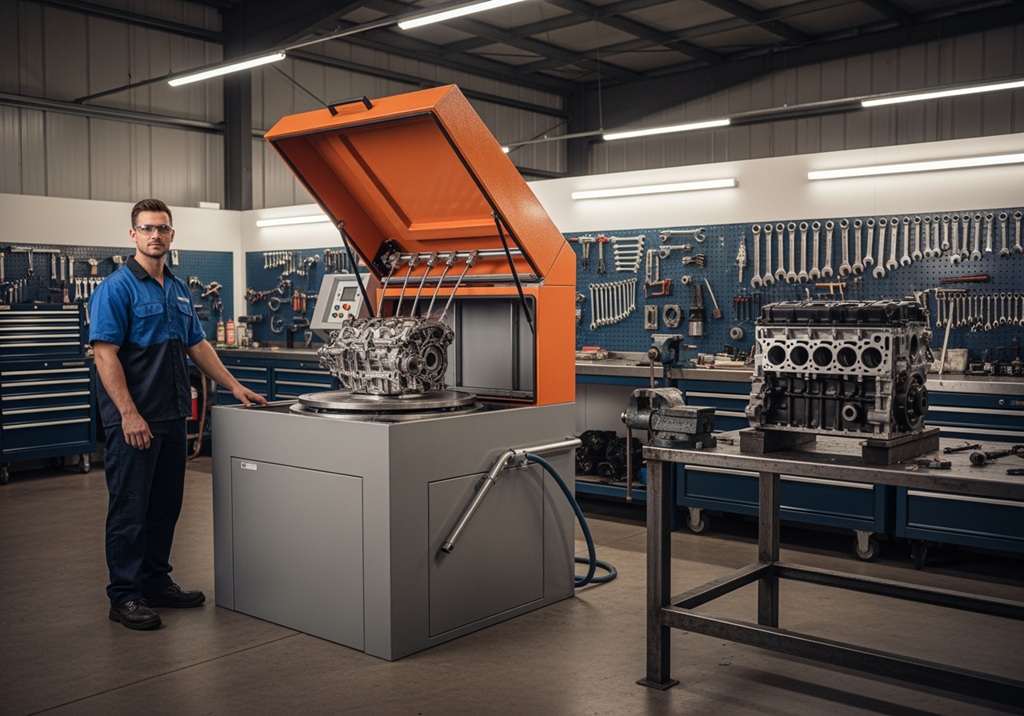
Food processing equipment carries a cleaning requirement that industrial workshop standards cannot meet. It is not simply that food equipment needs to be clean – it needs to be clean in a way that prevents bacterial contamination, meets regulatory inspection standards, and does not introduce foreign material into the production environment. Equipment that works perfectly in a mining workshop creates compliance failures in a commercial food processing facility.
The difference comes down to material selection and design features that address food safety requirements directly. This guide explains what those requirements are and why stainless steel construction and sliding door configurations have become standard for parts washer food industry applications.
Why Food Industry Parts Washing Differs From Industrial Applications
The Unique Cleaning Requirements of Food Processing
Food processing facilities clean equipment components far more frequently than industrial workshops. Where a mining workshop might clean components during a scheduled service, food processing operations clean production equipment multiple times per shift as part of standard hygiene protocols. This frequency creates sustained exposure to moisture, cleaning chemistry, and temperature cycling that standard industrial parts washing equipment handles poorly over time.
The contamination types also differ. Food residue – proteins, fats, sugars, and starches – creates biofilm on surfaces that are not cleaned to food safety standards. Biofilm protects bacteria from sanitisers even after cleaning appears thorough. Industrial parts washers are not designed to prevent biofilm formation because the operations they serve do not face this risk. A parts washer food industry application must address this specific challenge as a design priority, not an afterthought.
What Food Grade Parts Washer Requirements Actually Mean
A food grade parts washer is not simply a well-made industrial washer marketed with a different label. It is equipment designed to specific requirements that address food safety: corrosion-resistant materials that do not create contamination risk if surface protection fails, non-porous surfaces that deny bacteria the purchase points they need to establish colonies, and compatibility with the cleaning chemistry used in food production environments.
These requirements are practical, not cosmetic. The regulatory framework for food processing equipment in Australia requires that cleaning equipment does not introduce contamination risk into the facility. Equipment that corrodes, harbours bacteria, or leaves chemical residue on cleaned components fails this requirement regardless of how well it cleans in a mechanical sense. The parts washer range from Hotwash includes specific stainless steel variants designed for these requirements.
Stainless Steel Construction for Food Safety
Why Stainless Steel Is Standard for Food Industry Equipment
Stainless steel maintains its corrosion resistance through a passive chromium oxide layer that forms on the surface and reforms automatically when damaged. This inherent property – not an applied coating – means that stainless steel remains corrosion-resistant even in high-moisture, chemically active food processing environments over years of sustained use.
The surface of stainless steel is non-porous in a way that powder-coated steel is not. Even intact powder coating has microscopic surface irregularities where bacteria can establish colonies. Stainless steel’s smooth surface provides fewer establishment points for biofilm formation. This makes stainless steel parts washers the appropriate material choice for food industry applications where bacterial contamination risk must be controlled.
The Hotwash stainless steel range covers multiple capacity options with a gear-driven turntable and multiple spray bars as standard features. The range is designed for demanding cleaning applications where material integrity and thorough spray coverage are both essential.
How a Stainless Steel Parts Washer Handles Food Industry Demands
Standard powder-coated mild steel parts washers create specific problems in food processing environments. Constant moisture exposure and acidic cleaning agents accelerate coating degradation over time. When coating fails, rust develops on the underlying steel. Rust in a food processing facility creates contamination risk that hygiene inspections identify as a compliance failure.
A food grade parts washer built from stainless steel does not rely on coating integrity for corrosion protection. The material itself resists corrosion. This means that the equipment remains compliant over its service life without the coating maintenance and inspection that mild steel systems require, and without the contamination risk that coating failure creates.
Hygienic Parts Washing Design in Stainless Steel Systems
Hygienic parts washing design extends beyond material choice to the physical design of the equipment. Crevices, horizontal surfaces where moisture pools, and inaccessible areas where food particles accumulate all create contamination points that cleaning cannot adequately address. Food industry equipment design minimises these points through smooth internal surfaces, complete drainage, and accessible construction that allows thorough cleaning of the machine itself.
Stainless steel’s workability allows these design principles to be implemented effectively. Internal corners can be coved rather than sharp. Drainage can be designed into the chamber floor. Surface finishes can be specified to support cleanability. The material and the design work together to produce equipment that supports the hygiene standards food processing facilities must maintain.
Sliding Door Configurations
Why Hinged Doors Create Food Safety Problems
Hinged door mechanisms create contamination points that cannot be adequately addressed through normal cleaning. The hinge pin and mounting hardware accumulate food particles and moisture during operation. These areas are difficult to access for cleaning and impossible to inspect visually from a normal operating position. Even with thorough cleaning protocols, hinge mechanisms in food processing environments become contamination sites over time.
This is not a maintenance shortcoming but a design limitation. The hinge mechanism’s geometry creates accumulation points that the cleaning process cannot fully reach. A parts washer food industry application that uses hinged door design is accepting this contamination risk as part of its normal operation.
Sliding Door Parts Washer Design Advantages
A sliding door parts washer eliminates the hinge mechanism entirely. The door travels on tracks or rollers positioned outside the cleaning chamber, removing the mechanical assembly from the food-contact environment. There are no hinge pins to accumulate particles, no mounting brackets to trap moisture, and no inaccessible mechanical components near the cleaning chamber.
The Hotwash stainless steel range includes the SS1600 with a pneumatic sliding door – a design that confirms the practical application of sliding door configuration in a specific, available product. The pneumatic actuation means the door opens and closes through controlled mechanical action rather than manual force, which is relevant for high-frequency cleaning operations where door cycling happens many times per shift.
Operational Benefits of Sliding Door Design in High-Frequency Cleaning
Food processing operations cycle their cleaning equipment far more frequently than standard workshop applications. Multiple cleaning cycles per shift, sustained across production days, means the door mechanism operates many more times per week than in a typical workshop setting. Sliding door design distributes force through track and roller systems designed for high-cycle operation rather than concentrating it in hinge points that wear under sustained use.
The sliding door also supports visibility during operation where observation windows are incorporated into the design. This allows operators to monitor cleaning progress without opening the chamber, reducing the risk of incomplete cleaning cycles and supporting quality control during the cleaning process.
Food Processing Equipment Cleaning Requirements
Cleaning Frequency and Throughput Demands
Food processing equipment cleaning is not an occasional maintenance task – it is a routine production requirement that happens multiple times per shift. Slicing equipment, mixer attachments, conveyor components, and processing machinery all require cleaning between production runs, at shift changes, and as part of end-of-day protocols.
This frequency creates specific throughput demands. A parts washer food industry system must complete cleaning cycles quickly enough to return equipment to service within production scheduling requirements. Cycle time is not just a convenience factor – it directly affects whether the cleaning process creates a production bottleneck or integrates smoothly into the production schedule.
Food Processing Equipment Cleaning: What Gets Cleaned
The range of components that food processing facilities clean includes mixer blades and bowls, slicing and dicing equipment parts, conveyor belt components and rollers, processing and filling equipment parts, and commercial kitchen equipment in food service applications. These components vary in size, geometry, and material composition, requiring a cleaning system with flexible capability rather than optimisation for a single component type. For food processing workshops that also maintain non-food production equipment, heavy duty parts washers in mild steel construction suit general industrial cleaning alongside a dedicated stainless system for food contact components.
The stainless steel construction of food grade parts washers suits cleaning components made from food-grade materials including stainless steel, hard plastics, and food-safe alloys. The cleaning chemistry must be compatible with all these materials without causing surface damage that affects food safety or component function.
Temperature Requirements and Documentation
Food safety protocols typically specify minimum water temperatures and contact times for effective sanitisation. A parts washer food industry application must maintain these temperatures consistently throughout the cleaning cycle. Temperature fluctuation during a cycle affects the sanitisation effectiveness of the process, not just its cleaning performance.
The Hotwash stainless steel parts washer range incorporates thermostat controls that maintain operating temperature within the cycle. This temperature consistency supports the documented cleaning protocols that food processing facilities maintain for compliance purposes. Equipment that cannot maintain specified temperatures throughout its cycle cannot support documentation of compliant cleaning.
Food Grade Chemistry and Detergent Compatibility
Why Industrial Degreasers Are Not Suitable for Food Applications
Industrial cleaning chemistry formulated for automotive or mining applications is not appropriate for food processing equipment cleaning. These formulations may contain compounds that leave residues with taste, odour, or food safety implications when they remain on cleaned components. The concentration and chemistry type suitable for heavy industrial contamination is also not appropriate for the materials and surfaces found in food processing equipment.
Food-grade detergents clean effectively within the chemistry constraints that food safety requires. They must remove organic contamination including fats, proteins, and starches without leaving residue that contaminates food products or surfaces. A food grade parts washer must be compatible with these formulations across the alkaline and acidic chemistry types that food processing facilities alternate between for cleaning and sanitisation.
Rinsing and Residue Prevention
Thorough rinsing is a distinct requirement in food industry parts washing. After the cleaning cycle, components should carry no detergent residue that could transfer to food products or production surfaces. A dedicated rinse stage with fresh water separate from the detergent wash cycle ensures complete removal of cleaning chemistry before components return to food contact service.
The hot blasters and other specialist cleaning systems in the Hotwash range address different cleaning tasks within a full-featured food processing maintenance workshop. For surface preparation needs, wet abrasive blasters provide a method appropriate to components and surfaces that spray washing alone does not address.
Compliance Considerations for Food Industry Parts Washing
Regulatory Framework for Food Processing Equipment
Food processing facilities operate under Australian food safety standards that require equipment – including cleaning equipment – to not create contamination risk for food products. Equipment that corrodes, harbours bacteria, leaves chemical residue, or generates foreign material in the cleaning environment does not meet this requirement regardless of how effectively it cleans components.
Stainless steel construction with appropriate design, sliding door configuration that eliminates contamination accumulation points, and food-grade chemistry compatibility together address the material and design requirements that food safety compliance involves. This combination is why these specifications have become standard for hygienic parts washing in food processing applications.
The parts washer food industry range from Hotwash addresses these requirements through purpose-designed stainless steel systems.
Audit Documentation and Equipment Condition
Food processing facilities face regular compliance audits from regulatory bodies and customer quality assessors. Equipment condition is visible during these audits. Appropriate, well-maintained equipment that meets food safety specifications demonstrates the facility’s commitment to hygiene standards. Equipment that is visibly corroded, damaged, or inappropriate for the application creates audit findings that affect certifications and customer relationships.
Stainless steel construction supports long-term equipment condition because the material does not degrade under normal food processing cleaning conditions the way that coated mild steel does. Equipment that remains in good condition over its service life is easier to maintain in a compliant state than equipment that requires ongoing remediation of material degradation.
Choosing the Right Parts Washer for Your Food Industry Application
Matching System Capacity to Cleaning Volume
The stainless steel parts washer range from Hotwash includes multiple capacity options to match different food processing facility scales. The right capacity depends on the size of components being cleaned, the number of cleaning cycles required per shift, and the available floor space in the facility.
Chamber dimensions must accommodate the largest components the facility regularly cleans. Throughput capacity must support the cleaning frequency that production schedules require. Hotwash Australia can assist with matching the right system capacity to your specific cleaning volume and component range.
Key Questions Before Purchase
Selecting the right parts washer food industry system starts with understanding your specific requirements. What components do you clean and what are their dimensions? How many cleaning cycles do you need per shift? What are the regulatory requirements for your specific food processing category? What floor space and electrical supply is available?
With these questions answered, the specification for the right system becomes clear. The material choice (stainless steel for food industry applications), the door configuration (sliding door to eliminate contamination accumulation points), and the capacity (matched to your actual cleaning volume and component range) all follow from your requirements rather than from general product selection. For facilities with lower cleaning volumes or field maintenance requirements, manual parts washers provide professional cleaning capability. For components with internal passages requiring immersion cleaning, hot tanks complement the spray cleaning system.
Getting Specialist Advice
Selecting the right food grade parts washer involves matching specific compliance requirements, cleaning volumes, and facility constraints to an appropriate system. Specialist advice from people who understand food industry cleaning requirements ensures the system selected meets both the cleaning task and the regulatory environment.
For advice on parts washer food industry systems for your operation, contact our food industry cleaning specialists or email us at sales@hotwash.com.au.

Leave A Comment