
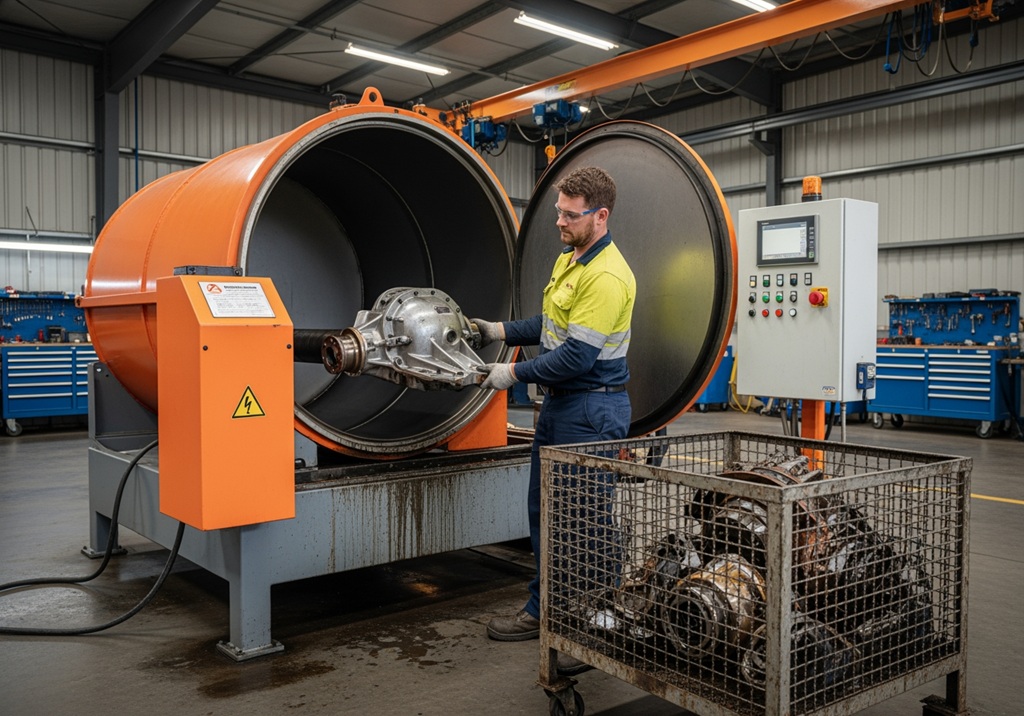
Mining and oil and gas maintenance operations generate some of the most challenging parts cleaning requirements in Australian industry. Components return from service coated in combinations of contamination that standard cleaning methods address poorly and manual scrubbing addresses slowly. The maintenance team’s priority is getting equipment back into service, and cleaning bottlenecks work directly against that goal.
A parts washer for mining and oil and gas operations replaces slow, labour-intensive manual cleaning with automated processes that deliver thorough results in a fraction of the time. This guide explains the specific contamination challenges these industries present, how automated cleaning addresses them, and how to select the right system for your operation.
Why Mining and Oil & Gas Components Need Specialised Cleaning
The Contamination Challenge in Mining Maintenance
Mining components return from service with contamination that often involves multiple types simultaneously. Hydraulic cylinders carry hydraulic oil mixed with fine mineral dust. Drivetrain components combine heavy gear oil with abrasive rock particles. Structural components accumulate mud, grease, and mineral deposits that bond together under operating heat and pressure.
This combined contamination is more difficult to remove than any single type alone. Abrasive particles embedded in lubricant create a paste that resists spray and requires sustained chemical contact to break down. Mining parts cleaning must address both the lubricant chemistry and the abrasive mineral content without spreading particles that accelerate wear on the cleaned components.
The scale of individual components also creates challenges that standard workshop cleaning does not encounter. A haul truck differential housing is not comparable to a passenger car differential. The weight, dimensions, and contamination loading of large mining components require cleaning systems with appropriate chamber size, load capacity, and heating power to deliver thorough results on the actual parts being cleaned.
Oil and Gas Contamination Types
Oil and gas components present a different contamination profile. Valve bodies, pump housings, and pipeline components accumulate crude oil, drilling fluids, and hydrocarbon residues that are dense, viscous, and resistant to cold cleaning. These components often have precision internal surfaces and sealing faces where contamination remaining after cleaning causes functional problems during reassembly.
A parts washer oil gas application must also address internal passage cleanliness. Valve internals, pump impeller passages, and control component cavities carry contamination that spray washing alone may not reach adequately. For these components, immersion cleaning provides access that external spray cannot match.
Why Manual Cleaning Cannot Keep Pace
Manually cleaning a heavily contaminated mining component requires sustained physical effort over an extended period. Hotwash states on their website that their automatic machines can complete what takes a tradesperson or apprentice four hours of manual cleaning in just 15 minutes. For mining and oil and gas operations where components at this scale of contamination are a daily cleaning task, that difference in time represents a fundamental change in how maintenance resources are allocated.
Manual cleaning also produces variable results depending on the operator, the time available, and the contamination severity. Automated cleaning delivers the same result every cycle regardless of workload pressure, shift timing, or which team member is operating the machine.
How Automated Parts Washers Handle Extreme Contamination
Hot Water and Spray Pressure for Heavy Contamination Cleaning
Automated parts washers combine heated water, biodegradable detergent chemistry, and rotating spray pressure to remove heavy contamination that manual methods struggle to address efficiently. Each element of this combination contributes to the result.
Elevated water temperature accelerates the chemical action of the detergent and reduces the viscosity of heavy oils and greases, making them easier to emulsify and flush from the surface. Biodegradable, water-based detergents break the molecular bonds between contamination and metal surfaces. Rotating spray pressure delivers mechanical force that dislodges embedded contamination and flushes it clear of internal recesses.
Super heavy duty parts washers provide the capacity and engineering for major mining operations handling the largest, most heavily contaminated components. These systems maintain cleaning performance through extended operational periods across multiple batches, which is the reality of a busy mining maintenance workshop.
Hot Tank Immersion for Internal Passage Cleaning
For components where internal passage cleanliness is critical – valve bodies, hydraulic components, pump housings, and pipeline fittings – hot tanks provide immersion cleaning that reaches everywhere the solution flows. Spray washing cleans external surfaces and areas the spray contacts. Immersion cleaning surrounds the component completely, flooding internal passages with heated chemical solution.
This heavy contamination cleaning method is particularly relevant for parts washer oil gas applications where precision valve and pump components must be clean on internal sealing surfaces and flow passages before inspection and rebuild. The sustained chemical contact during the soak period dissolves hydrocarbon deposits that brief spray contact cannot address.
Industrial Degreasing Equipment: Filtration for Mining Contamination
Mining contamination includes abrasive mineral particles that standard filtration systems are not designed to handle in the volumes that mine site cleaning produces. Industrial degreasing equipment for mining applications requires filtration systems that capture abrasive particles before they reach pump seals and spray nozzles.
Multi-stage filtration handles different particle sizes progressively. Coarse filtration removes large debris. Secondary filtration captures the finer abrasive particles that cause accelerated pump wear. Filter housing design for mine site applications allows easy cleaning access, because mine site contamination loads require more frequent filter service than standard workshop cleaning produces.
Productivity Benefits for Mining and Oil & Gas Operations
Equipment Maintenance Cleaning: What Automation Changes
Equipment maintenance cleaning in a mining or oil and gas workshop involves a stream of heavily contaminated components arriving from service and needing thorough cleaning before inspection, repair, or rebuild can proceed. The time cleaning takes is time equipment is not in service.
Automated parts washing changes this equation by separating cleaning time from technician time. A component loaded into the machine soaks or sprays whilst the maintenance team works on other tasks. This parallel processing – cleaning and other work happening simultaneously – increases the total productive output of the maintenance team without requiring additional staff.
Consistent Results for Inspection Accuracy
Thorough, consistent cleaning supports the inspection work that predictive maintenance depends on. A component returned from service still carrying contamination hides the cracks, wear patterns, and damage that inspection is designed to find. Contamination on a hydraulic cylinder rod obscures surface scoring. Deposits in bearing housings hide early-stage corrosion. Clean components are inspectable components.
Automated cleaning delivers this consistency every cycle. The same thorough result regardless of which shift ran the machine, how much pressure the maintenance team was under, or how contaminated the component was when it arrived. This consistency improves inspection accuracy and reduces the risk of returning a component to service with damage that manual cleaning left concealed. The parts washer range from Hotwash covers the full spectrum of automatic cleaning systems suited to mining and industrial maintenance operations.
Reducing Between-Service Downtime
Parts washer for mining operations reduce the time equipment spends in the cleaning stage of a maintenance interval. Manual cleaning of large, heavily contaminated components can occupy multiple technicians for extended periods. Automated cleaning reduces this to the cycle time of the machine plus loading and unloading time.
For operations where equipment downtime is expensive, reducing the duration of each maintenance event matters. Cleaning is a necessary part of every maintenance interval, but it should not be the bottleneck that extends maintenance time beyond what inspection, repair, and rebuild require. A well-matched parts washer running at appropriate throughput for the maintenance schedule eliminates cleaning as a constraint on how quickly equipment returns to service.
The reduction in cleaning time also directly affects the number of maintenance events a team can complete in a given period. Faster cleaning means more jobs completed within the same maintenance window, which is relevant for mine sites or oil and gas operations where maintenance windows are scheduled around production requirements.
Safety Improvements in Mining and Oil & Gas Workshops
Reducing Chemical Exposure for Maintenance Teams
Manual parts cleaning in mining and oil and gas workshops exposes technicians to chemical contact during the scrubbing process. Traditional solvent-based cleaning methods create vapour hazards in addition to skin and eye contact risks. Hotwash Australia uses biodegradable, water-based detergents in its automatic parts washing systems, eliminating the solvent hazard and reducing the risk from chemical contact.
The enclosed chamber design of automatic spray washers contains spray and solution during the cleaning cycle. The technician loads the component, starts the cycle, and steps away. Direct contact with cleaning chemistry is minimal and controlled.
Manual Handling and Repetitive Strain
Manually scrubbing large, heavy mining components involves sustained physical effort in awkward positions. Extended periods of this work contribute to back strain, shoulder problems, and repetitive strain injuries. Loading an automated parts washer involves positioning components using available lifting equipment – forklift, crane, or hoist for larger items – which concentrates physical effort into appropriate material handling rather than sustained manual scrubbing.
The enclosed design also eliminates the mess associated with manual cleaning. Floor contamination from manual washing – oil, grease, and degreaser puddles – creates slip hazards. Automated parts washers contain this contamination within the machine, keeping workshop floors dry and reducing slip risk. Heavy duty parts washers provide automatic cleaning in a robust enclosed system suited to the contamination levels Australian industrial workshops manage daily.
Matching the Right System to Your Operation
Parts Washer for Mining: Matching Capacity to Operation Scale
Mining operations range from small contractors servicing a handful of machines to major mine sites with dozens of pieces of heavy equipment in continuous operation. The right parts washer for mining at each scale reflects this range.
Smaller mining contractor operations and earthmoving service workshops often find extra heavy duty parts washers provide the capacity and engineering for their regular cleaning workload. These systems accommodate the larger components of mid-size mining equipment while delivering the cleaning performance that mining contamination requires.
Major mine sites with high daily cleaning volumes and the largest components need systems from the super heavy duty range. These industrial degreasing equipment systems run continuously and handle component dimensions and weights that smaller systems cannot accommodate.
Parts Washer Oil Gas: System Requirements for Valve and Pipeline Components
Oil and gas maintenance workshops have cleaning requirements that emphasise internal passage access, precision surface protection, and hydrocarbon chemistry. Hot tank immersion cleaning addresses the internal passage requirement for valve bodies, pump components, and control equipment where spray washing cannot reach adequately.
The parts washer oil gas selection should also consider component material sensitivity. Some precision components with soft metal surfaces or sealing faces require controlled spray pressure and chemistry that does not damage precision surfaces. Specialist advice on chemistry and system configuration ensures the cleaning process addresses contamination without compromising component integrity.
Planning for Workshop Integration
Integrating a parts washer for mining or oil and gas operations requires planning around electrical supply, water access, drainage, and floor space. Larger systems require three-phase electrical supply appropriate to their heating and pump load. Water supply and drainage access must be confirmed at the planned installation location. Floor loading capacity must be adequate for a filled system.
Component handling access is also an installation consideration. Large mining components require forklift or crane loading. The machine must be positioned with adequate access on the loading side for the equipment and component sizes your operation handles. A machine installed in a location that makes loading difficult creates a practical barrier to efficient use that costs more in productivity than any installation saving.
Stainless steel parts washers may suit specific oil and gas applications where corrosion-resistant construction or hygiene requirements apply. Wet abrasive blasters complement spray washing and hot tank systems for surface preparation and coating removal tasks that cleaning alone does not address.
Getting the Right System for Your Operation
Hotwash supplies parts washing equipment to major Australian mining and industrial operations including BHP, Rio Tinto, and Fortescue Metals Group. With over 40 years of experience in industrial cleaning equipment and more than 1,200 automatic parts washers deployed nationally, the team understands the specific cleaning challenges that mining and oil and gas maintenance operations present.
For advice on the right parts washer for your mining or oil and gas operation, contact our mining equipment specialists or email us at sales@hotwash.com.au.

Leave A Comment