
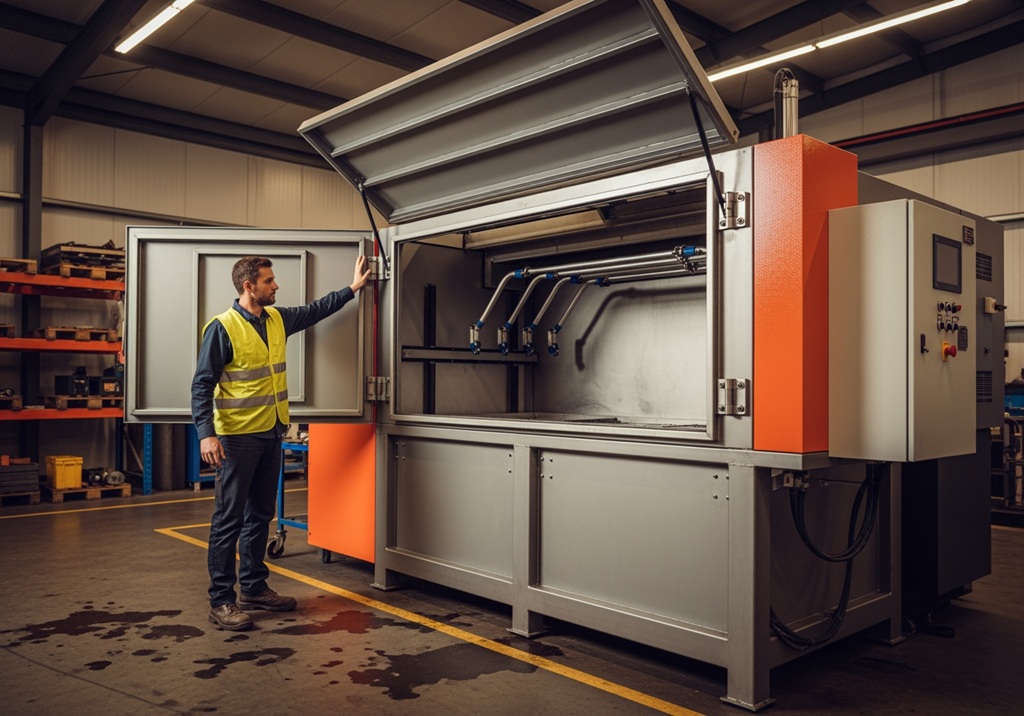
Industrial workshop cleaning equipment takes punishment that lighter-duty systems cannot handle. Components weighing hundreds of kilograms loaded and unloaded daily. Contamination levels that include abrasive particles, extreme grease buildup, and baked-on residues. Operating schedules that run machines for hours on end across multiple shifts. The construction of a heavy duty parts washer determines whether it is still performing reliably at year ten or has been replaced twice by then.
Understanding what mild steel construction means for durability helps workshop managers make informed purchasing decisions – not based on surface appearances, but on the engineering characteristics that determine real-world service life.
Why Material Choice Matters in Heavy Duty Parts Washers
The Industrial Workshop Environment
A heavy duty parts washer in an industrial workshop environment faces stresses that the manufacturer’s showroom floor never will. Forklift-loaded components dropped into the chamber. Thermal cycling from cold startup to operating temperature and back, repeated hundreds of times per year. Exposure to concentrated cleaning chemistry. Vibration from pumps, spray arms, and nearby machinery. Floor-level impacts from trolleys and equipment.
Industrial workshop equipment that survives this environment does so because of construction decisions made before the machine left the factory. Material choice, plate thickness, weld quality, coating application, and drainage design all contribute to how the machine performs after years of this treatment, not just on the day it arrives.
Why This Decision Has Long-Term Consequences
A heavy duty parts washer is not a consumable item. It is a long-service-life capital investment that should remain in productive operation for a decade or more. The price difference between a well-built and a poorly-built system becomes insignificant when spread across ten years of operation. But a machine that fails at year three or four, or requires repeated expensive repairs, turns a seemingly good purchase into a poor one.
Construction quality is difficult to assess from a brochure or a quoted specification. The practical indicators are material thickness, fabrication standards, coating application quality, and the manufacturer’s track record in the applications your workshop runs.
Why Mild Steel Dominates Heavy Duty Parts Washer Construction
Structural Strength Under Load
Mild steel provides the tensile strength and impact resistance that industrial workshop cleaning demands. A heavy duty parts washer built from adequate-gauge mild steel plate handles the repeated loading of heavy components, the impact of parts being positioned on the basket, and the mechanical stresses of continuous pump and spray arm operation without structural deformation.
This structural integrity matters more than surface corrosion resistance in the majority of industrial applications. A machine that maintains its shape, keeps its door seals aligned, and holds its spray arm geometry in place year after year delivers consistent cleaning performance. Structural compromise – frame deflection, door warping, spray arm misalignment – creates cleaning problems that no amount of detergent or cycle time can compensate for.
Cost Effectiveness at Industrial Scale
The cost difference between mild steel and stainless steel construction is meaningful at industrial scale. For applications without food-grade hygiene requirements, that difference can fund a larger chamber size, a higher-specification pump system, or additional equipment capacity that directly improves workshop productivity. A large parts washer in mild steel construction can provide greater chamber capacity for the same budget as a smaller stainless steel unit.
This is why mild steel dominates industrial workshop equipment across mining, manufacturing, transport, and earthmoving applications. These sectors need robust, high-capacity cleaning systems. They do not need food-grade hygiene standards. Choosing mild steel where it is appropriate allows the budget to go toward capacity and performance rather than material specifications the application does not require.
What Mild Steel Parts Washer Construction Actually Involves
A mild steel parts washer is not simply a steel box with a pump. Quality construction involves plate selection appropriate to the application, full-penetration welding at all joints, ground and finished seams that eliminate crevices where moisture collects, strategic reinforcement to prevent flexing under load, and drainage design that prevents water pooling after cycles complete.
The difference between quality and poor fabrication in mild steel construction shows in these details. Seam welds versus full-penetration welds. Reinforced corners versus bare plate joints. Sloped drainage channels versus flat surfaces where solution sits. These fabrication choices determine service life more than the material itself.
Powder Coating: How It Protects Mild Steel in Wet Environments
How Powder Coating Works
The powder coating process that protects mild steel parts washers involves multiple stages. Surface preparation removes manufacturing oils and creates a chemically clean substrate. An iron phosphate conversion coating bonds to the steel surface and provides its own layer of corrosion resistance. Electrostatic powder application deposits coating material uniformly across all surfaces. High-temperature curing cross-links the powder into a continuous, tough film.
A properly applied powder coated parts washer coating creates a barrier between the mild steel substrate and the wet, chemical-laden environment inside the wash chamber. The coating’s effectiveness depends on thickness, coverage completeness, and cure quality – all of which reflect the manufacturer’s investment in the coating process.
Powder Coated Parts Washer Durability in Practice
Powder coating handles the thermal cycling that parts washers undergo through operating life. Repeated heating and cooling stresses the bond between coating and substrate. Well-applied coating on properly prepared steel maintains this bond through thousands of thermal cycles. Coating applied over inadequately prepared steel, or at insufficient thickness, separates from the substrate as thermal cycling continues.
Chemical resistance in industrial-grade powder coatings withstands the alkaline detergents used in biodegradable parts washing chemistry. The coating does not degrade from normal cleaning chemistry contact, provided concentration is kept within the detergent manufacturer’s specifications. Operating outside those specifications – with excessively concentrated solution – can affect coating integrity over time.
Maintaining Coating Integrity for Long Service Life
Coating inspection at regular intervals catches damage before rust becomes structural. The areas that need attention are the points of highest mechanical contact: tank floor where baskets rest and components are positioned, door seals and frame where repeated opening creates wear, and spray arm mounting points where hardware contacts the chamber wall.
Small coating damage caught early requires minimal intervention – cleaning, light preparation, and touch-up with appropriate two-part coating material. Damage left unaddressed allows moisture and chemistry to reach the steel substrate, initiating rust that undercuts surrounding coating and spreads. The maintenance cost difference between early and late intervention is significant.
Durability in Industrial Workshop Conditions
Heavy Duty Spray Cleaning Demands on Construction
Heavy duty spray cleaning places continuous mechanical and thermal demands on the machine structure. Pump operation creates vibration transmitted through the machine frame. Rotating spray arms exert forces on their mounting points. Thermal expansion and contraction occur with every cycle. The accumulated effect of these stresses over years of operation reveals the quality of the original construction.
Mild steel construction handles these demands when the fabrication quality is adequate. The ductility of mild steel allows slight flexing without cracking – an advantage over more brittle materials under dynamic loading. Welded joints in properly fabricated systems have strength equal to or exceeding the base material, preventing joint failure under cyclic stress.
Fabrication Quality as the Determining Factor
Two heavy duty parts washers built from identical mild steel plate can have service lives that differ by years, depending on fabrication quality. Full-penetration welds create continuous metal structure. Partial welds leave gaps where moisture accumulates and corrosion initiates. Ground and finished edges prevent the early coating failure at cut edges that starts the rust process in poorly finished systems.
Drainage design prevents the water pooling that exploits coating imperfections. A tank bottom with proper slope and adequately sized drain ports sheds solution completely after each cycle. Standing solution finds coating imperfections and initiates rust from the inside. This detail of fabrication design costs nothing in material but significantly affects coating longevity in daily use. For operations that also need surface preparation or rust removal, wet abrasive blasters complement heavy duty spray systems by addressing what spray washing alone cannot.
Operating Environment and Its Effect on Longevity
The operating environment modifies how long coating protection lasts in practice. Indoor workshops with stable humidity and temperature present minimal corrosion challenge to well-coated mild steel. Coastal workshops with salt air, or particularly humid environments, accelerate coating degradation and require more frequent inspection and maintenance attention.
Stainless steel parts washers are the appropriate choice for environments where salt air, persistent moisture, or regulatory requirements make mild steel’s coating dependency a liability. For inland, controlled-environment industrial workshops, mild steel with quality coating delivers the necessary durability at better cost.
Large Parts Washer Capacity: Matching Chamber Size to Components
Why Chamber Dimensions Drive System Selection
A large parts washer serves operations where component size exceeds what standard-capacity systems can accommodate. Chamber length, width, and depth are the relevant specifications – not just total volume. A system with adequate volume but insufficient chamber length cannot accommodate long shafts or extended housings regardless of how much solution it holds.
The largest component you regularly clean sets the minimum chamber requirement. Everything above that minimum is additional capacity that improves throughput but adds to running costs. Right-sizing means finding the chamber dimensions that accommodate your largest regular components with the clearance needed for proper spray coverage, at the throughput level your daily volume requires.
Industrial Workshop Equipment: Which Capacity Tier Fits Which Application
The Hotwash range covers distinct capacity tiers matched to different workshop scales. Heavy duty parts washers suit workshops with consistent cleaning demands across standard automotive and industrial component sizes. Extra heavy duty parts washers suit operations cleaning larger components more frequently – heavy vehicle, earthmoving, and mid-scale mining maintenance. Super heavy duty parts washers provide maximum capacity for major mining and industrial operations with the largest components and highest cleaning volumes. For workshops with lower cleaning volumes, manual parts washers provide professional-grade cleaning capability matched to lower throughput requirements.
Each tier uses construction appropriate to its application. Heavier gauge construction, higher-specification pumps, and greater heating capacity in the larger tiers reflect the greater demands those applications place on the equipment.
Mild Steel vs Stainless Steel Construction
Where Mild Steel Parts Washer Construction Delivers Best Value
Mild steel construction delivers best value in the industrial workshop applications that represent the majority of Australian parts washing use. Mining, earthmoving, manufacturing, transport, and general industrial workshops all operate under conditions where mild steel’s structural strength, impact resistance, and cost effectiveness make it the appropriate choice.
Hotwash Australia builds its heavy duty, extra heavy duty, and super heavy duty systems with mild steel construction appropriate to these demanding applications. Trusted by operations including BHP, Rio Tinto, and Fortescue Metals Group, these systems perform under the operational conditions that Australian industrial workshops present. With over 40 years of experience and more than 1,200 automatic parts washers deployed nationally, the evidence for mild steel’s suitability in these applications is extensive.
Where Stainless Steel Is the Right Choice
Stainless steel construction is necessary where corrosion resistance must be inherent in the material rather than applied as a coating. Food processing, pharmaceutical manufacturing, marine workshops in coastal environments, and hygiene-critical applications need a material that does not rely on coating integrity for corrosion protection.
Hot tanks and other specialised systems may also use stainless steel components in contact with aggressive chemistry, even in applications where the overall machine is mild steel construction. The choice is application-specific rather than a universal preference for one material over another.
Choosing the Right Heavy Duty Parts Washer for Your Workshop
Key Factors in the Selection Decision
The material and capacity decision follows from honest assessment of your application requirements, operating environment, maintenance capability, and budget. Workshops without food-grade requirements operating in stable indoor environments get better value from mild steel construction with adequate capacity than from stainless steel at smaller capacity for the same budget.
Industrial workshop equipment selection should also account for maintenance capability. Mild steel systems require periodic coating inspection and touch-up. Workshops with maintenance staff who perform routine equipment care will keep mild steel systems running for extended service lives. The right system is one matched to both your cleaning requirements and your operational capability.
Getting Specialist Advice
Matching construction type and capacity to your specific workshop requires understanding your application in detail. Hotwash supplies heavy duty cleaning systems across Australia and provides specialist advice based on actual workshop requirements rather than generic recommendations.
For advice on the right heavy duty parts washer for your workshop, speak with our industrial equipment specialists or email us at sales@hotwash.com.au.

Leave A Comment