
Workshop technicians spend a significant portion of their working day on parts cleaning. Every hour spent scrubbing engine components, gearbox housings, or brake assemblies is an hour not spent on diagnosis, fitting, or the repair work that drives workshop revenue.
The right automotive parts washer reduces that cleaning time without sacrificing thoroughness. But the wrong system – one that is either too small for your volume or mismatched to your contamination type – creates new problems rather than solving old ones. This guide explains which parts washer machine types suit which workshop operation and how to match the system to your actual requirements.
The Mechanical Workshop Cleaning Challenge
What Manual Cleaning Costs Australian Workshops
Mechanical workshop cleaning is a necessary function, but it should not occupy skilled technicians. Hotwash states on their website that their automatic machines can complete what takes a tradesperson or apprentice four hours of manual work in just 15 minutes. That gap in time represents the productivity recovery that the right automotive parts washer delivers.
The challenge is that not every workshop has the same cleaning requirements. A small suburban automotive workshop cleaning passenger car components weekly has different needs from a FIFO mining service operation handling excavator hydraulics. The parts washer that works perfectly in one setting performs poorly in another. Understanding your own requirements is the essential first step.
Parts Washer Machine Types: The Core Options
Australian mechanical workshops have three main parts washer machine types to choose from: manual washers for lower-volume professional applications, automatic spray washers for the majority of workshop cleaning tasks, and hot tanks for components that need immersion cleaning. Each type suits a specific range of cleaning requirements.
Hotwash Australia supplies all three types, along with specialist systems for surface preparation. With over 40 years of experience and more than 1,200 automatic parts washers deployed nationally, the range covers the full spectrum of Australian automotive and industrial cleaning needs. Understanding which type fits your operation prevents both over-specifying expensive capacity you will never use and under-specifying equipment that cannot keep pace with your workload.
Manual Parts Washers for Smaller Automotive Operations
How Manual Systems Work
A manual parts washer uses a pump to circulate cleaning solution from the tank through a hand-operated brush or hose. The operator directs solution onto the component surface whilst scrubbing. A perforated work surface allows dirty solution to drain back into the tank for recirculation.
Hotwash’s manual range includes cold solvent models in the SW1000-HD series and hot manual washers in the SS1200 and SS850 models. These are designed for professional workshop use, not domestic applications. The range provides a proper mechanical workshop cleaning capability for operations where full automation is not yet justified.
The pump-and-brush design means the operator controls where cleaning effort goes. For components that need targeted cleaning in specific areas, or where operator judgement about contamination distribution makes sense, manual systems provide control that automated cycles do not offer.
When Manual Washers Suit Mechanical Workshop Cleaning
Manual parts washers suit lower-volume applications where the variety and infrequency of cleaning tasks makes an automated cycle less practical than operator-directed cleaning. A workshop that cleans a small number of varied parts each week, or one that frequently needs to clean specific areas of a component rather than the whole piece, may find a manual system delivers exactly the right level of control.
Field unit variants in the Hotwash manual range are designed for site use – portable enough to take to the work rather than requiring components to be transported to a fixed washer. This makes manual parts washer options useful for mobile mechanical operations and site-based maintenance work.
Limitations of Manual Systems as Volume Grows
Manual systems become less appropriate as workshop cleaning volume increases. When a technician consistently spends two or more hours per day at the manual washer, the case for an automated spray washer becomes clear. The manual system works when cleaning is an occasional task. When it becomes a daily bottleneck, automation provides a better return.
Results from manual cleaning also depend on operator effort and consistency. An automated spray washer delivers the same result every cycle regardless of who loaded it or how rushed the shift is. This consistency matters for workshop degreasing equipment used in engine rebuild work where cleaning quality directly affects the quality of the finished job. Components that look clean to a tired technician at end of shift may not meet the standard that an automated cycle delivers every time.
Automatic Spray Washers for Automotive Workshops
How a Spray Washer for Workshops Operates
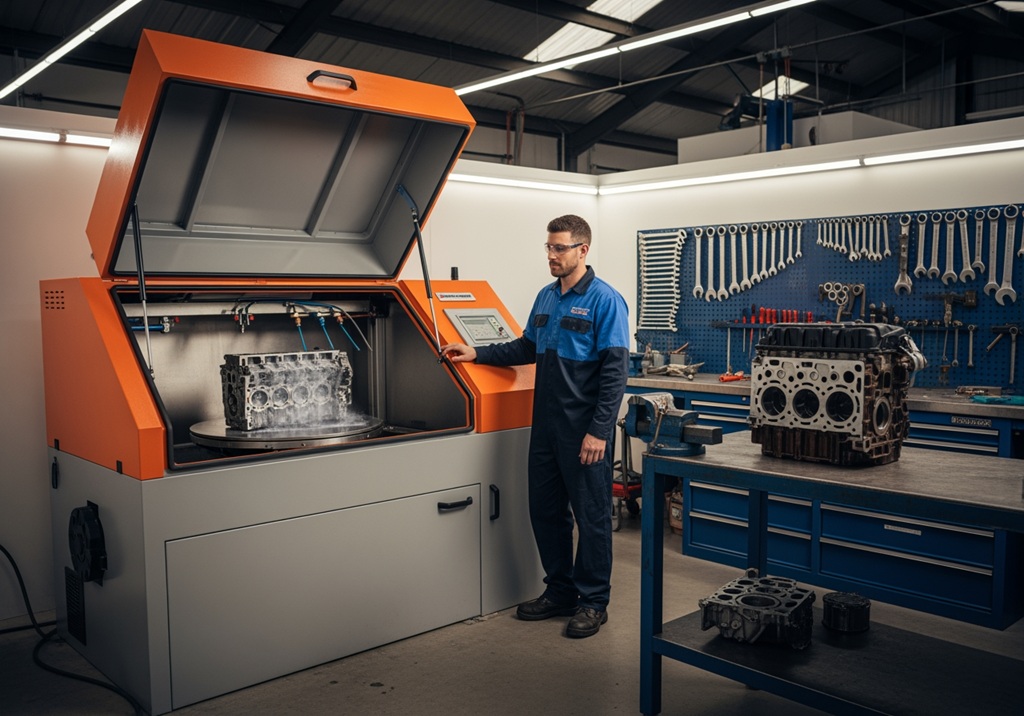
An automatic spray washer for workshops uses heated water and biodegradable detergent delivered through rotating spray arms inside an enclosed chamber. Components sit on a turntable and rotate slowly during the cycle. The spray arms rotate simultaneously, ensuring every external surface receives direct spray coverage.
The operational sequence is straightforward: load the component, close the door, start the cycle. The machine runs unattended while your technician moves to other work. When the cycle finishes, the component is clean and ready for inspection or reassembly. The enclosed chamber contains all spray and vapour, keeping the workshop floor dry and reducing chemical exposure for the operator.
This unattended operation is the fundamental productivity advantage of a spray washer for workshops. Cleaning and repair work happen in parallel across the shift rather than sequentially. The machine processes parts while the team works on vehicles, and the cycle completes in the time it takes for another task to advance.
Heavy Duty Automatic Systems for Regular Automotive Work
Heavy duty parts washers suit automotive workshops with consistent daily cleaning demands. Engine blocks, cylinder heads, transmission cases, differential housings, and brake assemblies all fall within the capacity range of heavy duty automatic systems. These machines handle the components that form the majority of automotive workshop cleaning volume.
Australian mechanical workshops face varied contamination types. Red dust from regional and mining service work bonds with oil to create stubborn combined contamination. Coastal workshops handle marine grease and salt residue. Agricultural mechanics deal with mud, crop residue, and varied lubricants. The combination of hot water, detergent chemistry, and rotating spray pressure in a heavy duty automotive parts washer handles all of these effectively.
For workshops with larger components or higher volumes, extra heavy duty parts washers provide additional chamber size and throughput capacity. For the largest industrial components from earthmoving or mining equipment, super heavy duty parts washers represent maximum automatic spray cleaning capacity.
Stainless Steel Spray Washers for Specific Applications
Stainless steel parts washers suit applications where corrosion resistance and hygiene are requirements rather than preferences. Marine workshops in coastal locations benefit from stainless steel construction that withstands the salt air and humidity that accelerate corrosion in standard steel systems. Workshops servicing food transport vehicles or refrigeration equipment may need stainless steel construction to meet hygiene requirements.
The Hotwash stainless steel range includes the SS1600 with a pneumatic sliding door – a design that reduces contamination points compared to hinged door systems. The range spans multiple capacities with a gear-driven turntable and multiple spray bars as standard features. For the right application, stainless steel construction provides long service life without the coating maintenance that mild steel systems require.
Hot Tanks for Heavy Contamination
When an Automotive Parts Washer Needs Immersion Cleaning
Spray washing handles surface contamination on external surfaces very effectively. What it cannot do is clean inside oil galleries, coolant passages, and complex internal cavities where spray jets cannot reach. For engine components where internal passage cleanliness directly affects rebuilt engine performance, a car parts washer Australia operation that relies solely on spray washing may deliver inadequate results on the hardest cleaning tasks.
Hot tanks use heated alkaline cleaning solution to submerge components fully. The part soaks in the solution while chemistry works from all directions simultaneously – including inside every passage and recess the solution can reach. Carbon deposits that resist spray washing dissolve under sustained chemical immersion. Coolant scale in cylinder head passages clears when flooded with heated cleaning solution.
Immersion cleaning suits any component where thoroughness inside the part matters as much as cleanliness on the outside. This includes all engine rebuild components with internal oil passages, coolant channels, and bearing drillings that must be free of contamination before assembly.
Workshop Degreasing Equipment: Hot Tank Applications in Automotive Workshops
The primary hot tank applications in automotive workshop degreasing equipment involve engine rebuild components. Cylinder heads with carbon deposits in valve ports, engine blocks with oil gallery contamination, and pistons with ring groove buildup all benefit from hot tank immersion rather than spray washing alone.
Many engine rebuild workshops use both systems in sequence: hot tank soaking as the primary cleaning stage for heavily contaminated engine components, followed by a spray wash cycle for the final rinse. This combination delivers results that neither method achieves as effectively on its own. The hot tank does the heavy chemical work on carbon and internal deposits; the spray washer removes loosened contamination and alkaline residue.
This sequenced approach also suits workshops where a proportion of the cleaning volume needs immersion and the rest does not. Routine parts – brake assemblies, diff housings, transmission cases – go to the spray washer. Engine rebuild components go to the hot tank first. Each system handles what it does best, and the workshop avoids running the slower hot tank cycle on components that the spray washer cleans perfectly well.
Choosing the Right Automotive Parts Washer for Your Workshop
Matching System Type to Workshop Volume and Contamination
The right parts washer machine types for your workshop follows from understanding your cleaning volume and contamination type. Lower-volume workshops with varied components can often manage with a professional manual system. Workshops with consistent daily automotive cleaning volume need an automatic spray washer. Operations with heavy carbon contamination or engine rebuild focus benefit from having hot tank capability alongside their spray washer.
The transition points are practical rather than arbitrary. When manual cleaning consistently occupies a significant portion of a technician’s day, automatic spray washing is justified. When spray washing consistently fails to adequately clean specific components due to internal passage or heavy carbon contamination, hot tank capability is needed.
Consider also the consistency requirement. If your workshop has different technicians running cleaning across different shifts, an automated system delivers the same result every cycle regardless of who operates it. Manual systems introduce variability based on operator effort and attention. For workshops where rebuild quality depends on cleaning thoroughness, that consistency advantage is a practical reason to choose automation even at moderate volumes.
Car Parts Washer Australia: Key Questions Before You Buy
Before approaching any supplier, document your actual cleaning requirements. What is the largest component you regularly clean? What contamination types do you encounter most often? How many cleaning cycles do you need each day? How much floor space is available? What electrical supply does your workshop have?
A car parts washer Australia selection based on measured requirements rather than rough estimates produces a better match between the system and the work it needs to do. Undersized equipment creates bottlenecks. Oversized equipment wastes capital and running costs on unused capacity. The right size follows directly from your documented requirements.
For workshops that need surface preparation, rust removal, or coating removal alongside standard parts cleaning, wet abrasive blasters address what spray washers and hot tanks do not handle. A complete workshop cleaning capability covers all the contamination types your operation encounters, not just the most common ones.
Getting the Right Advice
Hotwash supplies automotive parts washers and industrial cleaning systems to workshops across Australia, with over 40 years of experience in industrial cleaning equipment. The national service network covers Perth, Melbourne, Sydney, and Brisbane, and the team has matched cleaning equipment to workshop requirements across every industry and operation size.
For advice on the right automotive parts washer for your Australian workshop, contact our parts cleaning specialists or email us at sales@hotwash.com.au.

Leave A Comment