
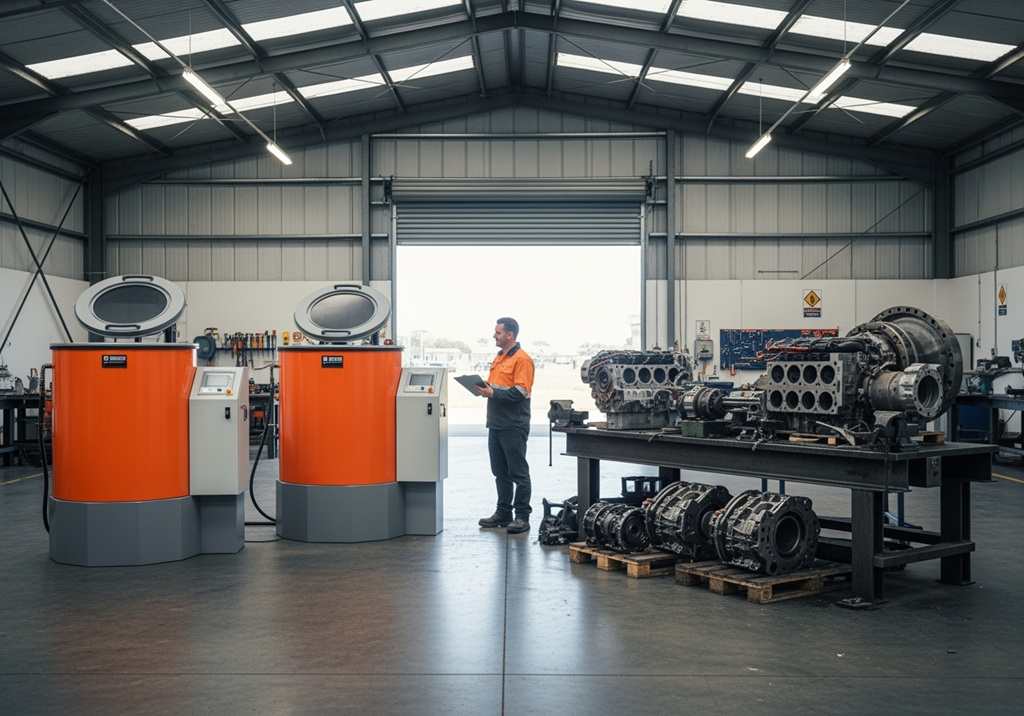
Buying a parts washer that is too small for your workload means backlogs, overtime, and technicians waiting for cleaning to finish before repairs can continue. Buying one that is too large means paying to heat, fill, and maintain capacity you never use.
The right size is the one matched to your actual cleaning volume – not the cheapest option that fits the budget, and not the largest machine the floor can accommodate. This guide explains how to calculate your requirements and select the right system from the range of parts washers for workshops that Australian operations need.
Why Size Matching Matters
The Cost of Getting It Wrong in Both Directions
An undersized industrial parts washer creates a bottleneck at the centre of your workshop workflow. Parts sit waiting for cleaning. Technicians cannot progress repairs. Cleaning backlogs build during peak periods and take days to clear. Every hour a technician spends waiting for the machine is an hour not spent on productive work.
An oversized machine wastes capital on purchase price and ongoing running costs. A machine with more capacity than you use heats more solution, consumes more energy to maintain operating temperature, and costs more to fill with cleaning chemistry. Over years of operation, that unnecessary capacity adds up to significant wasted expenditure.
Parts Washers for Workshops: The Starting Point
The right starting point for parts washer machine sizing is measuring what your workshop actually cleans. Not estimating, not approximating – tracking. A two-week measurement period gives you the data needed to make a reliable size decision. Skip this step and you are sizing on gut feel, which is how workshops end up with machines that are slightly wrong in ways that cost them money every working day.
Calculating Your Workshop Cleaning Volume
Tracking What You Actually Clean
For a representative period, record every component that goes through your cleaning process. Note the component type, its dimensions, the contamination level, and how many you clean on a typical day. Also record your busiest days – the peak periods that your system must handle without creating backlogs.
Workshop cleaning volume varies by day and season. A workshop that cleans an average volume daily but spikes during scheduled maintenance periods or fleet overhauls needs to size for those peaks, not the average. A machine that handles the average load comfortably may fall well short when the quarterly shutdown components arrive.
Workshop Cleaning Volume: Contamination Type and Cycle Time
Contamination type affects how long each cleaning cycle needs to run. Light oil and grease from regular maintenance clears faster than heavy carbon buildup or dried mud from earthmoving components. Longer cycle times mean fewer batches per shift, which means your effective daily throughput is lower than a cycle count alone would suggest.
When calculating your workshop cleaning volume requirement, factor contamination severity into the cycle time estimate. A workshop cleaning heavily contaminated components cannot process as many batches per shift as one cleaning lightly soiled parts in the same chamber. Both workshops might have identical chamber sizes but very different daily cleaning capacity.
Understanding Industrial Parts Washer Capacity
Chamber Volume vs Effective Cleaning Capacity
The stated volume of an industrial parts washer chamber is not the same as its effective cleaning capacity. Baskets and loading fixtures occupy space. Components displace solution when submerged. Adequate clearance around each component is needed for spray coverage. The practical cleaning space is meaningfully less than the nominal chamber volume.
This gap matters when comparing systems. A machine that nominally holds a given volume may only effectively clean a proportion of that volume per cycle once you account for proper component spacing and clearance. Sizing based purely on nominal volume without accounting for this gap leads to disappointment when the machine arrives and holds fewer components per cycle than expected.
Parts Washer Throughput vs Chamber Capacity
Parts washer throughput is the more useful measure than chamber volume alone. Throughput tells you how much you can clean in a working day, not just in a single cycle. It depends on cycle time, loading and unloading time, and the number of batches your operation can realistically run in a shift.
A larger chamber that runs the same cycle time as a smaller one produces more throughput per shift – but only if you have enough components to fill it. If your daily volume does not fill a large chamber, you are heating and cycling more space than you need. Parts washer throughput planning means matching chamber size and cycle frequency to your actual daily volume.
Parts Washer Machine Sizing: Capacity Tiers
Automatic Parts Washers by Tier
Parts washer machine sizing across the Hotwash range covers distinct capacity tiers, each matched to a different scale of workshop operation and component size.
Heavy duty parts washers suit workshops with consistent, high-volume cleaning demands – engine blocks, transmissions, and standard industrial components. Automotive workshops, diesel repair facilities, and light industrial operations typically fall into this category. These systems run efficiently in single-shift operations with regular cleaning volumes.
Extra heavy duty parts washers accommodate larger components and higher volumes. Heavy vehicle repair workshops, earthmoving maintenance facilities, and industrial operations cleaning large fabricated components regularly need the additional capacity and chamber dimensions this tier provides.
Super heavy duty parts washers represent the maximum capacity tier for major mining operations, oil and gas facilities, and other large-scale industrial applications. These industrial parts washer systems handle the largest components and the most demanding cleaning volumes that parts washers for workshops are called upon to manage.
Stainless steel parts washers address applications where corrosion-resistant construction is a requirement – food processing, marine, and coastal industrial environments where standard steel construction would not provide adequate service life.
Manual Parts Washers for Lower-Volume Applications
Not every workshop needs an automatic industrial parts washer. Manual parts washers from Hotwash are designed for professional workshop use – not domestic applications – and suit operations where cleaning volume does not justify full automation.
The Hotwash manual range includes cold solvent models and hot manual washers. These systems give workshops professional-grade cleaning capability at a scale that matches lower-volume requirements. As workshop cleaning volume grows, the transition from manual to automatic becomes justified by the labour savings automation delivers.
Cleaning Capacity Planning for Growth
Sizing for Peak Demand, Not Average Load
Cleaning capacity planning must account for peak demand, not just the daily average. Scheduled maintenance shutdowns, fleet overhauls, seasonal work peaks, and unexpected large jobs all create cleaning demand that exceeds normal volume. A system sized only for average load will fail at these critical periods.
Review your tracking data for your highest-volume days and periods. Size your system to handle these peaks without backlog or overtime. The capacity needed to manage peak demand comfortably is the minimum viable size for your operation. Hotwash Australia helps workshops work through this calculation based on their actual measured volumes.
Building In a Realistic Growth Buffer
Beyond peak demand, cleaning capacity planning should include a moderate growth allowance. Equipment you purchase today will serve your workshop for many years. Building in some headroom above your current peak demand accommodates growth without requiring early equipment replacement.
Base growth projections on actual historical volume trends. A workshop that has grown steadily over several years has a reasonable basis for projecting continued growth. One that has been static has less justification for large speculative headroom. A practical buffer – enough to accommodate moderate growth without paying for capacity that may never be used – is the sensible middle ground.
Matching Parts Washers for Workshops to Industry Type
Automotive and Diesel Repair Workshops
Automotive and diesel repair workshops typically clean engine components, transmission cases, differential housings, and brake assemblies on a regular basis. Parts washers for workshops in this sector need to handle the component sizes common to passenger vehicle and light commercial work through to heavy diesel engines.
Single-bay workshops with lower cleaning volumes may manage with a professional manual system or a smaller automatic unit. Multi-bay operations with consistent daily cleaning volumes need a heavy duty automatic system that can run multiple cycles per day without creating backlogs. The dividing line is daily cleaning volume – measure it before choosing.
Mining, Earthmoving, and Heavy Industrial
Mining and earthmoving maintenance operations deal with an industrial parts washer workload that differs from automotive workshops in both scale and contamination level. Components are larger, heavier, and arrive with more extreme contamination. Mining operations often run continuous or multi-shift maintenance programmes that demand high cleaning throughput.
Super heavy duty systems suit the largest mining operations cleaning haul truck components, excavator parts, and large structural assemblies. Extra heavy duty systems suit earthmoving repair workshops and mid-scale mining maintenance operations. The component dimensions and daily volume of your specific operation determine where you sit within this range.
Manufacturing, Food, and Marine Applications
Some workshop types have application-specific requirements beyond size and contamination level. Food processing facilities need stainless steel construction and food-safe cleaning chemistry. Marine workshops in coastal locations benefit from corrosion-resistant construction. Manufacturing facilities cleaning precision-machined components need appropriate spray pressure and cycle control.
Hot tanks and wet abrasive blasters complement spray washing systems in workshops that handle specialised cleaning tasks alongside standard degreasing. Cleaning capacity planning for these workshops covers the full equipment combination, not just the spray washer in isolation.
The Hidden Cost of Undersized Equipment
What Happens When the Machine Cannot Keep Up
When parts washers for workshops cannot keep pace with cleaning demand, the impact spreads beyond the cleaning station. Technicians wait for parts to come through the washer before assembly can proceed. Jobs that should complete in a day extend into a second day. Scheduling becomes difficult because cleaning time is an unpredictable variable rather than a known constant.
These downstream impacts often cost more in total than the price difference between an adequately sized and an undersized system. The machine that seemed like a sensible saving becomes an ongoing productivity liability that the workshop absorbs every working day.
Calculating Whether Your Current System Is Undersized
If your current system runs for most of the working day without catching up, you have likely outgrown it. Other indicators: backlogs developing during busy periods, technicians regularly waiting for cleaning to finish, and re-washes required because parts need to run again to finish cleaning. Any of these signals warrants reassessing your current equipment against your current volume.
The transition from a smaller system to a larger industrial parts washer is justified when the productivity impact of the current arrangement is visible and measurable. Tracking cycle count, backlog frequency, and technician waiting time for a representative period gives you the data to make that case clearly.
Choosing the Right System for Your Workshop
Key Questions Before You Choose
Parts washer machine sizing follows from answering these questions with measured data: What is the largest component you regularly clean? What is your daily cleaning volume? What contamination levels do you typically handle? What are your peak demand periods? How much floor space is available? What electrical supply do you have?
With these questions answered, the right tier and configuration become clear. The choice is not arbitrary – it follows logically from your actual requirements. A workshop that has done the measurement work before approaching a supplier arrives at the conversation with the data needed to get a well-matched recommendation rather than a generic one.
Getting the Right Advice
With over 40 years of experience and more than 1,200 automatic parts washers deployed across Australia, Hotwash has matched parts washers to workshop requirements across every industry and operation size. Specialist advice based on your measured requirements is the most reliable path to the right equipment decision. The national service network across Perth, Melbourne, Sydney, and Brisbane means that qualified support is accessible wherever your operation is located.
For guidance on matching parts washer capacity to your workshop’s daily cleaning volume, contact our equipment sizing specialists or email us at sales@hotwash.com.au.

Leave A Comment