
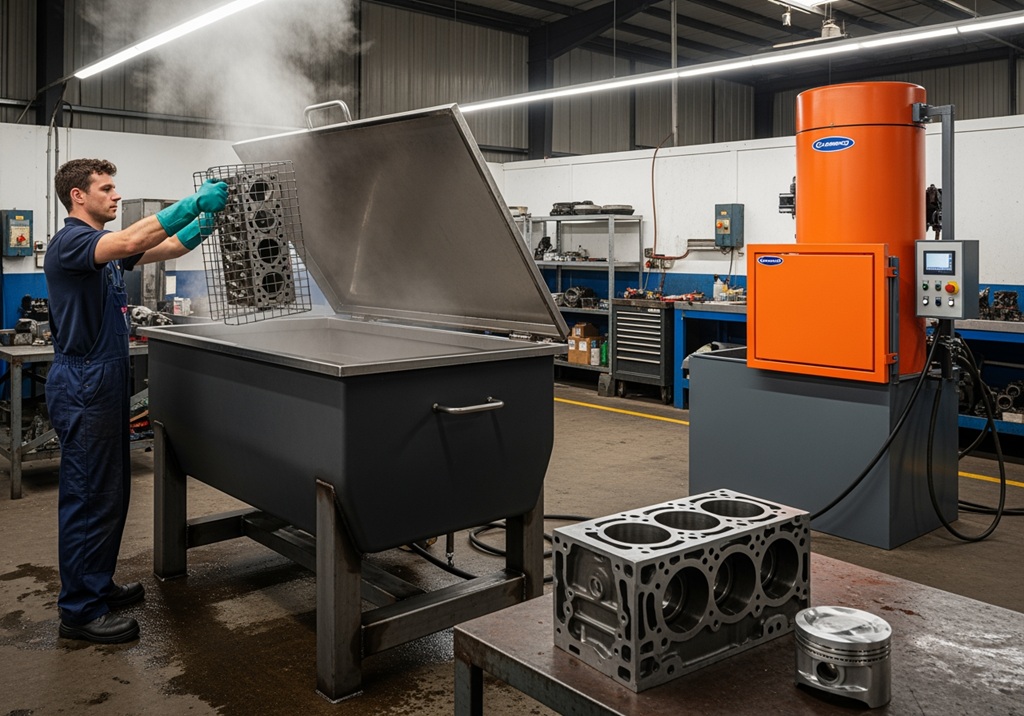
Not every dirty part needs the same cleaning method. Most workshop components – gearbox housings, differential cases, wheel hubs – clean effectively in a spray washer. They come out free of oil and grease, ready for inspection and reassembly.
Engine components are different. Cylinder heads with exhaust ports packed with carbon, engine blocks with oil galleries coated in baked-on residue, pistons with ring grooves full of hardened deposits – these parts have contamination that spray washing alone cannot fully address. For these components, engine component soaking in a hot tank is the method that actually works.
How Carbon Deposits Form on Engine Components
Why Carbon Builds Up Inside Engines
Carbon buildup is the result of incomplete combustion. Not all fuel burns cleanly during each combustion cycle. The residue from this process contacts metal surfaces at high operating temperatures and bakes on. Over thousands of hours of operation, layer builds upon layer until deposits measure in millimetres rather than microns.
Unlike grease or oil that sits on a metal surface, carbon bonds with the metal over time. The longer an engine runs between rebuilds, and the harder it operates, the more severe this bonding becomes. Mining and earthmoving engines that run under continuous load accumulate carbon faster than vehicles in lighter service.
What Makes Carbon Deposits Different From Standard Grease
Grease and oil are organic compounds that emulsify readily in heated detergent solution. They dissolve into the cleaning water and rinse away. Carbon deposits do not behave the same way. They have been chemically altered by prolonged heat exposure and resist the mechanical action of spray washing.
This is why hot tank carbon removal requires a different approach from standard spray washing. The chemistry used in hot tank systems, combined with sustained immersion at elevated temperature, attacks the molecular bonds holding carbon to the metal surface. Force alone does not remove it effectively.
Why Spray Washing Has Limitations With Heavy Carbon
How Spray Washers Clean
Spray washers clean through the combined action of heated water, detergent, and mechanical pressure. Rotating spray arms direct water jets at components from multiple angles. This method removes surface oil, grease, mud, and loosely adhered contamination very effectively. For the majority of workshop parts cleaning, a spray washer is the right tool.
Parts washers in the heavy duty and super heavy duty range handle high-volume spray cleaning for large industrial components across mining, transport, and manufacturing applications. They are well matched to these standard contamination types.
Spray Washing Limitations and Internal Passages
Spray washing limitations become apparent when components have internal passages and hardened contamination. Spray jets hit the surfaces they can reach. Oil galleries inside engine blocks run through the casting in directions that spray nozzles cannot access directly. Coolant passages in cylinder heads follow complex internal paths. Blind holes and recessed surfaces in valve bodies receive little or no spray coverage.
Even where spray does reach, the contact time is brief – a rotating spray arm passes each surface area for a fraction of a second. Hardened carbon does not respond to brief mechanical contact. It requires sustained chemical exposure. This is where spray washing limitations make hot tank soaking the more appropriate method.
How Hot Tank Carbon Removal Works
Heat and Chemistry for Engine Cleaning
Hot tank carbon removal works by combining elevated temperature with alkaline cleaning chemistry in a sustained immersion environment. The heated alkaline solution becomes more chemically active as temperature increases, attacking the molecular bonds in carbon deposits more aggressively than cold or room-temperature chemistry would.
Hot tanks maintain consistent operating temperature throughout the cleaning cycle. This sustained temperature is important because the cleaning reaction needs to remain active for the full duration of the soak. A tank that drops temperature significantly when a cold component is loaded will clean more slowly and less thoroughly.
Why Immersion Reaches Where Spray Cannot
Engine component soaking works regardless of component geometry because the heated solution surrounds the part completely. Oil galleries fill with solution. Coolant passages flood from both ends simultaneously. Threaded bores, valve guide bores, and recessed combustion chamber surfaces all receive the same chemical exposure as the exterior of the component.
There is no spray shadow, no missed passage, and no surface that is sheltered from the cleaning chemistry. For engine components where internal cleanliness directly affects rebuilt engine performance, this complete coverage is the defining advantage of hot tank immersion over spray washing.
Which Engine Components Benefit Most From Hot Tank Soaking
Cylinder Head Hot Tank Cleaning
Cylinder head hot tank cleaning is one of the most common applications for engine workshop hot tanks. Cylinder heads accumulate carbon in combustion chambers and exhaust ports, scale in coolant passages, and varnish deposits in oil return passages. These are areas that spray washing reaches only partially.
Submerging a cylinder head in the hot tank allows the heated solution to penetrate combustion chamber carbon deposits, flood coolant passages and dissolve mineral scale, and clean around valve seats and valve guides. After a full engine component soaking cycle, passages that appeared blocked by scale clear effectively without mechanical scrubbing.
Engine Blocks and Internal Gallery Cleaning
Engine block oil galleries distribute oil throughout the engine to bearings, camshafts, and valve train components. In an engine that has accumulated significant mileage or operating hours, these galleries can carry deposits that restrict oil flow. A rebuilt engine with restricted galleries will suffer oil starvation at critical lubrication points.
Spray washing may clean the exterior of an engine block effectively but cannot adequately address contamination inside the gallery network. Engine component soaking exposes every gallery to cleaning solution simultaneously. Hot tank carbon removal dissolves deposits from gallery walls throughout the entire network, not just at accessible entry and exit points.
Heavy duty parts washers handle the subsequent spray rinse step effectively, removing loosened contamination from galleries after the hot tank soak has done the primary chemical work.
Pistons, Crankshafts, and Turbocharger Housings
Pistons accumulate carbon on their crowns and in the ring grooves that hold piston rings. Ring groove carbon affects ring movement and sealing performance in a rebuilt engine. Engine rebuild parts cleaning for pistons often requires hot tank soaking to clear ring groove deposits that manual scrubbing and spray washing leave behind.
Crankshafts with cross-drilled oil passages benefit from hot tank immersion for the same reason as engine blocks. These internal oil drillings feed lubricant to main and rod bearing surfaces. Contamination in these passages poses a direct risk to bearing longevity in a rebuilt engine.
Turbocharger housings, particularly on the exhaust side, accumulate carbon that resists spray washing. The complex internal geometry and baked-on deposits make these components well suited to hot tank soaking as the primary cleaning method.
Engine Parts Soak Time and Cycle Planning
How Contamination Level Affects Soak Duration
Engine parts soak time varies with the severity of contamination. Lightly contaminated components – those from engines with regular service history and moderate operating hours – need less time than components from engines that have accumulated heavy carbon over extended periods.
The condition of your solution also affects engine parts soak time. A fresh, correctly concentrated solution at the right operating temperature cleans faster than a depleted or contaminated solution. Maintaining your hot tank solution in good condition is a practical way to keep cycle times consistent and cleaning quality high.
The type of component also influences how long a soak needs to run. Components with deep internal passages – engine blocks and cylinder heads – need more time than components with simpler geometry. The solution needs time to penetrate fully into internal features and maintain chemical contact long enough to dissolve deposits from gallery walls and passage surfaces.
Planning Your Workshop’s Hot Tank Schedule
Integrating a hot tank into an engine rebuild workflow requires planning around the soak cycle. Unlike spray washing, where the cycle runs and components come out ready for the next step, hot tank soaking involves loading components and returning when the soak is complete. For a workshop running multiple rebuilds simultaneously, a hot tank allows components from several jobs to soak together.
This batching approach makes hot tank soaking efficient. Load components from multiple jobs, set the timer, and move on to other tasks. Return when the cycle is complete, unload, rinse, and move the parts through. Hotwash Australia hot tanks are designed for the durability and operational reliability that workshop use demands across multiple daily cycles.
Why Proper Cleaning Matters for Engine Rebuilds
Clean Components and Rebuild Quality
Engine rebuild parts cleaning is not a routine step – it directly determines the quality of the finished rebuild. A rebuilt engine assembled from inadequately cleaned components carries forward contamination that affects performance and longevity from the first operating hours.
Carbon left in combustion chambers affects compression. Oil residue in coolant passages restricts coolant flow and contributes to hot spots. Deposits in oil galleries restrict lubrication at bearing surfaces. Each of these problems originates at the cleaning stage of the rebuild process.
Preventing Premature Failure in Rebuilt Engines
Blocked oil galleries are a leading cause of premature bearing failure in rebuilt engines. The bearing receives insufficient lubrication not because of a mechanical fault introduced during reassembly, but because the gallery was not cleaned thoroughly enough during the rebuild process.
For workshops that stand behind their engine rebuild work, engine rebuild parts cleaning to the standard that hot tank soaking provides is a practical way to reduce the risk of premature failures. Extra heavy duty parts washers and hot tank systems together give rebuilding workshops a complete cleaning capability for even the heaviest contamination.
Combining Hot Tank Soaking and Spray Washing
Using Both Methods in Sequence
The most effective approach for heavily contaminated engine components uses hot tank soaking and spray washing in sequence. The hot tank handles the primary cleaning task – dissolving carbon, clearing galleries, and breaking down baked-on contamination. The spray washer completes the process, rinsing away loosened deposits and alkaline solution residue.
After hot tank soaking, components still carry dissolved contamination and cleaning chemistry. A final spray wash rinse removes this residue and leaves the component ready for inspection, machining, and reassembly. This two-stage approach delivers results that neither method achieves as effectively on its own.
Which Parts Go to the Hot Tank and Which to the Spray Washer
Not all engine components need hot tank soaking. Valve covers, oil pans, timing covers, and other external components that accumulate surface oil and grease clean effectively in a spray washer without the additional immersion step. Reserve the hot tank for components with internal passages or heavy carbon: cylinder heads, engine blocks, pistons, crankshafts, and turbocharger housings. For workshops cleaning large mining or earthmoving engine components, super heavy duty parts washers handle the spray cleaning stage for oversized components that standard washers cannot accommodate.
For surface preparation, rust removal, and stripping old coatings ahead of reassembly, wet abrasive blasters address what neither spray washing nor hot tank soaking handles effectively.
Choosing the Right Equipment for Your Rebuild Workflow
Hot Tank Systems for Engine Rebuilding
A cylinder head hot tank cleaning application requires a tank with adequate chamber depth and length to accommodate cylinder head dimensions and allow proper immersion. Engine blocks require more capacity. The right hot tank for your workshop depends on the largest components you regularly rebuild and the volume of work you process.
Stainless steel parts washers complement hot tank systems by providing the spray washing capability needed for components that do not require immersion and for the final rinse stage after hot tank soaking.
When to Add Spray Washing Capability Alongside a Hot Tank
Engine rebuilding workshops benefit from having both hot tank and spray washing capability available. The two systems serve different stages of the cleaning process and handle different components. A hot tank alone leaves you without an efficient method for standard spray cleaning. A spray washer alone leaves you unable to adequately clean components that need immersion.
For advice on the right combination of cleaning equipment for your engine rebuild workshop, discuss your requirements with our cleaning equipment specialists or email us at sales@hotwash.com.au.

Leave A Comment