
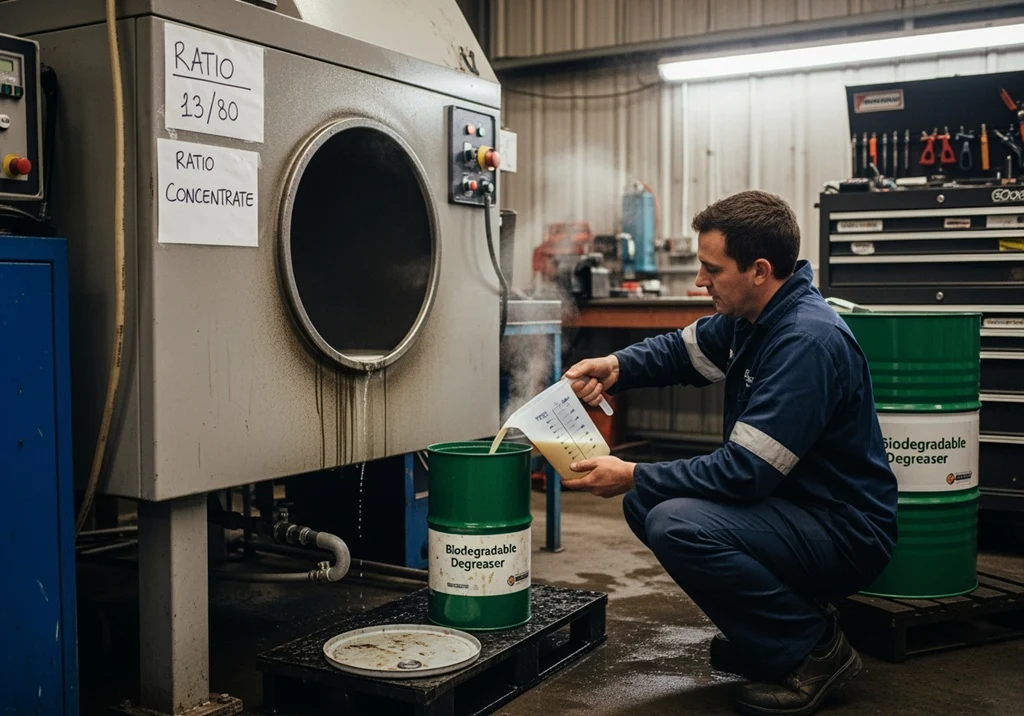
When temperatures drop in your workshop, the industrial degreaser that performed reliably all summer suddenly struggles to cut through grease. Cleaning times blow out. Parts come back with residue still clinging to threads. Mechanics run components through twice. What changed is not your parts washer – it is basic chemistry.
Most workshop degreasers are water-based, and cold water does not dissolve grease as effectively as hot water. When ambient temperatures fall, your chemical concentration needs adjusting to maintain the same cleaning power you had in warmer months. This article explains why cold affects your chemistry, how to calculate the right ratios, and how to manage seasonal changes without disrupting your workshop’s cleaning efficiency.
Why Cold Weather Changes Degreaser Performance
The Three Cold-Weather Chemistry Problems
Cold weather creates three compounding problems for workshop cleaning chemistry that each reduce performance on their own – and combine to cause significantly worse results when they occur together.
The first problem is temperature loss. Your parts washer may heat water to 80°C, but in a cold workshop, that temperature drops quickly. Cold workshop air, cold chamber walls, and cold metal parts all absorb heat from the cleaning solution. By the time hot water reaches a cold engine block or diff housing, it has already lost meaningful cleaning energy. Cold water chemistry performs a fraction of the work that heated solution does at full temperature.
The second problem is chemical viscosity. Most water-based industrial degreasers become thicker in cold conditions. Thicker chemistry does not spray as effectively, does not penetrate grease as well, and does not rinse as cleanly from component surfaces. The result is longer cycle times, uneven coverage, and inconsistent cleaning across the same batch of parts.
The third problem is the contamination itself. Grease, oil, and carbon deposits become more viscous and stubborn at lower temperatures. What washed away easily at 25°C now clings harder at 10°C. Cold weather parts washing means fighting harder contamination with weaker chemistry at lower effective temperatures – all at once.
What This Means for Your Cleaning Results
When all three factors combine, the impact on workshop output is significant. Parts that came out spotless in warmer months now carry grease residue in recesses, blind holes, and threaded connections. Technicians notice the difference quickly – cycle times extend, re-washing becomes routine, and frustration builds as productivity drops through the coldest months of the year.
Understanding the chemistry is the first step to solving it. The fix is not a different parts washer or a different detergent brand. It is adjusting your degreaser concentration ratio to compensate for what cold weather takes away.
How Temperature Affects Degreaser Concentration
Temperature Ranges and Corresponding Ratios
The standard mixing ratio for most workshop degreasers sits between 2% and 5% concentration – that is 2 to 5 litres of chemical per 100 litres of water. This range works well in moderate workshop conditions between 15 and 25°C. As temperatures fall below this band, that standard ratio loses effectiveness and needs to move toward the higher end – or beyond it.
Above 20°C, a standard 2 to 3% concentration works well. Water stays hot longer, chemistry flows freely, and grease softens quickly under spray pressure. Between 15 and 20°C, moving to 3 to 4% concentration compensates for mildly reduced performance. Cleaning cycles run slightly longer but results stay consistent.
Between 10 and 15°C, cold water chemistry begins to fail noticeably at standard ratios. Increasing to 4 to 5% concentration is the appropriate response. At this temperature, standard ratios leave visible grease residue that a higher degreaser concentration ratio resolves. Below 10°C, a 5 to 6% concentration is warranted, though at this point you should also evaluate workshop heating and equipment insulation – chemistry adjustment alone cannot overcome extreme cold indefinitely.
The Science Behind Concentration Adjustments
These adjustments work because of how surfactants – the active cleaning molecules in industrial degreasers – respond to temperature. Cold reduces each surfactant molecule’s ability to break the molecular bond between grease and metal. More surfactant molecules in the solution compensate for their reduced individual effectiveness.
This is why increasing concentration in cold conditions is not about using more chemical for the same result – it is about restoring the total surfactant activity in the solution to the level your cleaning process requires. The degreaser concentration ratio you use in winter is not wasteful chemistry; it is correctly calibrated chemistry for the conditions your workshop is actually operating in.
Calculating Adjusted Chemical Ratios
The Simple Method for Workshop Tanks
Most workshops do not need a chemistry lab to calculate adjusted ratios. A straightforward formula covers the most common tank sizes. Multiply your tank capacity in litres by the desired percentage divided by 100 to get the litres of chemical you need.
For a 400-litre tank: at 2.5% (standard summer ratio) you need 10 litres of chemical. At 4% (cold weather parts washing ratio for 10 to 15°C) you need 16 litres. At 5% (very cold ratio for below 10°C) you need 20 litres. The same formula scales directly – a 600-litre tank at 4% needs 24 litres of chemical; at 5% it needs 30 litres.
Write these calculated volumes on a label near your tank and update them seasonally. This removes guesswork from the mixing process and ensures consistent concentration every time a tank is topped up or replaced.
The Practical Test Method
If you are unsure what concentration your specific workshop needs, an empirical test gives you a reliable answer that accounts for your actual conditions – workshop temperature, contamination type, parts washer model, and typical part geometry.
Run a representative greasy part – a diff housing or gearbox cover – at your current concentration and time the cycle. Inspect the result carefully, paying attention to threads, blind holes, and internal recesses. If grease remains, increase concentration by 0.5% and repeat. Continue in 0.5% increments until parts come out spotless in the same cycle time you achieved in warmer weather. The concentration that delivers that result is your winter setting for parts washer detergent adjustment. Document it and use it consistently until conditions change.
Signs Your Chemical Ratio Needs Adjusting
Early Warning Signs in Cleaning Results
Do not wait until parts consistently come out dirty before adjusting your ratio. Visible grease after normal cycles is a clear signal, but earlier indicators give you a chance to correct the problem before productivity suffers.
Watch for longer cleaning times. When you are routinely running parts through a second cycle or extending wash times to compensate, you are using mechanical action to cover for weak chemistry. Streaky or filmy residue after washing indicates the industrial degreaser is moving grease around rather than fully dissolving it – a classic sign of under-concentration in cold conditions. Both are signals that winter workshop cleaning requires a higher degreaser concentration ratio than you are currently running.
Tracking Consumption as a Leading Indicator
Counterintuitively, a correctly concentrated solution often uses less chemical than a weak one. Strong chemistry emulsifies grease completely and holds it in suspension, maintaining cleaning power across more parts per tank. Weak chemistry becomes contaminated faster, requiring more frequent tank changes and top-ups.
If you notice chemical consumption increasing without a corresponding increase in parts volume, your ratio may actually be too low rather than too high. Track litres of detergent used per week alongside parts throughput. Unexplained increases in consumption during cold months are a reliable signal that parts washer detergent adjustment is overdue.
Balancing Cost Versus Performance in Cold Weather
The True Cost of Under-Dosed Chemistry
The instinct to keep chemical costs down by running lower concentrations is understandable – but in cold conditions it is false economy. Consider the real cost comparison.
If weak chemistry doubles cleaning time per batch, you are spending extra skilled labour time on every cleaning cycle. That labour cost typically far exceeds the small saving from running lower chemical concentration. Add the cost of re-washing parts that did not come out clean the first time – double the water, double the heating energy, double the cycle time, and double the wear on your parts washer – and the picture becomes clearer. A small increase in chemical spend during winter months delivers returns that easily justify the cost when measured against the full operational impact of cold weather parts washing done incorrectly.
Finding the Efficient Concentration Window
The goal is not maximum concentration – it is the minimum concentration that maintains summer-equivalent cleaning performance throughout winter. Track both chemical consumption and average cleaning time per batch. When you increase concentration and cleaning time drops back to your warm-weather baseline, you have found your efficient winter setting.
Hotwash Australia recommends keeping a simple weekly log of temperature, concentration used, and cleaning results. After one full winter of tracking, you will have a reliable data set that tells you exactly what works in your specific workshop. You will be able to adjust proactively at the start of the following winter rather than troubleshooting for weeks.
Seasonal Chemical Management Strategy
Summer and Autumn Transition Planning
Rather than making daily adjustments, experienced workshops use a seasonal approach that prevents the sudden performance drop when cold weather arrives. During warmer months – October through March across most of Australia – run standard concentrations in the 2.5 to 3% range and monitor results weekly.
As autumn temperatures drop below 15°C consistently in April and May, increase to 3.5 to 4% concentration. This transition prevents winter workshop cleaning problems from appearing suddenly during the first cold snap. Parts washer detergent adjustment is easier and less disruptive when made gradually ahead of the conditions that demand it, rather than reactively after performance has already dropped.
Winter and Spring Strategy
During the coldest months – June through August – run 4 to 5% concentration consistently rather than fine-tuning daily. The cost of inconsistent cleaning through constant small adjustments outweighs the minor chemical savings from trying to minimise concentration each day. Set a reliable winter ratio, communicate it clearly to all workshop staff, and maintain it until conditions reliably improve.
As temperatures stabilise above 15°C in September, reduce gradually – drop by 0.5% increments and monitor results before reducing further. Reducing too quickly risks a performance dip that is just as frustrating in spring as it is in winter. Stainless steel parts washers with well-insulated tanks hold heat more effectively than older equipment, which can reduce how aggressively you need to increase winter concentrations – the tank loses less heat to cold ambient air, keeping your solution temperature higher for longer.
Additional Cold-Weather Cleaning Strategies
Pre-Heating Parts and Insulating Equipment
Chemical ratio adjustment is the primary lever for cold weather parts washing, but several complementary strategies improve results without requiring higher chemical spend. Pre-heating parts before washing makes a meaningful difference. A part that starts at 15°C retains heat better during washing than one brought directly from a cold storage area at 5°C. Where practical, bring parts into a warmer area for 30 minutes before the cleaning cycle.
Insulating your parts washer is another effective option. Wrapping hot tanks with insulation during winter months maintains solution temperature longer between cycles and reduces heating costs. This is particularly useful for workshops that run cleaning in batches with gaps between cycles, where the tank temperature has time to drop before the next load.
Cycle Time Adjustment and Solution Management
Sometimes extending cycle time by five minutes compensates for lower temperatures more efficiently than increasing chemical concentration further. Before doubling chemical use, try a longer cycle first – particularly when ambient temperatures sit just below your standard operating threshold rather than at extreme cold.
Winter contamination is also typically heavier than summer – mud, road salt, and cold-hardened grease all accumulate differently on components. Change your wash solution more frequently during winter months to maintain cleaning power. A solution that would last a week in summer may need replacing mid-week during heavy cold-weather use. Heavy duty parts washers with adequate tank volume give you more cycles before solution saturation degrades performance – a key consideration when sizing equipment for workshops in colder regions.
Proper Chemical Handling in Cold Weather
Storage, Mixing, and Container Procedures
Cold temperatures affect chemical storage as well as performance. Some concentrated degreasers can separate or partially solidify if stored below 5°C. Check manufacturer specifications and keep concentrated product in a temperature-controlled storage area. Bring containers into a warmer area 30 minutes before use if they have been stored in cold conditions – or use a pump system that avoids manually pouring thick, cold chemical.
When mixing, pour concentrated industrial degreaser slowly into hot water and allow the circulation system to distribute it evenly. Pouring cold concentrated chemical rapidly into hot water can cause foaming or uneven mixing that affects solution performance. Cold water chemistry mixed correctly from the start maintains consistent concentration throughout the tank rather than creating pockets of varying strength.
Working With Different Degreaser Types
Not all industrial degreasers respond to temperature the same way. Water-based alkaline degreasers are most affected by cold and require the concentration adjustments outlined in this article. They are the most common type used in modern automated parts washers because they are safer and more environmentally responsible than solvent-based alternatives.
Biodegradable degreasers vary by formulation – some perform well in cold conditions whilst others struggle significantly. Test your specific product’s cold-weather performance before winter arrives rather than discovering the problem mid-season. Some suppliers offer winter blend formulations with additives that improve cold-weather performance. Extra heavy duty parts washers used in mining and heavy transport applications often benefit from these winter blends given the extreme contamination loads and cold operating conditions common in regional Australian workshops.
For advice on chemical ratios, cold-weather detergent selection, and equipment configuration for your workshop’s winter cleaning requirements, contact our parts washer specialists or email us at sales@hotwash.com.au.

Leave A Comment