
Winter hits Australian workshops harder than most people anticipate. When temperatures drop across southern states and regional sites, the oils and greases coating engine blocks, excavator components, and mining equipment do not simply become harder to remove – they change their physical behaviour in ways that defeat standard cleaning approaches entirely.
Understanding how chemical surfactants work against winter-thickened contamination transforms cold-season cleaning from a frustrating, time-consuming problem into a predictable, manageable process. This article covers the science behind surfactant oil lifting, why temperature is a multiplier rather than just a variable, and how different industries apply this chemistry to maintain cleaning productivity through the coldest months.
How Winter Temperatures Change Oil Behaviour
Why Cold Makes Oils and Greases Harder to Clean
Crude oil, engine oil, hydraulic fluid, and grease all share one characteristic – they thicken as temperature drops. The viscosity change is not subtle. Oil that flows readily at summer workshop temperatures moves like heavy syrup at 5°C. This change creates several compounding cleaning problems that explain why winter oil contamination removal demands more than just running the same cleaning cycle for longer.
Adhesion strength increases as cold oil bonds more aggressively to metal surfaces. The molecular attraction between solidified oil and steel intensifies, creating a grip that resists both water pressure and manual scrubbing. Surface tension also rises – thickened oil forms a continuous film across parts rather than breaking into droplets, which shields contamination from cleaning agents and requires more aggressive chemistry to penetrate. Using a standard surfactant cleaning solution at summer concentrations against winter-thickened oil produces noticeably weaker results.
The Compounding Effect on Workshop Productivity
For high-volume operations – mining maintenance sites, heavy vehicle workshops, and fleet maintenance facilities – these changes translate directly into lost productive time. What takes a short cycle in summer extends significantly in winter when using identical methods and concentrations.
The problem is not limited to slower cycles. Heavy equipment components pulled from service in winter arrive coated in oil that will not drip, will not spray off under cold water, and will not respond to ambient-temperature cleaning. Without appropriate chemistry and heat, cleaning teams work through entire shifts on jobs that should take minutes. Winter oil contamination removal that relies on the same approach used in summer reliably fails to keep pace with maintenance schedules.
What Surfactants Actually Do
The Molecular Mechanism of Surfactant Cleaning
Chemical surfactants solve the cold-oil cleaning problem through a fundamental chemical mechanism that water alone cannot replicate. Surfactant molecules have a split structure – one end is hydrophilic (attracted to water) whilst the other end is lipophilic (attracted to oil). This dual nature allows them to operate at the boundary between oil contamination and water-based cleaning systems, doing something no single-component cleaner can achieve.
When surfactant molecules contact an oil film on a metal surface, the oil-loving ends insert themselves into the contamination whilst the water-loving ends point outward into the cleaning solution. This molecular arrangement weakens the bond between oil and metal, making the contamination vulnerable to removal through water pressure and mechanical action.
The Four Stages of Surfactant Action
Chemical surfactants work through a four-stage process that each play a necessary role in complete contamination lift. Wetting comes first – surfactants reduce water’s surface tension, allowing cleaning solution to spread across oily surfaces rather than beading up and rolling off. Without this stage, the cleaning solution never makes contact with the contamination.
Penetration follows, as surfactant molecules work between the oil film and metal surface, inserting themselves into the bond interface and weakening adhesion. Emulsification then breaks the oil into microscopic droplets surrounded by surfactant molecules, suspending contamination in the water solution as an oil lifting agent rather than leaving it on the part surface. Finally, removal – water pressure and mechanical action carry emulsified oil away from the part and into the wash tank, where filtration prevents it from redepositing onto the next component.
Why Temperature Matters for Surfactant Performance
Heat as a Multiplier for Surfactant Activity
Surfactants work better when combined with heat, and the relationship between temperature and performance is multiplicative rather than linear. A surfactant cleaning solution at 60 to 85°C performs dramatically better than the same solution at ambient temperature, particularly against winter-thickened oils.
Heat accelerates surfactant activity in three distinct ways. Warmer surfactant molecules move faster, penetrating oil films more quickly and breaking contamination bonds with greater energy. Heat also softens thickened oil, reducing its viscosity and making it easier for surfactants to penetrate and emulsify. Thirdly, chemical reaction rates improve at elevated temperatures, reducing the time required to complete the emulsification process. Each of these effects amplifies the others – the combination of heat and chemical surfactants creates cleaning power that neither achieves independently.
Optimal Temperature Ranges for Winter Oil Removal
Hot spray washer performance depends on maintaining the right temperature window throughout the cleaning cycle, not just at the start. Systems that heat water to 75 to 85°C at the beginning of a cycle but allow temperature to drop significantly during washing deliver inconsistent results – the early part of the cycle does most of the work whilst later phases operate below optimal conditions.
Systems with adequately sized heating elements and insulated chambers maintain target temperatures across the full cycle. This is particularly important in cold workshops where ambient air, cold chamber walls, and large cold metal parts all draw heat from the solution. Consistent temperature throughout the cycle is the foundation of consistent hot spray washer performance in winter conditions.
Surfactant Chemistry in Industrial Cleaning
Anionic and Nonionic Surfactants Explained
Industrial parts washing formulations combine different surfactant types to address the full range of contamination found in workshop environments. Anionic surfactants carry a negative charge and excel at removing hydrocarbon contamination – engine oil, grease, and diesel residue. They work aggressively against petroleum-based films and emulsify oil effectively, making them the primary active ingredient in most heavy duty degreasing chemistry.
Nonionic surfactants carry no electrical charge and provide excellent wetting properties. They reduce surface tension significantly, allowing cleaning solutions to spread across complex part geometries and penetrate blind holes, threaded fasteners, and tight clearances where oil accumulates and manual cleaning cannot reach. The combination of anionic and nonionic surfactants in a single formulation addresses both the emulsification and the surface penetration requirements of effective workshop cleaning.
Alkaline Builders and Their Role
Alkaline builders are not surfactants themselves but work alongside chemical surfactants to enhance performance against petroleum contamination. Alkaline compounds at moderate pH levels saponify oils and fats – converting them into soap-like substances that rinse away more easily – whilst amplifying the emulsification work the surfactants are already doing.
The biodegradable detergents used in Hotwash cleaning systems combine anionic surfactants, nonionic surfactants, and alkaline builders in balanced formulations. The result is heavy duty degreasing chemistry that lifts winter-thickened oil without damaging metal surfaces, seals, or bearings, and without creating the safety and disposal challenges of solvent-based alternatives. Heavy duty parts washers running these formulations deliver consistent results on the contamination loads most commonly seen in Australian automotive, mining, and transport workshops.
Mechanical Action Amplifies Surfactant Effectiveness
How Spray Pressure Completes the Cleaning Process
Chemical surfactants weaken the bond between oil and metal – but they need mechanical energy to complete the cleaning process. This is why industrial spray washers outperform soaking tanks even when both use identical chemistry. The spray pressure provides the force that carries emulsified oil away from part surfaces and prevents it from redepositing as the cycle continues.
High-pressure spray jets deliver surfactant cleaning solution at velocities that physically dislodge contamination that chemistry alone has loosened. Surfactants reduce adhesion strength, making contamination vulnerable. Spray pressure removes it. Heated solution maintains fluidity throughout the cycle, preventing re-deposition of contamination onto surfaces that have already been cleaned. And proper filtration removes suspended oil from the wash solution, maintaining surfactant effectiveness across subsequent components.
Automated Systems Versus Manual Cleaning
Hot spray washer performance cannot be replicated by manual cleaning methods regardless of surfactant concentration or exposure time. A worker with a brush and bucket can apply surfactant cleaning solution but cannot match the consistent pressure, multi-angle coverage, and sustained mechanical energy of rotating spray arms delivering heated solution from multiple directions simultaneously.
Hotwash Australia automated spray washers exploit this mechanical-chemical partnership through high-pressure rotating spray systems combined with heated surfactant solutions and recirculating filtration. Super heavy duty parts washers used in mining applications handle the extreme contamination loads common on excavator, dozer, and haul truck components – delivering complete winter oil contamination removal on components that would occupy a worker for most of a shift if cleaned manually.
Real-World Applications Across Industries
Mining and Earthmoving Operations
Mining operations face the most demanding winter oil contamination removal challenges. Excavator components, dozer undercarriage parts, and haul truck assemblies accumulate thick coatings of oil mixed with mud, mineral dust, and cold-hardened grease. Standard cleaning approaches in winter conditions simply cannot keep pace with maintenance schedules at major sites.
Surfactant-based automated washing handles this challenge through combined heat, chemistry, and mechanical action. The chemical surfactants emulsify the oil component of the contamination whilst mechanical spray action removes the solid particles. Extra heavy duty parts washers provide the chamber capacity and spray coverage required for large mining components, maintaining cleaning productivity through the coldest months of the Western Australian and Queensland mining seasons.
Automotive and Transport Workshops
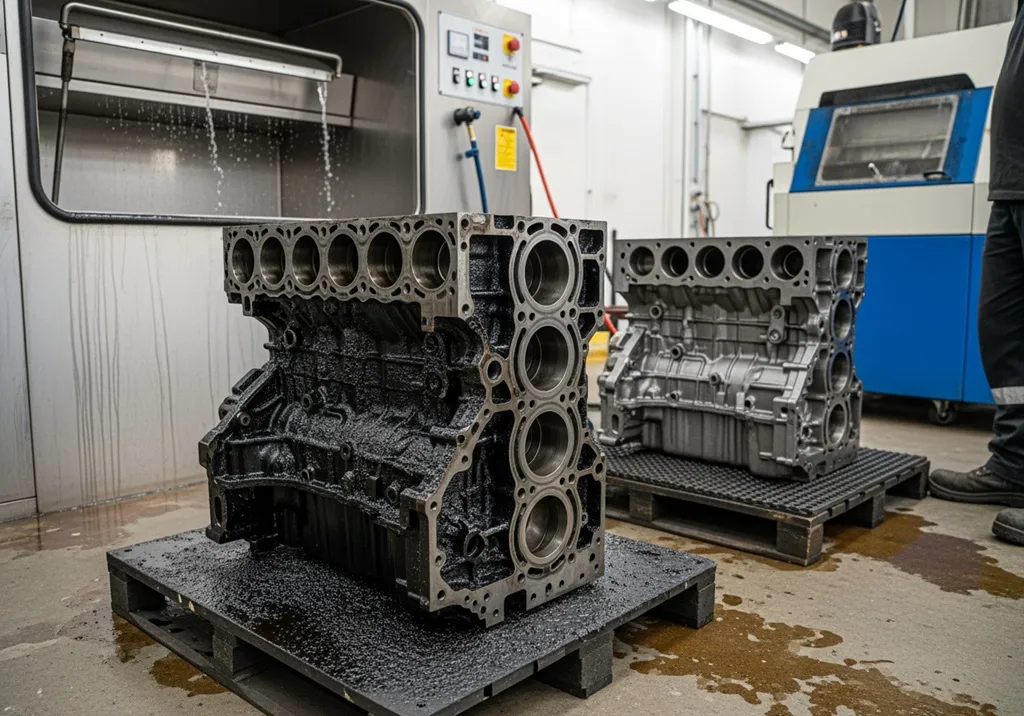
Engine blocks, cylinder heads, and transmission cases need thorough degreasing before rebuilding. Winter oil clings to casting surfaces and internal galleries in ways that summer contamination does not. Surfactant spray washing reaches these areas through pressure penetration – forcing heated solution into internal passages where manual cleaning methods cannot sustain adequate contact.
Heavy duty degreasing chemistry applied through automated spray systems removes winter-thickened oil from complex component geometries in a fraction of the time manual methods require. Workshops that switch to automated surfactant washing in winter consistently find that their cycle times stabilise rather than extending as temperatures drop – the chemistry compensates for the seasonal change in contamination behaviour.
Oil, Gas, and Food Processing Applications
Oil and gas facilities deal with crude oil residue that solidifies in cold conditions on valves, fittings, and pipeline components. Hot tanks using heated surfactant solutions dissolve these deposits through combined thermal and chemical action, reaching contamination inside valve bodies and fittings that spray washing alone might not fully address.
Food processing facilities using stainless steel equipment need surfactants that meet food-safe standards whilst maintaining performance against winter grease. Food-grade surfactant formulations applied through stainless steel parts washers deliver consistent cleaning regardless of ambient temperature, because the enclosed heated system operates independently of workshop conditions.
Comparing Surfactants to Alternative Cleaning Methods
Solvent Degreasers and Caustic Hot Tanks
Solvent degreasers dissolve oil through chemical action but carry safety hazards – flammability, toxicity, and environmental disposal requirements – that surfactant-based systems avoid entirely. Surfactant cleaning solutions match solvent cleaning performance against most workshop contamination without the associated risks.
Caustic hot tanks using strong alkaline solutions clean aggressively but damage aluminium, zinc plating, and painted surfaces. Surfactants operating at moderate pH clean effectively without material compatibility issues – an important advantage in workshops handling mixed-alloy components. This is the foundation of heavy duty degreasing chemistry in modern Australian workshops: the performance of caustic or solvent cleaning, with none of the material or safety compromises.
Steam Cleaning Versus Heated Surfactant Solutions
Steam softens oil through heat but lacks the chemical action to emulsify and fully remove it. Surfactant solutions at controlled temperatures outperform steam by combining thermal energy with chemistry. The result is more thorough contamination removal from complex geometries, faster cycle times, and better consistency across different contamination levels.
Material compatibility is another advantage. Steam at very high temperatures can affect some alloys and painted surfaces. Surfactant solutions at 70 to 80°C with controlled chemistry clean effectively without the surface risk that high-temperature steam carries.
Optimising Surfactant Concentration for Winter Conditions
Starting Concentration and Adjustment Approach
Most industrial surfactant detergents specify concentration ranges between 2% and 5% by volume. Winter conditions benefit from the higher end of this range because thickened oil requires more oil lifting agent molecules in the solution to achieve complete emulsification in the available cycle time.
Start at the manufacturer’s recommended concentration and run representative parts through a full cycle. If oil residue remains in blind holes or recesses, increase by 0.5% increments and retest. Most winter applications find effective performance between 4% and 5% concentration. Avoid the temptation to go above the manufacturer’s maximum – over-concentration wastes chemical without improving results and can create foam management challenges.
Monitoring Solution Condition and Replacement Timing
Surfactant cleaning solution loses effectiveness as it accumulates oil and particulate contamination. Fresh solution foams and cleans predictably. Heavily contaminated solution behaves differently – it may foam more, clean less thoroughly, and require more anti-foam agent to manage.
Maintain temperature throughout – concentration adjustments cannot compensate for inadequate heat. Keep solution temperature above 60°C for winter oil contamination removal regardless of concentration. When solution appears milky or grey and cleaning performance declines despite adequate concentration, it is time for a full tank change rather than more chemistry. Regular solution replacement on a schedule matched to your throughput volume keeps surfactant cleaning solution performing consistently across the whole winter season.
For advice on surfactant-based parts washing systems matched to your operation’s contamination levels and winter cleaning requirements, speak with our industrial cleaning experts or email us at sales@hotwash.com.au.

Leave A Comment