
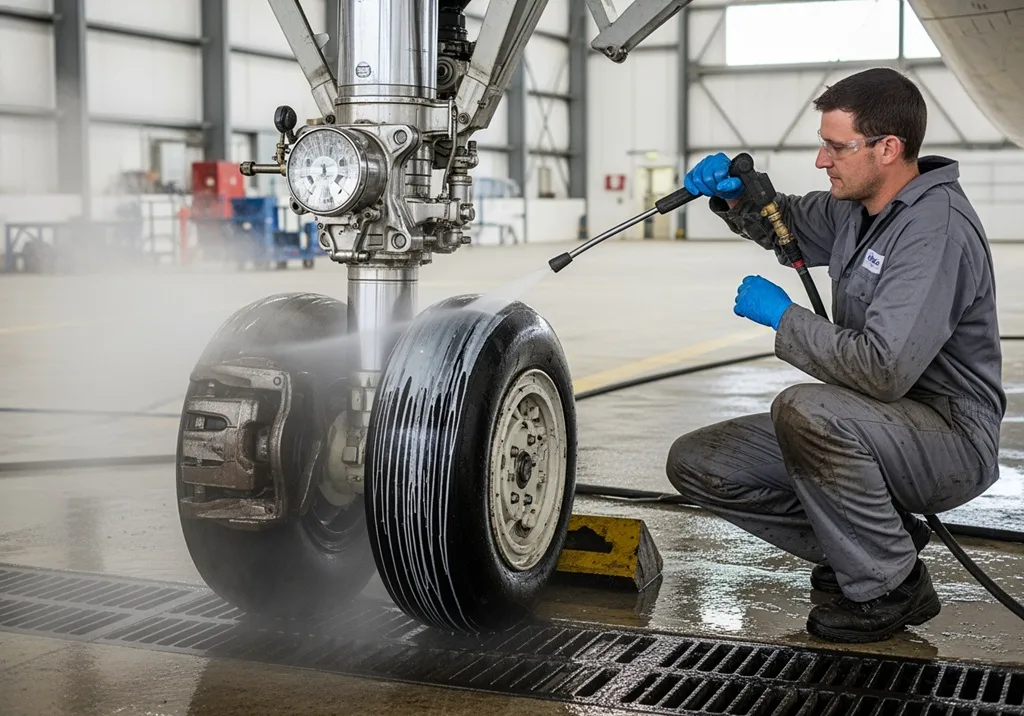
Aircraft landing gear takes a beating every time it touches down on a wet runway. Water mixed with hydraulic fluid, de-icing chemicals, and runway contaminants creates a corrosive mix that clings to struts, actuators, and brake assemblies. Left unchecked, this residue accelerates wear, compromises seals, and can lead to hydraulic system failures that ground aircraft for days.
This article covers why wet runway operations create persistent cleaning challenges, how automated washing systems handle hydraulic residue removal, and what to look for when selecting equipment for landing gear service in Australian aviation maintenance facilities.
Why Wet Runway Operations Create Cleaning Challenges
What Wet Runways Do to Landing Gear
Water on runways does not simply splash onto landing gear and dry off. It creates an emulsion with leaked hydraulic fluid, tyre rubber particles, and de-icing chemicals that gets forced into every gap, seal, and threaded connection by the pressure of landing and taxiing.
Hydraulic fluid contamination poses a persistent risk. Even small amounts of water mixing with hydraulic fluid can promote corrosion, reduce lubrication effectiveness, and encourage bacterial growth that clogs filters and damages seals. When landing gear retracts after wet runway operations, contaminated surfaces carry residue back into the wheel wells and into contact with adjacent systems.
Wet runway contamination is also compounded by glycol-based de-icers, which are hygroscopic – they attract and hold moisture. A thin film of de-icer on landing gear struts continues absorbing atmospheric moisture long after the aircraft returns to the hangar, keeping metal surfaces damp and accelerating corrosion. Hydraulic residue removal that addresses the full contamination mix, not just visible fluid, is essential for landing gear corrosion prevention.
Why Manual Cleaning Struggles to Keep Up
Manual cleaning with brushes and solvent rags cannot address wet runway contamination thoroughly. Brushes cannot reach into tight spaces between brake assemblies and wheel hubs. Solvent wipes leave residue in threaded holes and behind mounting brackets. Inconsistent technique means some areas are cleaned well whilst others harbour contamination that will cause problems during the next maintenance interval.
Manual scrubbing also fails to remove glycol-based contamination completely. Rags spread contamination across a wider surface area rather than lifting it away. Technicians working in awkward positions under aircraft undercarriages cannot maintain the sustained pressure and coverage that thorough aircraft degreasing requires across all landing gear surfaces.
The result is a landing gear assembly that looks clean on accessible surfaces but retains contamination in the areas that matter most – threaded connections, seal grooves, bearing races, and internal passages where residue causes long-term damage.
The True Cost of Manual Landing Gear Cleaning
Labour Time and Workshop Throughput
A single main landing gear assembly can take two mechanics an extended period to clean properly after wet runway operations. Multiply that across both main gears and the nose gear, and manual landing gear service consumes significant workshop hours before inspection even begins.
At current aviation maintenance labour rates, the cost of manual cleaning per aircraft adds up quickly. For facilities operating in climates with frequent wet weather, this is not an occasional cost – it is a recurring one that scales with fleet size. Time spent cleaning is time not spent on higher-value maintenance tasks, and every extended cleaning session contributes to longer maintenance windows and delayed aircraft return to service.
Aircraft degreasing done manually also creates throughput bottlenecks. When multiple aircraft require landing gear service after the same weather event, manual cleaning capacity becomes a limiting factor on how quickly your facility can turn aircraft around.
Safety and Health Costs for Maintenance Teams
Chemical exposure is an ongoing concern in manual landing gear cleaning. Solvent-based degreasers require personal protective equipment, ventilation, and careful waste disposal. Workers develop skin conditions and respiratory sensitivity from prolonged chemical contact, and repetitive strain injuries from hours of scrubbing in awkward positions under aircraft add to the long-term cost of manual methods.
Landing gear service performed manually creates slip hazards from spilled solvents and water. Enclosed automated washing systems contain this risk within the machine, keeping the workshop floor dry and reducing incident exposure for the maintenance team.
How Automated Washing Transforms Landing Gear Service
The Automated Cleaning Process Explained
Heavy duty parts washers aviation facilities use for landing gear service clean assemblies in a fraction of the time manual methods require. The process uses rotating spray arms that direct heated water and biodegradable detergent at high pressure into every surface, crevice, and cavity.
The cleaning cycle begins with a pre-rinse to remove loose contamination, followed by a heated wash phase where water at 75 to 85°C combines with detergent to dissolve hydraulic residue and emulsify oils. High-pressure spray jets reach areas manual brushes cannot access – behind brake assemblies, inside strut tubes, and around actuator mounting points. After the wash phase, a rinse cycle removes detergent residue, followed by a heated dry cycle that prevents water spots and flash rust.
Temperature is the key difference. Heated water dissolves contamination that cold water and manual scrubbing leave behind. The thermal energy breaks down hydraulic fluid films, softens greases, and helps detergent penetrate into tight spaces. This is not simply faster than manual cleaning – it is more thorough.
Time Savings and Scheduling Flexibility
Automated landing gear service cycles take a fraction of the time required for manual cleaning. Mechanics load components, start the cycle, and return to other productive tasks whilst the machine operates. When the cycle completes, landing gear components are ready for inspection – not still waiting for a technician to finish scrubbing.
This speed advantage changes maintenance scheduling. Aircraft can move through landing gear service faster, reducing hangar time and returning to revenue service sooner. For facilities managing multiple aircraft through wet weather maintenance cycles, automated washing creates capacity that manual methods cannot match.
Specific Applications in Landing Gear Maintenance
Main Struts and Chrome Surfaces
Main landing gear struts collect the worst wet runway contamination because they are the first contact point with the surface. Hydraulic fluid leaking from seals mixes with runway water and gets driven into the strut’s sliding surfaces. Manual cleaning struggles to remove this contamination from chrome-plated surfaces without causing scratches that can initiate corrosion.
Automated washing uses chemical action rather than mechanical abrasion for hydraulic residue removal. The combination of heat, detergent, and water pressure dissolves contamination without contacting the surface with abrasive materials. Chrome plating remains intact, and the risk of introducing scratches that would compromise landing gear corrosion prevention is eliminated.
Stainless steel parts washers with high-temperature capability are well suited to strut cleaning because their construction avoids the rust contamination risk present in mild steel systems. Stainless steel parts washers prevent iron particles from depositing onto aluminium and chrome surfaces during the cleaning process – a contamination pathway that can initiate corrosion cells if overlooked.
Brake Assemblies and Wheel Hubs
Heat from braking bakes contamination onto brake assembly surfaces, creating deposits that manual scrubbing cannot fully remove. These deposits interfere with brake performance and trap moisture against metal surfaces, accelerating wet runway contamination effects between service intervals.
Wheel hubs and bearings require particularly thorough cleaning because any residual contamination mixes with fresh grease during reassembly. Manual cleaning cannot guarantee complete removal of old grease, water, and contaminants from bearing races and hub interiors. Automated washing with heated detergent solution removes old lubricants and contamination thoroughly, ensuring bearings are packed with clean grease that performs as intended. This is a critical step in landing gear corrosion prevention for high-cycle operations.
Actuators, Linkages, and Threaded Connections
Actuators and linkages contain threaded connections, pivot points, and seal grooves where wet runway contamination hides. These areas are nearly impossible to clean thoroughly by hand – the geometry prevents sustained contact between cleaning materials and contaminated surfaces. Heavy duty parts washers force heated detergent solution into threads and crevices under pressure, flushing out contamination that would otherwise cause premature wear or seal failure at the next retraction cycle.
Automated spray washing also reaches internal passages that manual methods miss entirely. For complex actuator bodies, the difference between a visually clean exterior and a thoroughly clean component is significant – and it matters for aircraft degreasing standards that aviation maintenance procedures require.
Selecting the Right Parts Washer for Aviation Maintenance
Chamber Size and Load Capacity
Landing gear components are large, heavy, and awkwardly shaped. The parts washer needs a chamber large enough to accommodate main landing gear assemblies without requiring disassembly into smaller components. Chamber depth and width must accommodate the assembly dimensions of the aircraft types your facility services.
Load capacity is equally important. Main landing gear assemblies are substantial in weight. The washer’s turntable or rack system must support this load whilst rotating or positioning the component for optimal spray coverage. Industrial-grade construction with reinforced chambers and heavy-duty turntables prevents mechanical failures that would disrupt maintenance schedules.
For larger commercial aircraft landing gear, extra heavy duty parts washers provide the chamber dimensions and load ratings required without compromising spray coverage across the full assembly surface.
Temperature Control and Spray Pressure
Effective hydraulic residue removal requires water temperatures maintained consistently throughout the wash cycle. Systems with adequately sized heating elements and insulated chambers maintain target temperatures even when cleaning large thermal masses like landing gear assemblies.
Spray pressure needs to reach the levels required to force cleaning solution into tight spaces and remove stubborn contamination. Lower pressures work for general parts cleaning but lack the penetrating power needed for aviation components with complex internal geometries. Excessively high pressures can damage seals and painted surfaces. The right balance provides thorough cleaning without risking component damage.
Filtration Systems for Multi-Component Cleaning
Filtration systems protect pump components and ensure cleaning solution stays effective throughout the cycle. Multi-stage filtration with coarse screens, intermediate bag filters, and fine cartridge filters keeps recirculated water clean when processing multiple landing gear assemblies in succession.
This matters specifically for landing gear service – contamination from the first assembly should not redeposit onto subsequent components during the same shift. Hotwash Australia engineers filtration systems into their heavy duty aviation washers to maintain consistent cleaning solution quality across extended production runs.
Operational Benefits Beyond Faster Cleaning
Consistency and Regulatory Compliance
Consistency is the hidden advantage of automated parts washing. Manual cleaning quality varies based on who is doing the work, how tired they are, and whether they are working to a deadline. Automated systems deliver identical results every cycle. Every landing gear assembly receives the same thorough cleaning regardless of shift schedules, workload pressures, or individual operator differences.
This consistency matters for regulatory compliance. Aviation maintenance operates under strict quality control requirements where inspectors need confidence that cleaning procedures meet documented standards. Automated washing with documented cycle parameters – temperature, pressure, duration – provides objective evidence that cleaning met specification. Aircraft degreasing performed manually offers no equivalent documentation trail.
Environmental Compliance and Safety Improvements
Biodegradable detergents used in automated washing systems break down naturally and can be treated through standard wastewater systems after proper filtration to remove oils and solids. Solvent-based manual cleaning generates hazardous waste requiring special disposal, adding cost and regulatory burden to your facility’s environmental compliance obligations.
Safety improvements extend beyond eliminating chemical exposure. Workers no longer crouch in awkward positions for extended periods, reducing musculoskeletal injury risk. The enclosed washing process contains spray and contamination, keeping the work area dry and reducing slip hazards. Mechanics spend their time on skilled work rather than repetitive scrubbing – a better use of trained aviation maintenance personnel.
Making the Business Case for Automated Cleaning
Calculating Labour and Downtime Savings
The financial case for automated landing gear service rests on three pillars: labour savings, reduced aircraft downtime, and longer component life. Start by calculating current labour costs for manual cleaning across your annual landing gear service volume. This figure typically represents a significant recurring expense for facilities operating in wet weather regions.
Add the opportunity cost of extended maintenance time. If automated cleaning reduces hangar time per aircraft, multiply that time saving by the revenue value of the aircraft during that period. For a fleet serviced regularly through winter months, the cumulative saving on maintenance windows creates a meaningful revenue recovery that manual cleaning cannot achieve.
Component Life and Return on Investment
Thorough cleaning removes corrosive contamination that would otherwise accelerate wear. When automated washing extends landing gear overhaul intervals – even by a modest amount – the savings in parts and labour for premature overhauls contribute meaningfully to the return on investment calculation.
Against these benefits, consider operating costs including electricity, water, and detergent per cycle. Total operating cost per landing gear assembly through an automated system is substantially lower than the equivalent labour cost of manual cleaning. Payback periods for operations servicing multiple aircraft monthly are typically well within the first two years of operation.
For specialist advice on heavy duty parts washers aviation maintenance facilities use for landing gear service, speak with our industrial cleaning experts or email us at sales@hotwash.com.au.

Leave A Comment