
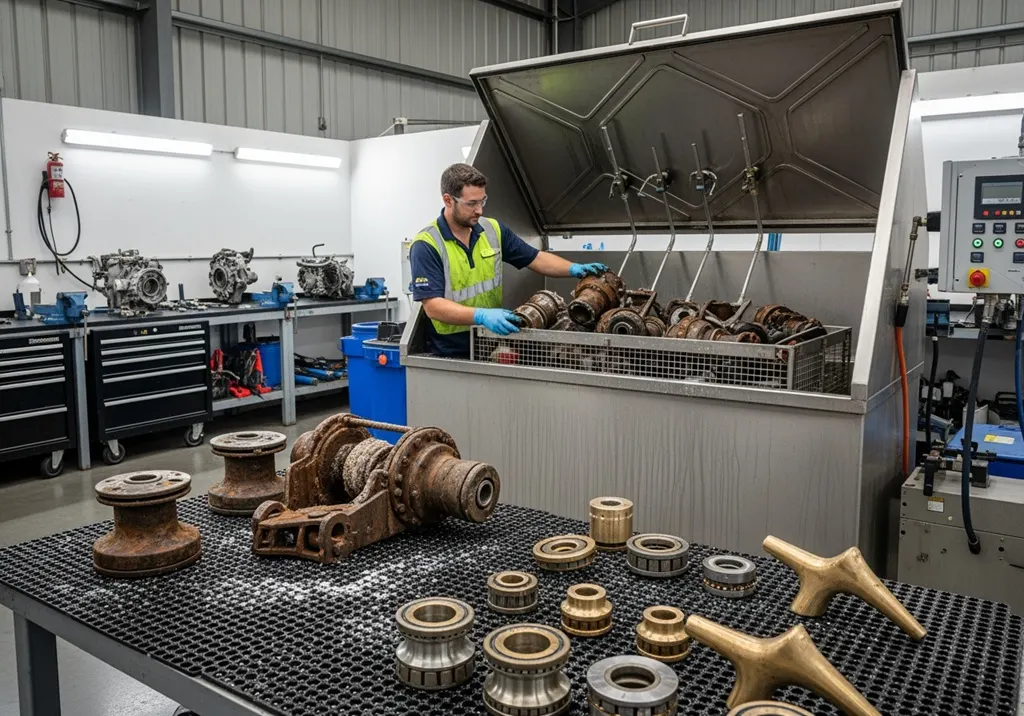
The end of fishing season is when the real work begins. A full season of salt water, fish oils, blood, and organic waste leaves commercial fishing gear in a state that shortens equipment life season by season. The contamination doesn’t stop attacking metal just because the vessel is docked. Salt crystals in threaded connections, grease baked onto deck machinery, and organic material trapped in cooling passages keep corroding throughout the off-season.
This guide covers what post-season cleaning actually involves for commercial fishing operations, why manual methods fall short, and which equipment handles the job most effectively. Whether you run one vessel or a large fleet, the decisions you make at season end determine how long your gear lasts and how much you spend keeping it operational.
Why Post-Season Cleaning Determines Equipment Longevity
The Problem with Salt Contamination Left Unchecked
Salt corrosion doesn’t wait for the next season. The moment a vessel docks with contaminated equipment, marine engine cleaning becomes urgent – not optional. Salt crystals draw moisture from the air and maintain a corrosive cycle even when components appear dry. A fishing winch left uncleaned for two weeks can develop surface rust that penetrates bearing surfaces and seal grooves.
Pressure washing removes visible surface grime, but it leaves salt deposits behind in threaded connections, bearing assemblies, and hydraulic fittings. These deposits keep working throughout the off-season. By the time crews return to prepare for the next season, they are replacing components that proper cleaning would have saved.
Heavy duty parts washers use heated water and biodegradable detergent to dissolve salt deposits and flush contamination from internal passages. The combination of heat, pressure, and proper chemistry reaches areas that manual cleaning misses entirely.
The Real Cost of Skipping Proper Cleaning
Salt corrosion prevention marine operations require proper investment in cleaning – the numbers justify it every time. Replacing corroded winch components on a single vessel costs many times more than the labour and detergent required for thorough post-season cleaning. A proper clean costs a fraction of a single component replacement, and the return on that investment compounds across every season the equipment remains in service.
The savings are not just in avoided replacements. They also appear in reduced downtime, fewer mid-season breakdowns, and the higher resale value that well-maintained vessels command compared to poorly maintained equivalents.
What Automated Washing Removes That Manual Methods Miss
Salt Crystals and Fish Oils in Tight Spaces
Commercial fishing gear accumulates contamination in layers, and the dangerous layers are the ones underneath. Post-season parts washing targets what manual scrubbing cannot: salt crystals locked inside bolt threads and fitting connections that draw moisture and cause galvanic corrosion, seizing fasteners over the off-season.
Stainless steel parts washers suited to marine workshop environments use heated immersion cleaning to dissolve these deposits completely. Processing equipment and deck machinery coated with fish oils mixed with hydraulic fluid leaks form a sticky residue that attracts further contamination. Hot water spray systems emulsify these oils and flush them away at temperature levels that cold water simply cannot match.
Spray washing also flushes contamination away from seals rather than pushing it inward – the opposite of what happens when workers manually scrub around bearing assemblies.
Organic Material and Carbon Deposits
Engine cooling passages, heat exchangers, and refrigeration coils trap organic material that blocks flow and reduces efficiency over time. Hot tanks soak components in heated solution until this material dissolves, restoring full cooling capacity without mechanical scrubbing.
Hot tank carbon removal is particularly valuable for diesel engine components. Pistons, valves, and exhaust parts develop carbon buildup during a full season of operation in marine environments. Heated cleaning solutions with proper chemistry remove this carbon thoroughly, allowing accurate inspection of the component surface underneath.
Critical Components That Need Professional Cleaning
Marine Diesel Engines and Turbochargers
Marine engine cleaning is where the investment in automated equipment pays back most clearly. Cylinder heads, fuel injection systems, turbochargers, and cooling components face salt water exposure combined with combustion byproducts – a combination that accelerates corrosion far faster than either alone.
A turbocharger that receives proper post-season cleaning will outlast an uncleaned equivalent by a meaningful margin. The precision components inside are particularly vulnerable to salt deposits, which continue attacking machined surfaces throughout storage if left untreated. Proper cleaning means zero salt residue in these critical areas.
Hydraulic Systems and Deck Machinery
Hydraulic pumps, valves, and cylinders operate at high pressure. Contamination in these systems causes leaks and component failures that create both costly repairs and operational downtime. A hydraulic pump cleaned in heated solution has contamination removed from areas that cannot be reached by any manual method.
Commercial fishing equipment care for deck machinery – winches, pulleys, cleats, and processing equipment – matters because these components operate under constant salt spray, fish processing waste, and mechanical stress. Extra heavy duty parts washers built for high-volume cleaning handle the largest winch assemblies and deck components effectively.
Refrigeration and Safety Equipment
Refrigeration compressors, condensers, evaporators, and expansion valves are expensive to replace. Salt corrosion in these systems causes failures that shut down fish processing operations at the worst possible time. Regular post-season cleaning is far less expensive than emergency refrigeration repairs during a season.
Safety equipment requires particular attention. Life raft canisters, emergency release mechanisms, and safety system components that corrode during the off-season create serious liability risks for operators. A release mechanism that fails to operate due to corrosion is a problem that no maintenance shortcut is worth.
Automated Cleaning vs Manual Methods
Time Savings and Productivity Gains
Hotwash Australia has deployed over 1,200 automatic parts washers across Australian fishing, mining, transport, and industrial operations. The time difference between manual and automated cleaning is substantial at the component level. A diesel engine cylinder head cleaned manually requires hours of scrubbing, wire brushing, and solvent application. The same component processed through an automated hot tank or spray washer takes a fraction of that time, with the technician free to work on other tasks during the cycle.
For fleet operators managing multiple vessels, this difference determines whether post-season maintenance takes weeks or months. Automated systems process components continuously, allowing mechanics to disassemble, load, inspect, and reassemble without bottlenecks.
Workplace Safety and Environmental Benefits
Manual cleaning with chemical solvents exposes workers to health risks that automated systems eliminate. Skin contact, vapour inhalation, and repetitive strain from sustained scrubbing are ongoing concerns in workshops using traditional cleaning methods. Salt corrosion prevention marine operations run better when the cleaning process itself does not create additional safety issues.
Hotwash machines use biodegradable, water-based detergents that meet Australian workplace safety standards. Workers load components and operate controls rather than handling harsh chemicals directly. The contamination is contained inside the machine rather than spread across the workshop floor.
Choosing the Right Machine for Your Fleet
Matching Capacity to Fleet Size
Fishing boat maintenance requirements vary significantly with fleet size. Small operators running one or two vessels need a system that handles engine components, pumps, and deck equipment without requiring the throughput capacity of a large commercial operation. A heavy duty spray washer with appropriate chamber dimensions handles cylinder heads, manifolds, and deck equipment for this scale effectively.
Medium fleets running several vessels need more throughput. An extra heavy duty parts washer with larger capacity handles multiple vessels’ worth of maintenance components and processes winch assemblies, hydraulic pumps, and refrigeration compressors that smaller machines cannot accommodate.
Large commercial operations processing many vessels require continuous-run capacity. Super heavy duty parts washers process the volume of components from major fleet maintenance, running continuously during the maintenance window as fast as mechanics can disassemble equipment.
Construction and Environmental Suitability
Marine environments demand corrosion-resistant construction from the cleaning equipment itself. Standard powder-coated steel washers deteriorate under the same salt exposure they are designed to help you address. Wet abrasive blasters also serve marine maintenance teams for surface preparation and rust removal on deck components, while stainless steel washer construction handles salt water environments in coastal workshops without degrading.
High-temperature capability is non-negotiable for marine applications. Water temperature in the range needed to dissolve salt deposits and emulsify marine grease and fish oils makes the difference between thorough cleaning and surface cleaning. Robust filtration is equally important – marine contamination carries organic material that damages pump systems in machines not built to handle it.
Integrating Cleaning Into Your Post-Season Workflow
A Week-by-Week Approach
Effective fishing boat maintenance at season end follows a structured sequence. The first week covers initial disassembly – removing deck equipment, draining hydraulic systems, and beginning engine disassembly. Smaller components go through the cleaning system immediately while larger equipment comes apart. This prevents a backlog forming when the major components are ready.
The second week processes the large components – cylinder heads, winch assemblies, hydraulic pumps, and refrigeration components through the parts washers. While machines clean, mechanics inspect processed components and order replacement parts. Commercial fishing equipment care at this stage means not waiting for clean components before identifying what needs replacing.
Week three covers thorough inspection and reassembly. Corrosion, wear, and damage are visible clearly on clean surfaces in a way they never are on contaminated ones. Week four completes reassembly, tests all systems, and verifies proper operation before the vessel is considered ready for the next season.
Why Clean Components Make Every Stage Faster
Post-season parts washing accelerates every subsequent stage of the maintenance process. Clean mating surfaces install correctly and seal properly because contamination is not preventing proper contact. Inspection is faster because damage is immediately visible rather than hidden under layers of marine fouling.
The result is a maintenance window that takes less total time compared to operations using manual cleaning methods. Components spend less time waiting to be cleaned, and mechanics work more efficiently when the parts in their hands are properly prepared for inspection and reassembly.
Conclusion
Post-season maintenance determines whether commercial fishing equipment survives another season or fails at the worst possible time. Salt water, fish oils, and marine contamination create corrosion that manual cleaning cannot properly address. Marine engine cleaning with automated equipment removes contamination from areas that brushes and pressure washers cannot reach, extending component life and reducing maintenance costs across the fleet.
For fleet operators, the choice between manual cleaning and automated systems is a straightforward calculation. The investment in proper equipment pays back through saved labour, extended component life, and prevented failures. Fishing boat maintenance done thoroughly at season end is worth far more than the same time and money spent on emergency repairs mid-season.
For expert advice on the right parts washer for your fishing operation, contact our parts washer specialists or email us at sales@hotwash.com.au.

Leave A Comment