
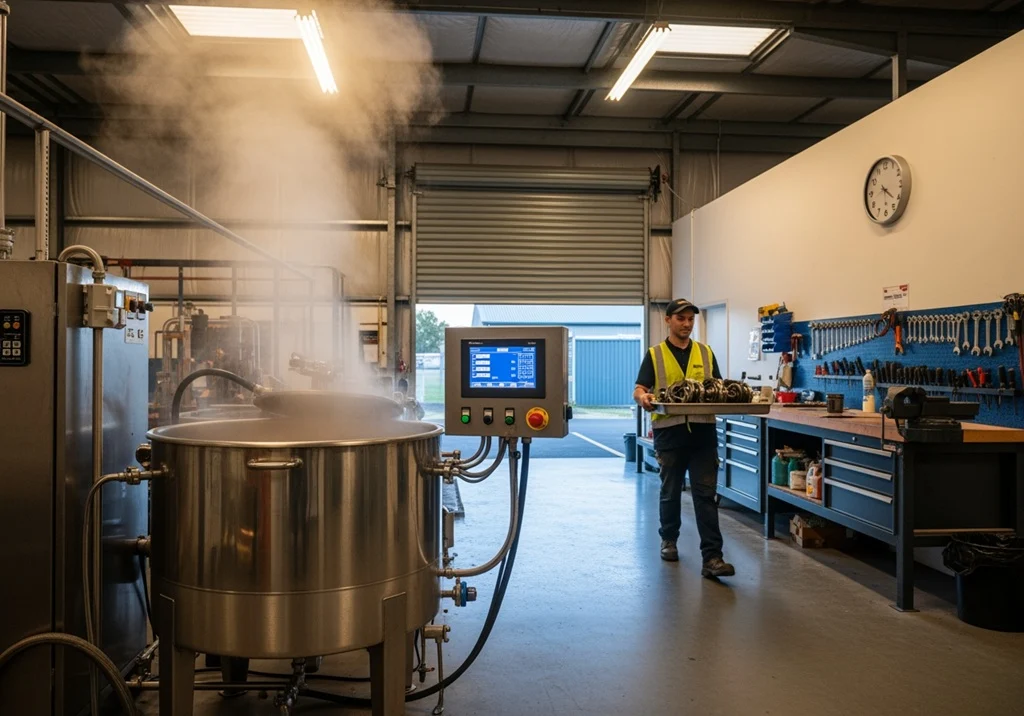
Every workshop manager knows the frustration. Workers arrive at 7am ready to start cleaning excavator parts, engine components, or fabricated assemblies – but the hot tank sits cold. It takes another hour or more to reach operating temperature. Paid labour waits while water heats up.
Automated pre-heating solves this completely. Pre-set timer systems start the heating cycle before workers arrive, so the hot tank is at full operating temperature the moment the first shift begins. This guide covers how timer systems work, how to calculate the productivity gain for your specific operation, and why installing in Q2 – April to June – positions your workshop for maximum benefit before the peak winter demand period.
The Morning Productivity Problem
How Much Time Workshops Lose Waiting
Australian workshops lose significant time every week waiting for cleaning equipment to reach operating temperature. For a team of workers at standard trade rates, that translates to a meaningful weekly cost in unproductive time. It compounds across every working week of winter.
The heat-up time depends on tank volume and heating element capacity. In winter, when overnight workshop temperatures drop, the same tank starts colder and takes even longer. Workshop efficiency suffers most at exactly the time of year when operations can least afford delays.
Parts washers and hot tanks face the same cold-start problem. Both sit idle during pre-heat, and both cost the same labour while waiting. The solution is identical for each: a pre-set timer that starts the heating cycle before the shift begins.
The Direct Labour Cost of Cold Equipment
The cost calculation is straightforward. Multiply the daily heat-up wait time by the workers affected by the daily rate. Over a full working month, even a modest team waiting an hour each morning accumulates significant labour cost for doing nothing. Workshop efficiency drops to zero during that wait. A hot tank timer system eliminates it entirely.
Morning workshop productivity is directly tied to how quickly cleaning equipment reaches operating temperature. Operations that eliminate cold-start delays consistently outperform those that accept them. Parts washer pre-heat timer systems follow the same logic for spray washers as for immersion tanks. Heat before the shift, not during it.
How Pre-Set Heating Timers Work
Timer Technology in Industrial Hot Tanks
Automated pre-heating uses timer technology integrated into industrial hot tank control systems. Workshop managers programme the system to begin heating at a specific time – typically 60 to 120 minutes before the first shift starts.
The timer activates heating elements automatically. By the time workers arrive, the hot tank has reached optimal cleaning temperature – 75 to 85 degrees Celsius – and is ready for immediate use. No manual switches, no waiting, no wasted labour hours.
Hot tanks with integrated timer controls operate on seven-day programming schedules. Different heating times for weekdays and weekends prevent energy waste on non-working days. Multiple time slots accommodate split shifts or extended operations. Temperature verification confirms water reached target temperature before the shift begins.
Key Features of Quality Timer Systems
Quality industrial timer systems include dry-run protection. Sensors detect low water levels and disable heating automatically, preventing element damage. Independent thermal cutoffs prevent overheating if timers malfunction. Emergency stop integration connects automated heating to workshop shutdown circuits.
Manual override allows immediate heating for unscheduled needs outside programmed times. Lockout capability lets maintenance teams disable automated heating safely during service work. These features make hot tank timer systems reliable and safe in industrial environments.
Calculating the Productivity Gain
Single-Shift Workshop Savings
With pre-heating on a timer, heat-up begins before workers arrive and the tank is ready at shift start. Lost labour is zero. The daily labour saving multiplied across a working month is substantial, regardless of team size.
Morning workshop productivity rises from the first day the timer runs. No ramp-up period, no adjustment required. Workshop efficiency improvement is immediate and compounding. Parts washer pre-heat planning is simple: calculate heat-up time, subtract from shift start, set the timer.
Multi-Shift and Mining Operation Savings
For operations running multiple shifts, savings multiply at each shift change. When the next shift arrives to a cold tank because the previous shift drained it, the same wait recurs. Timer-controlled pre-heating timed to each shift change eliminates every cold-start delay across the full operating day.
Hotwash Australia supplies hot tank systems to mining operations running 24-hour maintenance schedules. For these facilities, pre-heating on a schedule is not a convenience – it is an operational requirement. The labour cost of cold-start delays at a large mining site across a full year is substantial.
Why Q2 Is the Right Installation Window
Moderate Conditions for Easier Installation
April to June provides the ideal installation timing for timer systems across Australian workshops. Q2 installation allows qualified electricians to work without the extreme heat of summer or the urgency of peak winter demand already biting. Equipment downtime for installation – typically 2 to 4 hours – is easier to schedule during the shoulder season.
Heavy duty parts washers and hot tanks can be retrofitted with timer systems without replacing base equipment. For workshops planning equipment upgrades, specifying timer-equipped systems during initial purchase eliminates retrofit costs entirely. The same applies to extra heavy duty parts washers used in high-volume cleaning environments.
Optimised Before Winter Demands Peak
Q2 installation gives workshop teams 6 to 8 weeks to programme, test, and fine-tune timer schedules before the coldest months arrive. By the time winter morning temperatures drop, the system has already been calibrated and the team operates it confidently.
Cold mornings in winter are when workshop efficiency pressure is highest. Equipment that is not ready to run the moment workers arrive creates compounding delays across every shift. Installing and optimising timer systems in Q2 means winter arrives with the problem already solved.
Programming Strategies for Different Operations
Single-Shift Workshops
Single-shift operations programme heating start 90 minutes before shift commencement and heating stop at shift end. Weekends off. This approach reduces energy use dramatically versus continuous heating. The element runs only when it is needed.
A maintenance temperature mode during breaks and lunches uses far less energy than reheating from cold after each break. Machines with large tank volumes benefit most from this approach. The energy difference between maintaining temperature and reheating fully is greatest at scale.
Double-Shift and Continuous Operations
Double-shift operations programme two heating peaks – one before the morning shift and one timed to the afternoon shift change. The tank stays at operating temperature through the morning shift and the timer pulse brings it back to peak as the new shift begins.
For continuous 24-hour operations, temperature maintenance mode overnight – holding a lower temperature rather than full shutdown – is more efficient than a full cold-start reheat every morning. This is the hot tank energy savings calculation that most continuous operations confirm within their first month of timer operation.
Safety Features That Matter
Protection Systems in Automated Pre-Heating
Dry-run protection prevents heating elements activating when water levels drop below safe minimums. Temperature limiting ensures water never exceeds safe maximums even if timers malfunction. Emergency stop integration ceases all automated heating immediately when workshop emergency stops are activated. These protections work independently of the timer programming. They cannot be overridden by a scheduled heating cycle.
Stainless steel parts washers designed for food industry applications include additional temperature monitoring requirements. Timer systems in these environments must integrate with food safety compliance records – logging actual water temperature and heat-up time for each cycle.
Australian Compliance Requirements
Australian workplaces must ensure automated heating systems meet AS/NZS 3000 Wiring Rules and relevant state electrical safety regulations. Licensed electricians must perform all installation work. DIY timer installation violates workplace safety requirements and may void equipment warranties and insurance coverage.
For workshops in hazardous areas, timer systems require additional certifications. Super heavy duty parts washers designed for mining applications often include pre-certified timer systems meeting both general electrical standards and mining-specific safety requirements.
Energy Cost: Timer Systems vs Continuous Heating
The Numbers Compared
Many workshops run hot tanks continuously, assuming the energy cost of maintaining temperature is lower than reheating from cold. Timer system data demonstrates this assumption is wrong in most single-shift and double-shift scenarios.
Continuous heating runs the element for every hour the workshop is not actively using the machine – nights, weekends, and public holidays included. Timer-controlled heating runs the element only for the hours needed to pre-heat and maintain temperature during operating periods.
For a single-shift operation, the reduction in operating hours is substantial. Annual hot tank energy savings from switching to timer-controlled heating are significant and measurable within the first quarter of operation.
Optimising for Your Shift Pattern
Energy savings vary by shift pattern. Single-shift operations achieve the largest reduction. Double-shift operations achieve a moderate reduction. All patterns benefit from the labour savings of eliminating cold-start wait times. The combined ROI is compelling irrespective of how the operation runs.
Spray washers and hot tanks used together in the same workshop follow the same energy logic. Scheduling pre-heat across all cleaning equipment – not just the hot tank – maximises the total hot tank energy savings available to the operation.
ROI Timeline and Maintenance
Payback Period Calculations
Total installation investment for a quality industrial timer system covers the timer unit, professional installation, and staff training. Monthly savings combine labour recovered from eliminated wait time and reduced energy consumption. Even conservative estimates for smaller operations show payback within a few months. Larger mining and manufacturing operations often achieve full ROI within weeks.
Ongoing Maintenance Requirements
Timer systems use solid-state electronics with no moving parts. Annual maintenance requirements are minimal: verify programmed times match current shift schedules, test manual override functions, inspect control panel for moisture or corrosion, confirm temperature sensors read accurately.
A properly maintained hot tank timer system runs reliably for years without significant intervention. The maintenance burden is far lower than managing the daily scheduling and labour supervision required when heating is manual.
Manual parts washers and smaller bench-top units can also benefit from timer-controlled pre-heating where water is pre-heated in an adjacent hot tank before use. Parts washer pre-heat planning is the same regardless of machine type. Heat before the shift, not during it.
Staff Training and Compliance
What Staff Need to Know
Timer system operation requires minimal training. Essential topics include: basic programming to set daily heating start and stop times, schedule adjustments for seasonal or operational changes, manual override activation for unscheduled needs, and safety protocols for lockout during maintenance.
Training typically requires 30 to 45 minutes per staff member. Focus on supervisors and team leaders. Keep laminated quick-reference guides near control panels for common programming tasks.
Documentation and Standards
Document current heating schedules and any changes made. This creates an audit trail for compliance purposes and helps identify programming errors when unexpected cold-start delays occur. Quarterly reviews of timer programming ensure settings still match current shift patterns and seasonal conditions.
Timer-controlled heating eliminates one of the most persistent sources of morning workshop inefficiency. The technology is proven, the installation is straightforward, and the ROI is among the fastest available to any workshop operation.
Conclusion
Automated pre-heating transforms morning workshop operations from a frustrating wait into immediate productivity. Timer systems eliminate the daily cost of workers standing idle whilst equipment reaches operating temperature – delivering measurable ROI within weeks of installation.
Q2 is the right time to act. Moderate installation conditions, time to optimise programming, and the system running confidently before winter peak demand arrives. The combination of labour savings and hot tank energy savings creates a compelling financial case for operations of every size. Workshop efficiency gains from eliminating cold-start delays are immediate and sustained across every winter season that follows.
To discuss timer system options and hot tank specifications suited to your operation, talk to our workshop equipment experts or email us at sales@hotwash.com.au.

Leave A Comment