
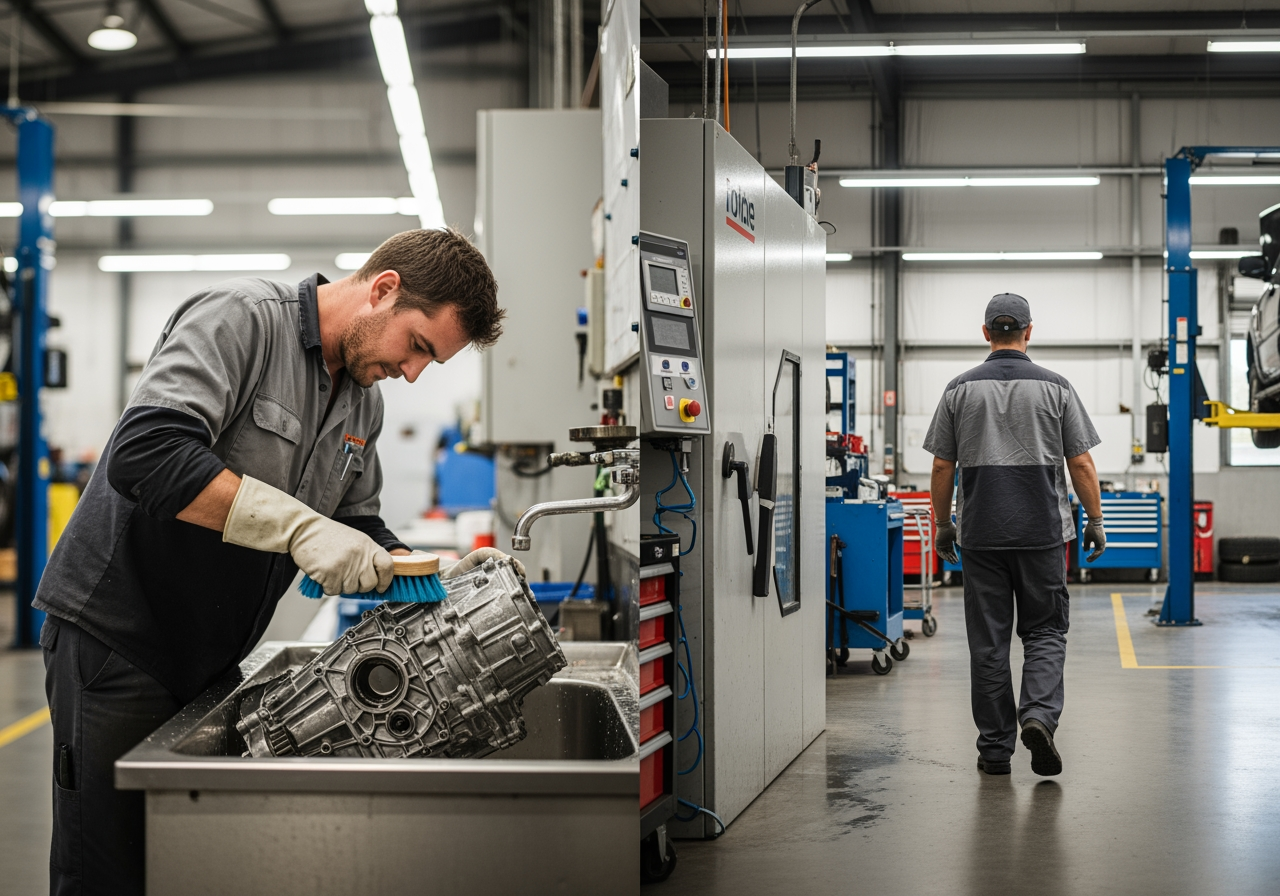
Most workshop managers track labour hours and chemical costs separately. Few calculate the true cost per wash. This gap matters more than most people realise.
The difference between manual scrubbing and automated washing can mean thousands of dollars per month in hidden costs. Understanding these figures helps justify capital equipment purchases with concrete numbers – not vague promises of efficiency gains.
Manual Parts Cleaning Cost Breakdown
Labour, Chemical, and Safety Costs
Labour forms the largest expense in manual cleaning. A mechanic earning $40 per hour who spends 3-4 hours cleaning engine components costs $160 in direct labour per batch. Add 30% for superannuation, workers compensation, and payroll tax, and the real cost per batch reaches $208.
Chemical costs compound the problem quickly. Solvent-based degreasers cost $45-80 per 20-litre drum. A single engine block cleaning uses 2-3 litres of degreaser, plus rags, brushes, and disposal materials. Chemical costs per batch: $8-12. Parts washer chemical savings versus this method are significant – biodegradable detergent costs $2.40-3.00 per cycle.
Safety equipment adds further expense. Workers need chemical-resistant gloves, safety glasses, and protective aprons. Skin exposure to harsh chemicals causes dermatitis in 15-20% of mechanics who clean parts regularly.
Hidden Labour and Productivity Losses
Productivity loss is the biggest manual cleaning hidden cost in any workshop. Whilst a mechanic scrubs parts, they are not earning workshop revenue.
A qualified mechanic generating $120-150 per hour in billable work who spends four hours cleaning parts costs the workshop $480-600 in lost productivity per batch. This cost rarely appears on any invoice, but it is very real.
Total manual cleaning cost per batch: $220-230 in direct costs, plus $480-600 in lost productivity. Real cost to the workshop: $700-830 per batch.
Automated Parts Washer Cost Analysis
Per-Cycle Operating Costs
Loading parts into an automated spray washer takes 5 minutes. The machine runs for 15-20 minutes whilst the mechanic works on billable tasks. Unloading takes 3 minutes. Total labour time: 8 minutes per batch.
Labour cost per batch at $40 per hour: $5.33. Biodegradable detergent cost per cycle: $2.40-3.00. Water cost for a 60-80 litre cycle: $0.18. Power cost for a 15kW heating element running 20 minutes: $1.40.
Total automated operating cost per cycle: $9.31-9.91. Add maintenance amortised across the machine’s lifespan: approximately $3.20 per cycle. Total operating cost per cycle: $12-13.
Capital Cost and Amortisation
Manual cleaning equipment provides the starting point for small or low-volume workshops. Automated spray washers deliver a different return for busy operations.
A heavy-duty automated spray washer costs $15,000-25,000. Amortising a $15,000 washer over 12 years at 250 washes annually (3,000 total washes) adds $5.00 per wash in capital cost.
Total all-in cost per automated wash: $17-18. Compare that to $700-830 per manual wash. Saving per wash: $683-812.
Cleaning Method Comparison: The Real Numbers
This cleaning method comparison uses a typical Australian automotive workshop running 20 washes monthly.
Cost Per Wash: Side by Side
Manual cleaning per batch: $700-830 (including lost productivity) Automated washing per batch: $17-18 (all-in, including capital amortisation) Saving per batch: $683-812
At 20 washes monthly, savings reach $13,660-16,240 per month. At 10 washes monthly, savings are $6,830-8,120. Even small workshops cleaning five batches monthly save $3,415-4,060 per month.
Five-Year Total Cost Comparison
Hotwash Australia has helped hundreds of Australian workshops complete this exact analysis. The five-year numbers are compelling.
Manual cleaning at 20 washes monthly over five years: $840,000-996,000. Automated washing over the same period including equipment purchase: $21,600-26,400. Five-year saving: $818,400-969,600.
Using conservative estimates that halve those savings, the automated option still delivers well over $400,000 in five-year value for a mid-volume workshop.
Hidden Costs That Manual Methods Create
Beyond direct expenses, manual cleaning generates costs that automated systems eliminate. These are the manual cleaning hidden costs that rarely appear in standard calculations but significantly affect profitability.
Injuries, Compliance, and Waste Disposal
Repetitive scrubbing causes shoulder and wrist injuries. Chemical exposure leads to dermatitis and respiratory issues. Workers compensation claims cost workshops $8,000-35,000 per incident.
Industrial parts washer solutions with enclosed wash chambers eliminate 90% of these chemical exposure risks. This reduces workers compensation claims and can lower insurance premiums over time.
Solvent-based degreasers require hazardous waste disposal at $180-250 per 200-litre drum. Switching to biodegradable detergent reduces hazardous waste costs by 80-90%. Workshop cleaning productivity improves when teams are not managing ongoing chemical compliance.
Rework and Quality Control Failures
Manual cleaning quality varies with worker fatigue. Parts cleaned late on a Friday afternoon are rarely as clean as a Monday morning batch. This automated vs manual parts cleaning inconsistency creates rework costs – an extra 1-2 hours of labour per batch when re-cleaning is needed.
Automated systems deliver identical results every cycle. Mechanics trust that parts from an automated washer are clean and ready for assembly. This reduces assembly errors and warranty claims that can cost workshops $2,000-8,000 per incident.
Industry-Specific Cost Impacts
Different industries see different returns from the automated vs manual parts cleaning comparison.
Automotive and Transport Workshops
Automotive workshops cleaning 15-20 engine blocks monthly save $10,000-12,000 per month by switching from manual to automated methods. A spray washer handles cylinder heads, transmission cases, and differential housings with consistent results every cycle.
Heavy duty cleaning equipment suits workshops also processing axle housings, gearboxes, and larger driveline components. Higher capacity reduces the number of cycles per shift and improves workshop cleaning productivity overall.
Mining and Food Processing Operations
Mining operations face extreme cleaning demands. Excavator components covered in mud and heavy grease take 6-8 hours to clean manually. An automated washer completes the same job in 25-30 minutes. For mining workshops cleaning 40-50 components monthly, savings exceed $25,000 per month.
High-capacity cleaning equipment handles the largest mining components without compromising cycle time. It is designed for operations running multiple shifts with consistent throughput.
Hot tanks work well for oil and gas valves and fittings with heavy crude contamination. Immersion cleaning removes stubborn deposits at $12-15 per piece. Manual cleaning of the same components runs $150-200 per piece in labour and chemicals.
Calculating Your True Cost Per Wash
Workshop managers can calculate their actual cleaning costs per batch using a straightforward formula.
Formula for Workshop Managers
For manual cleaning, calculate:
- Labour hours x (hourly wage x 1.3 for overheads)
- Add chemical costs, water, and disposal per wash
- Add lost productivity (hours x billable rate)
For automated cleaning, calculate:
- Capital cost / (lifespan years x washes per year)
- Add labour time (load and unload in minutes / 60 x hourly wage)
- Add chemical, water, electricity, and maintenance costs per wash
A typical automated workshop example at $15,000 equipment cost, 18 monthly engine cleans, and $42 per hour labour: savings reach $639 per wash. That is $11,502 per month. The washer pays for itself in under two months.
Conclusion
This automated vs manual parts cleaning comparison shows a consistent result across all workshop types. Manual cleaning costs $700-830 per batch including lost productivity. Automated washing costs $17-18 per batch, all-in.
The cleaning method comparison confirms that for workshops processing 10 batches monthly, annual savings reach $81,960-97,440. Equipment payback periods of under three months make this one of the fastest-returning capital investments available to Australian operations.
Workshop cleaning productivity improves immediately when skilled mechanics return to billable work. Parts washer chemical savings also extend to waste disposal – biodegradable detergent eliminates the need for hazardous solvent disposal costing $2,000-4,000 annually. These combined savings make a compelling case for every workshop manager.
To calculate your workshop’s exact savings, speak with our industrial cleaning experts or email us at sales@hotwash.com.au.

Leave A Comment