
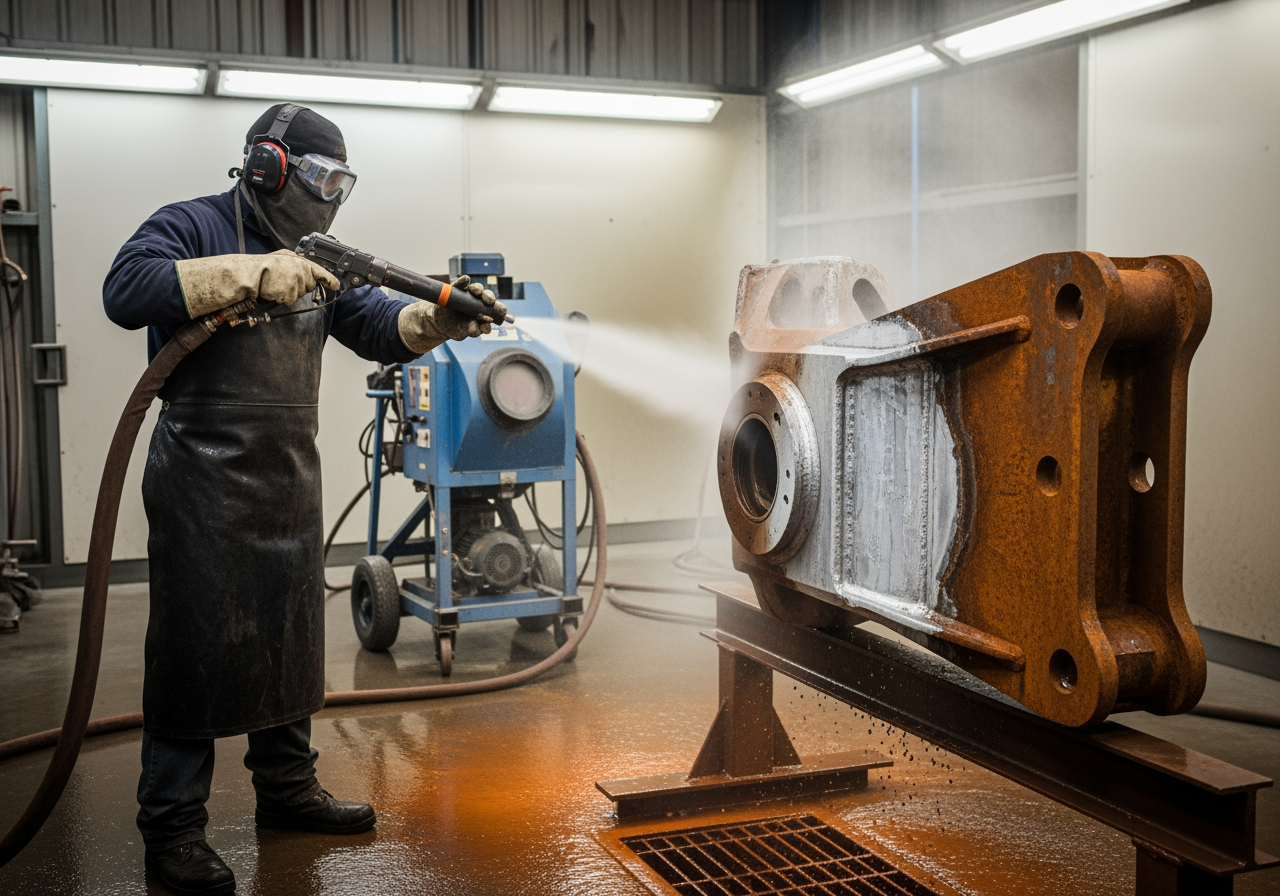
Selecting the wrong wet abrasive blaster costs far more than the purchase price. A machine rated for 10 hours of daily use fails within months when pushed through 14-hour mining shifts. A large-capacity system bought for a small automotive workshop sits underutilised and ties up capital that could be working elsewhere.
Understanding blasting equipment specs before purchasing prevents both outcomes. The right specifications match your actual operating hours, contamination types, substrate materials, and electrical supply. Get this right and your equipment delivers years of reliable performance. Get it wrong and replacement cycles arrive years too early.
This guide explains the key operating specifications for wet abrasive blasters and how to match them to real workshop requirements across different Australian industries.
Understanding Wet Abrasive Blaster Duty Cycles
What Duty Cycle Ratings Mean for Your Workshop
Duty cycle defines how long equipment operates before requiring rest. A wet abrasive blasters system rated at 60% duty cycle runs 36 minutes per hour – 36 minutes blasting and 24 minutes cooling. Equipment marketed as continuous duty operates without mandatory rest periods.
Most workshop failures with blasting equipment come from exceeding duty cycle ratings. Running an intermittent-duty blaster through 8-hour production runs burns through pumps and heating elements within six months. Continuous-duty models cost more upfront but eliminate the replacement cycles that make cheap intermittent-duty equipment expensive over time.
Mining operations demand continuous-duty wet abrasive blasters. FIFO maintenance schedules compress work into tight windows. Equipment must run 12-14 hours straight. Intermittent-duty models create bottlenecks that delay equipment returning to production.
Calculating Your Actual Operating Hours
Before selecting wet blast duty cycle specifications, calculate actual daily operating hours accurately. Do not estimate – track blasting time over a two-week period and use real numbers.
Small automotive workshops blasting two or three cylinder heads daily operate equipment for about 90 minutes total per shift. Intermittent-duty models handle this workload comfortably for years. Fabrication shops with multiple operators sharing equipment throughout shifts need continuous-duty systems to prevent breakdowns that create expensive production delays.
Industrial heavy duty washers complement wet abrasive blasters in workshops where both spray cleaning and surface preparation are required. Planning both systems together prevents capacity mismatches between your blasting and washing operations.
Pressure and Flow Rate Requirements
Blast Pressure Ranges for Different Applications
Wet abrasive blasting equipment specs for pressure range from 40 PSI to 120 PSI. Light-duty rust removal on sheet metal requires 40-60 PSI. Heavy paint stripping on structural steel demands 80-120 PSI. Pressure requirements scale with coating thickness and substrate hardness.
Selecting pressure specifications requires understanding your predominant contamination type. A workshop primarily removing light surface rust from fabricated components runs efficiently at 60 PSI. A facility stripping heavy epoxy coatings from mining infrastructure needs 90+ PSI to complete work in productive time.
Water Flow Rate and Media Suspension
Water flow rate affects media suspension consistency and surface finish. Low flow rates (15-25 litres per minute) conserve water but produce inconsistent media delivery. High flow rates (40-60 litres per minute) ensure uniform coverage but increase water consumption and disposal costs.
Extra heavy duty cleaning machines for mining and heavy industry applications use higher flow rates to maintain consistent media suspension across extended blasting sessions. The additional water consumption is justified by consistent surface preparation quality across large component batches.
Abrasive Media Specifications
Choosing Media for Substrate and Contamination
Different applications require specific abrasive media types and sizes. Wet abrasive blasters handle aluminium oxide, glass bead, crushed glass, and garnet. Media hardness must match substrate material. Soft media on hard surfaces wastes time. Hard media on soft surfaces causes damage that requires additional rectification work.
Aluminium oxide (60-80 grit) removes heavy rust and thick coatings from steel components in single passes. It leaves anchor patterns suitable for coating adhesion but not fine finishes. Glass bead (100-200 grit) produces smooth, satin finishes on aluminium and stainless steel. Marine workshops use glass bead for outboard components without damaging soft metals. Garnet media balances cutting speed with surface finish quality – effective for mining workshop pins and bushings where inspection is required after cleaning.
Media Consumption Rates and Operating Costs
Media consumption rates vary by pressure, nozzle size, and operator technique. A workshop blasting at 80 PSI through a 6mm nozzle consumes 15-20kg of media per hour. Higher pressures and larger nozzles double consumption rates and significantly impact weekly operating costs.
Calculate media costs as part of total operating cost before purchasing. The cheapest blasting equipment often has the highest media consumption rate. Higher initial investment in efficient nozzle design and controlled pressure delivery reduces media costs across years of operation.
Water Temperature and Heating Capacity
Cold vs Hot Water Wet Blasting
Water temperature determines what contamination types the system handles effectively. Cold water wet blasting (15-20°C) removes loose rust and light contamination from clean metal substrates. Hotwash Australia offers heated wet abrasive blasting systems for operations where contamination types include oils, greases, and baked-on coatings that cold water cannot remove efficiently.
Hot water systems (60-80°C) cut through oil, grease, and baked-on coatings that cold water leaves behind. Oil and gas workshops blasting valve bodies contaminated with crude oil and drilling fluids benefit significantly from heated water. The temperature boost cuts blasting time by up to 60% on petroleum-contaminated components compared to cold water systems.
Heating Capacity Requirements by Application
Heating capacity determines how quickly equipment reaches operating temperature and maintains heat under continuous use. A 15kW heating element brings 200 litres from cold to 70°C in 45 minutes. Continuous blasting drops temperature 5-10°C – adequate heating capacity recovers temperature between workpieces without interrupting production.
Food processing facilities require hot water wet blasting to remove organic contamination and sanitise components. Corrosion-resistant cleaning equipment complements wet blasters for complete food-grade cleaning systems – spray washing for standard cycle cleaning, wet blasting for surface preparation before coating or reassembly.
Adding heat increases hourly operating costs by 3-5kW. Workshops blasting clean steel components with no oil contamination rarely justify heating costs. Operations removing heavy hydrocarbon contamination recover heating costs through faster cycle times and reduced labour per component.
Tank Capacity and Refill Frequency
Matching Tank Size to Shift Length
Tank capacity determines operating time before refilling. A 200-litre wet abrasive blaster runs 3-4 hours at 50 litres per hour consumption. Refilling takes 10-15 minutes including media top-up and filter checks. Workshops blasting 6-8 hours daily refill twice per shift – 30 minutes total downtime.
Mining maintenance facilities run 400-600 litre systems that operate full shifts without refills. The larger tank costs more upfront but eliminates mid-shift interruptions that delay equipment returning to production. Calculate the cost of refill downtime against the capacity upgrade cost before deciding on tank size.
Water Recycling Systems
Closed-loop water recycling systems filter and recirculate blast water. A 300-litre tank with recycling operates eight hours on a single fill. Initial water costs drop from $40 daily to $5 weekly. Recycling systems also reduce contaminated water disposal costs – a significant consideration for operations blasting components with heavy oil or chemical contamination.
Hot blaster machines can be paired with closed-loop water recycling to maximise efficiency in operations where water disposal costs are significant or water supply is limited.
Electrical Requirements and Power Consumption
Single-Phase vs Three-Phase Supply
Light-duty wet abrasive blasters under 5kW total load run on standard 240V single-phase supply. Heavy-duty systems with heating exceed 10kW and require 415V three-phase. A typical heavy-duty system with a 3kW pump and 12kW heating element draws 15kW total – three-phase power prevents voltage drop and nuisance circuit breaker trips.
Workshops without three-phase power face three choices. Upgrade electrical service ($3,000-8,000), use smaller single-phase equipment with limited capacity, or operate unheated systems that sacrifice cleaning speed on oil-contaminated components. The upgrade cost amortises over two to three years for operations running equipment daily.
Operating Costs and Annual Electricity Expenses
A wet abrasive blaster running six hours daily at 12kW consumes 72kWh – approximately $25 daily at commercial electricity rates across Australia. Annual operating costs reach $6,500 before water and media expenses. Factor these ongoing costs into total cost of ownership calculations when comparing equipment options.
Pump, Nozzle, and Filtration Specifications
Pump Capacity and Pressure Consistency
Pump capacity determines whether blast pressure stays consistent under continuous operation. Undersized pumps lose pressure during extended sessions. Initial 80 PSI drops to 50 PSI after 20 minutes. Adequate pump capacity maintains rated pressure throughout the duty cycle without performance degradation.
Centrifugal pumps handle abrasive-laden water better than positive displacement pumps. The open impeller design passes media without clogging whilst maintaining flow rates. A 2.5kW centrifugal pump delivers 50 litres per minute at 80 PSI – adequate for single-operator blasting. Dual-operator systems require 4-5kW pumps to maintain pressure across two blast guns simultaneously.
Nozzle Configuration and Blast Pattern Control
Nozzle diameter controls media flow rate and blast pattern size. Smaller nozzles (4-6mm) concentrate media into tight patterns for precision work. Larger nozzles (8-12mm) cover broad areas faster but require higher pump capacity to maintain pressure.
Carbide-lined nozzles last 300-500 hours in abrasive service. Standard steel nozzles wear in 50-80 hours – the bore enlarges, pressure drops, and blast patterns become uneven. The higher upfront cost of carbide nozzles delivers significantly lower replacement costs across 12 months of regular use.
Filtration and Water Clarity
Water filtration prevents pump damage and maintains blast quality. Primary filters (200-300 micron) catch large debris before reaching pumps. Secondary filters (50-100 micron) remove fine particles that cloud water and reduce visibility during blasting operations.
Unfiltered systems accumulate spent media and contamination. After three months without tank cleaning, effective capacity drops 25% and pumps draw contaminated water that accelerates wear. Self-cleaning filtration systems backwash every two to four hours automatically, preventing manual tank clean-outs and the downtime that comes with them.
Matching Specifications to Workshop Type
Small Automotive and Fabrication Workshops
Small automotive workshops with one to three staff suit 150-200 litre wet abrasive blasters with intermittent duty ratings. Daily use totals two to four hours. Continuous-duty specifications waste capital on unused capacity for this application.
Fabrication shops with five to fifteen staff require 300-400 litre continuous-duty systems. Multiple operators share equipment throughout shifts. Inadequate capacity creates queues and production delays that cost more in lost labour productivity than the price difference between intermittent and continuous-duty equipment.
Mining and Heavy Industry Applications
Mining maintenance facilities demand parts washer machines for workshops and wet abrasive blasters both rated for continuous operation. Equipment downtime delays million-dollar assets returning to production. Oversized workshop abrasive blasting application specifications provide reliability margins that justify premium pricing in this context.
Food processing plants need stainless steel construction and hot water capability. Mild steel equipment corrodes in washdown environments. Replacement cycles arrive every three to five years. Stainless steel construction lasts 15-20 years and maintains hygiene compliance throughout service life.
Conclusion
Wet abrasive blaster operating specifications determine whether equipment matches workshop demands or fails under real-world operating conditions. Calculate actual daily operating hours, contamination types, workpiece sizes, and electrical supply before selecting specifications. Wet blast duty cycle ratings, pressure capacity, tank size, and heating capability must all align with your actual workload.
Workshop abrasive blasting applications across mining, fabrication, automotive, and food processing each have different specification requirements. Matching equipment to the actual job prevents the costly early replacement cycles that result from under-specified blasting equipment pushed beyond its design limits.
For wet abrasive blaster specifications matched to your workshop requirements, get advice from our technical team or email us at sales@hotwash.com.au.

Leave A Comment